Camping Meals for Large Groups: Plan for Feeding 6 to 20 People


The hardest part of cooking for a large camping group isn’t the food. It’s the scaling. A chili recipe for four people doesn’t just multiply by three when you’re feeding twelve. The pot changes, the cook time changes, the heat distribution changes, and your prep window changes. I learned this the hard way on a Bandarban trip in 2019, when I tripled a curry recipe, used a pot that was too small, and ended up serving half-cooked rice to eight tired trekkers at 9 p.m. This guide covers what I’ve figured out since then about feeding groups well outdoors.
The best camping meals for large groups are one-pot scalable dishes (chili, pasta sauce, curry, stew), assembly-line meals (taco bar, breakfast burritos, sandwich station), and foil packets that each person builds themselves. Plan 1.5 to 2 pounds of food per person per day, use pots sized to your group, and prep heavily at home.

Also know: Easy Camping Meals for Two That Cook Fast and Leave Zero Waste
How much food do you need per person per day?
Plan 1.5 to 2 pounds of food per person per day for active camping with hiking. For low-activity car camping, 1 to 1.5 pounds works. Multiply by group size and trip length, then add 10 percent buffer.
| Meal | Per person |
|---|---|
| Breakfast | 0.5 lb |
| Lunch | 0.5 lb |
| Dinner | 0.75 lb |
| Snacks | 0.25 lb |
So twelve people, three days, active trip: 12 × 2 × 3 = 72 lb of food, plus about 7 lb extra. That sounds like a lot until you weigh out a single bag of pasta and realize how fast it adds up.
Water is separate. Plan a gallon per person per day for drinking and cooking combined. My breakdown on how much water to pack for camping covers the math by climate and activity level.
What pot size do you actually need?
This is the part most group cooking guides skip. Pot size is the difference between dinner at 7 p.m. and dinner at 9:30 p.m.
| Group size | Main pot | Secondary pot | Skillet |
|---|---|---|---|
| 4–6 people | 6 quart | 4 quart | 12 inch |
| 7–10 people | 10–12 quart | 6 quart | 14 inch |
| 11–15 people | 16–20 quart | 8 quart | 16 inch or two 14 inch |
| 16–20 people | Two 12 qt pots | 10 quart | Two 14 inch |
Rule of thumb: your main pot should be at least 1 quart of capacity per two people for soups and chili, and 1 quart per person for pasta. Undersized pots mean longer cook times, uneven heat, and burned bottoms.
Burners matter too. One stove burner for groups under six. Two burners for seven to twelve. For thirteen plus, you want two stoves running simultaneously, or a stove plus a campfire grate. Trying to cook for fifteen on a single burner is how dinner ends at 10 p.m.
What’s the best breakfast for a big camping group?
Breakfast hash and breakfast burritos are the two most scalable hot breakfasts. Hash uses one large skillet for the whole group, and burritos let everyone build their own from a shared filling pot.
Scaled breakfast hash for 10 people:
- 4 lb diced potatoes (parboil at home, saves 15 minutes at camp)
- 2 lb sausage or bacon
- 3 large onions, diced
- 4 bell peppers, diced
- 20 eggs
- Salt, pepper, paprika, garlic powder
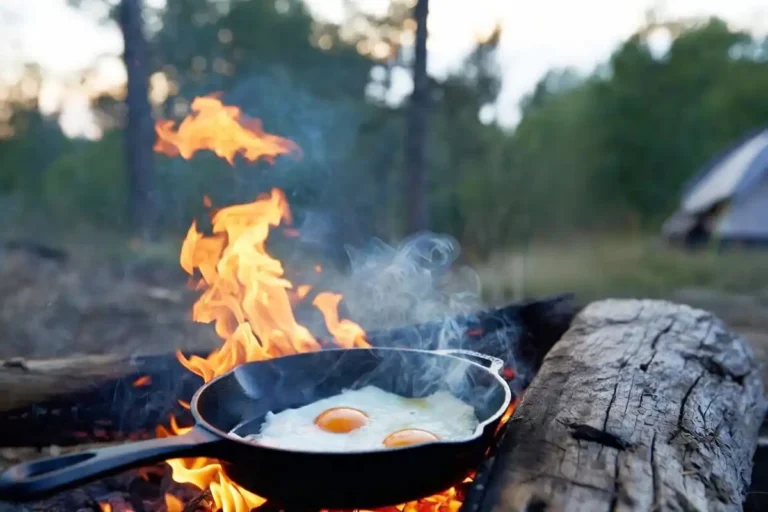
Cook sausage first in a 14-inch skillet, remove, cook potatoes in the fat until golden (about 12 minutes), add peppers and onions (5 minutes), return sausage, crack eggs over the top, cover with foil for 4 minutes. Done in about 25 minutes total.
For cold breakfasts, overnight oats prepped in individual jars at home work great for groups. Each person grabs their jar and eats. No cooking, no cleanup. My guide on cooking a full breakfast at camp walks through the minimal-gear version that scales cleanly.

What lunch works best when feeding many people?
Cold assembly lunches beat hot cooked lunches every time for groups. Nobody wants to fire up stoves at noon when you could be hiking, swimming, or napping.
Three lunch formats that scale:
- Sandwich/wrap station. Lay out tortillas or bread, deli meats, cheese, lettuce, tomato, hummus, mustard. Each person builds their own. For ten people, plan 20 tortillas, 1.5 lb deli meat, 1 lb cheese.
- Mediterranean board. Pita, hummus, olives, cheese, salami, cucumber, cherry tomatoes, crackers. Cheap, no cooking, travels well.
- Hot soup from a thermos. For cold-weather camping, make soup at breakfast, store in two large insulated thermoses, serve at lunch. Stays hot 6 hours.
For active hiking days, hand-held lunches matter. Wraps don’t fall apart in a backpack the way sandwiches do.
What are the best camping dinners for large groups?
Five dinners that scale reliably and don’t require advanced cooking skills:
1. Chili (the workhorse). One large pot, almost foolproof, leftovers are even better. For 10 people: 3 lb ground beef, 4 cans beans, 2 cans diced tomatoes, 1 can tomato paste, 3 onions, chili spices. Brown meat at home and freeze flat in a bag (it doubles as cooler ice for day one). At camp, dump everything in a 12-quart pot, simmer 45 minutes. Serve with cornbread, shredded cheese, sour cream, hot sauce.
2. Pasta with meat sauce. Two pots, two burners. For 10 people: 3 lb pasta, 2.5 lb ground meat sauce, 2 jars marinara, fresh garlic, parmesan. Boil pasta in salted water, simmer sauce, combine in bowls.
3. Taco/burrito bar. The most flexible group meal. Cook 3 lb seasoned ground beef plus 2 cans of beans. Set out tortillas, lettuce, tomato, cheese, salsa, sour cream, hot sauce. Vegetarians eat just beans and toppings. People with dairy issues skip cheese. Same meal, different builds.
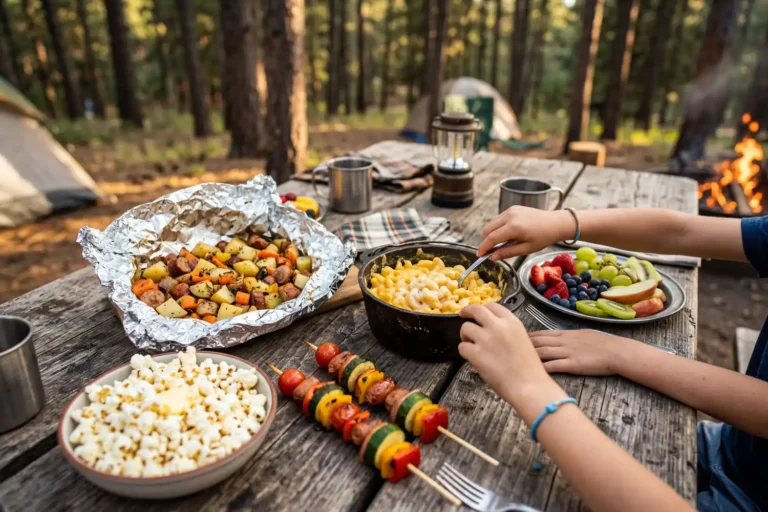
4. Foil packet dinners. Each person builds their own with a protein, vegetables, oil, and seasoning. Cooks on coals in 20 to 25 minutes. Zero pots to wash. My foil packet method on hot coals covers fold technique and coal placement, which matters more than people think.
5. Grilled meat with rice and salad. Pre-marinate meat at home in zip bags. Grill over fire or stove. Cook rice in a covered pot. Toss a quick salad. Restaurant-feel dinner with about 40 minutes of camp work. Getting rice right is the hardest part, so I keep my notes on cooking rice over a fire without scorching it handy for newer cooks in the group.

What does feeding a group actually cost?
For a 3-day trip in 2025 grocery prices in the U.S., budget roughly $25 to $35 per person for food (cooking from scratch, mid-tier ingredients). That breaks down to about $8 to $12 per person per day.
Dehydrated backpacking meals run $10 to $15 per single serving, so a 3-day backpacking trip with dehydrated meals is $90+ per person. Cooking from scratch saves real money for groups, which is why for trips of six or more, scratch cooking almost always wins.
Splitting costs fairly across the group matters, especially when one person does most of the shopping. My take on splitting camp costs fairly in a group covers methods that don’t cause friction.
How do you handle dietary restrictions in a group?
Ask before you shop, not at camp. Send one group message: “Any allergies, vegetarians, religious restrictions, or strong dislikes?” Build the menu around what works for everyone, with modular add-ons for meat eaters.
Modular meal structure: taco night, burrito bowls, foil packets, and pasta bars all let people opt in or out of ingredients without separate cooking. The base is shared, the toppings are individual.
For severe allergies (peanut, shellfish, gluten), bring a dedicated small pan and cutting board. Cross-contamination at camp is a real risk because the wash setup is rough. I keep one cutting board marked with red tape for raw meat, one for produce, and a third for allergy-safe prep.
A real story: the meal that taught me everything
In 2021, I led a 4-day trek to Keokradong with seven other hikers. I planned dinner for night two as a chicken curry with rice. Big pot, ambitious. What I didn’t account for: the cookfire was wetter than expected, the wind kept dropping the temperature, and my pot was too small. The curry simmered for two hours instead of forty minutes. By the time it was ready, the rice was cold, two people had gone to bed hungry, and the dish was disappointing.
Three lessons stuck:
- Always bring a backup stove. Fire alone isn’t reliable for group meals.
- Pot size is non-negotiable. Buy bigger than you think.
- Have a 15-minute emergency meal ready (instant noodles, tuna pouches, tortillas). Some nights you need to feed people fast.
Since that trip, I’ve always packed one quick backup meal per day of the trip. I’ve used it maybe one time in five, but on that one time, it saved the evening.
Food storage and safety
Cold food below 40°F, hot food above 140°F. Block ice lasts longer than cubed ice (about twice as long in my experience). Two coolers work better than one giant cooler: a “today” cooler that gets opened often, and a “later” cooler that stays sealed for day two and three food.
Bears, raccoons, and rodents love group leftovers. Hang food bags or use bear canisters where required. My detailed write-up on safe food storage at camp covers bear country specifics.
Cross-contamination prevention: separate cutting boards, wash hands after handling raw meat (hand sanitizer is acceptable in the field), and use a thermometer for chicken and pork. Foodborne illness in the backcountry is genuinely dangerous because you’re hours from help.
Prep and cleanup that doesn’t burn people out
Home prep checklist (do all of this before leaving):
- Dice all vegetables, pack in labeled zip bags by meal
- Brown and freeze ground meat (doubles as ice)
- Mix dry spice blends in small jars or bags
- Pre-measure rice, pasta, and dry goods into portions
- Marinate meats in zip bags (freeze for day-two meals)
- Pack each meal’s ingredients in one labeled grocery bag
This typically takes 2 to 3 hours the night before. At camp, you’ll save 5 to 7 hours over a three-day trip. Worth it.
Three-bucket wash station:
- Hot soapy water (wash)
- Clean rinse water
- Sanitizing solution (1 tbsp bleach per gallon, or boiling-hot water)
Assign a rotating dish duo per meal. One cook + one helper + two dishwashers per meal means everyone works once or twice a day, never every meal.
Sample 3-day menu for 10 people
| Meal | Dish | Notes |
|---|---|---|
| Day 1 breakfast | Granola, yogurt, fruit | No cooking, eat fast |
| Day 1 lunch | Wrap station | Day-of-arrival simplicity |
| Day 1 dinner | Chili and cornbread | Use frozen meat as ice |
| Day 2 breakfast | Breakfast hash | Big skillet, one pan |
| Day 2 lunch | Mediterranean board | Hiking day, no cooking |
| Day 2 dinner | Taco bar | Crowd pleaser, modular |
| Day 3 breakfast | Pancakes and bacon | Slow morning treat |
| Day 3 lunch | Leftover chili in tortillas | Use it up, light pack-out |
| Backup meal | Instant noodles with tuna | For the bad-weather night |
Total food weight: roughly 55 lb. Two coolers. One 12-quart pot, one 8-quart pot, two 14-inch skillets, two stoves.
Final thoughts
Cooking for a large group at camp comes down to three things: scale your pots to your group, prep heavily at home, and pick recipes that forgive mistakes. Chili doesn’t care if you’re a little off on quantities. Foil packets don’t care if the fire is uneven. Taco bars don’t care about dietary differences. Lean into forgiving food, share the work, and dinner becomes the best part of the day instead of the most stressful. If your fire skills need sharpening, my notes on heat control over a campfire will save you a few burned dinners.