How Many Miles Can You Hike in a Day? Daily Mileage by Skill Level

Most adult hikers cover 8 to 15 miles in a day on moderate terrain. That range shifts a lot based on fitness, trail conditions, pack weight, and elevation gain. I’ve finished short 6-mile day hikes around Kaptai that felt harder than 14-mile ridge walks, and the reason almost always came down to terrain and weather. This guide breaks down realistic daily mileage, the math behind hiking pace, and how to plan a distance you’ll actually enjoy finishing.
A reasonably fit adult on a well-marked trail can hike 10 to 12 miles in a day with moderate elevation. Beginners should plan for 5 to 8 miles. Experienced thru-hikers often manage 20 to 25 miles, sometimes more on flat trail. Solo backpackers carrying 30-plus pound packs usually drop to 8 to 12 miles even when fit. So the honest answer depends on who’s asking and where they’re hiking.
What affects how far you can hike
Terrain and elevation gain
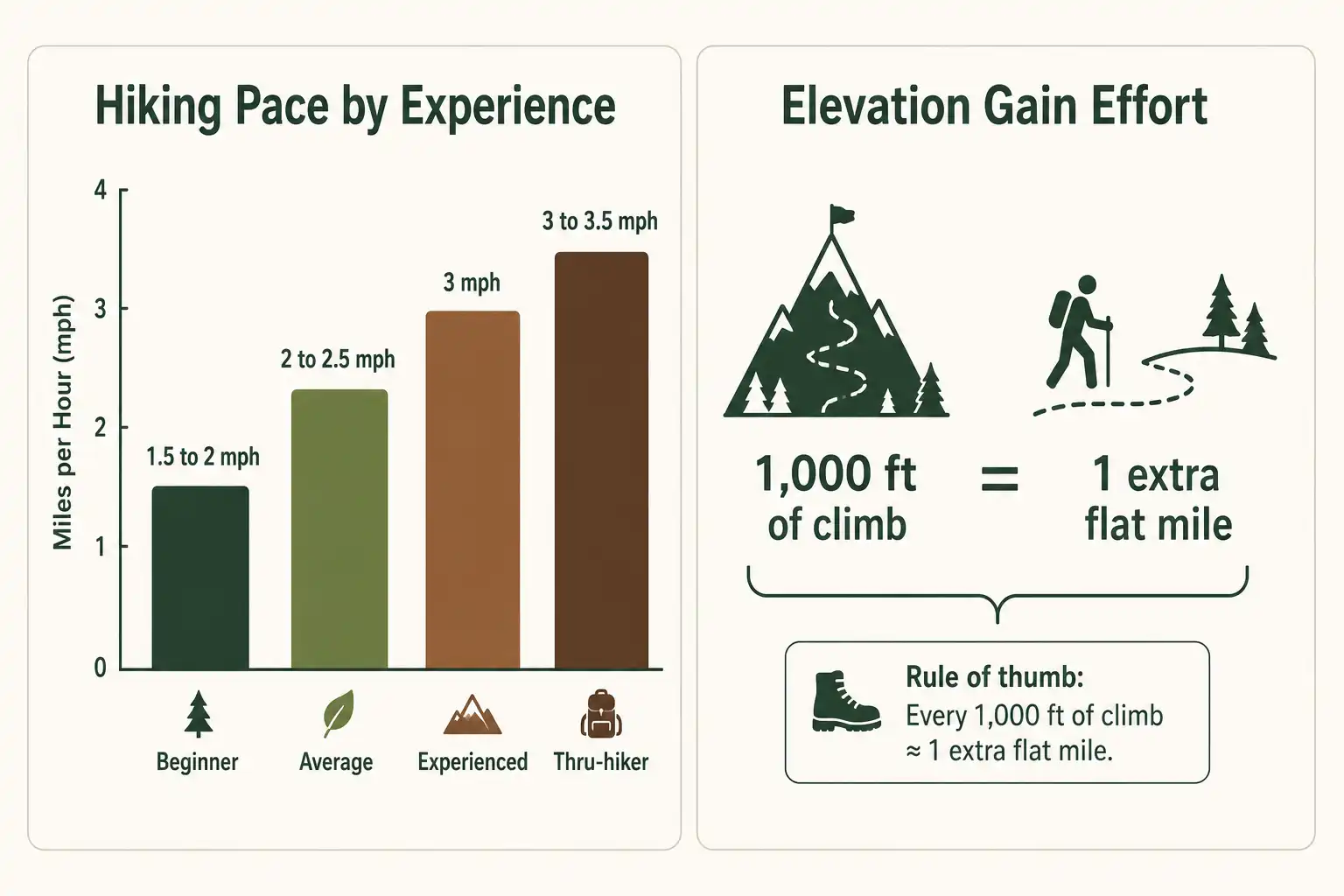
Flat trail moves fast. Rocky, root-tangled, or steep trail slows you to a crawl. A rough rule from hiking guides: every 1,000 feet of elevation gain adds roughly the same effort as one extra mile of flat walking. So a 10-mile loop with 3,000 feet of climb feels like 13 miles. For a deeper breakdown, my notes on what counts as significant elevation gain on a hike cover specific numbers by trail type.
Pack weight
A daypack at 10 to 15 pounds barely affects pace. Once you load a multi-day pack past 25 pounds, however, your speed drops by 15 to 25 percent and fatigue sets in faster. That’s why backpackers cover less ground per day than day hikers on the same trail.
Fitness and trail experience
Cardio fitness sets your ceiling, but hiking-specific muscle endurance is what actually carries you over miles 8 through 14. Someone who runs marathons can still hit a wall on a steep trail because the leg mechanics differ. If you’re prepping for something serious, my notes on the fitness level needed for multi-day backpacking are a useful baseline.
Weather and daylight
Heat above 90°F can cut your safe range almost in half. Cold and wet conditions slow you down too, because you spend energy on temperature regulation. Also, plan around available daylight. After sunset on unfamiliar trail, you should already be at camp.
Trail type
Wide, graded paths like rail-trails or national park nature loops let you move at 3-plus mph. Technical singletrack, scree, river crossings, or jungle trails often slow you to 1 to 1.5 mph. I learned this the hard way on the trek to Nafakhum, where 8 km looked easy on the map and took nearly six hours.
The math: hiking pace and time
Most hikers use a version of Naismith’s Rule to estimate time:
- Allow 1 hour for every 3 miles of flat distance.
- Then add 1 hour for every 2,000 feet of climb.
So a 12-mile hike with 2,000 feet of elevation works out to about 4 hours flat plus 1 hour climb, or 5 hours of moving time. Add another 30 to 60 minutes for breaks, snacks, photos, and route-finding. That’s a 6-hour day, which fits comfortably inside daylight even in winter.
For a quick gut check, here’s a realistic pace table:
- Beginner on moderate trail: 1.5 to 2 mph
- Average fit hiker: 2 to 2.5 mph
- Experienced hiker on good trail: 3 mph
- Thru-hiker on easy terrain: 3 to 3.5 mph
These are moving averages, not trail-time. Once you add breaks, knock 15 to 20 percent off.
Realistic daily mileage by experience level
Beginner day hikers
Stick to 5 to 8 miles with under 1,000 feet of gain. You’re learning your body’s signals, breaking in boots, and figuring out what gear works. Pushing past this on early hikes is how blisters, knee pain, and bad first impressions happen.
Intermediate hikers
After a few months of regular trail time, 10 to 14 miles becomes comfortable on moderate terrain. Elevation handling improves, recovery shortens, and your pace stabilizes. So this is where most weekend hikers settle in.
Advanced day hikers
With consistent training, 15 to 20 miles a day is achievable on rolling trail. Above 20 miles, however, you’re entering ultra-distance territory, where nutrition and pacing matter as much as fitness.
Backpackers vs. day hikers
Carrying overnight gear cuts daily mileage. A fit backpacker who hikes 18 miles as a day-tripper might only manage 12 with a loaded pack. Multi-day trips also bring cumulative fatigue, so day 3 is almost always slower than day 1.
How to set a target you’ll actually finish
Start with the trail’s stated distance and elevation, then run Naismith’s math. Cut your estimated pace by 20 percent if you’re new to the area, hiking solo, or expecting heat. Also add buffer time for getting lost, weather, or a slower partner. I always plan to finish two hours before sunset, not at sunset.
Pacing matters more than raw speed. Going out too fast in the first hour is the most common reason hikers bonk mid-afternoon. My guide on holding a sustainable rhythm on long hikes covers this in detail. On long climbs specifically, the trick to climbing without burning out early is steady cadence and short, frequent breaks.
Fueling is the other half. Underfeeding past mile 6 turns a fun hike into a slog, so trail nutrition for a long day hike should give you about 200 to 300 calories per hour of expected effort.
Safety limits and red flags
The American Hiking Society and the National Park Service hiking safety guidance both recommend matching trail choice to your real fitness, not your goal fitness. Red flags during a hike include sharp joint pain, lightheadedness, nausea, and stopping to rest more than every 20 minutes on flat ground. Any of those mean you should shorten the route or turn back.
Downhill is where most injuries happen. Long descents hammer the knees more than climbs, especially with a pack. If that’s a weak spot for you, managing knee pain on steep descents is worth reading before a big mileage day.
Bottom line
For most people, a safe and enjoyable day hike falls between 8 and 14 miles with moderate elevation. Beginners do well in the 5 to 8 mile range. Trained hikers comfortably push 15 to 20. Distance is a number, but the real measure is whether you finish tired but fine, or wrecked. Plan for the first one. Start short, track how you actually feel at mile 6, mile 10, mile 14, and grow from there.