How to Set Up a Hammock for Camping and Sleep Flat All Night

A camping hammock takes about five minutes to hang once you know the numbers. Most people get it wrong on the first night, then blame the hammock for a sore back. Below I walk through the whole setup, from choosing trees to pitching a tarp and sleeping warm underneath.
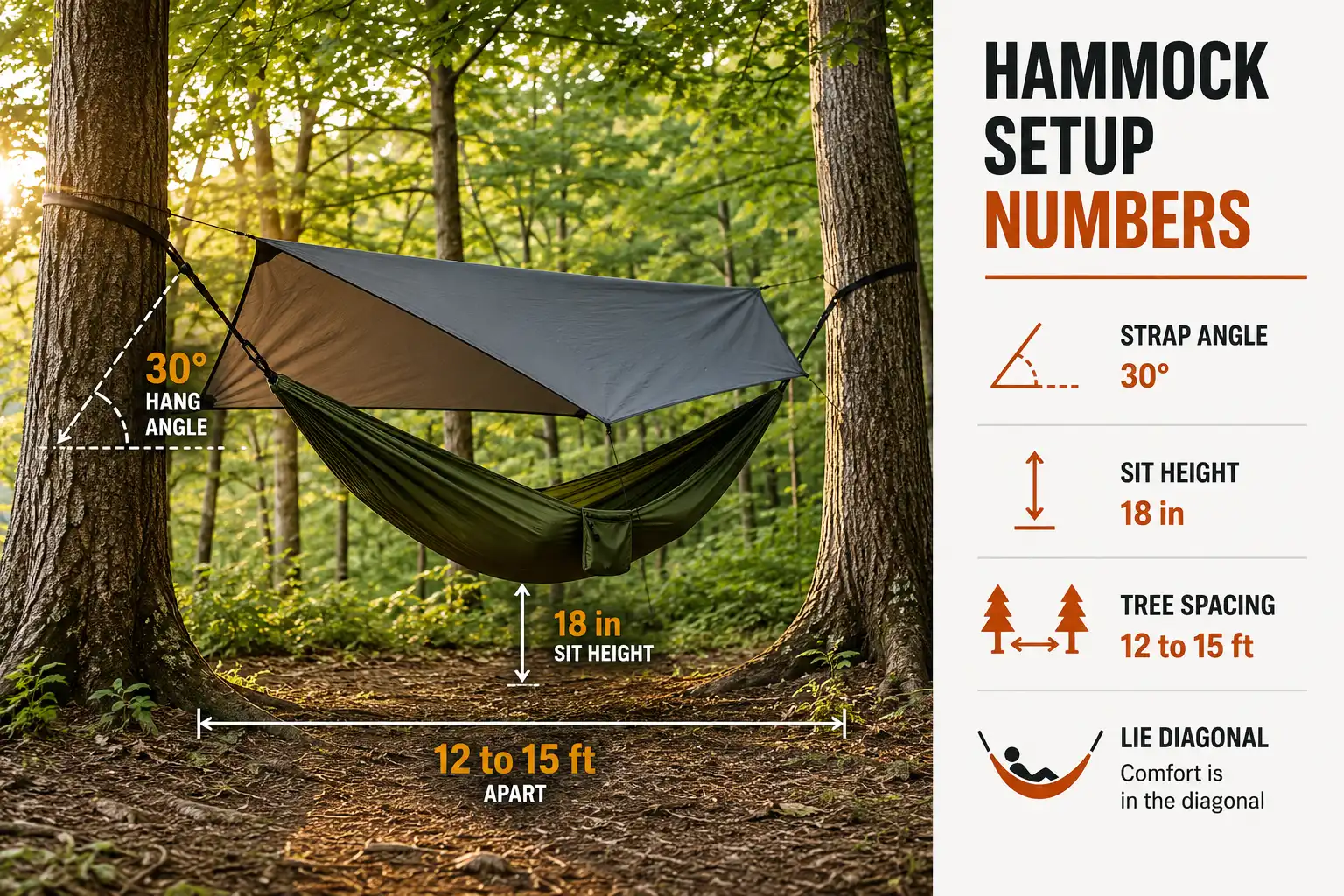
To set up a hammock for camping, hang your straps at roughly a 30 degree angle to the ground. Then set the height so the bottom of the hammock sits about 18 inches off the ground once you climb in. Choose healthy trees 12 to 15 feet apart. Then lie diagonally across the fabric instead of straight down the middle.
What you need to hang a camping hammock
Here is the full kit, and most of it packs into a stuff sack the size of a loaf of bread.
- Camping hammock. A gathered end model 10 to 11 feet long suits most adults.
- Two tree straps. Flat webbing, at least 1 inch wide, usually 8 to 10 feet long.
- Carabiners or toggles. These normally come with the straps.
- Tarp plus guy lines and four to six stakes. Skip it only if you are certain the night stays dry.
- Bug net. Some hammocks build this in, and separate nets slip over the whole hammock.
- Bottom insulation. An underquilt or a sleeping pad.
- Top insulation. A quilt or a sleeping bag.
Two extras earn their weight. A structural ridgeline gives you the same sag every time, and two short pieces of cord act as drip lines when it rains.
How to set up a hammock for camping, step by step
Follow this order and you avoid the fiddling that frustrates most beginners.
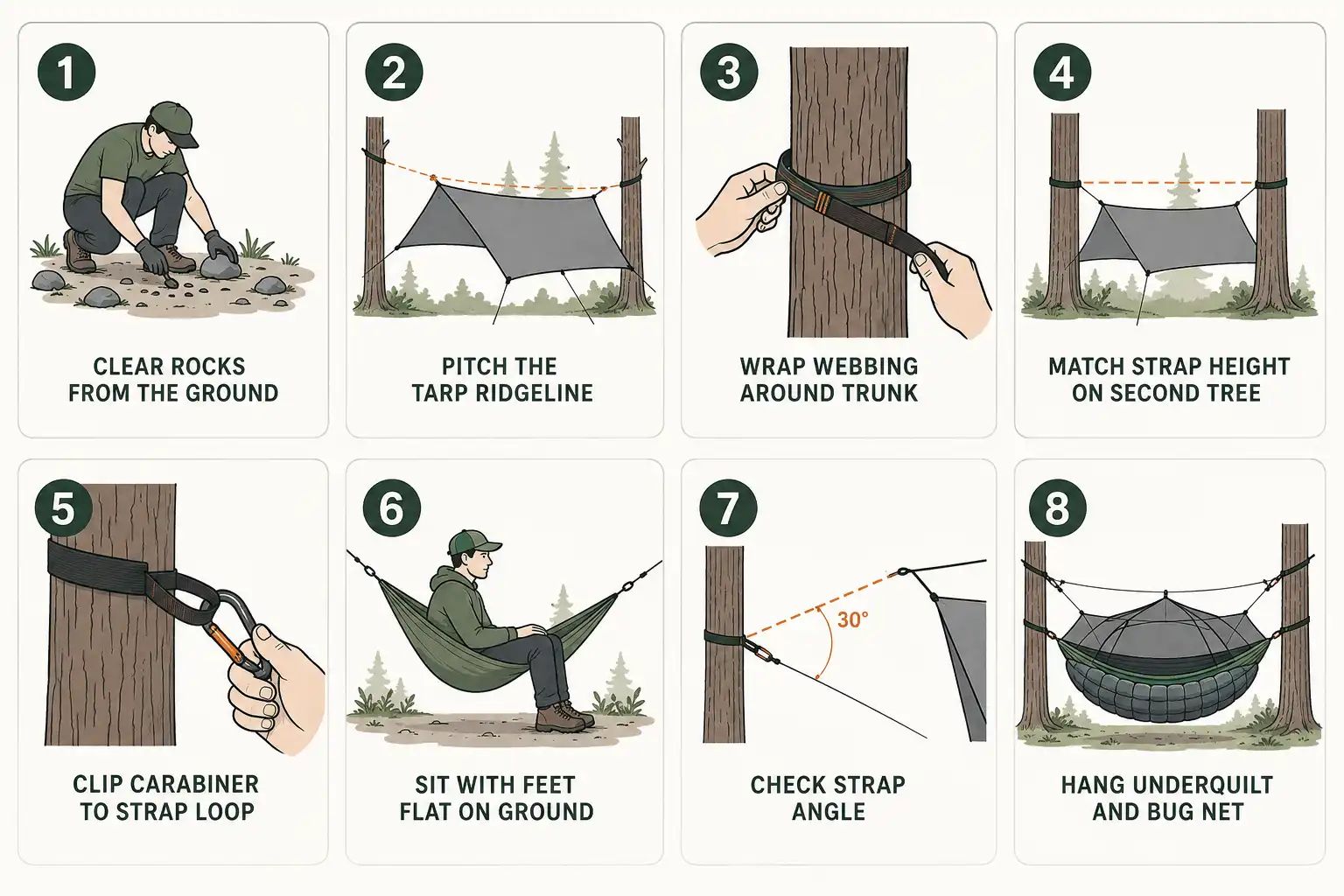
- Scan the ground first. Clear rocks, roots, and anything sharp from the area under the hammock. Also look up for dead branches before you commit to the spot.
- Pitch the tarp first if rain threatens. String the tarp ridgeline high between the two trees, then work underneath it. Otherwise your quilt gets soaked while you fumble with straps.
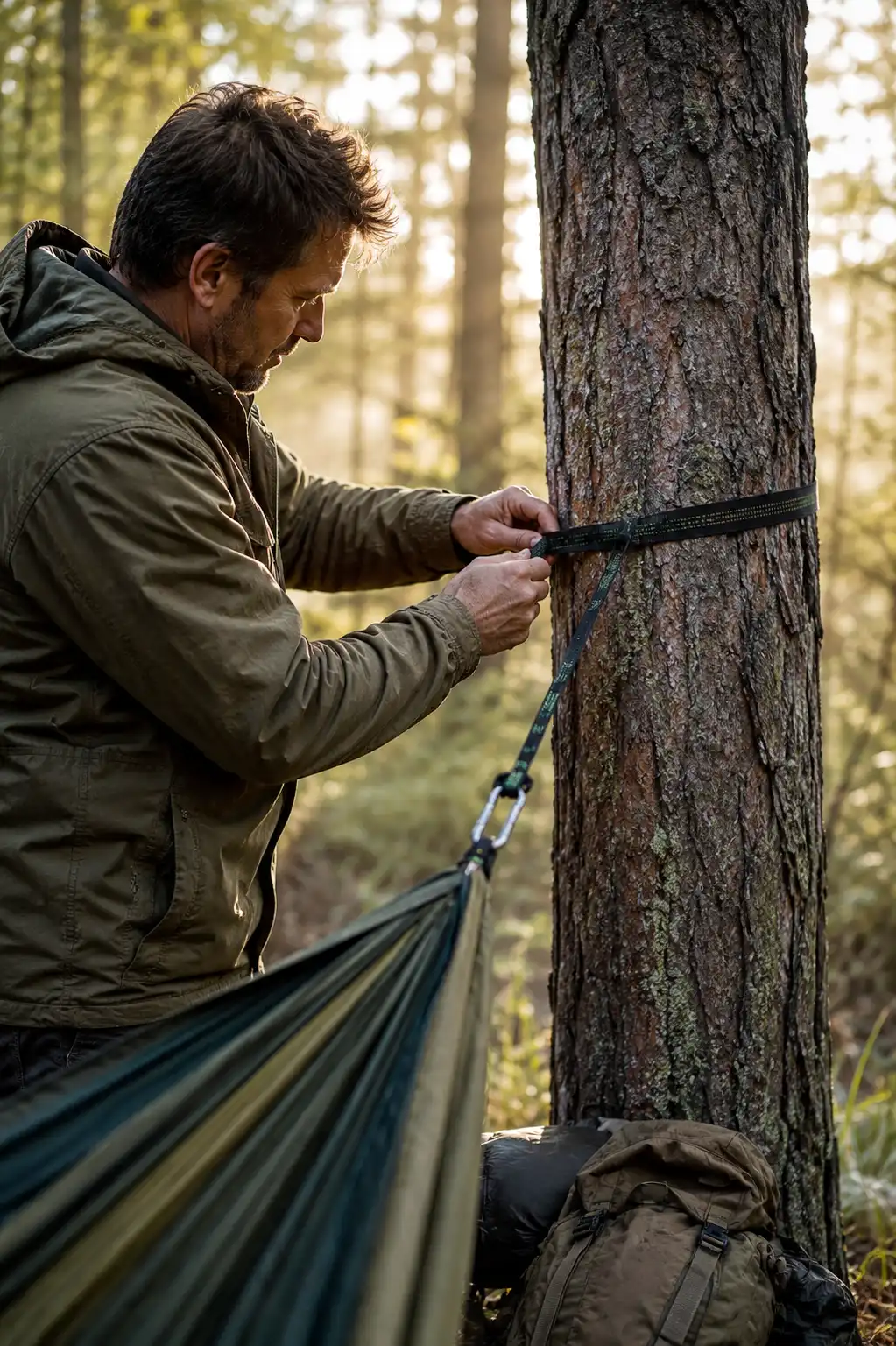
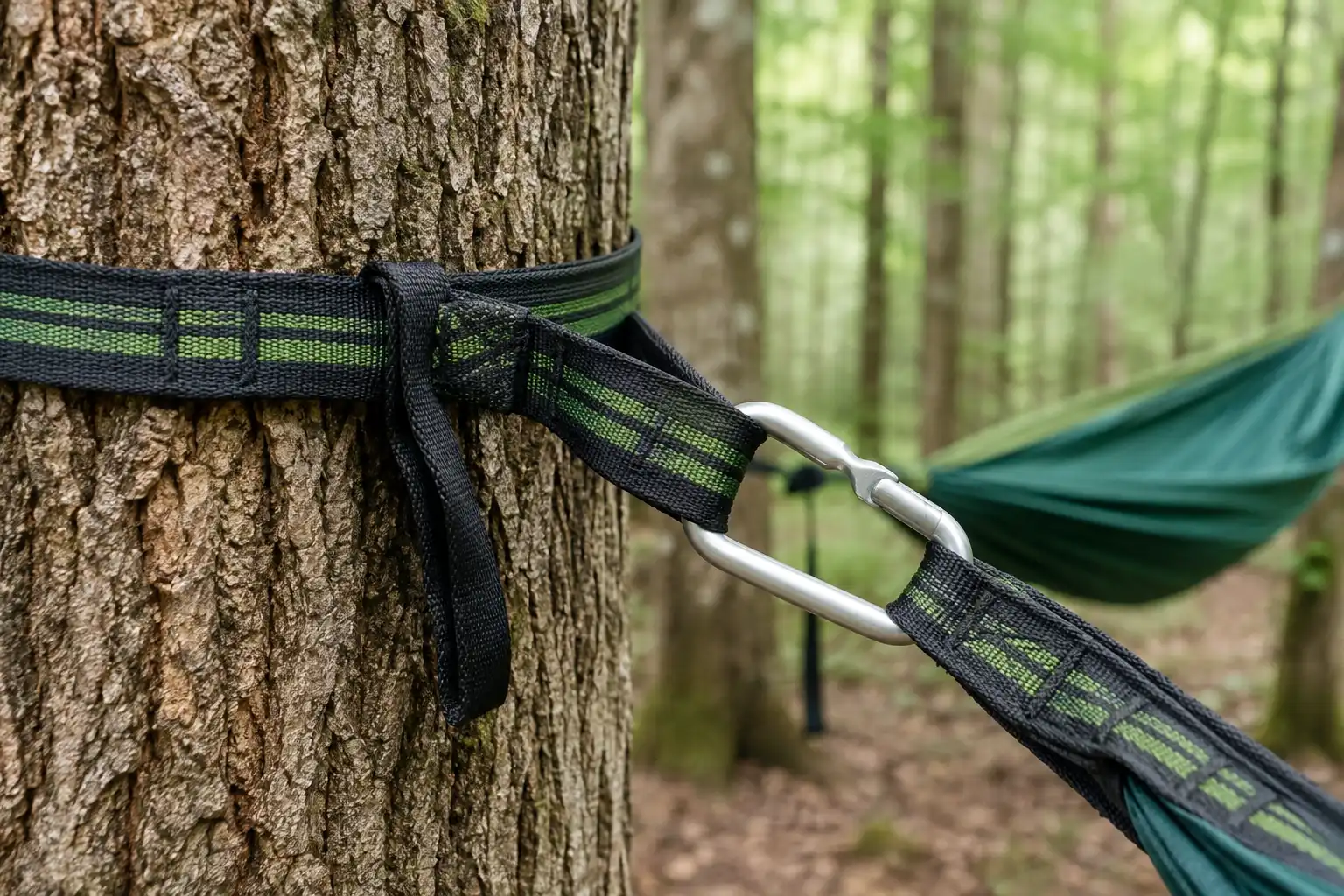
- Wrap the first strap. Loop the webbing around the trunk at roughly head height, then pass the tail through the end loop and pull it snug. The strap should sit flat against the bark, never twisted.
- Wrap the second strap the same way. Match the height on both trees so the hammock hangs level.
- Clip the hammock in. Attach a carabiner to a webbing loop on each side. Start near the middle loop, since that leaves room to adjust in either direction.
- Sit in the middle and check the height. Your feet should touch the ground easily, like sitting on a low chair. If you sink too far, move up a loop on each strap.
- Check the angle. Step back and look at the straps. Each one should run at about 30 degrees to the ground.
- Add your insulation and bug net. Hang the underquilt underneath, drop the top quilt inside, then fit the bug net last.
How far apart should the trees be for a camping hammock?
Trees 12 to 15 feet apart work best for a standard 10 or 11 foot hammock. That spacing gives you enough room for a relaxed sag without stretching the straps to their limit.
You can still hang between trees 10 feet apart, though you will use only the first loop or two on each strap. Wider gaps also work if your straps are long enough. Once trees sit more than about 18 feet apart, you need to tie in much higher on each trunk to keep the same angle, and the strap tension climbs.
After a few trips you stop measuring. I judge spacing by pacing the gap between the two trunks, since my normal stride runs close to two and a half feet. Five paces therefore puts me in the right range.
Which trees are safe to hang a hammock from?
Pick living trees at least 6 inches thick, with no dead limbs above and no visible rot at the base. Lean your weight into the trunk with one hand first. If it flexes or sways, walk on.
Dead trees fail without warning, so skip them no matter how perfectly spaced they look. Standing deadwood overhead deserves the same attention, because wind brings limbs down at night more often than during the day. A ten second look at the canopy costs nothing.
Also check what already occupies the tree. Ant columns, wasp nests, and beehives all turn a good site into a bad night. In the hills around Kaptai I always tap the trunk once and wait a few seconds before I commit.
Then think about the tree itself. Flat webbing at least 1 inch wide spreads your load across the bark. Rope and paracord cut into a narrow band instead, and repeated hangs can girdle the living layer underneath. Leave No Trace guidance puts the minimum at 0.75 inches, while many parks now require a full inch or more. Wider straps also grip better, so there is no reason to go thin.
What is the right hang angle for a camping hammock?
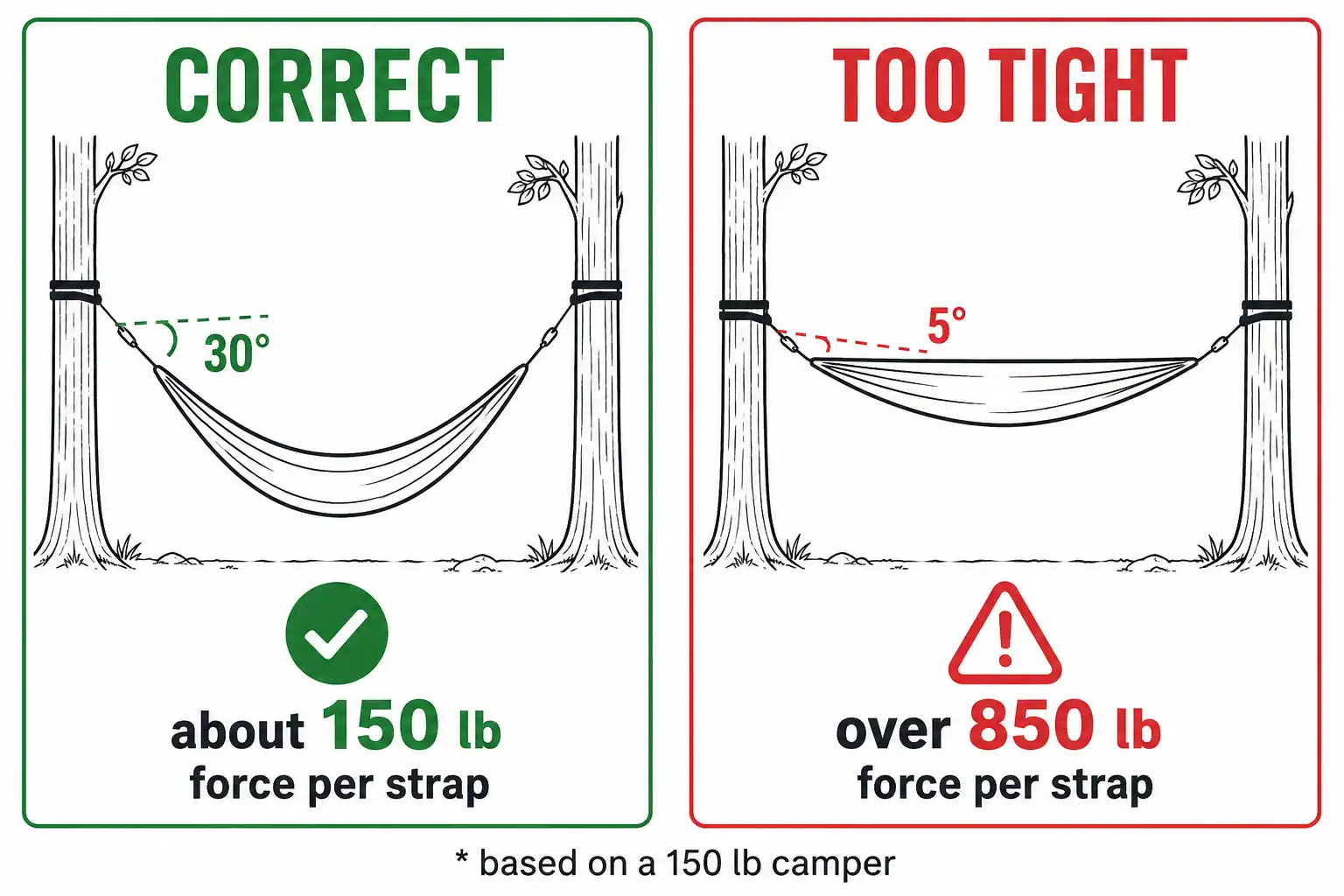
Aim for about 30 degrees between each strap and the ground. That angle keeps the load on your straps and trees close to your own body weight, and it produces the natural sag that makes a flat lay possible.
The physics matters here. At 30 degrees, a 150 pound camper puts roughly 150 pounds of pull on each anchor. Flatten that angle to 10 degrees and the same camper loads each strap with close to 430 pounds. Pull it nearly level at 5 degrees and the figure passes 850 pounds. So a tight hammock stresses your gear far more than a loose one, even though it looks tidier.
Comfort follows the same rule. A tight hang squeezes the fabric against your shoulders and forces you into a banana shape. Loosen it, and the fabric opens up so you can spread out.
You do not need a protractor. Hold your arm out with your thumb up and your index finger pointing sideways, then form an L. Half of that gap is roughly 45 degrees, and 30 degrees sits a little below it. Alternatively, run a rough check with the sit test in the next section, because the two go together.
How high should a camping hammock hang?
Set the hammock so its lowest point sits about 18 inches off the ground while you sit in it, which puts the fabric at chair height. Sit down, and your feet should rest flat with your knees bent at a comfortable angle.
Height serves two purposes. First, it keeps you clear of cold air pooling on the ground and away from crawling insects. Second, it limits the drop if a strap slips, which matters more than most people expect.
Fabric stretches under load, especially nylon. Therefore hang a little higher than your target on the first setup, then let it settle for a few minutes and adjust. On humid nights in Bandarban I have watched a hammock drop three or four inches over an hour, so I now build in that margin every time.
How do you lie in a hammock without back pain?
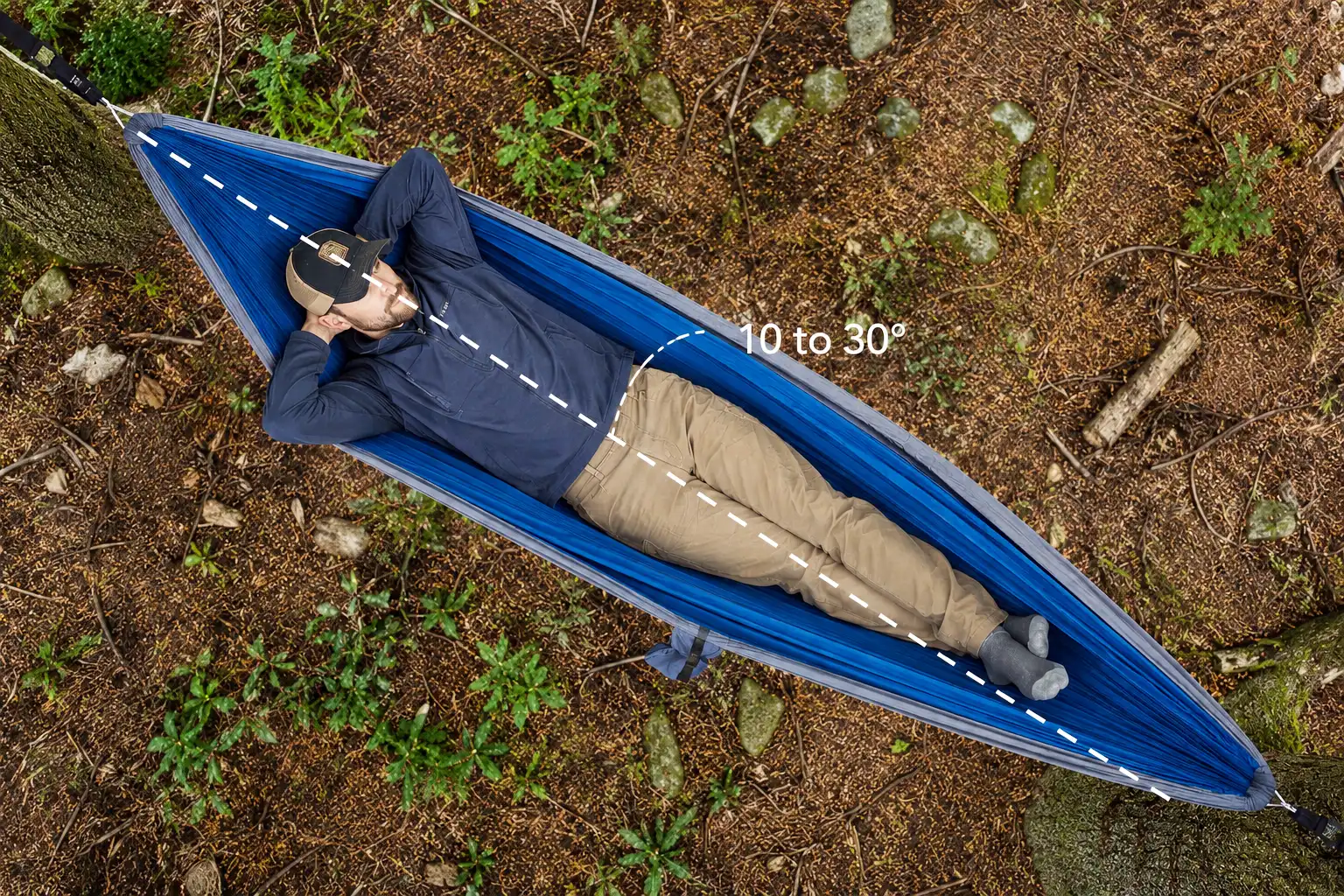
Lie diagonally, roughly 10 to 30 degrees off the center line, rather than straight along the middle. The diagonal position flattens your back and takes the pressure off your shoulders.
Get in by sitting first, then swinging both legs up together. Once you are in, shift your feet toward one corner and your head toward the opposite corner. Your spine should straighten out almost immediately. Many campers add a small pillow or a stuff sack under the knees, which relieves any remaining tension in the lower back.
Side sleepers manage fine in a hammock too, provided the sag is generous. Curl slightly and let the fabric wrap your hip and shoulder. Stomach sleeping rarely works well, so plan on your back or your side.
Do you need a structural ridgeline?
A structural ridgeline is optional, but it makes every setup identical. The cord runs between the two ends of the hammock and fixes the sag. Therefore your lay feels the same whether the trees stand 11 feet apart or 16.
Set the ridgeline at about 83 percent of your hammock length as a starting point. An 11 foot hammock therefore needs a cord around 110 inches long. Shortening it adds sag, and lengthening it flattens the hammock, so adjust from there until the lay suits you.
Use low stretch cord such as Amsteel or Dyneema in a 1/8 inch diameter. Paracord stretches too much and drifts out of adjustment as the night goes on. The ridgeline also gives you somewhere to clip a headlamp, glasses, and a small gear pouch, which keeps clutter out of the hammock itself.
How to set up a tarp over your hammock
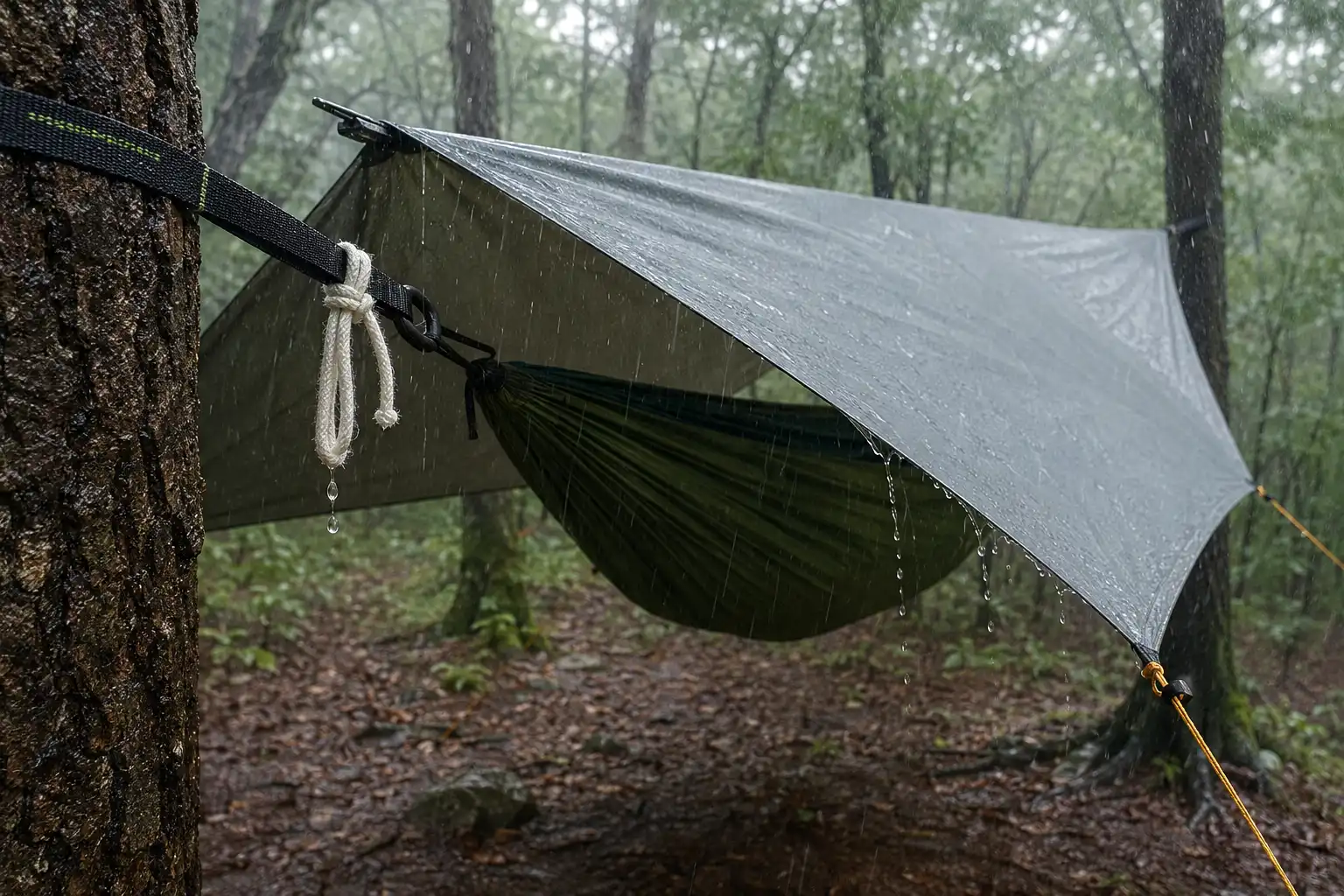
Run a tarp ridgeline between the same two trees, above your hammock straps, then drape the tarp over it and stake out the corners. Pull the guy lines out at about 45 degrees so the fabric stays tight and water runs off instead of pooling.
Two pitches cover almost everything:
- A frame. Even coverage on both sides, staked low in wind or heavy rain. Use this as your default.
- Porch mode. One side propped up with a trekking pole for airflow and a dry sitting area. Save it for calm weather.
Center the tarp over the hammock body rather than over the suspension, since splash hits the sides where you sleep. Keep both hammock ends well inside the tarp edges. Tarps rated for 11 foot hammocks usually measure around 11 by 10 feet. The same coverage math applies when you work out tarp dimensions for any shelter setup.
Drip lines finish the job. Tie a short cotton shoelace around each strap just outside the tarp edge. Water running along the webbing then drops off there instead of reaching your hammock. That one trick has saved me more wet nights than any piece of expensive gear.
How to stay warm in a camping hammock
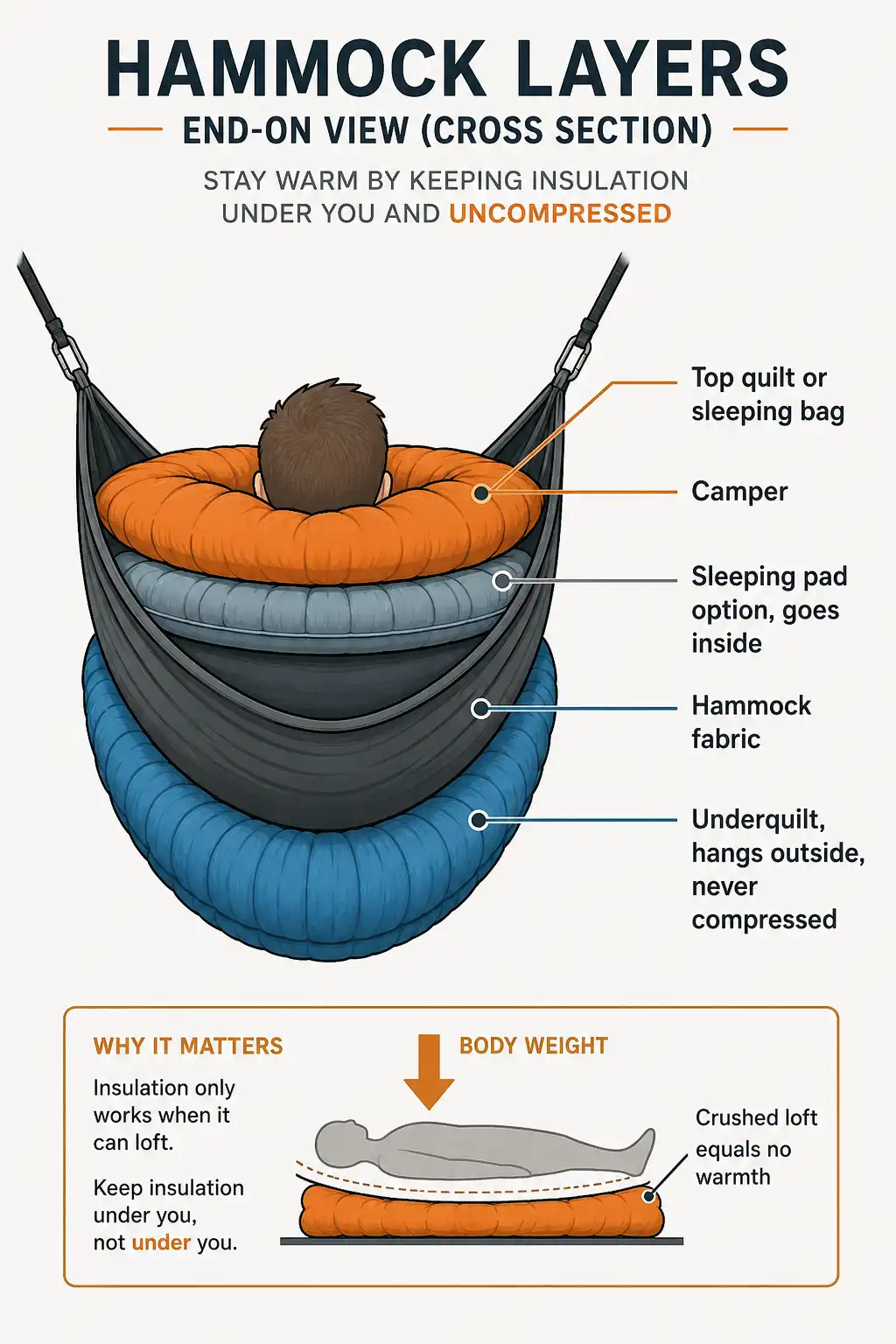
Insulate underneath you before you worry about anything on top. Your body weight crushes the loft of a sleeping bag against the hammock fabric, so the compressed layer stops working and cold air strips heat straight off your back.
Campers call the result cold butt syndrome, and it usually wakes people around 3 or 4 in the morning. The effect starts to show below about 60°F (15°C) and turns miserable near 40°F (5°C). You have two fixes:
- Underquilt. Hangs outside the hammock and never gets compressed. Warmer, easier to sleep on, and more expensive.
- Sleeping pad. Goes inside, costs less, and doubles for ground camping. Pads slide around, though, and narrow ones leave your shoulders cold.
For anything below freezing I use an underquilt. Warm nights near Kaptai Lake need almost nothing underneath, so I carry a torso length foam pad and slide it under my hips. On top, a quilt beats a zipped bag for most hammock campers. The compressed underside of a bag adds no warmth anyway, so the trade offs between quilts and bags shift in the quilt’s favor here. Before you push into colder nights, it also helps to know the temperature limits for sleeping out without proper gear.
How to keep bugs out of a camping hammock
Use a bug net rated for the hammock length, and make sure it hangs clear of your face and arms. Netting pressed against your skin gives mosquitoes a direct target through the mesh.
Integrated nets zip into the hammock and stay put. Separate sock style nets slide over the entire hammock, seal at both ends, and work with any model. Either way, clip the net to your structural ridgeline or to the tarp guy lines so it stays lifted. The same habits that keep insects out of your sleeping space overnight apply here, only the geometry changes.
Treating the net and your sleep clothes with permethrin adds another layer. Also remember that hanging above the ground already removes ticks, ants, and most crawling insects. That is one of the underrated advantages of hammock camping in the hill tracts.
How to hang a hammock when there are no trees
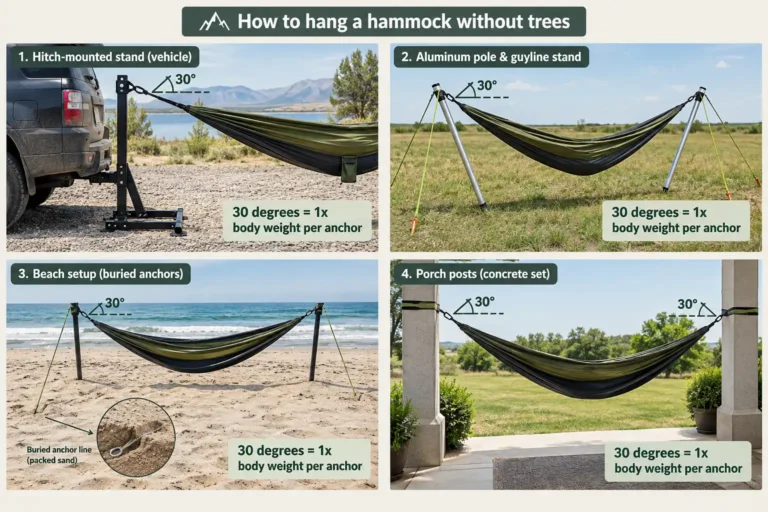
Use a portable hammock stand, sturdy posts, or a vehicle when trees are missing. Beaches, alpine sites, and open riverbanks all force this problem eventually.
Freestanding stands work well for car camping, though most weigh 15 pounds or more. Backpacking stands exist and pack lighter, yet they cost far more than a hammock. Alternatively you can rig one end to a tree and the other to a solid post, a boulder anchor, or a vehicle roof rack. Never use a lone fence post or a young sapling, because neither handles the sideways pull.
When nothing works, drop the hammock to the ground and use it as a bivy layer under your tarp. It is not comfortable, but it beats sleeping on bare soil. Sites near water often make this call for you. Low light makes it harder again, so I plan the hang before dark and run the same checks I use when settling on a spot after arriving late.
Mistakes that ruin a first hammock night
Most bad first nights trace back to five errors, and all five are easy to avoid.
- Hanging too tight. The single most common mistake. Loosen the straps and let the fabric sag.
- Skipping bottom insulation. Warm air above you does nothing for a crushed layer below you.
- Lying straight down the middle. This creates the banana shape people complain about.
- Forgetting drip lines. Rain follows webbing straight into your hammock.
- Testing gear for the first time on the trail. Hang it in your yard first and sleep a full night in it.
One more habit helps in wet climates. Pack the tarp where you can reach it without opening the main compartment, so a sudden shower does not soak everything. If the worst happens anyway, getting soaked gear dry again at camp is a skill worth learning early.
FAQs on Setting up a Hammock for Camping

Can you sleep in a hammock all night?
How much weight can a camping hammock hold?
Do you need a sleeping pad in a hammock in summer?
Can two people sleep in one camping hammock?
Final thoughts on Set Up a Hammock for Camping
Hammock setup comes down to four numbers. Aim for 30 degree straps, an 18 inch sit height, trees 12 to 15 feet apart, and a body angled across the fabric. Learn those and almost any forest becomes a campsite. Practice the whole rig once in your yard, including the tarp and the insulation, so your first night on the trail is about the view rather than the gear.