Base Camp Trekking in Nepal: Costs, Permits, Routes for 2026

Nepal sets the global standard for base camp trekking. Five iconic peaks open their feet to walkers without demanding climbing skills, and the country has built one of the most reliable trekking infrastructures in Asia. Plenty has changed in the last two years though. New guide rules, a rebuilt permit system, and rerouted Lukla flights mean older guides on the internet are flat-out wrong. This piece covers what actually applies in 2026, what each route really costs, how to choose between them, and what most first-timers wish they’d known before flying in.
What is base camp trekking in Nepal?
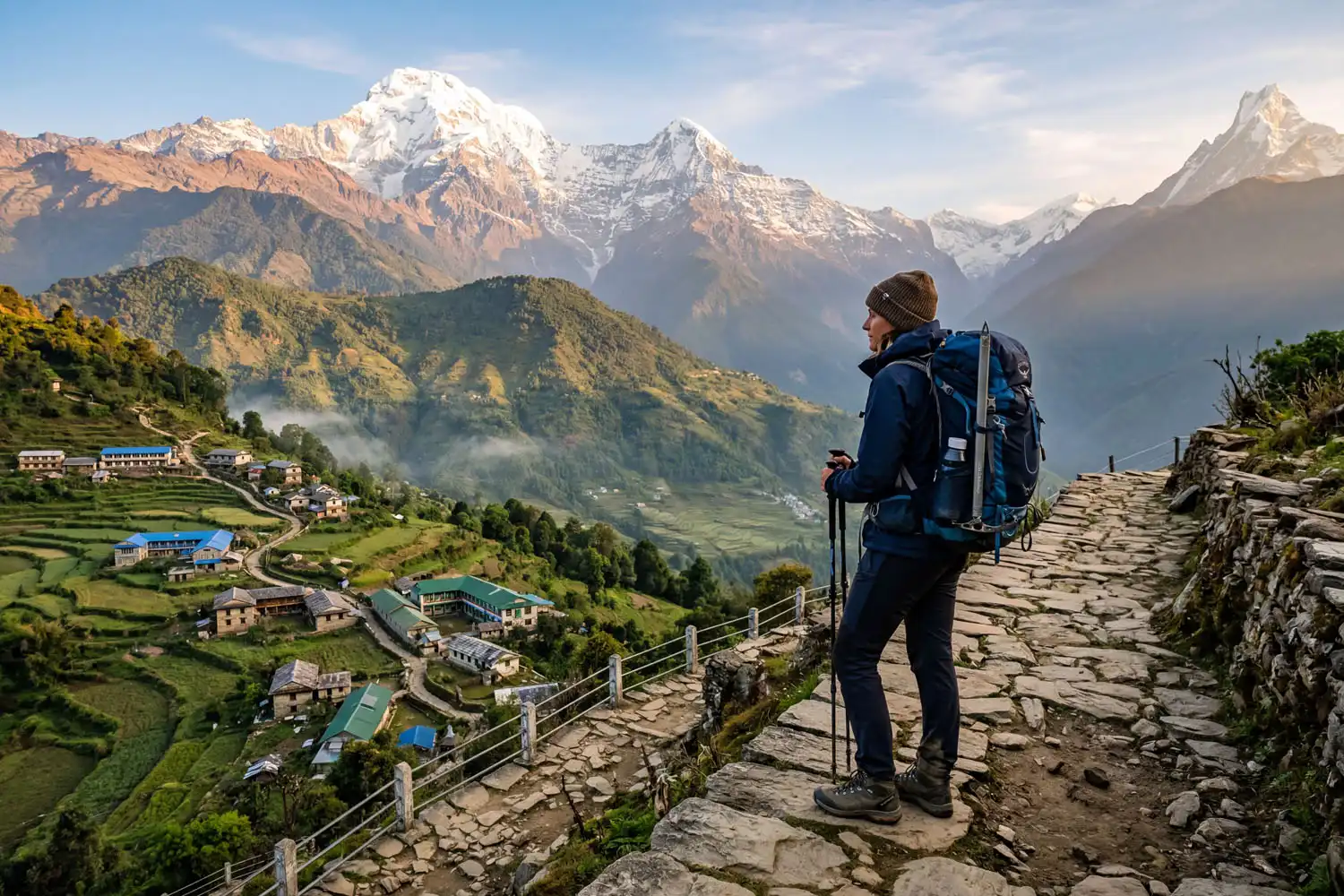
Base camp trekking in Nepal means walking to the foot of a major Himalayan peak without attempting the summit. Five established routes lead to Everest, Annapurna, Manaslu, Makalu, and Kanchenjunga base camps. Trekkers cross mountain villages, glacial valleys, suspension bridges, and high passes, then return on foot or by helicopter. Difficulty ranges from moderate (ABC) to expedition-grade remote (Kanchenjunga). Daily walking sits between 5 and 8 hours, sometimes at altitudes above 5,000 meters.
What changed in Nepal trekking rules for 2026?
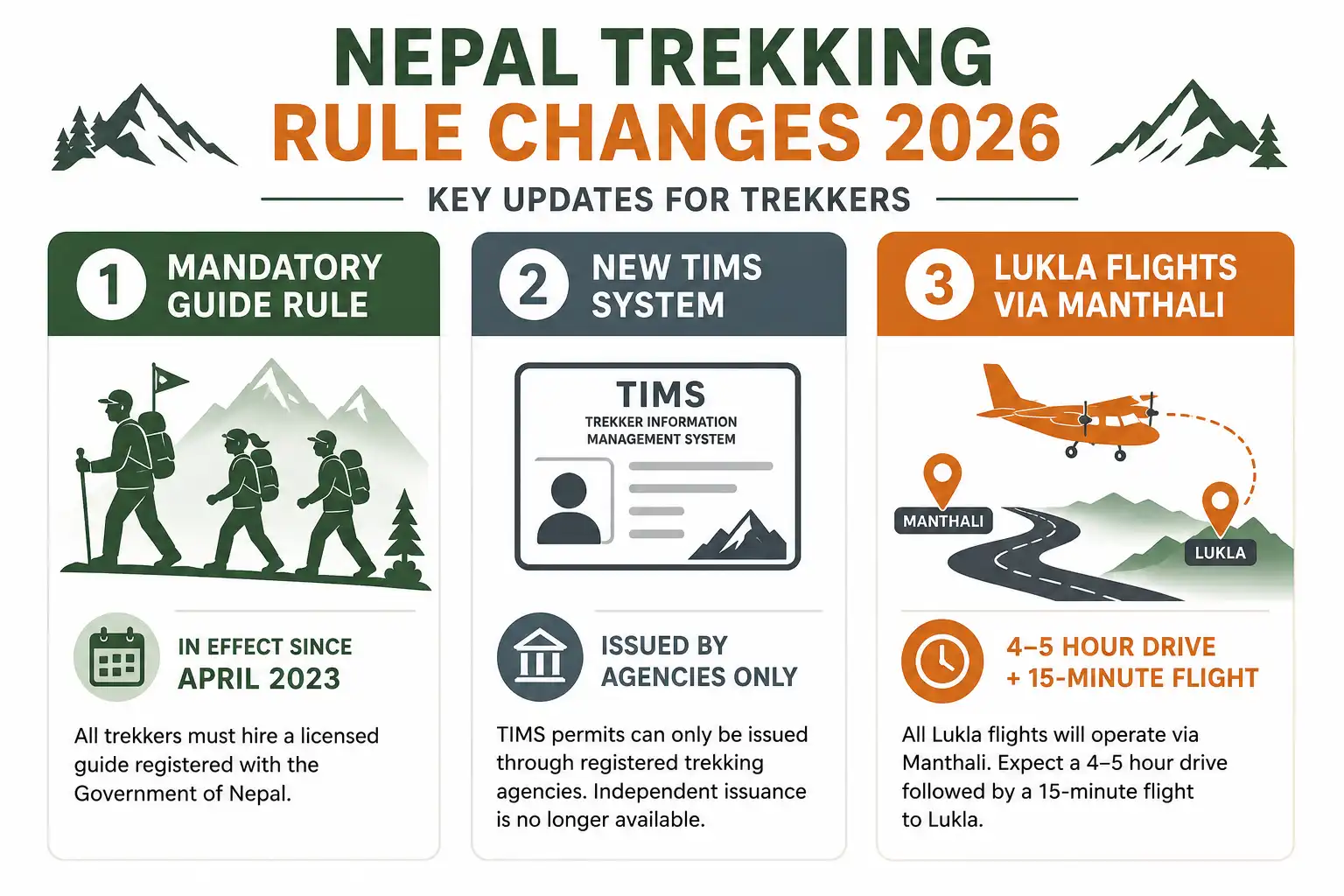
Three major shifts now affect every foreign trekker, and ignoring them can end a trip before it starts.
The mandatory guide rule
Since April 1, 2023, the Government of Nepal has required foreign trekkers to hire a licensed guide through a registered agency for any trek inside a national park, conservation area, or restricted area. That includes Everest Base Camp, Annapurna Base Camp, Manaslu, Langtang, and every other major route. Trekking solo on these trails is no longer legal, and attempting it can result in immediate removal from the route, fines, or blacklisting from future permits. The only exemptions are short day hikes around Kathmandu and Pokhara valleys.
The new TIMS card system
The old green independent TIMS card no longer exists. The TIMS card is now only issued to trekkers who are part of a registered, guided group. You can’t buy one as an individual at the Nepal Tourism Board office anymore.
Lukla flights now leave from Manthali
During peak trekking months (March to May and October to November), a significant portion of Lukla flights are operated from Manthali Airport in Ramechhap District rather than from Kathmandu. Ground transfer requires a 4 to 5 hour drive from Kathmandu, with most departures leaving between 1:00 AM and 2:00 AM. The flight from Manthali to Lukla itself takes 15 to 20 minutes, shorter than the 30 to 35 minute Kathmandu departure. Manthali flights are actually more reliable, but the brutal early start catches many trekkers off guard.
Which base camp treks in Nepal are most popular?
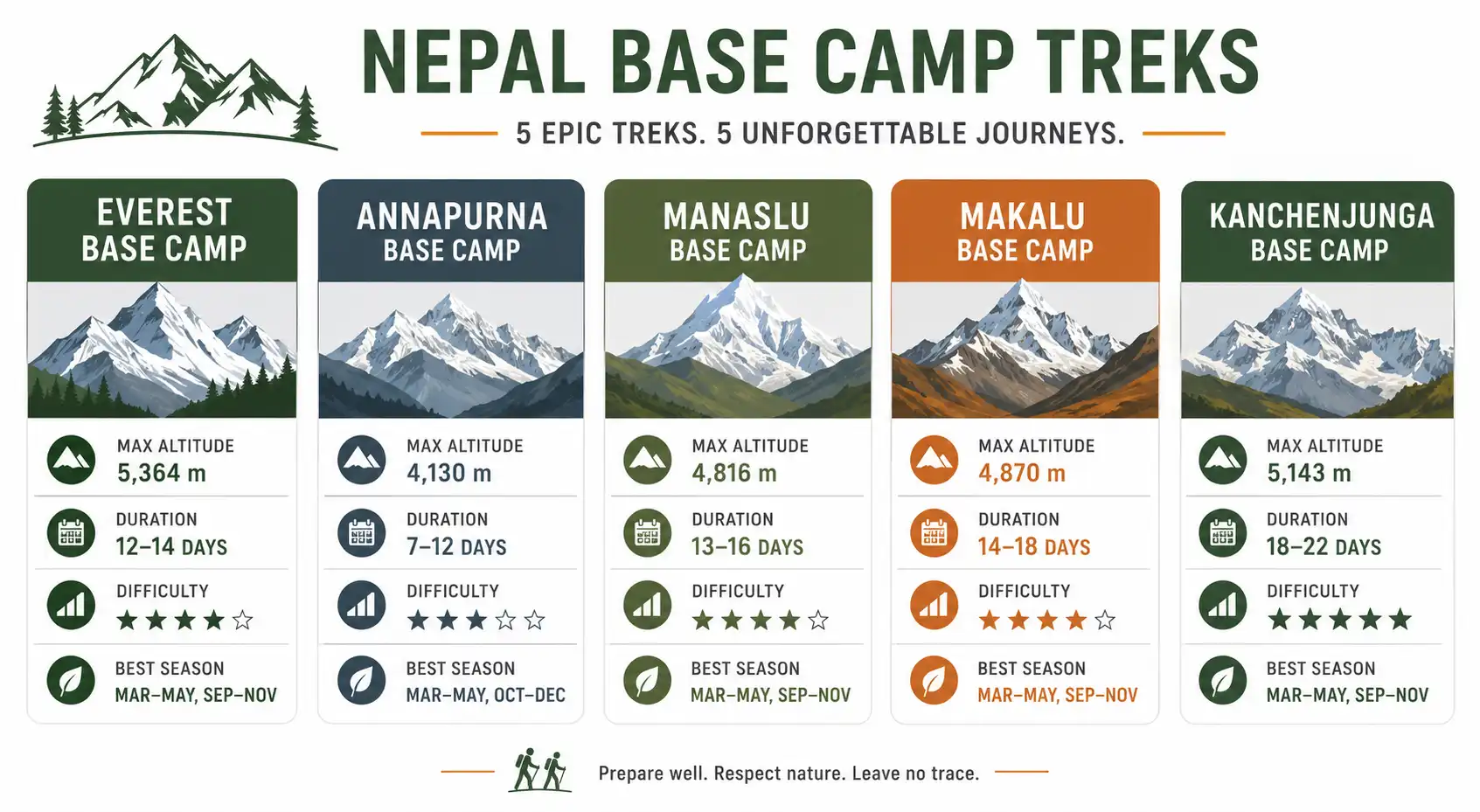
Five base camp routes dominate the trekking calendar, and each one suits a different traveler.
Everest Base Camp (EBC)
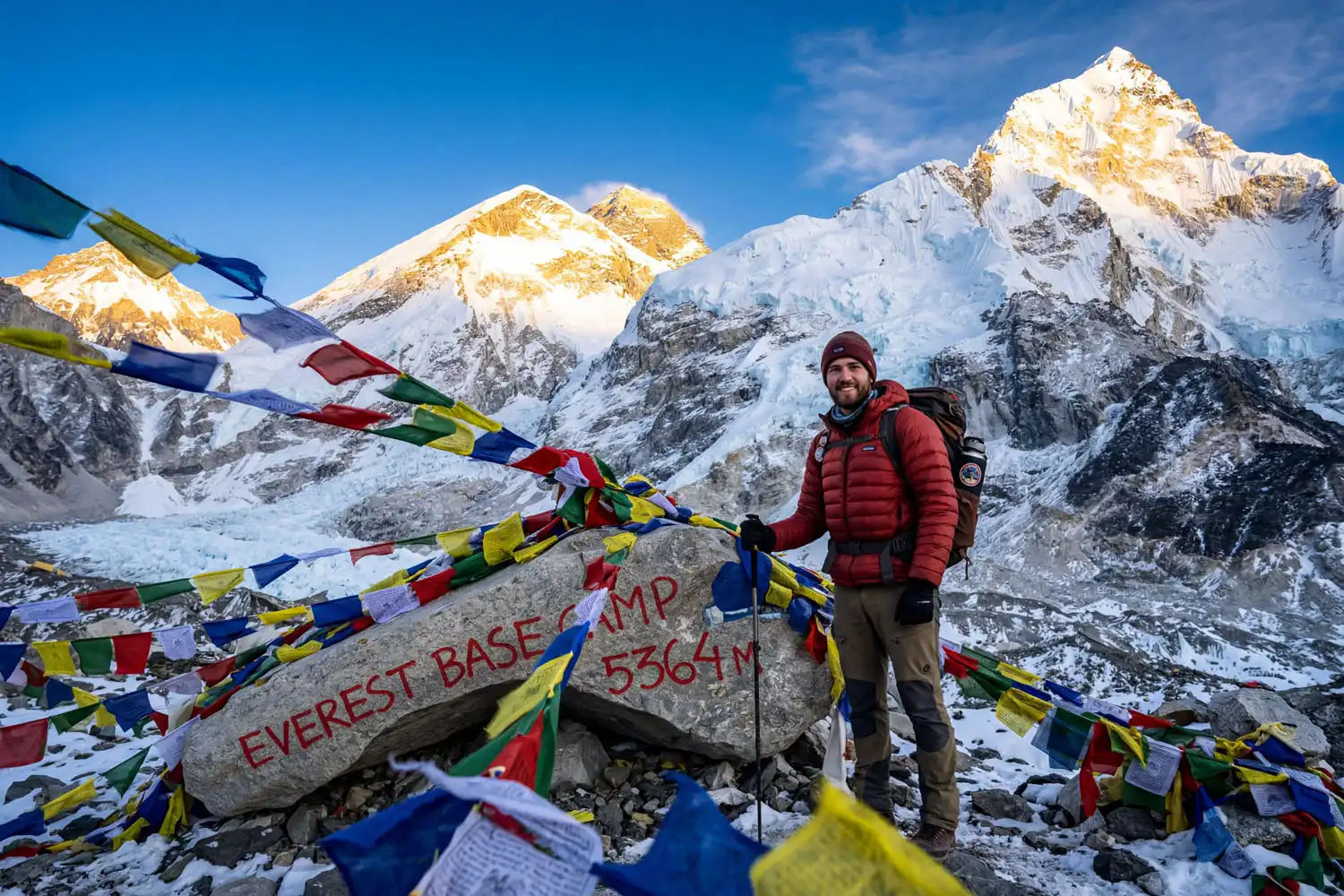
The headline trek. EBC sits at 5,364 meters and takes 12 to 14 days round-trip from Lukla. Trekkers pass through Namche Bazaar, Tengboche monastery, Dingboche, Lobuche, and Gorak Shep. The trail is well-established, teahouses are plentiful, and the Khumbu region has the best mountain rescue coverage in Nepal. For more on this route’s altitude profile, my breakdown of the base camp’s actual elevation walks through the numbers.
Annapurna Base Camp (ABC)
ABC is the friendliest serious trek in Nepal. The route tops out at 4,130 meters, takes 7 to 12 days, and starts from Pokhara. Trekkers walk through Gurung villages, rhododendron forests, and the dramatic Annapurna Sanctuary. The shorter, lower profile makes ABC the best first Himalayan trek for most people.
Manaslu Base Camp and Circuit
Manaslu is the quieter alternative. Most trekkers combine the base camp side trip with the full Manaslu Circuit, which crosses Larkya La Pass at 5,106 meters. The area is restricted, so permit costs and group size requirements run higher. Plan for 14 to 18 days.
Makalu Base Camp
Makalu sits east of Everest at 5,250 meters. The trek runs 18 to 22 days with limited teahouses, big elevation swings, and a wilder feel. Pick this if you want emptier trails and don’t mind rougher logistics.
Kanchenjunga Base Camp
The longest mainstream route in Nepal at 22 to 26 days. Kanchenjunga (8,586 m) is the world’s third-highest peak. Permits are restricted, infrastructure is minimal, and the trek demands strong cardio and patience.
How do you pick the right base camp trek?
For first-time Himalayan trekkers with average fitness, pick ABC. Lower altitude, shorter days, easier logistics, no Lukla flight. For trekkers who want the iconic experience and have 16 to 18 days, pick EBC. For experienced trekkers looking for solitude and willing to spend more, pick Manaslu. And for seasoned mountain people only, Makalu or Kanchenjunga.
When is the best season for base camp trekking in Nepal?
The two main windows are spring (March to May) and autumn (late September to November). Autumn brings the clearest skies and the most stable weather, which is why I’d pick it for a first trip. Spring runs a close second, with longer daylight and blooming rhododendrons but more haze at lower elevations.
Avoid the monsoon (June to early September) because of leeches, landslides, and clouded views. Winter (December to February) works for shorter, lower treks like Poon Hill or parts of ABC, but EBC pushes into dangerous cold above 5,000 meters with frequent teahouse closures.
What permits do you need in 2026?
Every base camp trek in Nepal requires at least two permits. Your registered agency will handle these in your package, but here’s what you’re paying for:
| Trek | Permits Required | Approximate Cost (USD) |
|---|---|---|
| Everest Base Camp | Sagarmatha National Park (NPR 3,000, ~$22) + Khumbu Pasang Lhamu Rural Municipality (NPR 2,000, ~$15) | $40 to $50 |
| Annapurna Base Camp | ACAP (NPR 3,000, ~$22) + TIMS Card (NPR 2,000, ~$15) | $40 to $50 |
| Manaslu Circuit | Restricted Area Permit + MCAP + ACAP | $100 to $185 (varies by season and days) |
| Makalu BC | Makalu Barun National Park + TIMS | $35 to $50 |
| Kanchenjunga BC | Restricted Area Permit + KCAP | $50 to $80 |
You’ll also need a valid passport (six months remaining), a Nepal tourist visa, and several passport photos.
How fit do you need to be?
You need to comfortably hike 5 to 8 hours a day for 10 to 14 consecutive days, with a daypack of 6 to 8 kg, at altitudes above 3,000 meters. That’s the honest minimum. You don’t need to be an athlete, but cardiovascular endurance, leg strength, and recovery ability all matter. My guide on the fitness level needed for multi-day backpacking covers training specifics.
Start training at least 8 to 12 weeks before departure. Mix long hikes on hills, stair repeats, and steady-state cardio (running, cycling, swimming). Add a weighted pack in the last month. Also work on ankle stability, because Nepali stone steps wreck weak ankles fast.
What gear do you actually need?
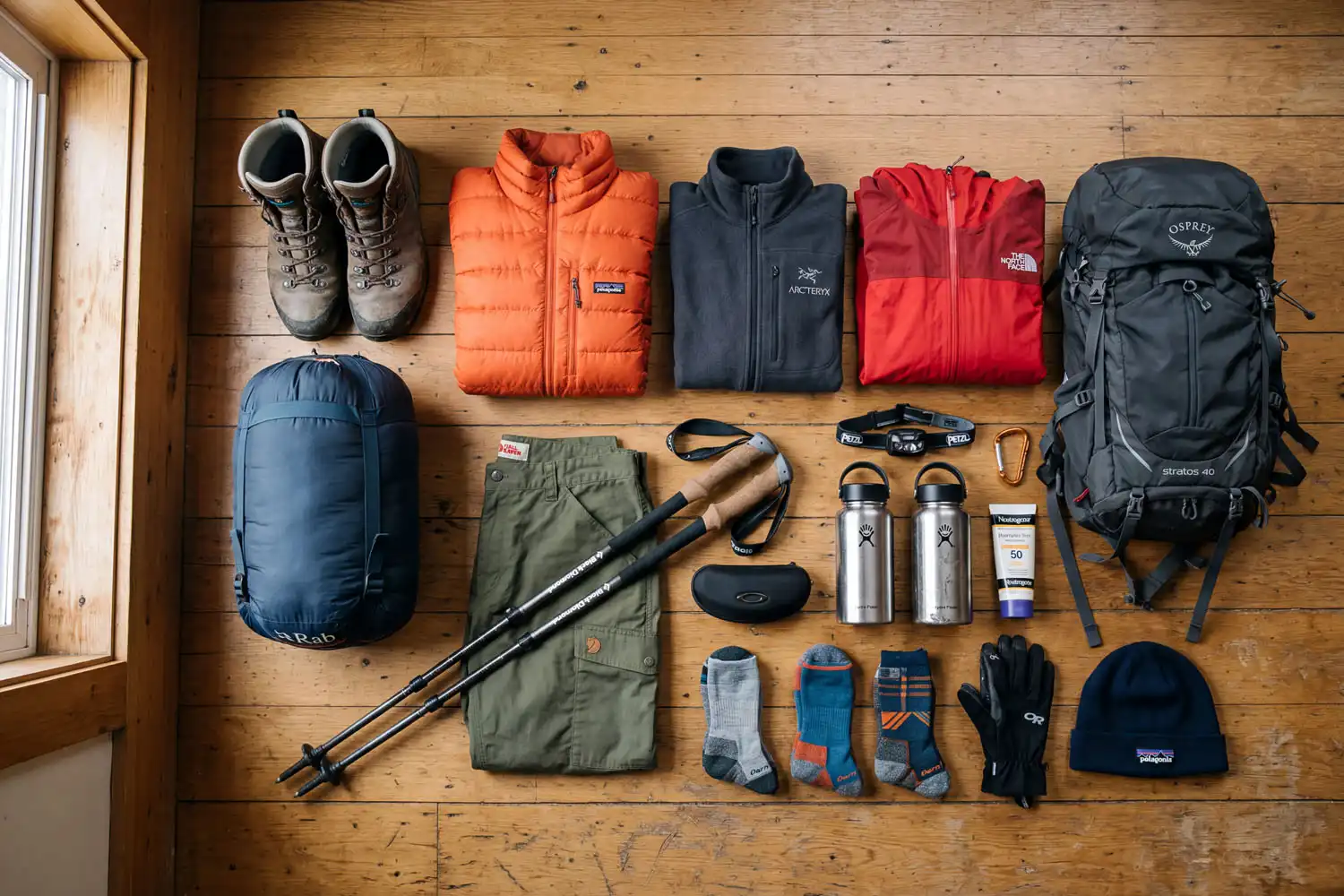
Pack light, layer smart, prioritize warmth and dry feet. Here’s the core kit:
- Footwear: broken-in waterproof hiking boots, three pairs of merino wool socks, lightweight camp shoes. If your boots are new, my notes on breaking in boots before a long trail save a lot of pain later.
- Clothing layers: moisture-wicking base, fleece mid-layer, insulated down jacket, waterproof shell, trekking pants, thermal bottoms, beanie, gloves, buff.
- Sleep system: sleeping bag rated to at least minus 15°C for EBC and Manaslu, minus 5°C for ABC.
- Daypack: 30 to 40 liters with rain cover (porter carries the duffel).
- Accessories: trekking poles, headlamp with spare batteries, two 1L water bottles, water purification tablets or a Sawyer-style filter, Category 3 or 4 sunglasses, SPF 50+ sunscreen, lip balm.
- First aid kit: blister care, ibuprofen, paracetamol, Diamox (after consulting your doctor), oral rehydration salts, antiseptic.
- Documents and cash: passport, visa, insurance proof, photocopies, and enough Nepali rupees for daily extras. ATMs disappear after Namche.
Most teahouses provide blankets, but they’re not enough above 4,000 meters. Bring your own sleeping bag, no exceptions.
How do you handle altitude sickness?
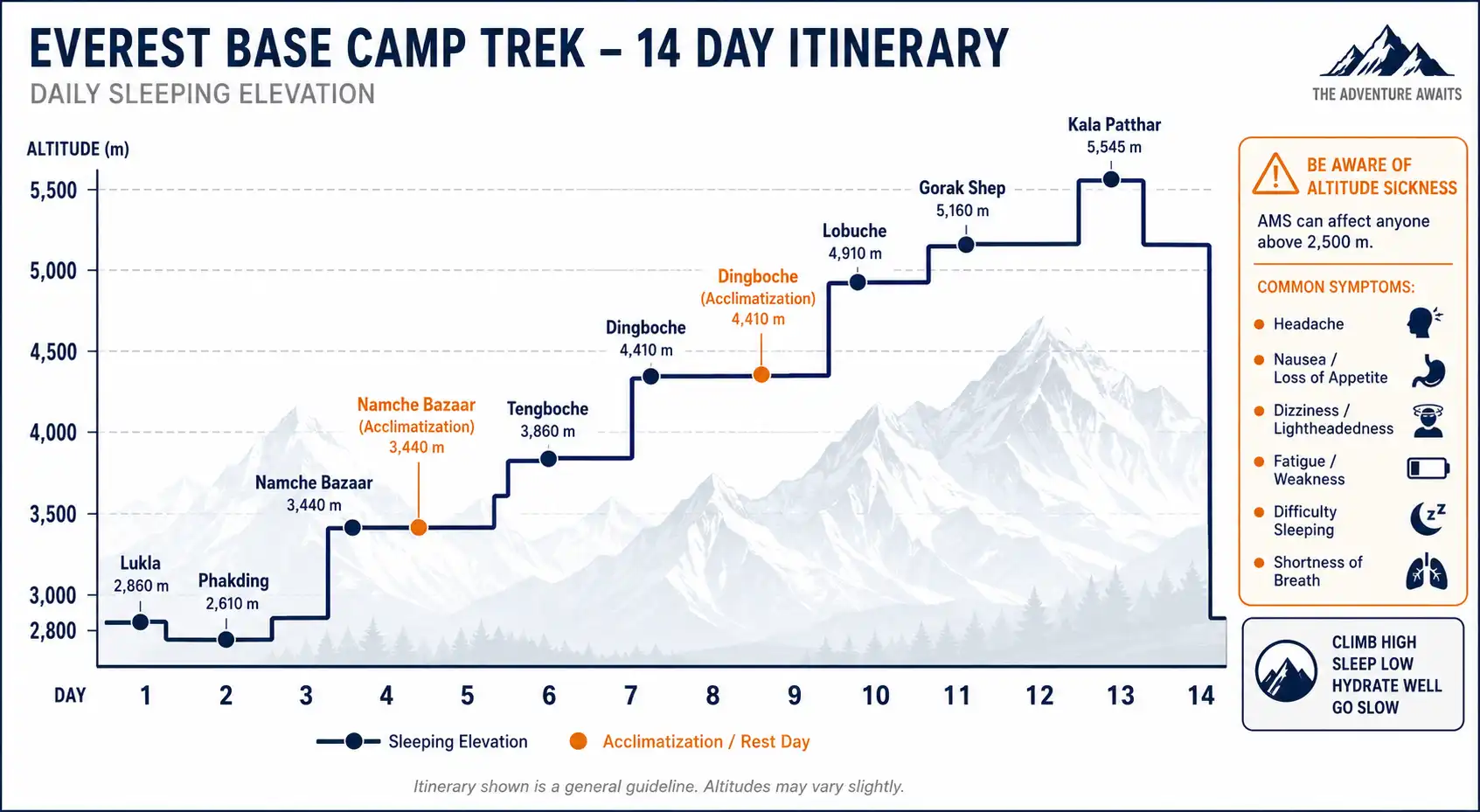
Altitude sickness is the single biggest reason trekkers turn back. The rule that has saved countless trips is “climb high, sleep low.” Gain no more than 300 to 500 meters of sleeping elevation per day above 3,000 meters. Build in acclimatization days at Namche (3,440 m) and Dingboche (4,410 m) on the EBC route, and at Machhapuchhre Base Camp (3,700 m) on the ABC route.
Warning signs of acute mountain sickness (AMS):
- Persistent headache that doesn’t respond to ibuprofen
- Nausea or loss of appetite
- Dizziness or confusion
- Shortness of breath at rest
- Trouble sleeping
If symptoms worsen, descend immediately. Don’t push higher. Severe forms (HACE and HAPE) can kill within hours. For full medical guidance, the CDC’s altitude illness page is the most reliable English-language source before your trip.
UV is also brutal above 4,000 meters. My write-up on picking sunscreen for high-altitude hiking explains why standard SPF isn’t enough.
What’s teahouse life actually like?
Teahouses are simple wooden lodges that serve food, hot drinks, and basic sleeping rooms. Most have a shared dining hall heated by a yak-dung or wood stove. Sleeping rooms are unheated. Walls are thin. Here’s what to budget for daily extras:
|
Item |
Lower Elevations |
Above 4,000 m |
|---|---|---|
|
Room (with meals at lodge) |
$3 to $5 |
$5 to $10 |
|
Dal bhat (set meal) |
$5 to $8 |
$8 to $12 |
|
Bottled water (1L) |
$1 to $2 |
$3 to $5 |
|
Hot shower |
$2 to $4 |
$4 to $6 |
|
Wi-Fi (per day) |
$2 to $3 |
$4 to $5 |
|
Device charging (per hour) |
$1 to $2 |
$3 to $5 |
A few field notes. Dal bhat (rice, lentils, vegetables, sometimes meat) usually includes free refills and is the best fuel for big days. Bottled water prices double after Namche, so a filter or tablets pay for themselves quickly. Cash is king, and ATMs in Namche cap out fast in peak season, so bring rupees from Kathmandu or Pokhara.
How much does base camp trekking in Nepal actually cost in 2026?
Realistic 2026 ranges, fully inclusive of licensed guide, porter, permits, teahouse lodging, food on trail, and domestic transport. International flights, visa, gear, tips, and insurance are extra.
|
Trek |
Budget Package |
Standard Package |
Premium Package |
|---|---|---|---|
|
Everest Base Camp (14 days) |
$1,200 to $1,500 |
$1,800 to $3,000 |
$3,000 to $5,000+ |
|
Annapurna Base Camp (10 days) |
$500 to $900 |
$900 to $1,500 |
$1,800+ |
|
Manaslu Circuit (16 days) |
$1,400 to $1,800 |
$1,800 to $2,800 |
$3,500+ |
|
Makalu BC (20 days) |
$1,800 to $2,500 |
$2,500 to $3,500 |
$4,500+ |
|
Kanchenjunga BC (24 days) |
$2,500 to $3,500 |
$3,500 to $5,000 |
$5,500+ |
Premium tiers usually include helicopter exits, upgraded lodges, and private guiding. A one-way Manthali to Lukla flight ticket runs about $177 per person, and most packages include this. Travel insurance with high-altitude evacuation coverage above 5,500 meters is non-negotiable, and reputable agencies require proof. My overview of what adventure travel insurance actually covers helps you compare policies before booking.
What does a sample EBC itinerary look like?
A standard 14-day Everest Base Camp itinerary:
- Kathmandu to Lukla (via Manthali in peak season), trek to Phakding (2,610 m).
- Phakding to Namche Bazaar (3,440 m).
- Acclimatization day in Namche.
- Namche to Tengboche (3,860 m).
- Tengboche to Dingboche (4,410 m).
- Acclimatization day in Dingboche.
- Dingboche to Lobuche (4,940 m).
- Lobuche to Gorak Shep (5,164 m), then push to EBC (5,364 m), back to Gorak Shep.
- Kala Patthar (5,545 m) sunrise, descend to Pheriche.
- Pheriche to Namche.
- Namche to Lukla.
- Fly Lukla to Manthali, drive to Kathmandu.
- Buffer day in Kathmandu (essential for weather delays).
- Departure.
Always build in at least one buffer day. Lukla flights cancel often, and missing your international connection because of weather is preventable.
What does a sample ABC itinerary look like?
A standard 10-day Annapurna Base Camp itinerary:
- Kathmandu to Pokhara (drive or fly).
- Pokhara to Nayapul, trek to Tikhedhunga.
- Tikhedhunga to Ghorepani (2,860 m).
- Poon Hill sunrise, trek to Tadapani.
- Tadapani to Chhomrong (2,170 m).
- Chhomrong to Dovan.
- Dovan to Machhapuchhre Base Camp (3,700 m).
- MBC to Annapurna Base Camp (4,130 m), return to Bamboo or Sinuwa.
- Bamboo to Jhinu Danda (hot springs), drive to Pokhara.
- Pokhara to Kathmandu.
What mistakes do first-time trekkers make?
A few patterns repeat trip after trip:
- Skipping acclimatization days. Trekkers in a hurry are the trekkers who get evacuated.
- Underestimating cold above 4,000 m. Sleeping bags rated to 0°C are useless above Dingboche.
- Cotton clothing. It soaks and chills you. All layers should be synthetic or wool.
- Buying boots in Kathmandu. Brand-new boots on the trail mean blisters and a ruined trip. My notes on preventing trail blisters cover what actually works.
- Cheap insurance without altitude coverage. Standard travel insurance often caps at 4,500 meters. EBC needs coverage to at least 6,000 meters.
- Forgetting to budget for tips. Guides typically expect $10 to $15 per day, porters $7 to $10 per day, from the group total.
- Bottled water on every day. Plastic waste in the Himalayas is a real problem. Bring a filter.
- Ignoring jet lag. Flying into Kathmandu and starting the trek next day slows acclimatization badly.
FAQs on Everest Base Camp Trekking in Nepal

Can you trek to Everest Base Camp without a guide in 2026?
Is base camp trekking in Nepal safe?
How much does the Lukla flight cost in 2026?
Can beginners do Everest Base Camp?
What's the best month to trek?
Final thoughts
Nepal’s base camp treks reward preparation more than raw fitness. The 2026 rules favor properly organized trips: licensed guide, registered agency, full insurance, and real acclimatization days. Pick the right season, respect the altitude, pack what you actually need, and add buffer days for Lukla delays. Whether you choose EBC for the bucket-list moment or ABC for a friendlier first taste, the Himalayas deliver every time. Plan well, walk slow, and the trail will take care of the rest.