Can You Bring Hiking Poles on a Plane? TSA and Airline Rules

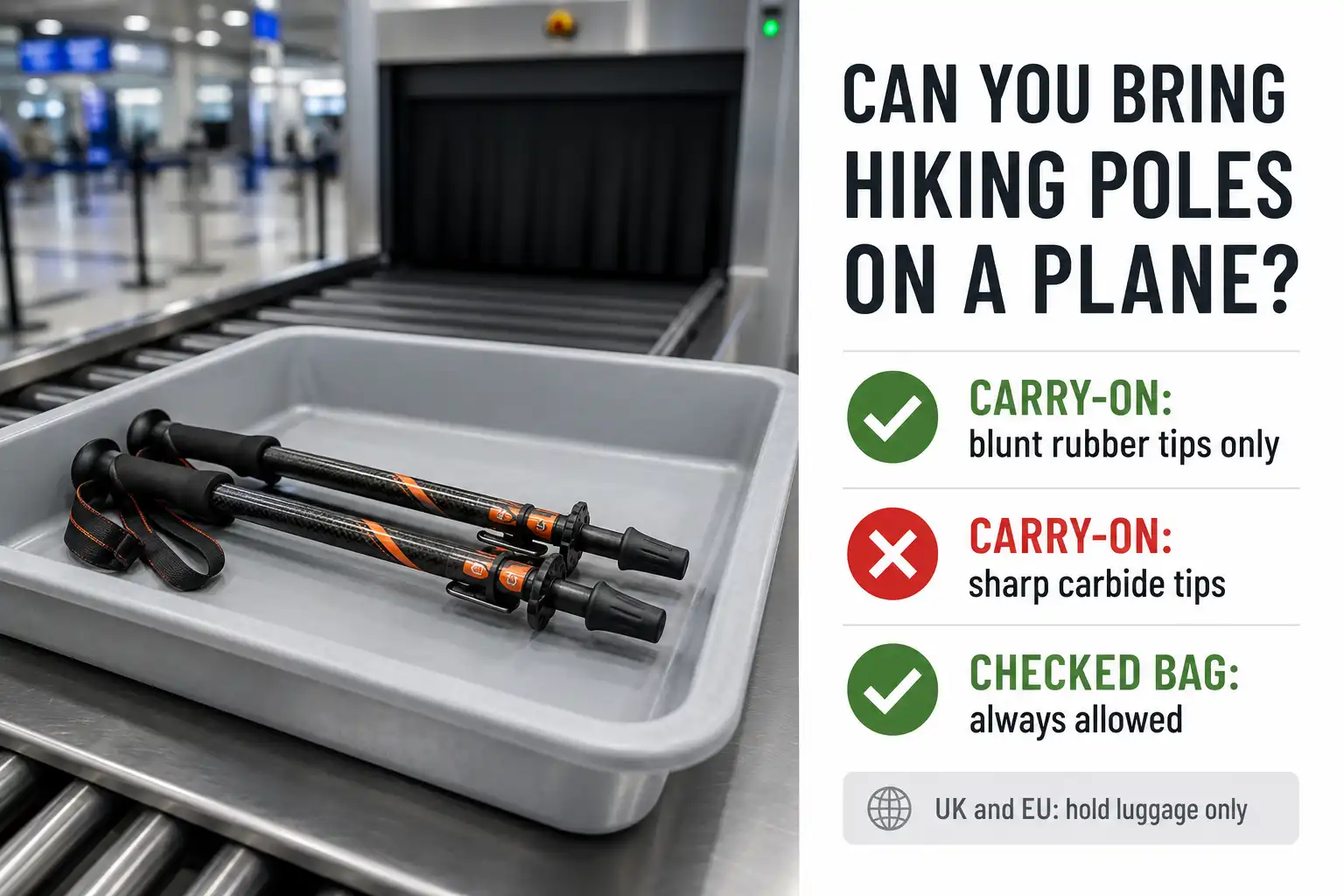
Flying with trekking poles confuses a lot of hikers, mainly because the rules changed and most articles never caught up. I fly with poles regularly, both inside Bangladesh and overseas. Below is what actually happens at the checkpoint, plus how to pack so you keep every piece.
Yes, you can bring hiking poles on a plane. In the United States, TSA allows blunt-tipped poles in carry-on and checked bags, while sharp-tipped poles must go in checked baggage. Most other countries, including the UK, keep all hiking poles out of hand luggage. Checked baggage works everywhere.
What does the TSA say about hiking poles?
TSA allows blunt-tipped hiking poles in carry-on and checked bags, and it does not allow sharp-tipped poles in the cabin. Officers screen your poles like any other property. However, the officer at the checkpoint makes the final decision, even for items the rule permits. TSA also tells travelers to confirm with the airline, since airlines set their own cabin bag limits.
That wording matters more than people realize. The current rule turns on the tip, not on the pole itself. So a pair with rounded rubber feet has a fair chance in the cabin, while a pair with exposed carbide spikes does not.
Two limits are worth remembering. First, TSA rules apply only at TSA checkpoints, so your flight home from another country falls under a different agency. Second, clearing security does not oblige the airline to accept your poles in the cabin. Both parties have to agree before your poles ride with you.
What counts as a blunt tip?
A blunt tip ends in a rounded surface with no point, almost always a rubber or elastomer foot. Sharp tips are the exposed steel or carbide spikes that bite into rock, ice, and hard clay. Most poles ship with both, since the spike is permanent and the rubber cap slides over it.
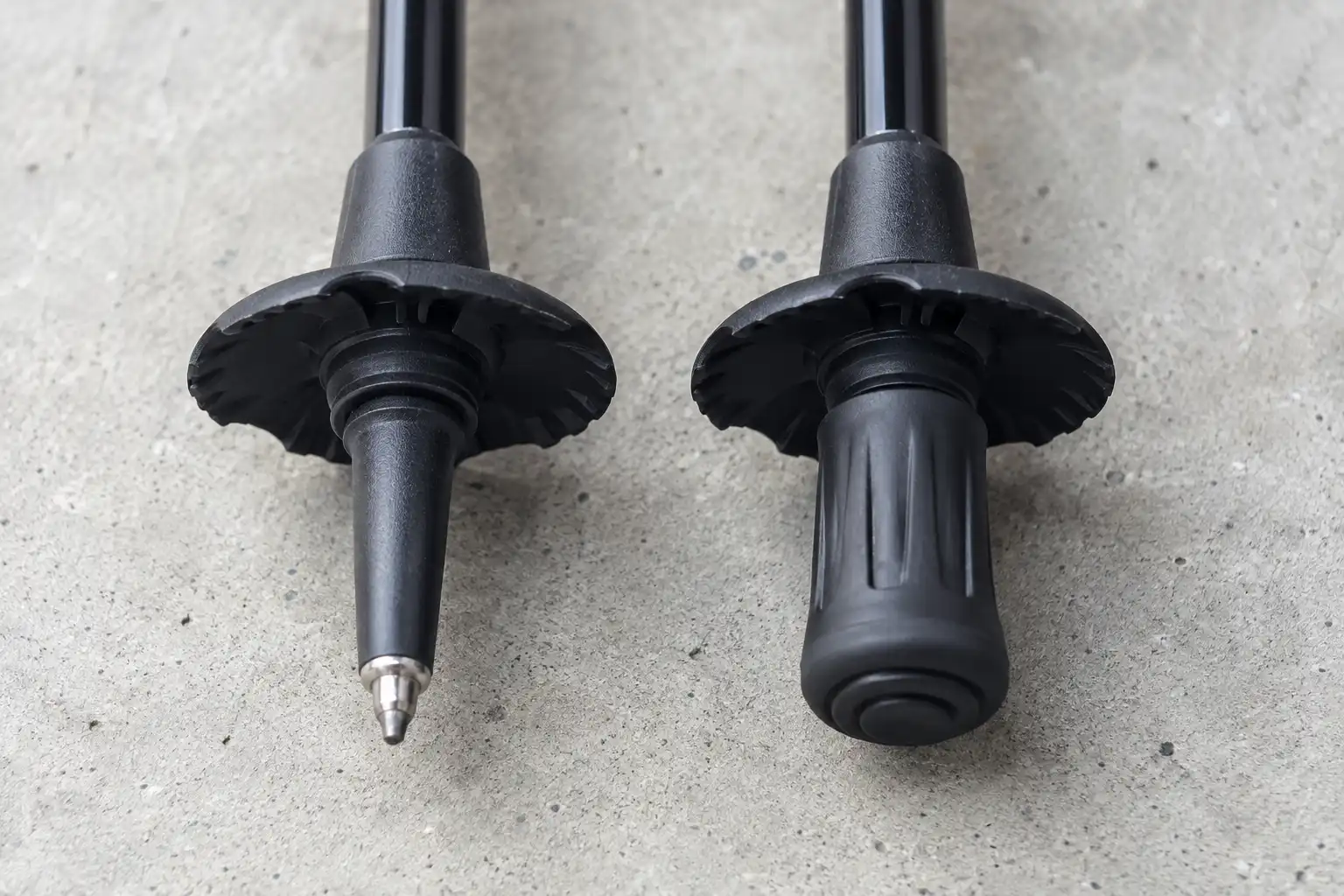
That combination sits in a gray area. Plenty of hikers push the rubber caps on and present the poles as blunt. Sometimes it works. Officers also know the cap pops off in a second, though, so many of them still send the poles to the hold.
Here is the practical read. Poles with permanently rounded feet are the only ones I would count on for the cabin. Anything with a spike underneath deserves a backup plan, because you may be told to check it after you have already cleared the bag drop.
Do folding poles get treated differently?
No. Folding and telescoping designs change how small your poles pack, not whether security accepts them. A Z-fold pole that collapses to roughly 13 to 16 inches carries the same tip as a long telescoping model, therefore it faces the same call at the belt.
Folding still helps in two ways. First, short sections fit inside a normal bag instead of sticking out past the frame. Second, poles packed inside your luggage travel better than poles strapped to the outside, where straps snag on conveyor belts and tips catch on other bags.
If you fly often and you are still deciding whether poles earn their place in your kit, my longer look at whether poles are worth carrying covers the trade-offs on the trail rather than at the airport.
Can you fly with hiking poles outside the United States?
Usually not in the cabin. Rules differ by country, so check the security agency for every airport where you pass through screening, not only your departure city. Connecting flights catch people out constantly.
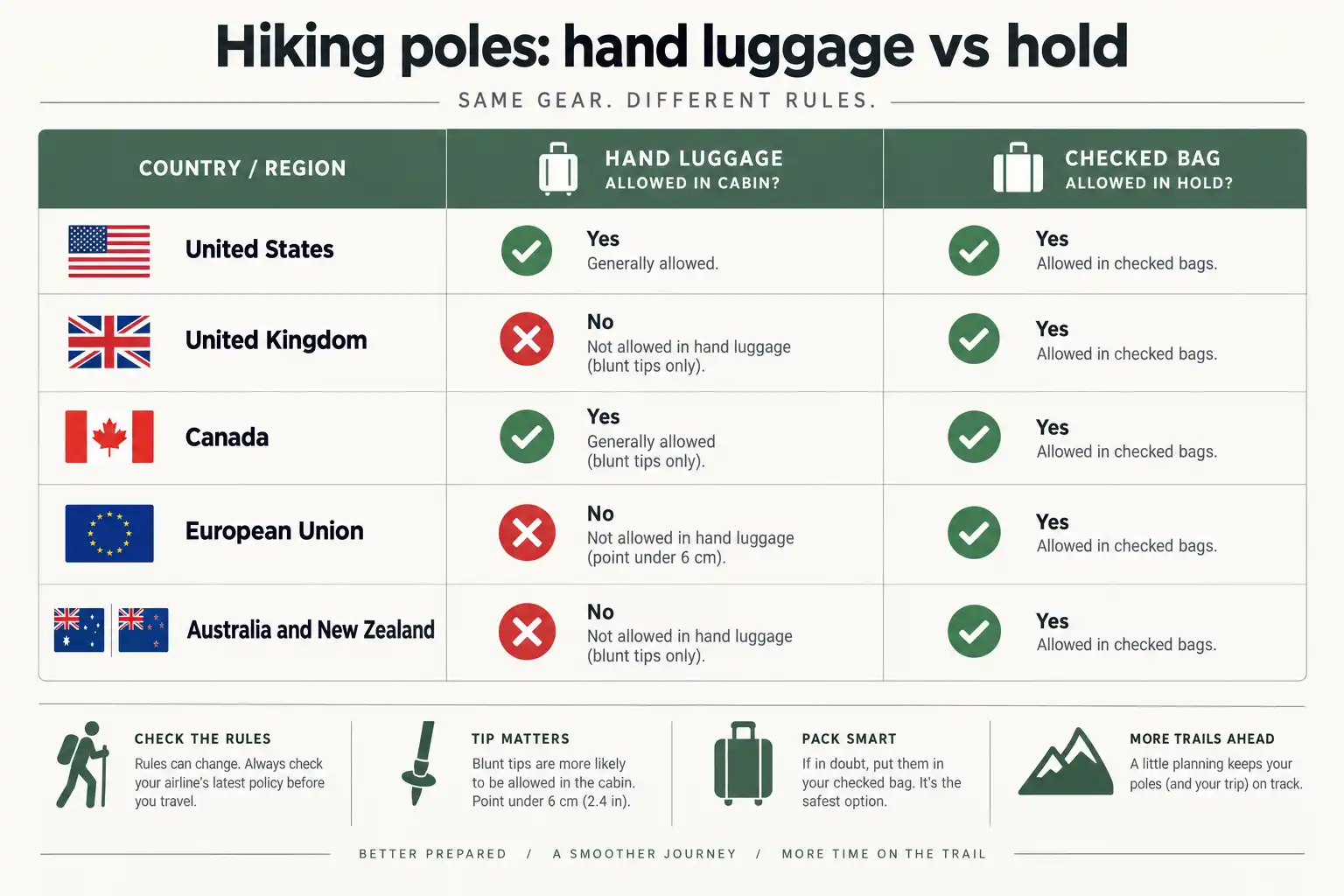
| Country or region | Hand luggage | Checked baggage |
|---|---|---|
| United States (TSA) | Blunt tips yes, sharp tips no | Yes |
| United Kingdom (official hand luggage list) | No | Yes |
| Canada (CATSA) | Yes, unless the pointed end measures more than 6 cm | Yes |
| European Union | Not named in the rules, refused at most airports | Yes |
| Australia and New Zealand | Usually refused as sporting equipment | Yes |
The UK is the clearest of the group. Its government hand luggage list puts walking and hiking poles in the hold only, with no exception for folding models. Canada reads the opposite way, because CATSA permits hiking sticks and poles through the checkpoint unless the pointed or sharp end runs longer than 6 cm.
European rules never name hiking poles directly. As a result, each airport applies its own judgment under the blunt instrument category, and most refuse them. Therefore I check my poles on every European itinerary and skip the argument.
What if you use poles as a mobility aid?
Then the rules shift in your favor. Canes and similar mobility aids travel in the cabin after screening, and US regulations require airlines to allow assistive devices on board without counting them toward your carry-on limit. If a device cannot fit in the cabin, the airline must stow it in the hold ahead of other baggage.
Please do not fake this, though. Staff can ask about your need for the aid, and officers keep full discretion to refuse. Claiming a disability you do not have also insults the passengers who depend on that rule.
Genuine need is a different matter. After a bad descent in the Bandarban hills years ago, I flew home leaning on one pole because my knee would not take stairs. Nobody questioned it, since the use was obvious. If you deal with recurring joint pain, my notes on protecting your knees on descents explain how much a pole actually offloads.
How should you pack hiking poles in checked baggage?
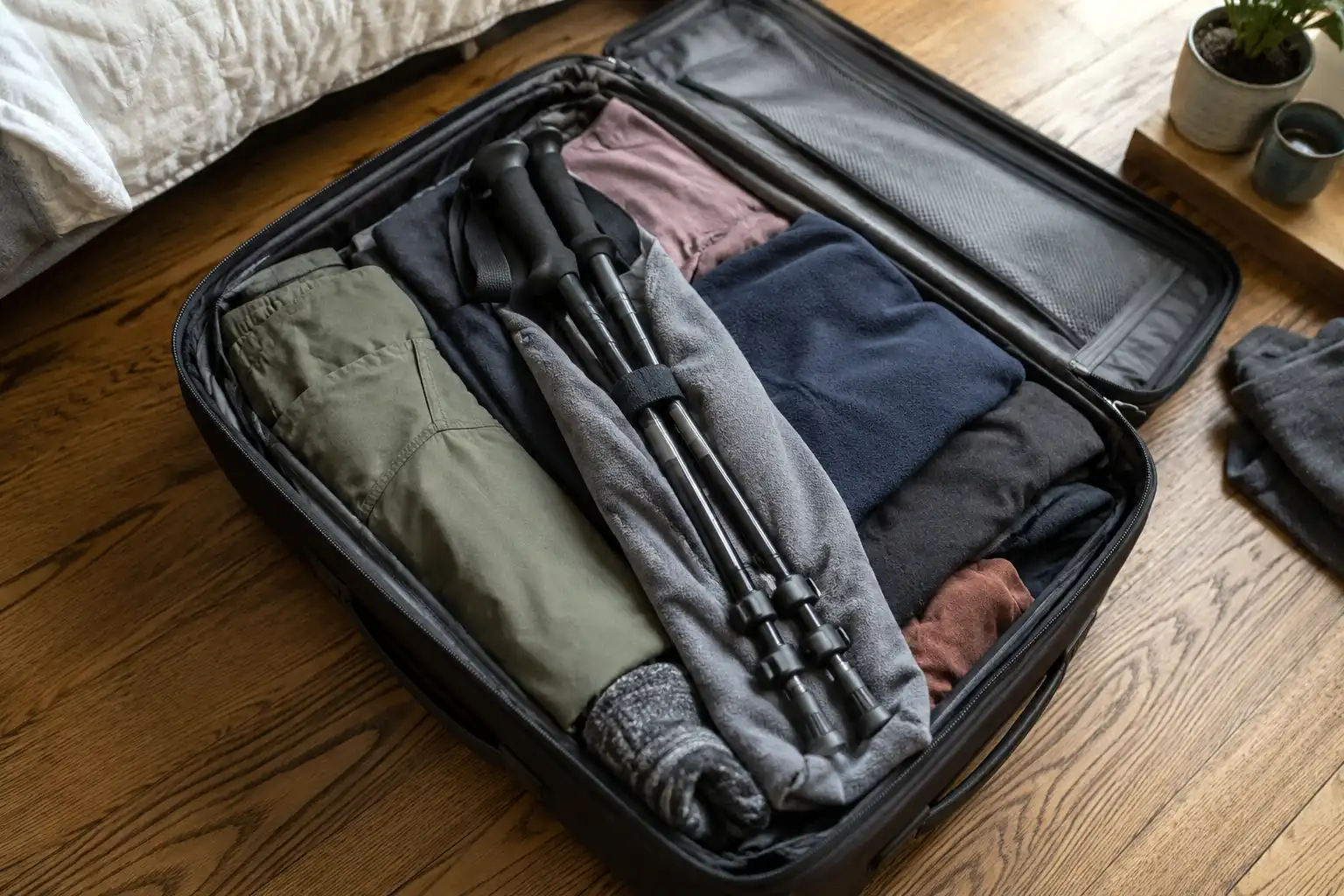
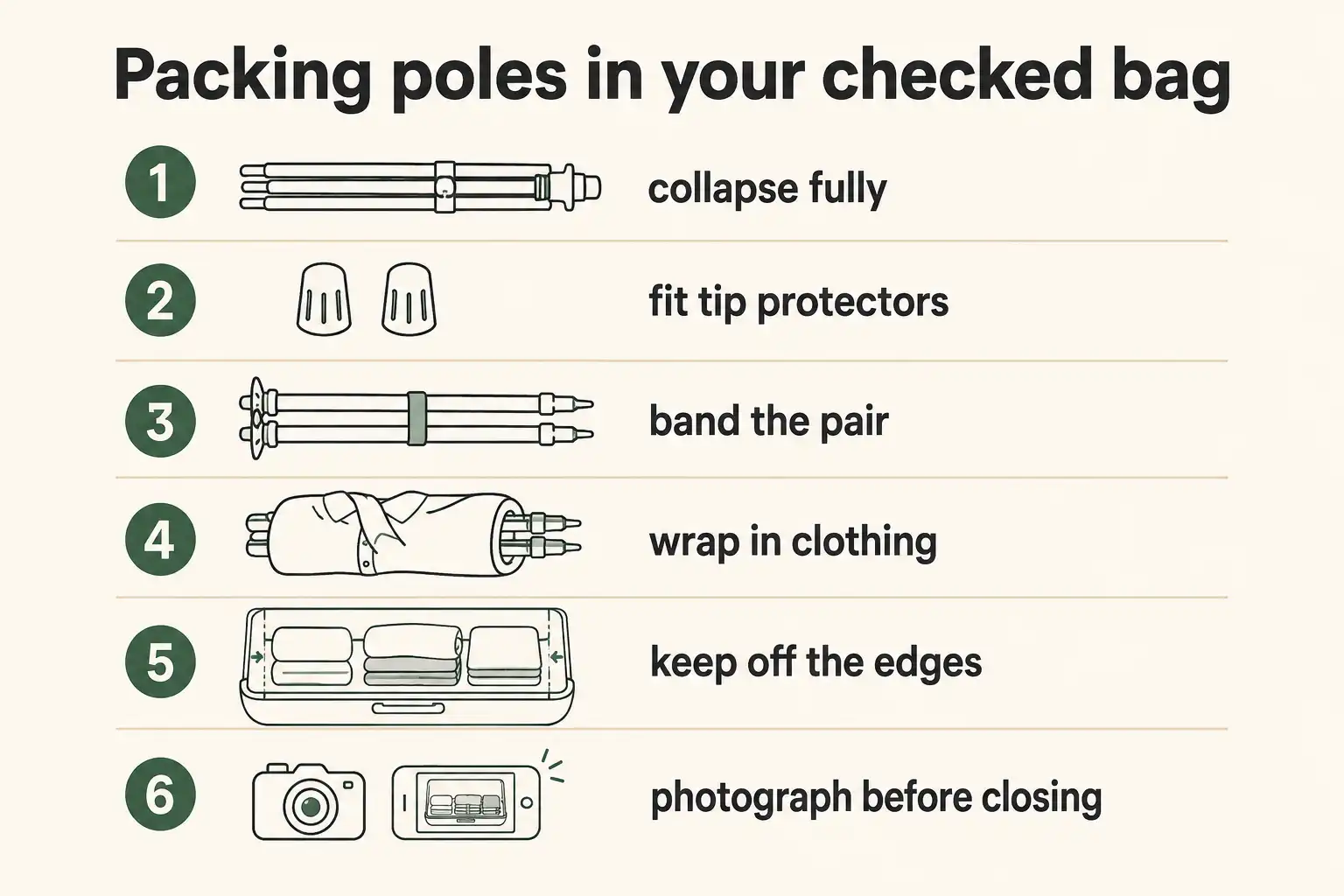
Pack them inside your main bag, not strapped to the outside. Handlers tear loose gear off in transit, and airlines rarely pay for items you attach externally. Flights also punish gear differently than road trips do, a difference I break down in my notes on packing for a flight rather than a drive. Follow these steps and your poles arrive intact.
- Collapse them fully. Telescoping poles drop to roughly 24 to 28 inches, while Z-fold poles reach about 13 to 16 inches.
- Fit the rubber tip protectors. Bare carbide punches through fabric, so cap every tip before packing.
- Band the pair together. A velcro strap or hair tie stops the sections from working loose and rattling apart.
- Wrap them in clothing. Roll a fleece or trousers around the shafts, then lay the bundle along the center of the suitcase.
- Keep them off the edges. Corners take the hardest hits, so the middle of the bag is safest.
- Photograph them before you close the bag. A dated photo makes a damage claim far easier.
Shaft material also changes how poles survive rough handling. Aluminum tends to bend and stay usable, whereas carbon stays lighter but can crack after a sharp impact. So if you own carbon poles, give them extra padding.
Which poles handle air travel best?
Four or five section folding poles handle flights best, simply because they disappear inside a carry-on. My travel pair folds short enough to sit under my clothes with room to spare, which removes the whole question of oversize charges.
Length limits rarely bite once you fold the poles. Most airlines accept a standard checked bag well beyond any collapsed pole, and folded poles sit inside that envelope easily. Fixed-length poles are the exception, since a rigid 51 inch shaft can trigger oversize handling or refusal outright.
Cork or foam grips also matter for a different reason. Both absorb sweat, so wash and dry them before packing, otherwise your clothes smell like last week’s trail. Runners weighing similar choices can compare notes in my guide to choosing running poles that hold up.
What happens if security stops you at the checkpoint?
You get two options, and neither is fun. Either you walk back to the check-in counter and check the bag holding your poles, or you surrender the poles and fly without them. Baggage fees and a fresh security queue come with the first choice.
Timing decides how painful this gets. Therefore I keep 30 extra minutes in the plan whenever poles ride in my carry-on. Some larger airports also run a mailing counter, so shipping the poles home stays possible if you have time to spare.
Stay polite either way. Arguing with an officer has never once changed an outcome for me, while a calm question about checking the bag often gets a helpful answer. For a wider look at the gear security pulls most often, see my rundown of items that cannot fly in your camping kit.
Do you need to declare hiking poles at customs?
Sometimes yes, and this step trips up more hikers than security does. New Zealand requires you to declare equipment used for outdoor activities, including camping and hiking gear, because soil carries pests and disease. Australia asks travelers to clean and dry all hiking and camping equipment used overseas, and officers may inspect it on arrival.

Dried mud in the baskets and around the tips is exactly what inspectors look for. So scrub the lower sections with a brush, rinse them, then dry them completely before you pack. Declaring gear costs you nothing, while failing to declare it can cost you a fine.
Kaptai clay taught me this the hard way. That soil sets like cement in the pole baskets, and it takes real scrubbing to shift. Now I clean my poles the night before any international flight, and I pack them near the top so an inspection takes two minutes. Anyone planning a first trip abroad should also read up on the paperwork and gear that international hikes require.
FAQs about TSA rules and packing guide

Are hiking poles allowed in carry-on bags in the United States?
Do airlines charge extra for hiking poles?
Can I keep the carbide tips in my carry-on and check the poles?
What if my connecting airport is stricter than my departure airport?
Should I just buy poles at my destination?
Conclusion
Poles fly fine once you know which rule applies. Check them if the tips are sharp, if your route touches the UK or Europe, or if you simply want zero hassle at the belt. Carry them only when the feet are permanently blunt and you can absorb a last-minute check. Clean the tips before any international flight, pack them inside your main bag, and confirm your airline’s cabin rules the week before you fly. Small steps, and your poles land with you.