Nafakhum Waterfall Trip: Route, Costs, and Tips That Save Money

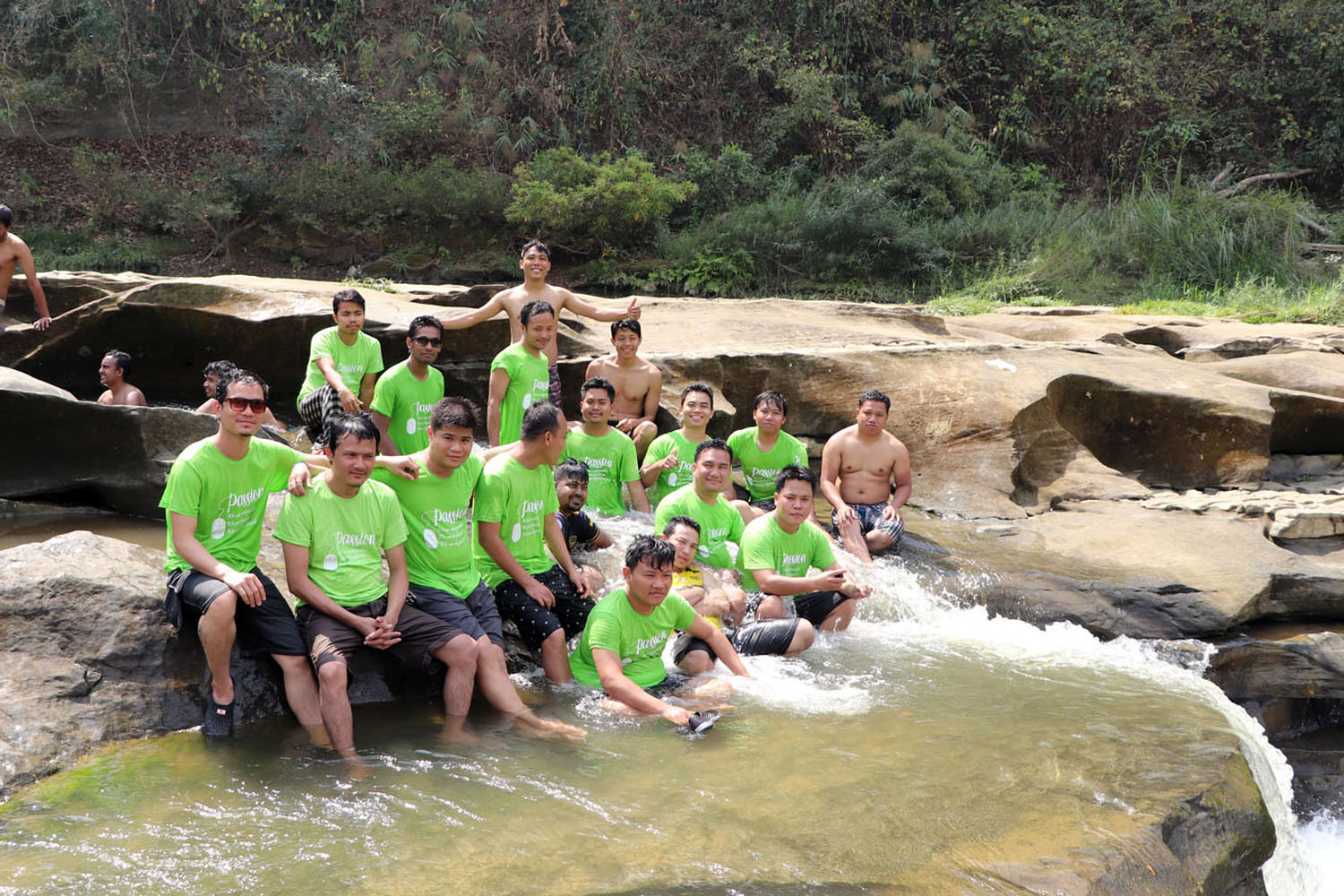
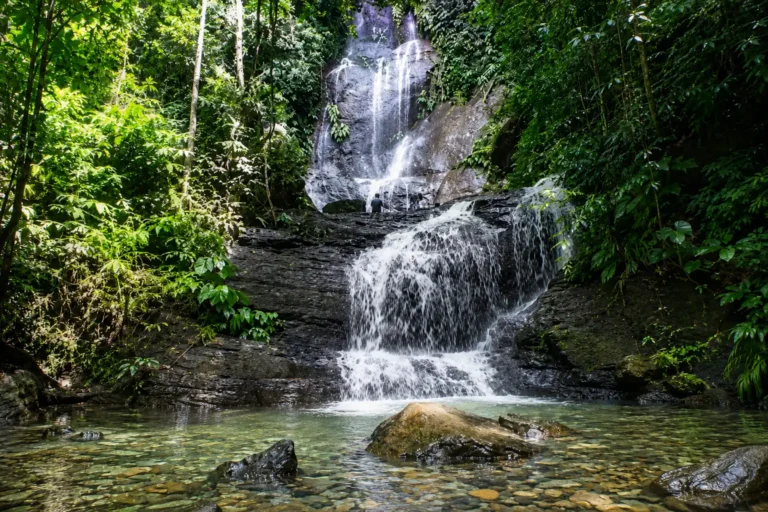
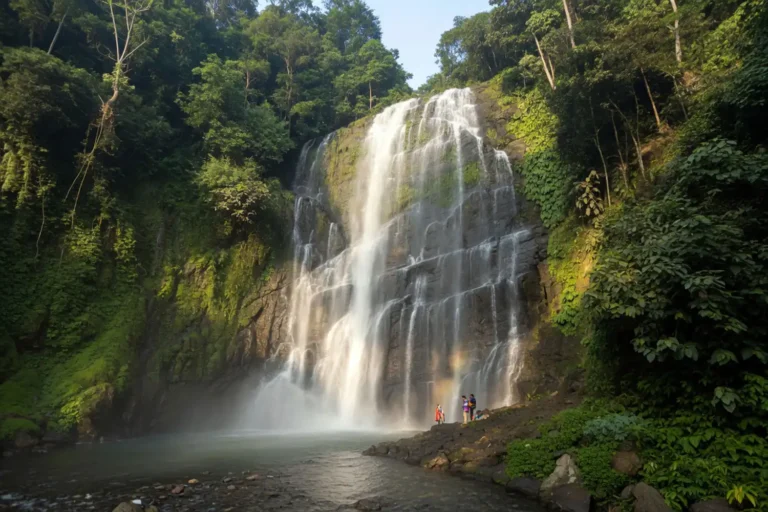
Nafakhum Waterfall (Bengali: নাফাখুম) is a natural waterfall located in Remakri union, Thanchi Upazila, Bandarban, Bangladesh. The waterfall cascades 25–30 feet down the rocky Remakri River into a stunning pool below. Known as the “Niagara of Bangladesh,” Nafakhum is one of the most breathtaking destinations for adventure lovers and nature seekers.
How to Reach Nafakhum Waterfall:
- Travel from Dhaka to Bandarban by bus or train
- Take a bus from Bandarban to Thanchi
- Hire an engine boat from Thanchi up the Sangu River to Remakri
- Trek 2–3 hours along the Remakri canal to reach the falls
A licensed guide is mandatory for all visitors. The best time to visit Nafakhum Waterfall is September through November.
What Makes Nafakhum Waterfall Special
Nafakhum is one of the biggest waterfalls in Bangladesh by water volume. Locals sometimes call it the Niagara of Bengal, which sets the bar high, yet the place still earns the nickname when the canal runs full. The falls sit in Remakri Union, inside Thanchi Upazila of Bandarban district. Remakri itself is home to Marma families, and in the Marma language the word khum simply means waterfall.
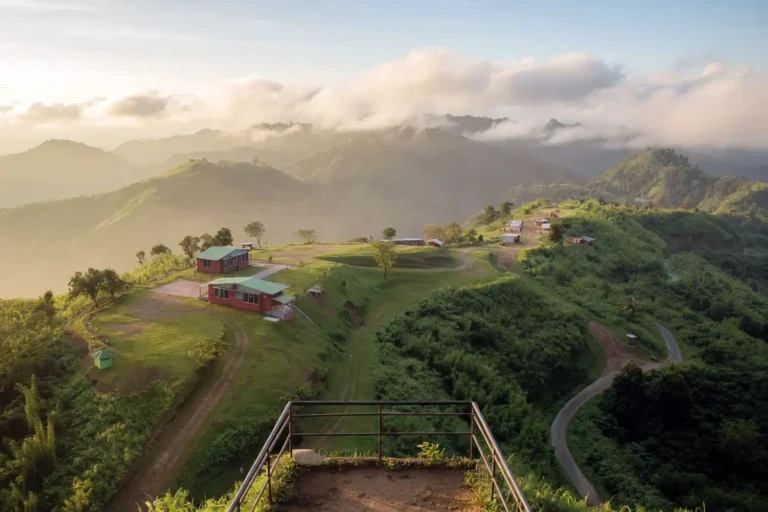
The water comes down the Remakri canal, bends sharply, and drops roughly 25 to 30 feet over a rock shelf. Spray hangs in the air below, so on a clear day you often catch a rainbow flickering across the mist. I grew up in the hills of Rangamati, not far from here, and Bandarban’s backcountry still surprises me every time. So if you love trekking, want to see deep green ridges, meet indigenous communities, and watch the Sangu shift from calm to fierce, this trip belongs on your list.
See more: Nepal Base camp trekking
When Is the Best Time to Visit Nafakhum?
The best window runs from September to November, right after the monsoon and before deep winter. During heavy monsoon, the Sangu often rises above the danger level, and the administration then stops issuing travel permission for safety reasons. In winter, on the other hand, the water at the falls drops a lot, so the cascade looks thin. Travelers still visit all year round, and the scenery rarely disappoints. Those autumn months simply give you the best mix of strong water flow and safe river conditions.
Complete Travel Guide to Nafakhum Waterfall
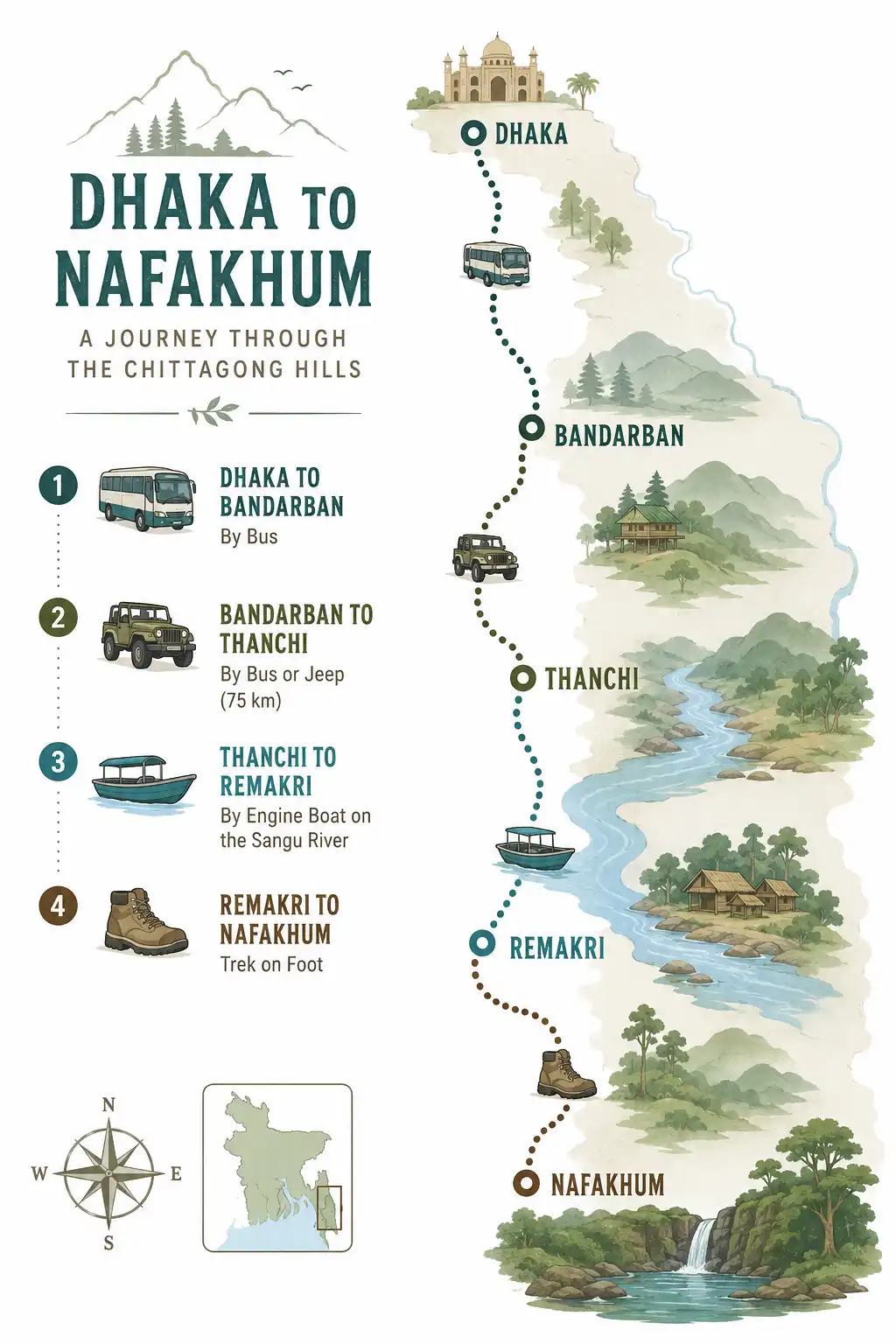
Reaching Nafakhum waterfall is a staged trip, not a single ride. First you reach Bandarban town. After that you go Bandarban to Thanchi, then by boat up the Sangu to Remakri Bazaar, and finally on foot to the falls. Below I break down each leg with rough fares so you can budget ahead.
A quick note on money: every price here is in Bangladeshi taka and reflects typical local rates. Fares also shift with fuel costs, season, and public holidays, so treat these as ballpark figures rather than fixed quotes.
Getting to Bandarban from Dhaka or Chittagong
From Dhaka, several coach operators run overnight buses to Bandarban, including Hanif, Shyamoli, Saudia, S. Alam, Unique, Saint Martin, and Dolphin, among others. Non-AC seats usually cost around 800 to 900 taka per person, while AC coaches run roughly 1,200 to 1,800 taka. If you prefer the train, you can ride from Dhaka to Chittagong first, then continue to Bandarban by road. Trains such as the Parjatak Express, Cox’s Bazar Express, Sonar Bangla, Suborno, and Mohanagar serve the Chittagong route, with fares between about 405 and 1,398 taka depending on class.
From Chittagong, head to the Bahaddarhat bus station, where Pubali and Purbani buses leave for Bandarban at around 220 taka per person. You can also catch a bus from the Dampara stop nearby. For more comfort, a rented microbus from Chittagong to Bandarban costs somewhere between 3,000 and 3,500 taka.
Bandarban to Thanchi
Bandarban to Thanchi covers about 75 kilometers, and you have two options: a local bus or a reserved jeep. Local buses leave the Thanchi bus stand in Bandarban roughly every hour. A seat costs around 250 to 280 taka per person, and the ride takes four to five hours on winding hill roads. Reserved jeeps, often called Chander Gari, run about 5,500 to 6,000 taka and cut the trip to three or three and a half hours. One jeep seats twelve to fourteen people comfortably, so splitting the cost is easy. Along this stretch you pass Milonchori, Chimbuk, and Nilgiri, and the ridgeline views keep your eyes busy the whole way.
Thanchi to Remakri by Boat
At Thanchi, you must hire a guide before going any further. No one travels to Nafakhum waterfall without one, and only guides approved by the upazila administration can take you. The guide fee runs about 1,500 taka and covers the trip until you return to Thanchi the next day. You can arrange a guide on arrival, or line one up in advance if you already know someone reliable.
Once you have a guide, you need permission from the Thanchi BGB camp and police station. Every member of the group writes down their name, address, phone number, destination, and length of stay, and your guide helps you handle this paperwork. Keep one rule in mind: after 3 PM, officials stop allowing boats to leave for Remakri. So if you want to reach Remakri the same day, plan to be in Thanchi by 2 PM. Otherwise you stay the night in Thanchi and head out the next morning, which adds a full day to your trip.
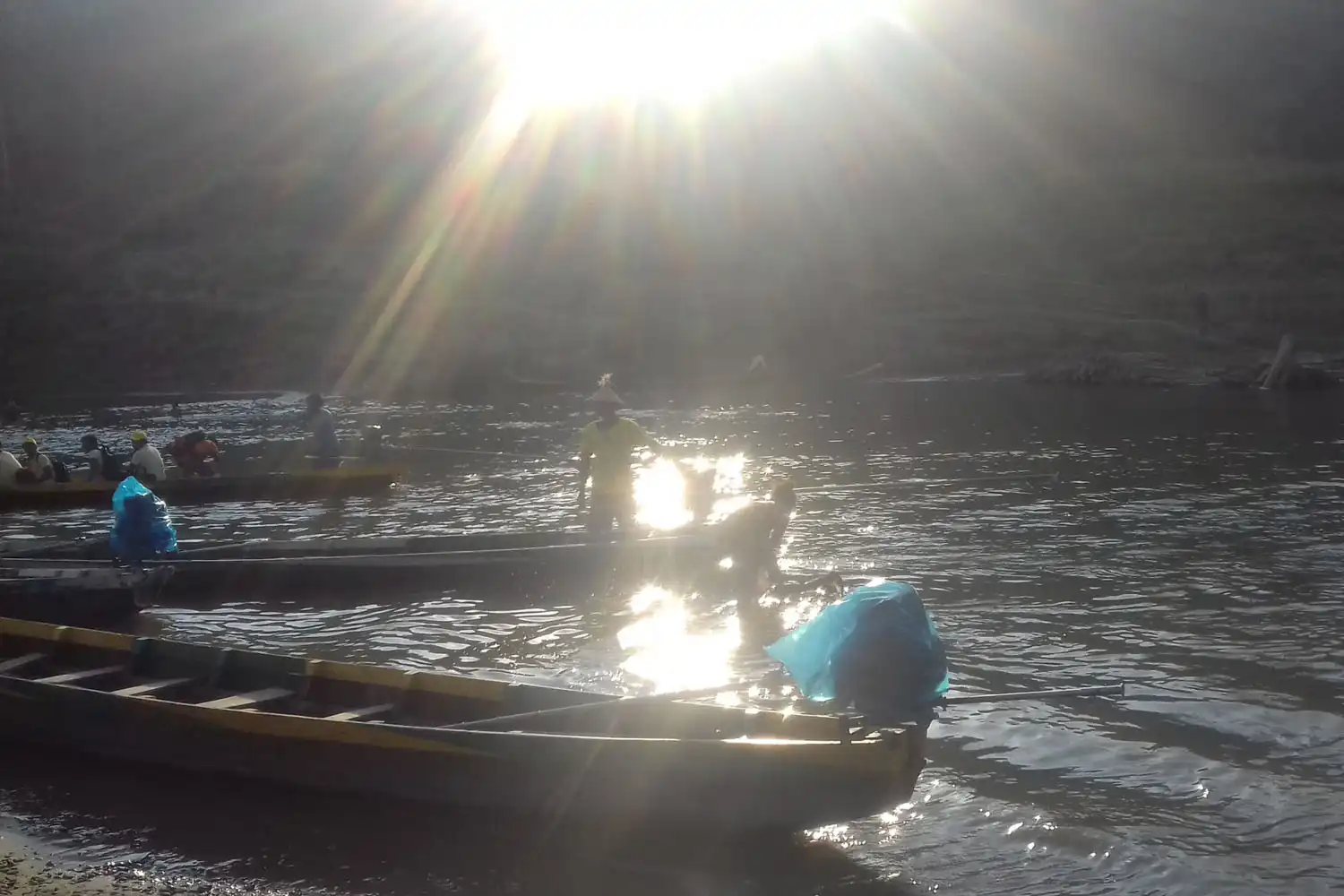
After clearing permission, you rent a small engine boat at the Thanchi ghat. Each boat carries four to five people. A reserved boat to Remakri and back the following day costs about 4,000 to 5,000 taka, and the journey takes two to two and a half hours. When the Sangu runs low, you sometimes step out and walk past shallow stretches, which stretches the time a bit. The river itself steals the show, and along the way you pass Padmamukh, the famous Tindu area, the Rajapathor and big-boulder zone, and Remakri Falls. Remember that you also cover your guide’s transport, food, and lodging.
Remakri to Nafakhum Waterfall on Foot
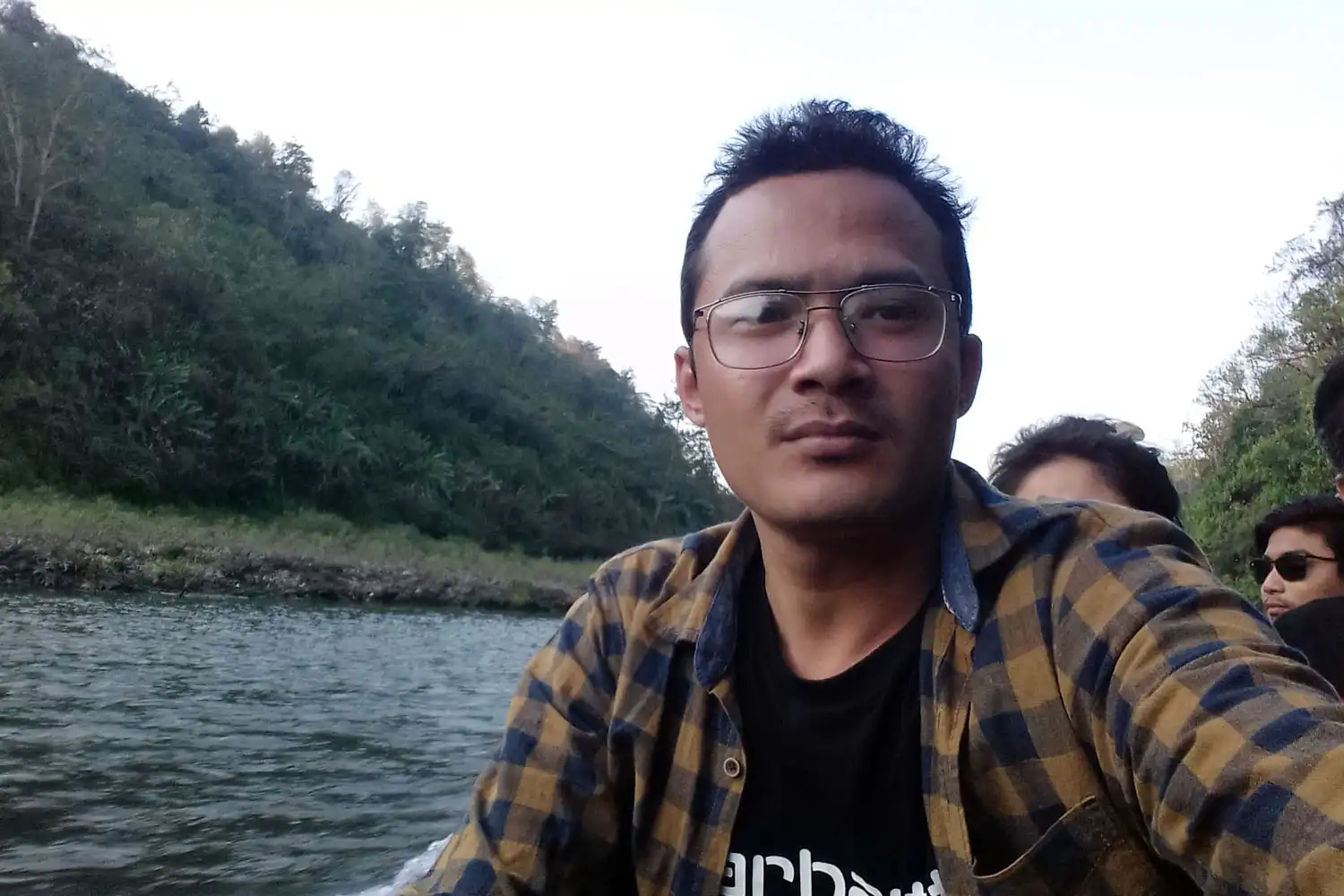
If you leave Bandarban early in the morning, you usually reach Remakri by late afternoon, too late to push on to the falls that day. So you spend the night at Remakri Bazaar and start the final leg the next morning. At Remakri, you pick up a second local guide for about 500 taka, and your Thanchi guide arranges this for you. From the village, you follow the Remakri canal on foot, and the walk to Nafakhum waterfall takes two to three hours.
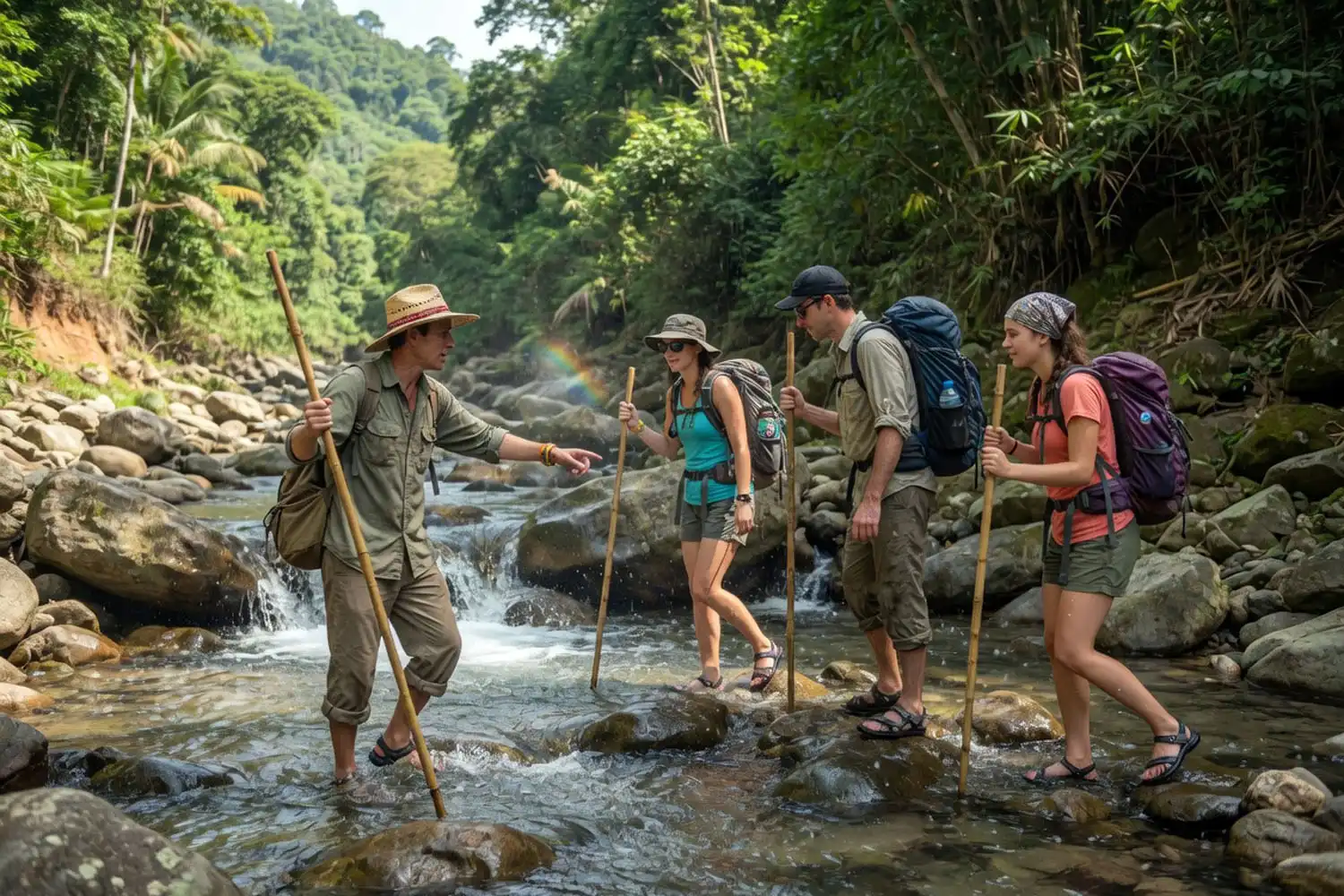
How long it actually takes depends on your group’s pace and the season. During monsoon, the canal carries a lot of water, sometimes waist deep or higher, and you cross from bank to bank in several spots. When the water sits high, those crossings slow you down. Your guide steers you through the tricky parts, so there is no need to worry. Then, somewhere along the canal, you catch the first low roar of the falls, and the last stretch flies by.
Where to Stay Near Nafakhum Waterfall
You have decent options in both Thanchi and Remakri. In Thanchi, for example, the BGB-run Border Holiday Center is the most comfortable choice, with rooms between 1,500 and 3,000 taka. Around Thanchi bazaar you also find simple cottages and rest houses charging roughly 1,000 to 2,000 taka per night, depending on quality. At Remakri, meanwhile, you sleep in indigenous homes, and a shared spot in a Marma rest house beside the Sangu costs only about 150 taka per person. The night I spent in a Remakri home was basic but warm, and falling asleep to the sound of the river is something I still remember.
Where to Eat
Food on this route is simple and cheap. Thanchi bazaar has a few modest eateries where you can grab a meal before heading out. In Remakri, you eat at indigenous homes, usually on a package basis, so tell your hosts ahead of time. A plate of rice, bhorta (mashed sides), vegetables, and egg costs around 80 taka, while swapping the egg for chicken brings it to about 120 taka. Because supplies are limited out here, let your guide know in advance what you want and how many people are eating.
A Simple Nafakhum Waterfall Tour Plan
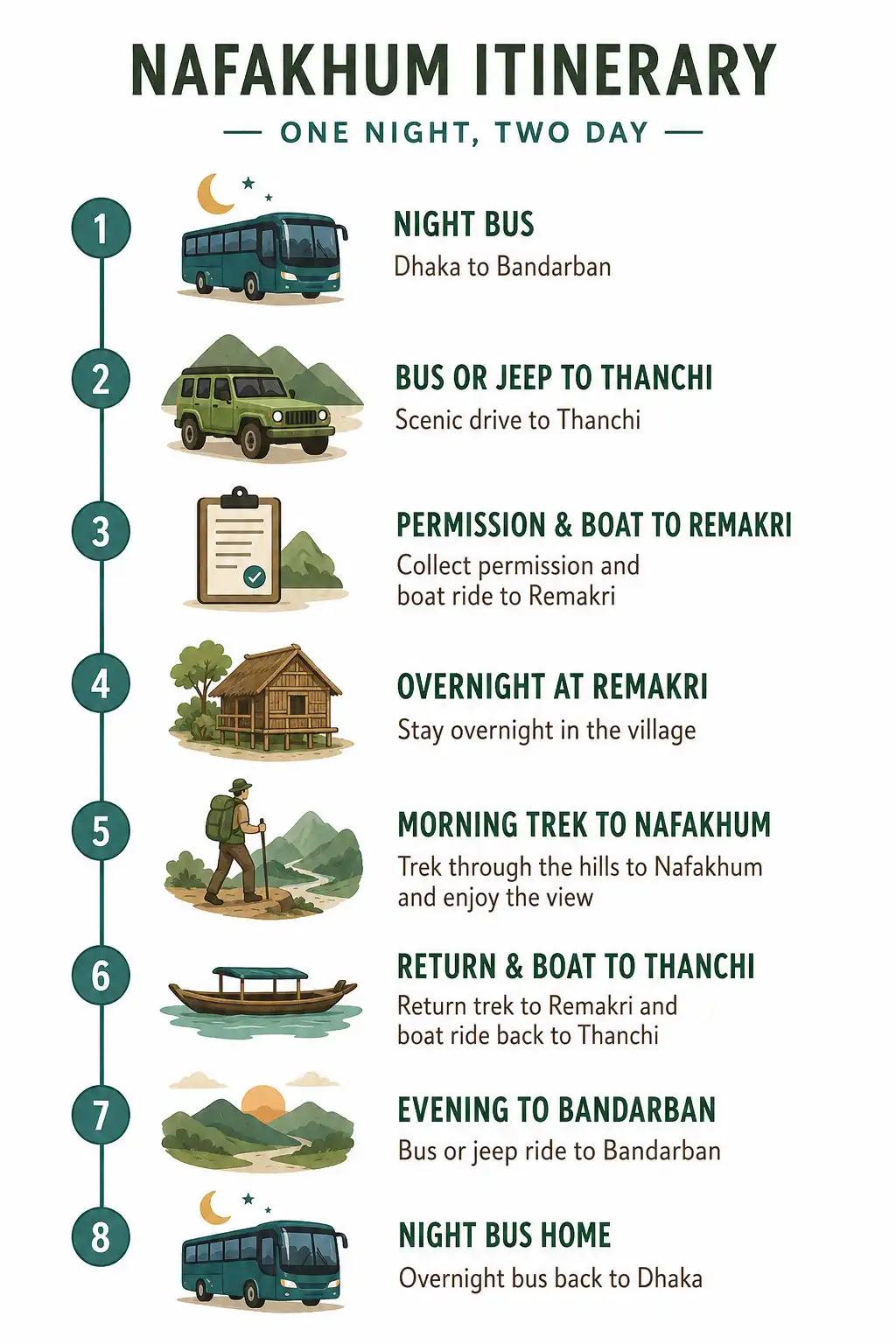
Here is a simple one night, two day route that works well. Leave Dhaka on a 9 or 10 PM bus and reach Bandarban in the morning. Without wasting time, take a local bus or jeep straight to Thanchi. Sort out your permission and other formalities, then board the boat to Remakri Bazaar. Spend that night in Remakri. The next morning, walk to Nafakhum waterfall, enjoy the falls, and return to Remakri by midday. After a quick lunch, take the boat back to Thanchi without lingering. From Thanchi, catch a bus or jeep to Bandarban by evening, eat something, and board a night bus home or onward to your next stop.
How Much Does a Nafakhum Waterfall Trip Cost?
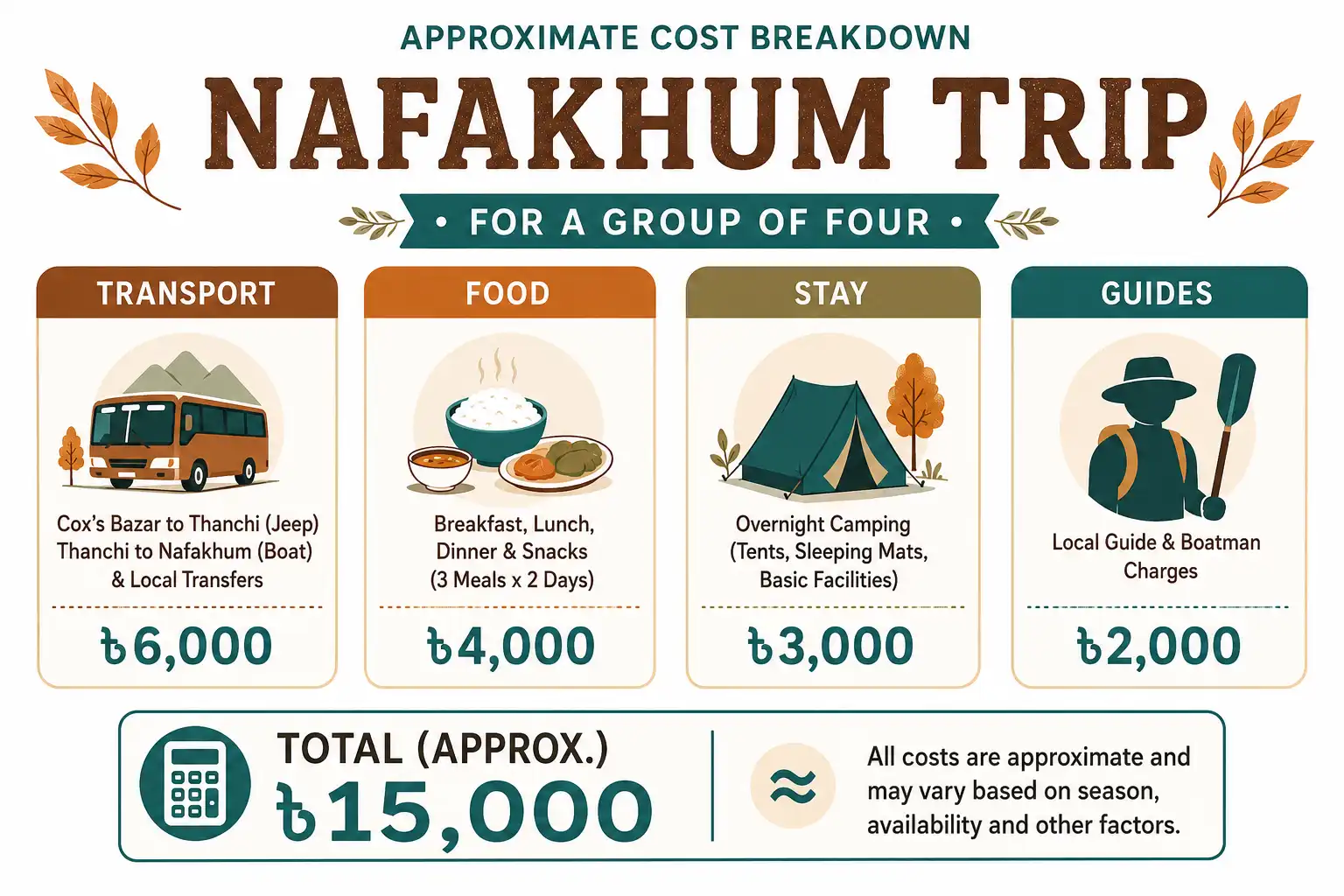
For a group of four sharing a one night, two day trip, you can do it on a modest budget, since transport is the main expense. Traveling in a group of three, four, nine, or fourteen works out cheapest, because boats and jeeps split neatly among those numbers. Taking non-AC buses and local transport instead of reserved vehicles also trims the bill. Here is a rough breakdown based on a four-person group.
Transport
- Dhaka to Bandarban, non-AC bus: about 1,600 taka per person round trip (800 each way)
- Bandarban to Thanchi, local bus: about 500 taka per person round trip (250 each way)
- Thanchi to Remakri, reserved boat for five including the guide: about 4,500 to 5,000 taka total
Food (per person, two days)
- Breakfast: about 200 taka
- Lunch at Thanchi and Remakri: about 300 taka
- Dinner at Remakri and Bandarban: about 300 taka
- Dry food for the trek: about 100 taka
Stay and guides
- Lodging at Remakri Bazaar: about 150 taka per person
- Guides at Thanchi and Remakri combined: about 2,000 taka total for the group
One more timing note: the last bus from Thanchi to Bandarban leaves at 3 PM. So if you plan to bus back, reach the Thanchi stand before 3 PM, or you will be stuck there for the night.
Nafakhum Waterfall Travel Tips and Safety
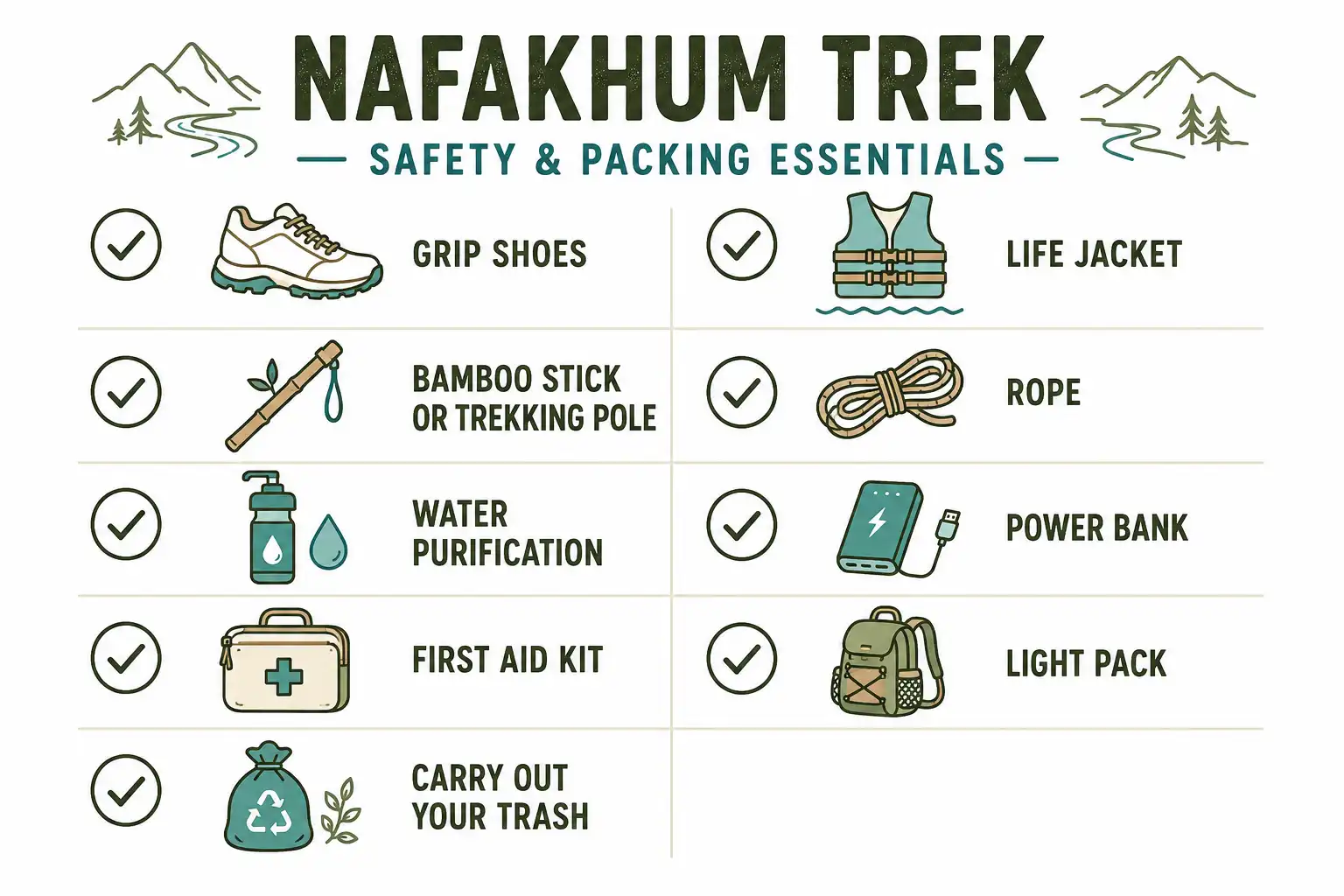
Wet rock is the biggest hazard out here, so footwear matters more than anything else. Pick shoes that fit snugly and grip wet stone, because one slip on the boulders can wreck your day. The rocky walls around the falls stay slick too, so move slowly near the edge. And never jump from the top of the cascade, since deep water and hidden rocks sit right below it.
In monsoon, the river crossings turn serious. Always wear a life jacket when you cross the Remakri canal during high water, because the current there can knock you off balance. For the deeper crossings, carry a length of rope, or ask your guide to bring one. A bamboo stick also steadies you on the canal bed, and it works much like a pole that saves your knees over a long descent.
Out past Thanchi, stream water is your only source, so plan to treat it. I always carry a way to purify water in the wild rather than trust a clear-looking pool, and I keep a bottle within reach on the trail. Dehydration also sneaks up on you fast when you are climbing in humid heat.
Connectivity basically stops after Thanchi. Mobile networks barely work, and there is no electricity past the town. So charge your phone, camera, and any other gear fully before you leave, and bring a power bank for backup. A small first aid kit belongs in your pack as well.
Keep your pack as light as you can, since every extra kilo wears on you across the river crossings and the climb. A reasonable fitness base helps too, because the trek mixes walking, wading, and scrambling over several hours. Breaking in your boots and conditioning your feet beforehand will also help you avoid blisters on the long days.
Treat the hills with respect. Please do not toss chip bags, chocolate wrappers, saline packets, or any plastic along the trail. Instead, carry your trash out, or gather and burn it responsibly. Be friendly and polite with the indigenous communities you meet, since you are a guest in their home. Finally, watch the clock, stay with your group, and look out for one another, because a person who gets separated in these hills can struggle to find the way back.
One honest caution: this trip is hard on very young children and elderly travelers, so I would leave them out of this particular route. Most other reasonably fit people handle it fine. And if you can avoid public holidays, do, since boat and jeep fares climb on those dates and the trail gets crowded.
What You Will See Along the Way and Nearby
This trip is about the journey as much as the destination. On the way in and out, you pass Chimbuk, Nilgiri, Thanchi, the Sangu River, Padmamukh, Tindu, the Rajapathor boulder field, Remakri Falls, and Remakri Para. Each stop adds something, and many travelers rate the river ride as highly as the waterfall itself.
If you have extra days, the wider region rewards you. Nearby sights include Amiakhum, Dim Pahar (Egg Hill), Alikadam, Bogalake, Nilachal, and the Golden Temple. Serious trekkers often pair this trip with the climb up Keokradong, one of the country’s most popular peak treks. On the jeep ride back, if time allows, a short stop at Nilgiri is well worth it.
FAQs on Nafakhum Waterfall

Do I need a guide to visit Nafakhum?
How many days does a Nafakhum trip take?
Is Nafakhum safe for beginners?
Can I visit Nafakhum during monsoon?
Final Thoughts
Nafakhum waterfall rewards the effort it takes to get there. The mix of a long bus ride, a boat up the Sangu, and a few hours on foot keeps the crowds thin and the scenery wild. So sort your guide and permission early, travel in a small group to save money, pack light, and respect the hills and the people who live in them. Go in autumn if you can, watch your footing on the rock, and you will come home with a trip you remember for years.