Is Hiking The Narrows in Zion Dangerous? Risks and Safety Guide

The Narrows is a river hike, not a trail hike. That one fact changes nearly every risk you face in Zion National Park. Below I cover what actually injures and kills people there, how the park manages those hazards, and what you can do to lower your own risk before stepping into the water.
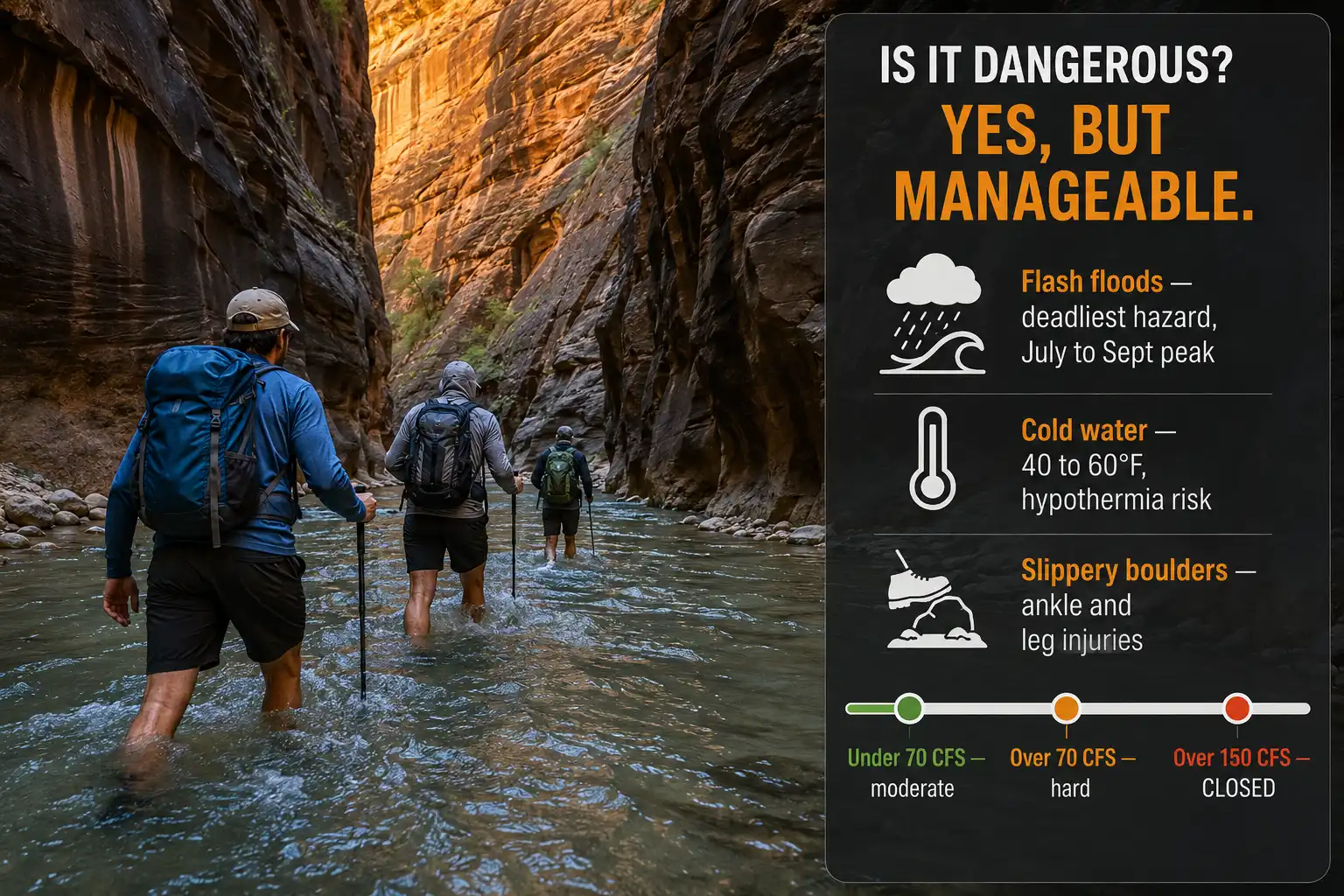
Hiking The Narrows is dangerous, though almost all of that danger is manageable. Flash floods, cold water, and slippery submerged boulders cause nearly every serious incident. Meanwhile, thousands of people finish the bottom-up route safely each week in summer. Your risk drops sharply once you check conditions, carry the right gear, and turn around early.
What makes The Narrows different from a normal hike?
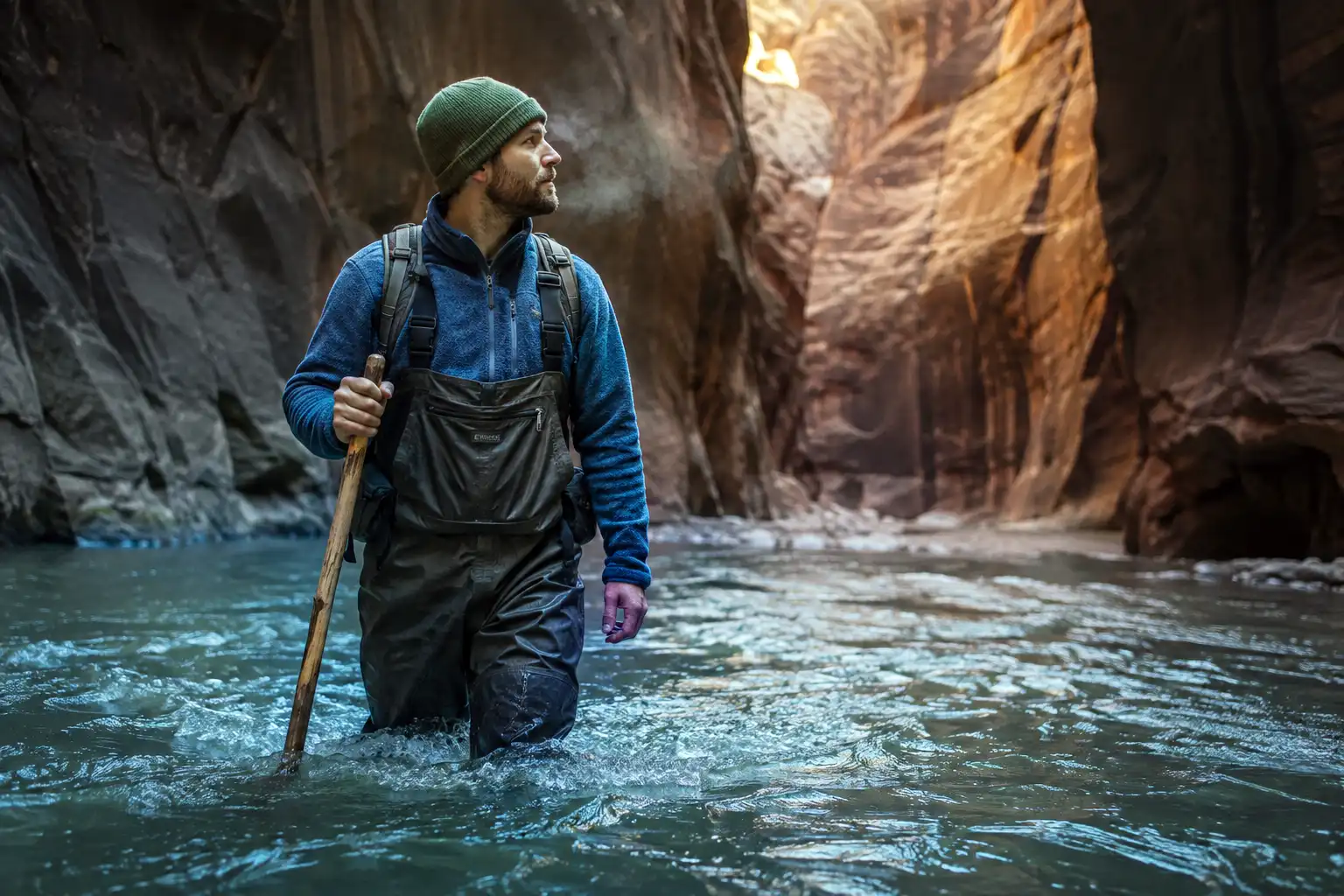
The Narrows has no trail, so you walk directly in the Virgin River. According to the National Park Service, at least 60 percent of the hike involves wading, walking, and sometimes swimming. Canyon walls climb to roughly 1,000 feet, and the gorge tightens to 20 to 30 feet wide in places. Because of that shape, there is often nowhere to move sideways or uphill when conditions turn.
Cell service also disappears inside the canyon. Therefore a twisted ankle two miles upstream becomes a slow, uncomfortable rescue instead of a quick phone call. Zion rangers handled 193 search and rescue incidents park-wide in 2024, and most of those clustered between Memorial Day and Labor Day.
I hike gorge routes at home in the Chittagong Hill Tracts, where the walk into Debotakhum and Amiakhum also runs straight through water between tall rock walls. Those lessons carry over. Water hides the ground, rock stays slick long after rain stops, and a stream you crossed easily at breakfast can look like a different river by afternoon.
How dangerous are flash floods in The Narrows?
Flash floods are the deadliest hazard here, and they have killed hikers in this canyon more than once. In 2014 a visitor died after rain swelled the river. Then in August 2022, a flash flood swept multiple hikers off their feet near the Temple of Sinawava, and 29-year-old Jetal Agnihotri died. During the search the river ran above 1,100 cubic feet per second, and by the end of the operation it had dropped back to 50. A park spokesperson told KUTV that 11 people have died in flash floods at Zion since 2010.
The mechanics explain why escape is so hard. Zion says a flash flood can rush down a canyon as a wall of water 12 feet high or more, and the level can rise within seconds. Floodwater also carries boulders, branches, and tree limbs, so most flood deaths come from blunt force trauma rather than drowning. Swimming through it is not realistic.
Distance is the part people miss. Storms can form 15 to 20 miles upstream inside the 288 square mile watershed that feeds The Narrows. As a result, the sky above you can look clear while a flood is already moving toward you.
What are the warning signs of a flash flood?
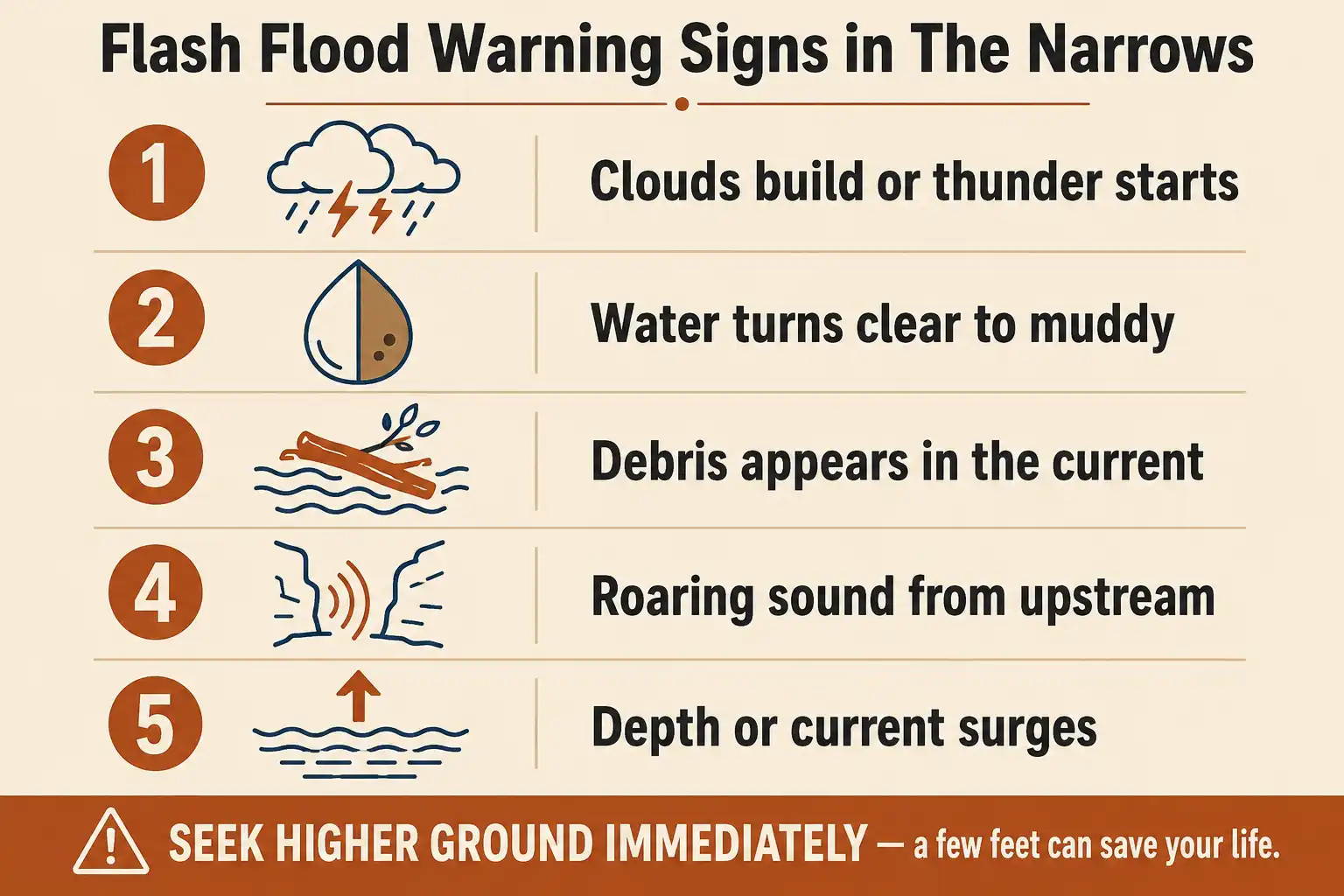
Watch for five specific signals that the park tells hikers to treat as immediate exit cues:
- Any deterioration in weather, including cloud buildup or thunder
- Water turning suddenly from clear to muddy
- Floating debris such as branches in the current
- An audible roar of water from up-canyon
- A quick surge in depth or current speed
If you notice any of these, climb to higher ground right away. Even a few feet of elevation can save your life. After that, stay put until conditions improve, since water levels usually drop within 24 hours. Never try to outrun a flood or cross moving floodwater.
How cold is the water in The Narrows?
Water in the Virgin River commonly runs between about 40°F and 60°F depending on the season, which is cold enough to cause trouble in an afternoon. The park calls hypothermia the number one killer of outdoor recreationists, even in summer, because immersion cools the body faster than air ever will. High canyon walls block sun for long stretches too, so the gorge stays cooler than anywhere else in Zion Canyon.
A November 2022 case shows how fast this turns serious. A married couple started the permitted 16-mile top-down trip, then became dangerously cold overnight. The 31-year-old woman died before rescuers reached her, while her husband was treated for hypothermia. USGS data showed river temperatures dropping to 38°F that night.
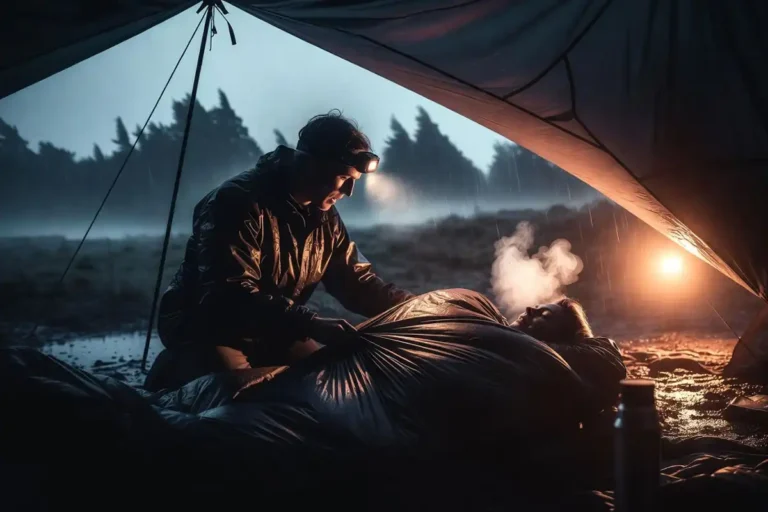
Symptoms usually arrive without the person noticing. Uncontrollable shivering comes first, followed by stumbling, poor coordination, fatigue, confusion, and slurred speech. Once you spot any of those, stop hiking immediately, swap wet clothing for dry layers, add warmth from another person’s body heat, and shelter from wind. Knowing how to recognize hypothermia and respond in the field matters more here than on almost any American day hike.
Skip cotton entirely. Wet cotton provides no insulation, so it actively speeds up heat loss.
Why do ankle and leg injuries happen so often?
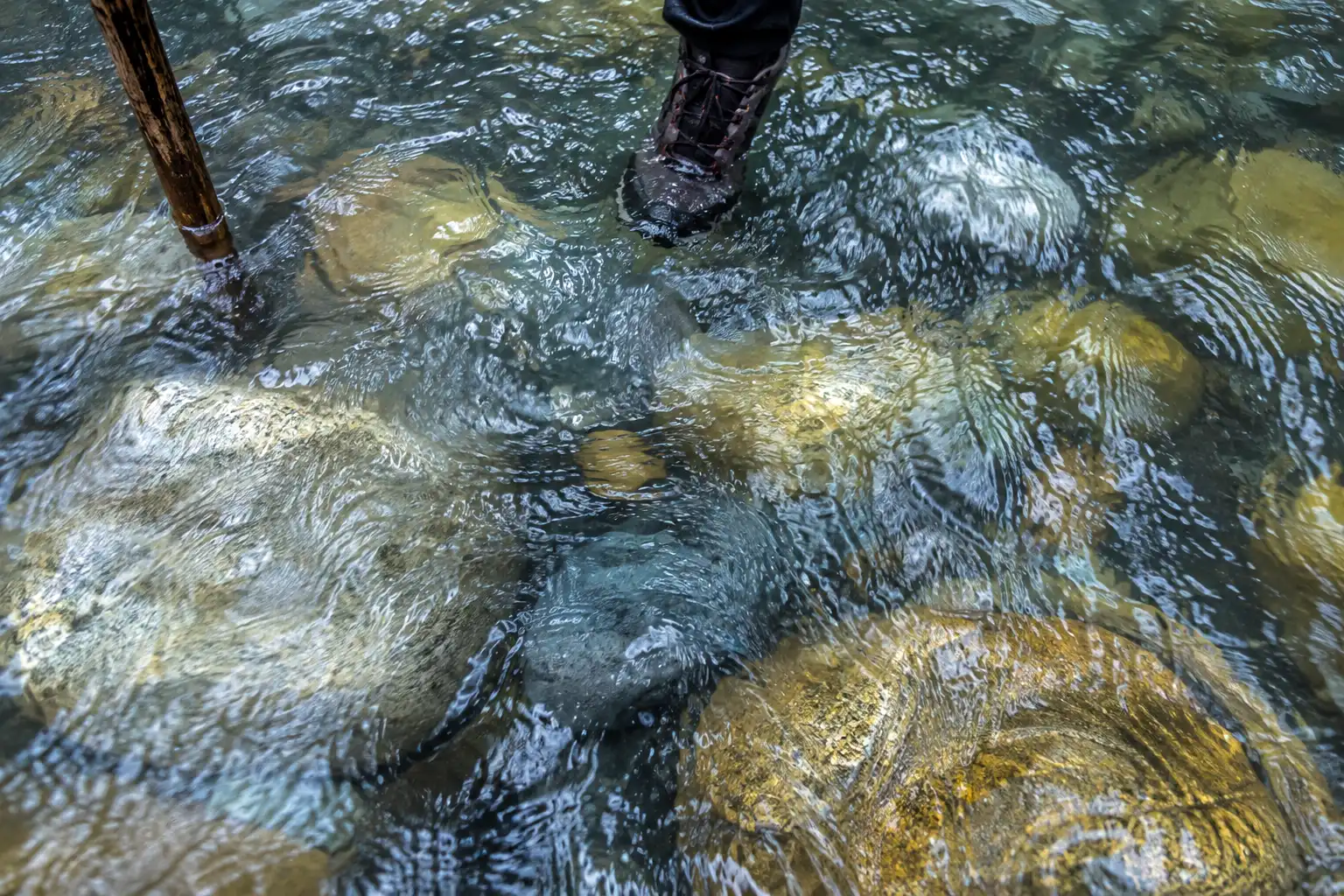
The riverbed is loose, uneven boulders sitting under moving water, so you cannot see where your foot is about to land. Zion compares the footing to walking on wet bowling balls. Because of that, lower leg fractures rank among the most common wilderness injuries in the park.
Jumping causes most of them. In one May 2014 incident near Big Spring, a 32-year-old man jumped from a rock about four feet above the water and injured his ankle badly enough that 20 park employees assisted, and the carryout finished the following morning. So lower yourself down slowly or find an easier line around the obstacle.
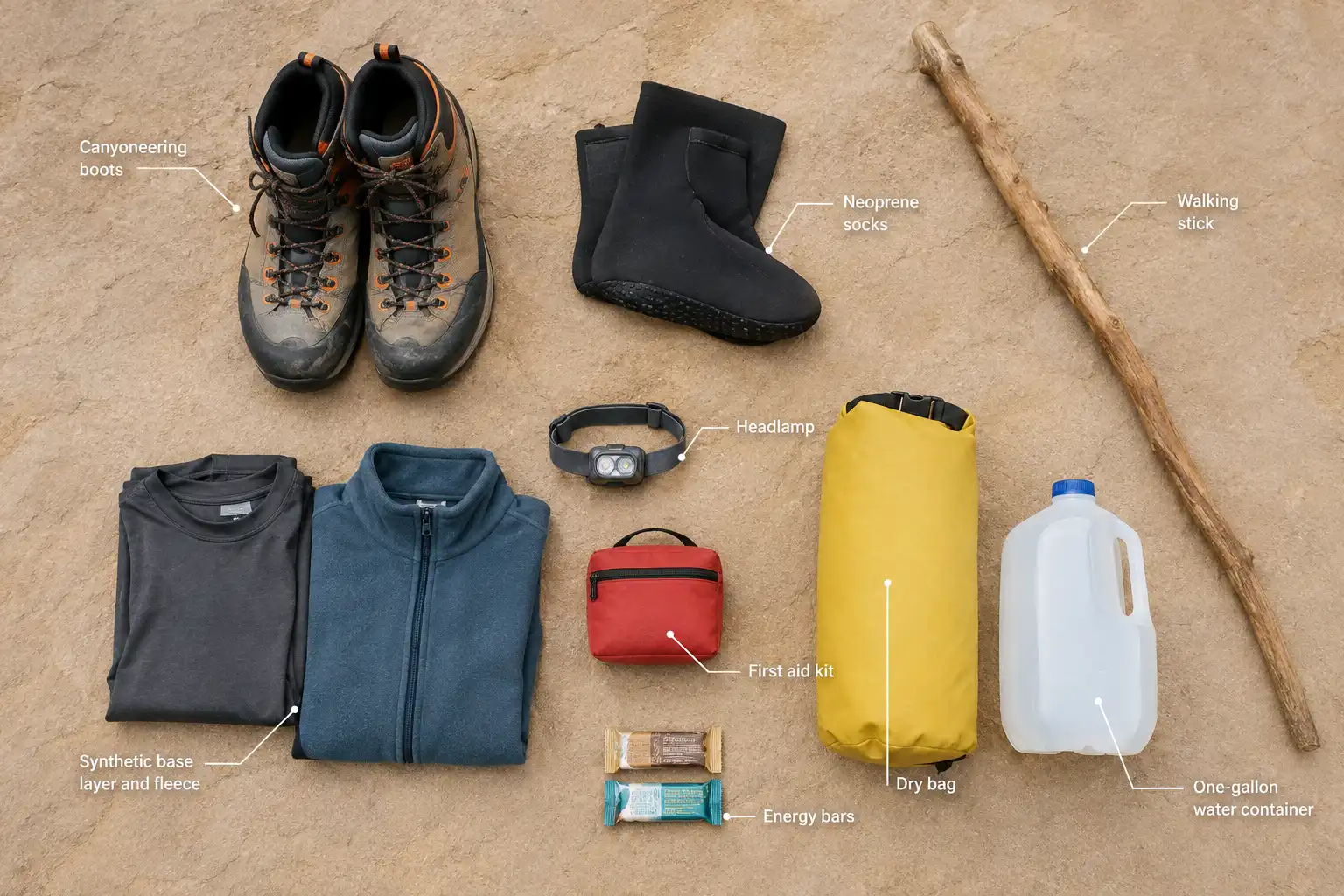
Footwear matters just as much. Sandals, Crocs, and bare feet are not appropriate, and they regularly produce twisted ankles and crushed toes. A pole or sturdy stick gives you a third contact point and lets you probe depth before committing weight, which is exactly why using poles to protect your knees on rough ground applies here. If something does go wrong, knowing how to stabilize a rolled ankle far from the trailhead buys you time.
Is the water in The Narrows safe to touch or drink?
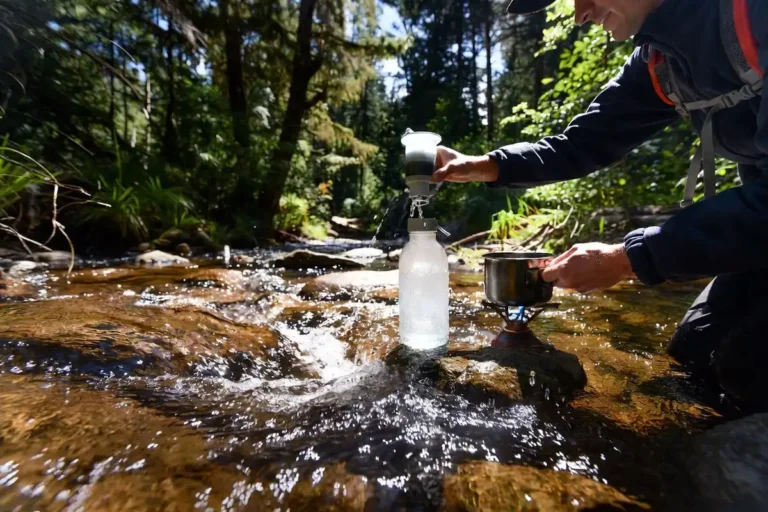
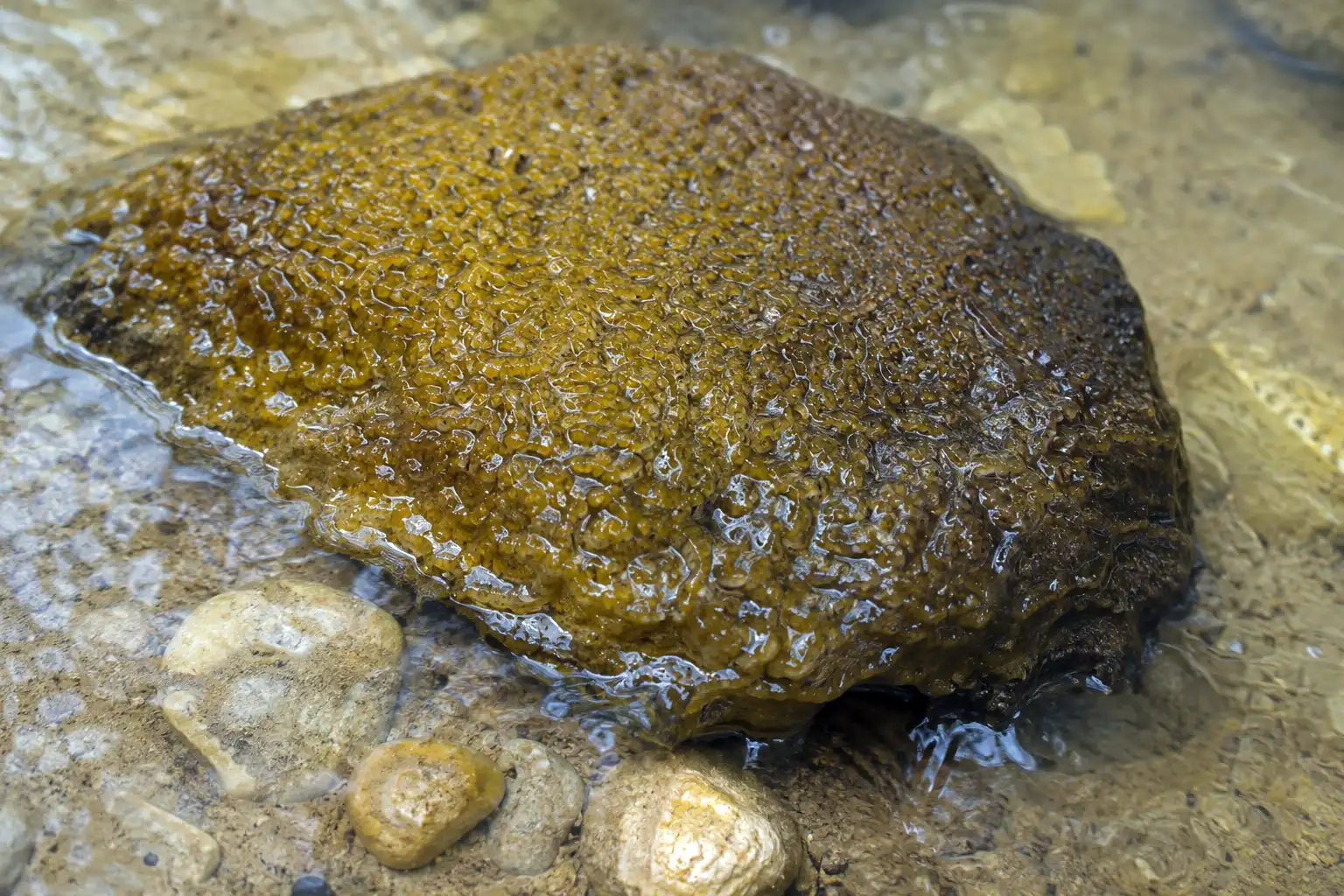
Never drink from the Virgin River. Park scientists have found toxic benthic cyanobacteria growing on rocks, plants, and the river bottom, along with cyanotoxins including anatoxin-a, microcystin, nodularin, and cylindrospermopsin. As of the park’s May 2026 update, the North Fork of the Virgin River sat at a Health Watch advisory level, meaning visitors should check first and avoid contact with algae mats.
Filtering does not solve this. No recreational filter or disinfection method reduces cyanotoxins to a safe drinking level, and boiling fails too. Therefore you carry your own water, roughly one gallon per person per day, or collect only from springs where mats are absent.
Contact risk is lower but still real. Do not submerge your head, avoid touching the mats, cover open wounds, and rinse off afterward. Symptoms range from skin rash and eye irritation to headache, vomiting, diarrhea, and in rare cases far worse. Young children face higher risk. If someone feels ill after exposure, call the Utah Poison Control Center at 800-222-1222, or 911 in an emergency.
When does Zion close The Narrows?
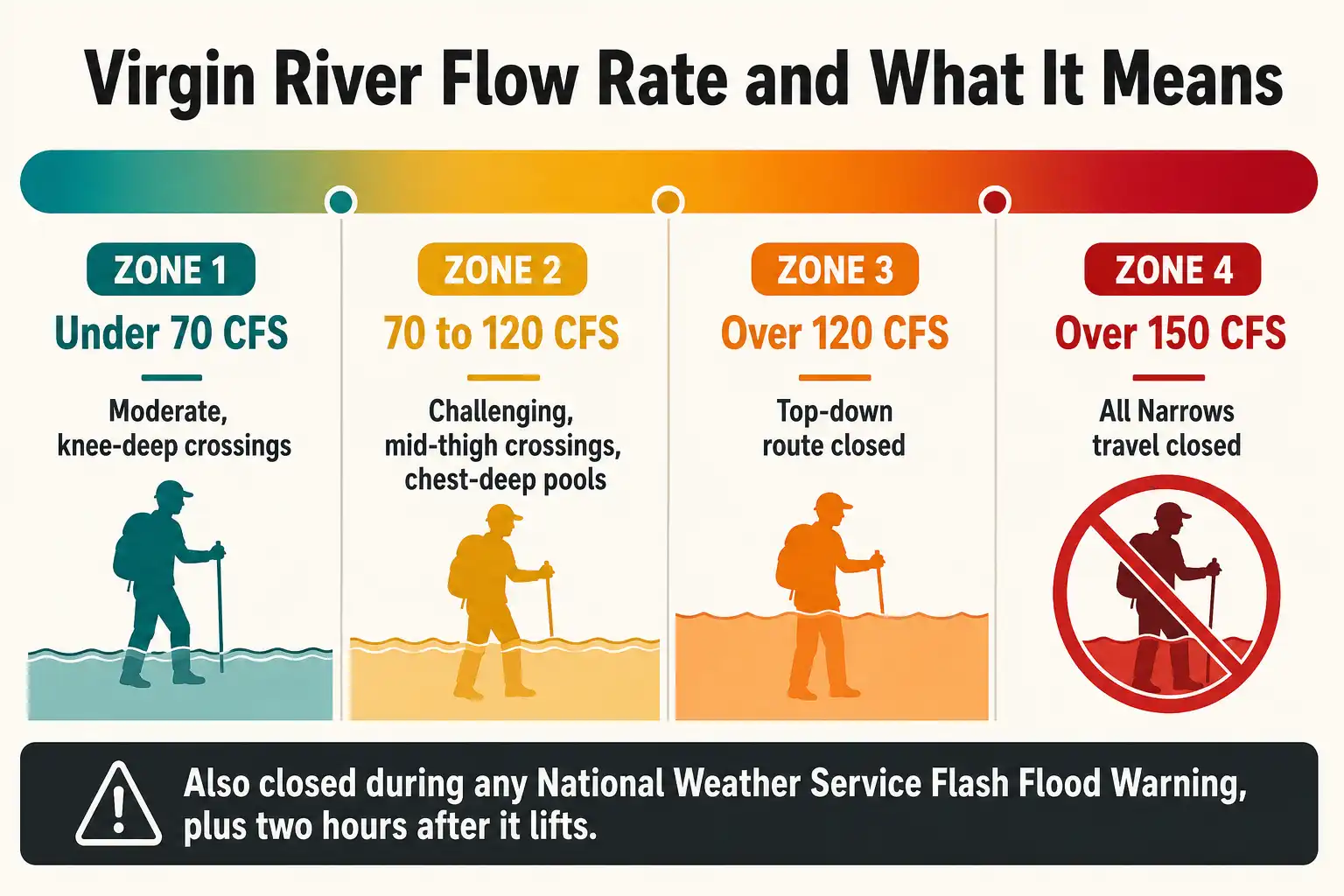
Zion closes the river to all hiking when flow exceeds 150 cubic feet per second, and it closes The Narrows whenever the National Weather Service issues a Flash Flood Warning. After the warning lifts, the canyon stays closed for another two hours. Top-down trips shut down at a lower threshold of 120 CFS.
Flow numbers also tell you how hard the day will be:
| Flow rate | What it feels like |
|---|---|
| Below 70 CFS | Moderately difficult, knee-deep crossings, occasional waist-deep pools |
| Above 70 CFS | Walking upstream turns challenging, mid-thigh crossings, chest-deep pools |
| Above 150 CFS | Closed to all travel |
Spring snowmelt closes the canyon in many years. Park records show closures from April 9 to May 18 in 2020, April 8 to June 19 in 2023, and April 11 to May 19 in 2024, while 2021 and 2022 stayed open. Monsoon closures happen too. In July 2026 alone, Zion shut The Narrows and all slot canyons twice because of flash flood threat.
One caution: open does not mean safe. Rangers post a daily flash flood potential rating, yet the final call is yours.
Is the top-down route more dangerous than bottom-up?
Yes, the 16-mile top-down route from Chamberlain’s Ranch carries considerably more risk. It commits you to a one-way trip with no easy bail-out, longer cold-water exposure, and remote terrain far from help. The road to the trailhead can also become impassable when wet, sometimes for days. Both fatal hypothermia victims mentioned earlier were on top-down trips.
Bottom-up is far more forgiving. From the Temple of Sinawava you walk the paved Riverside Walk for a mile, enter the river, and continue as far as Big Spring, a 9.4-mile round trip with only 334 feet of elevation change. Since you retrace your steps, you can turn around at any moment. Most people spend one to eight hours.
The permit rules differ as well, and I have covered whether a permit is needed for this hike separately.
When is the safest time to hike The Narrows?
Late spring through early summer and again in early fall offer the best balance, once snowmelt has dropped and outside the monsoon peak. Summer brings the warmest, lowest water, though monsoon season from July through September fuels the afternoon thunderstorms that cause flash floods. Spring often means high, cold, closed water. Winter means the coldest water of the year plus ice and snow falling from the cliffs.
Time of day matters within any season. Storms typically build in the afternoon, so an early start gives you a wider safety margin. Summer air temperatures at the trailhead can also top 100°F, which is why staying safe when the heat spikes still applies on a hike this wet.
What gear actually lowers your risk?
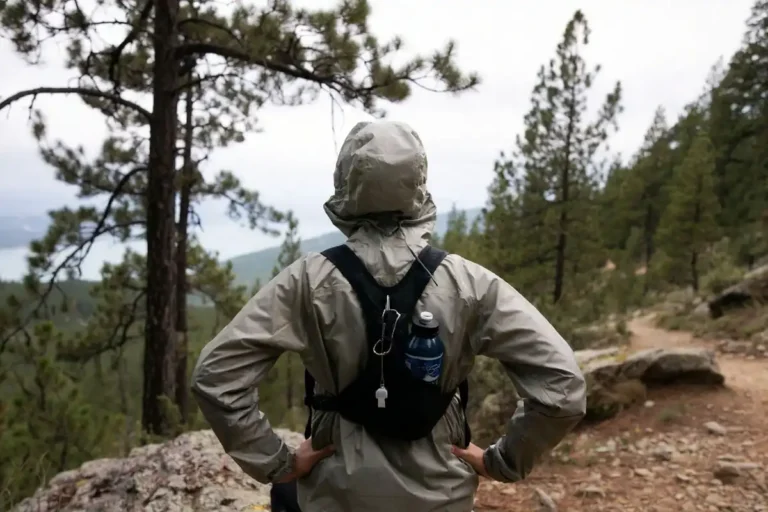
Closed-toe footwear with grip, a sturdy pole or stick, non-cotton layers, and a dry bag do the most work. Outfitters in Springdale rent canyoneering boots, neoprene socks, dry bibs, and dry suits, and renting is worth it whenever water sits below about 55°F.
Pack these as well:
- Quick-drying synthetic or wool layers, never cotton
- Dry bag for phone, keys, and spare clothing
- Headlamp, because the canyon darkens early
- Extra high-energy food, eaten before you feel cold
- Basic first aid kit
- Human waste disposal bags, since there are no bathrooms past the trailhead
How do I hike The Narrows more safely?
Follow this sequence on the morning of your hike:
- Check the USGS Virgin River gauge for current CFS before you leave your room.
- Read the flash flood potential rating and the park’s current conditions page.
- Talk to a ranger at the visitor center, since they hold the newest information.
- Start early so you finish before afternoon storms build.
- Note high ground as you walk upstream, because that is your escape plan.
- Set a turnaround time and honor it, then hike out the way you came.
- Do not jump from rocks at any height.
- Tell someone your plan, including your expected return time.
Since there is no cell coverage inside the canyon, learning how to call for help without a phone signal is worth reviewing before any river canyon trip.
Frequently asked questions

Has anyone died hiking The Narrows?
Can beginners hike The Narrows?
Is The Narrows safe for kids?
Should I hike it if rain is in the forecast?
Final thoughts
The Narrows deserves respect, not fear. Nearly every serious incident there traces back to three things: entering when a flood was possible, dressing wrong for cold water, or moving carelessly on hidden boulders. All three sit within your control. Check the flow rate and flash flood rating the same morning you hike, wear synthetic layers with proper footwear, carry a pole, and set a turnaround time before you start. Do that, and you get one of America’s finest canyon hikes at a risk level you actually chose.