What to Do if You See a Moose While Hiking? What You Need to Know

Moose look calm and slow on the trail. They are neither. This guide covers what to do the moment you spot one, how to read the warning signs before a charge, and how to react if a moose comes at you.
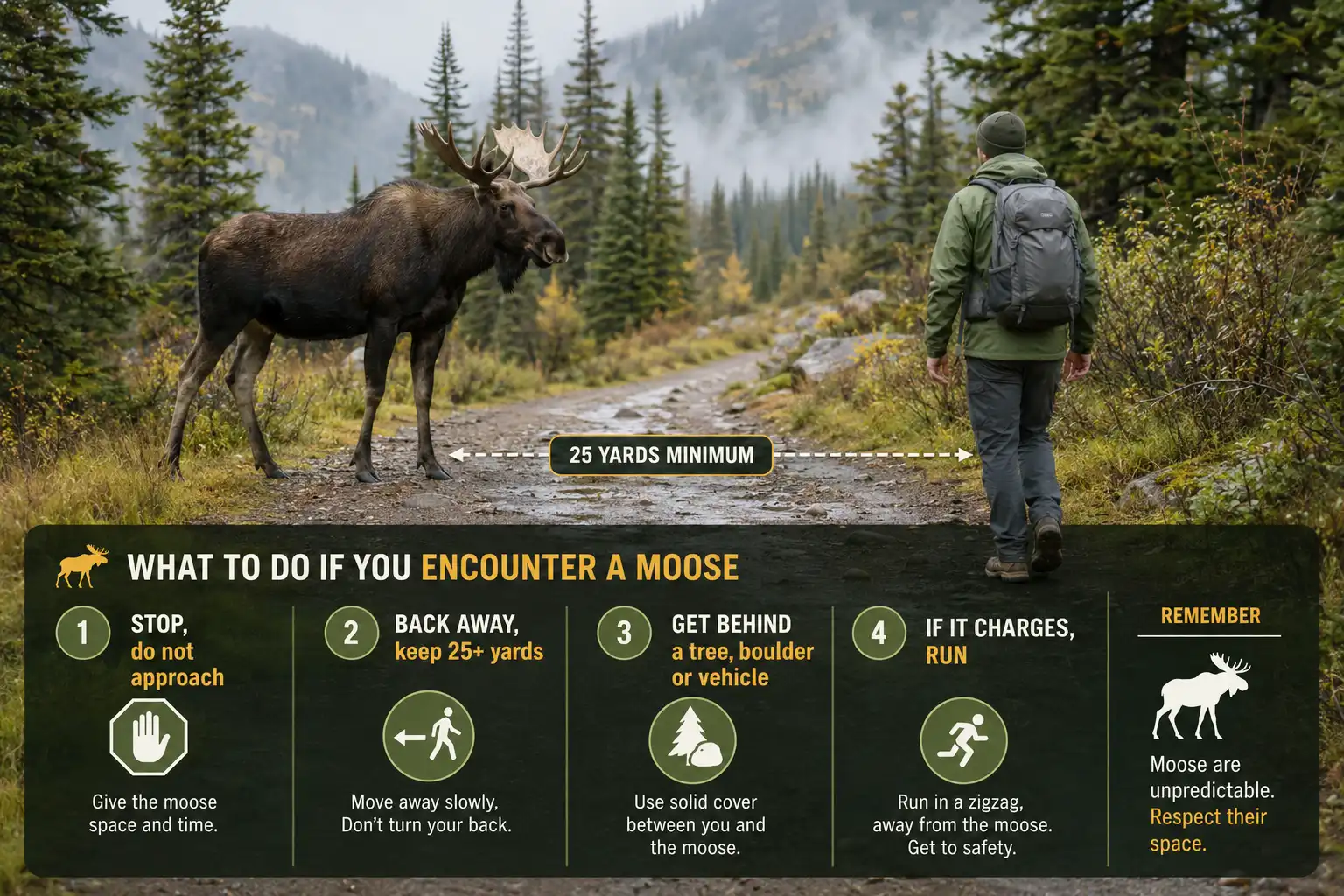
Stop where you are, then back away slowly and put at least 25 yards between you and the moose. Watch its ears and shoulders while you retreat. If it charges, run and get a tree, boulder, or vehicle between you. Most charges stop short.
What should you do the moment you spot a moose?
Stop moving and start backing away. Never walk closer for a photo, and never try to squeeze past one on a narrow trail. Give the animal room to carry on with whatever it was doing.
Here is the order I would follow:
- Stop. Freeze in place and check where the moose is looking.
- Look for a calf. Scan the brush nearby. A calf close by raises the risk sharply.
- Back away slowly. Face the moose while you retreat, and talk in a calm, normal voice so it knows you are human.
- Find cover. Note the nearest big tree, boulder, or vehicle before you need it.
- Leave or wait. Turn around, or hold well back until the moose moves off on its own.
Alaska wildlife biologists give the same advice. When a moose is on the trail ahead, turning around is usually the smartest choice available. That costs you a few minutes of your day, and the trade is worth it every time.
Learn more: Rattlesnake Bite on the Trail
How much distance should you keep from a moose?
Keep at least 25 yards, which is roughly two school buses parked end to end. Colorado Parks and Wildlife uses that number as a minimum, and Alaska agencies often push it further where moose have grown used to people.
There is a better rule than any fixed number, though. If the moose reacts to you, you are already too close. A moose that stops chewing, lifts its head, and stares has just told you to back off. Same message when it turns its body to face you squarely.
Distance is easy to hold in an open meadow. It gets hard fast in thick willow, along creek bottoms, and on brushy switchbacks where you cannot see far ahead. So slow down in that terrain and look hard before every blind corner.
How can you tell a moose is about to charge?
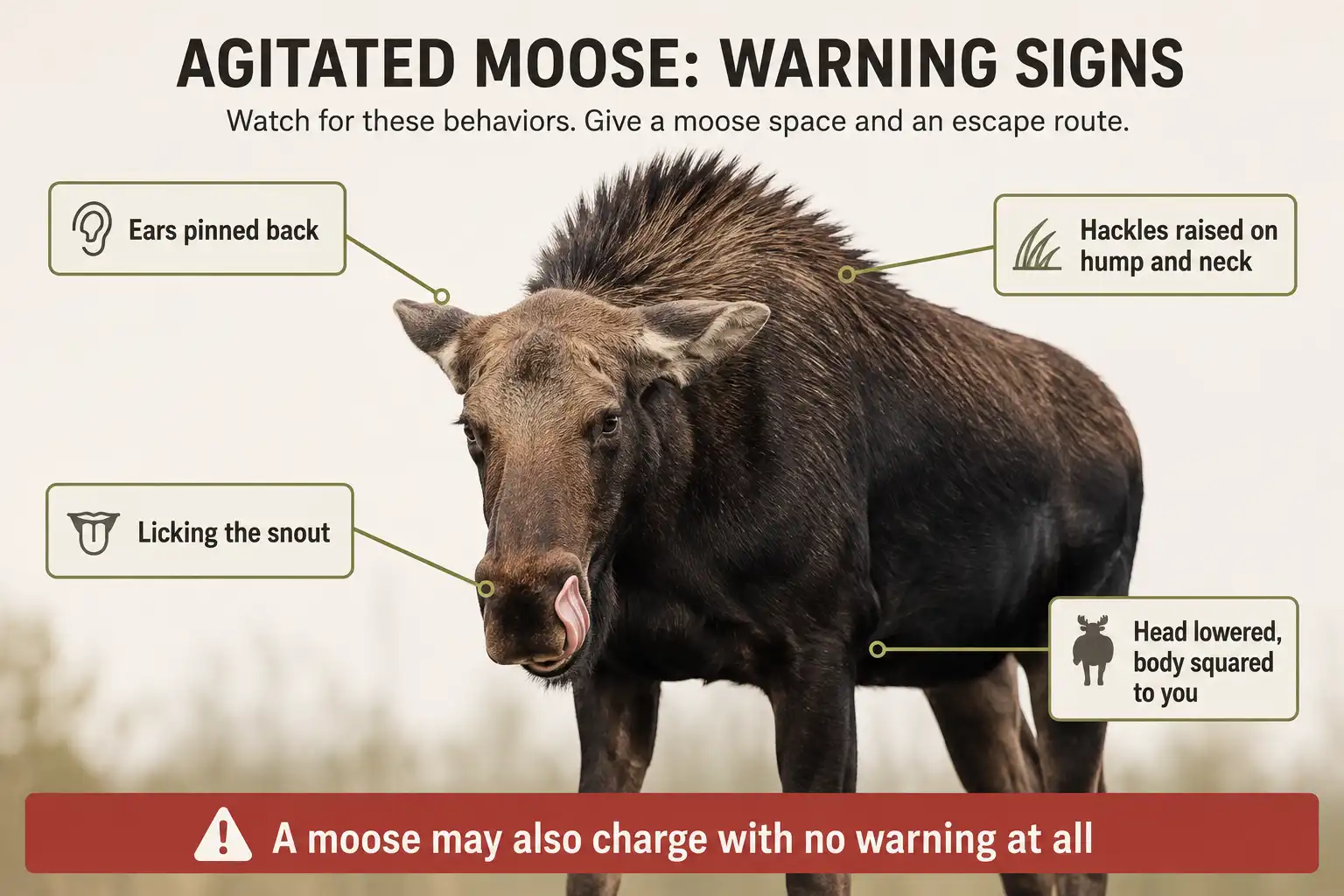
Watch the ears, the shoulder hump, and the mouth. A stressed moose lays its ears back flat, raises the long hairs along its hump and neck, and licks its snout. It may also lower its head, stomp or paw the ground, show the whites of its eyes, or toss its head upward like a horse.
Those signs mean you are too close right now. Back off immediately and get something solid within reach.
One warning matters more than the rest. A moose can skip every signal and charge with no build-up at all. Biologists in Maine and New Hampshire stress that these cues can appear and vanish in a fraction of a second. Therefore a calm-looking moose is not automatically a safe moose, and distance protects you far better than body language ever will.
What should you do if a moose charges you?
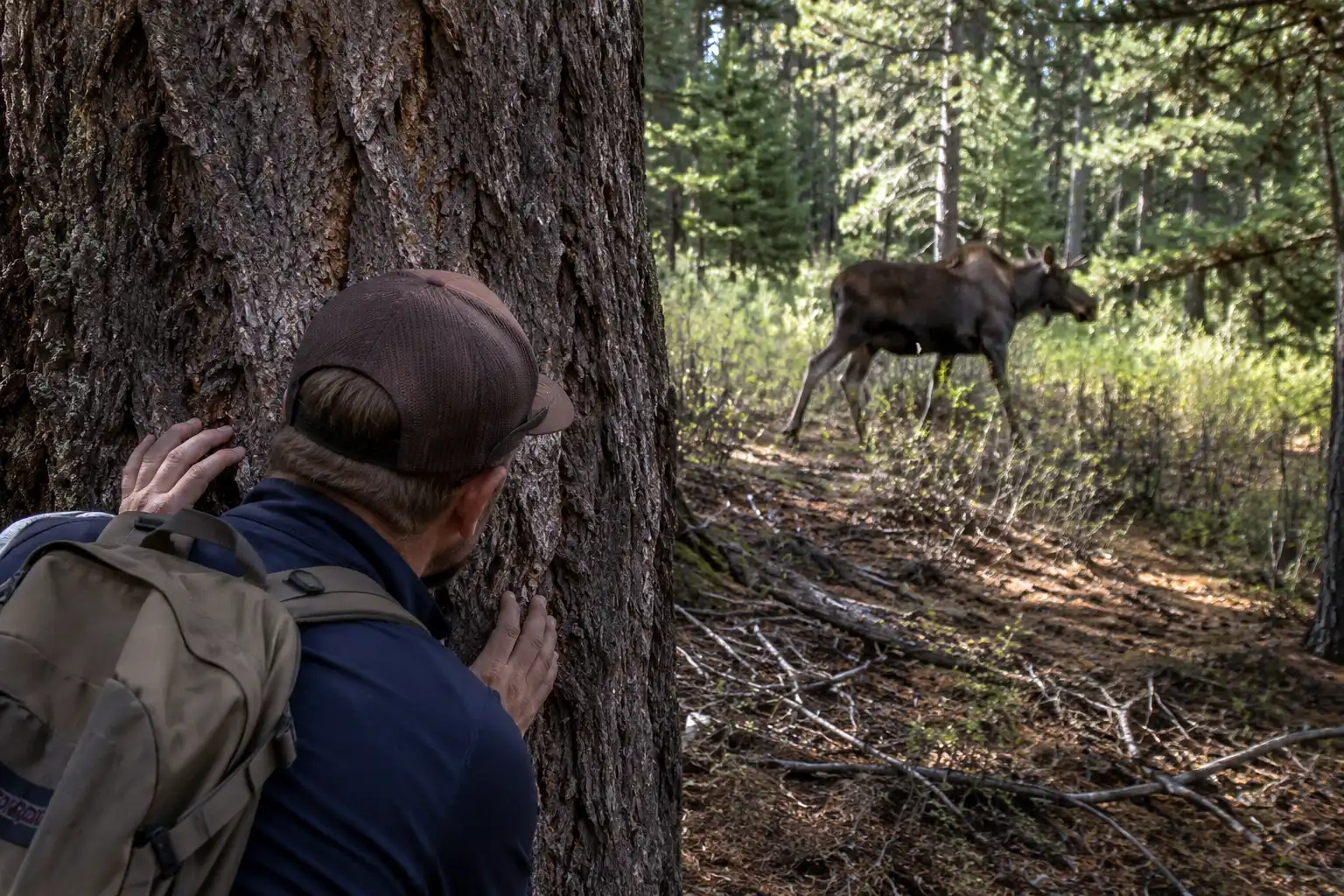
Run. Moose are the one large North American animal where running is the correct response, and that reverses everything you have heard about bears. Get behind a tree, a large boulder, a vehicle, or a building.
Moose corner badly at speed and rarely chase far. You can circle a tree trunk faster than a 1,000-pound animal can, and that single trick has spared plenty of hikers.
Most charges turn out to be bluffs. Even so, never stand there to learn which kind you are getting. A calf already weighs 300 or 400 pounds by its first winter, and that is enough to break bones.
Bear encounters run on opposite rules, which is why I keep the two filed separately in my head. Standing your ground is correct when a black bear wanders into your campsite, and badly wrong when a moose pins its ears at you.
Footing deserves a mention too. Several documented moose injuries happened because the hiker tripped while retreating, not because the animal caught them. Watch where you step, since a twisted ankle miles from the trailhead turns a scare into a rescue.
What if a moose knocks you down?
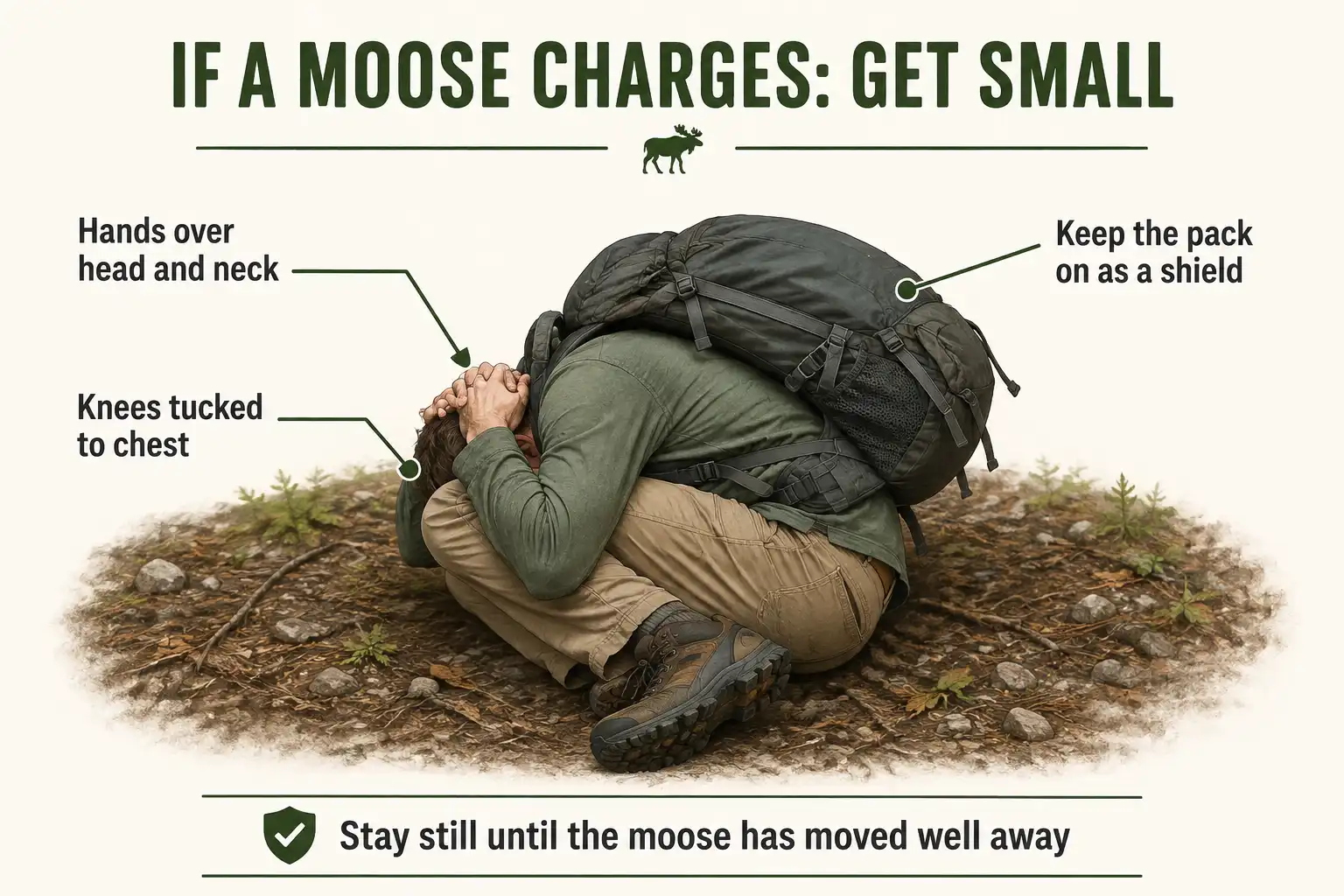
Curl into a ball, cover your head and neck with your hands, and hold still. Moose attack by kicking and stomping with all four feet, so shielding your head comes first. Your pack works well as armor across your back.
Do not stand up while the animal is over you. Movement often restarts the attack. Instead, wait until the moose has moved a safe distance away, then get up and leave in the opposite direction.
Afterward, get help moving. Stomping injuries land on the chest, ribs, and head, and they often prove worse than they feel in the moment. Out in a remote spot, knowing how to call for help from the backcountry counts for more than anything in your first aid kit.
Why do dogs cause so many moose attacks?
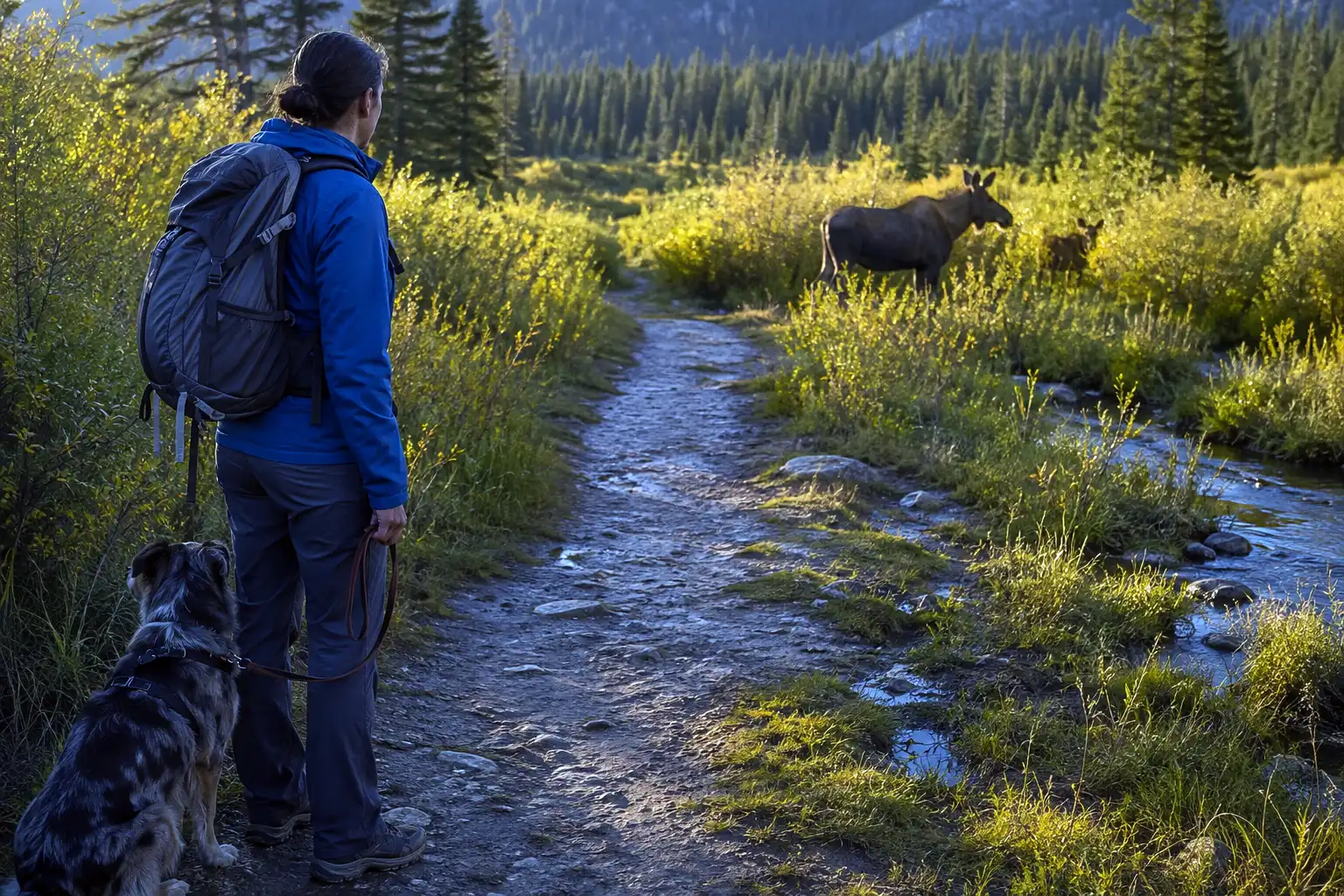
Moose react to dogs as they would to wolves, their main predator. Because of that instinct, a dog provokes a defensive response that a lone hiker often would not. Colorado Parks and Wildlife reports that most of its moose conflicts involve dogs, and one Colorado wildlife official has put the local share near 95 percent.
The pattern repeats over and over. An off-leash dog runs ahead, finds the moose, panics, then sprints back to its owner. Meanwhile the moose follows the dog straight to you.
So leash your dog in moose country, every single time. Better still, leave the dog at home during calving season in late spring. Colorado officers handled several serious maulings through 2025 and 2026 involving dogs, including dogs that were properly leashed.
When are moose most dangerous?
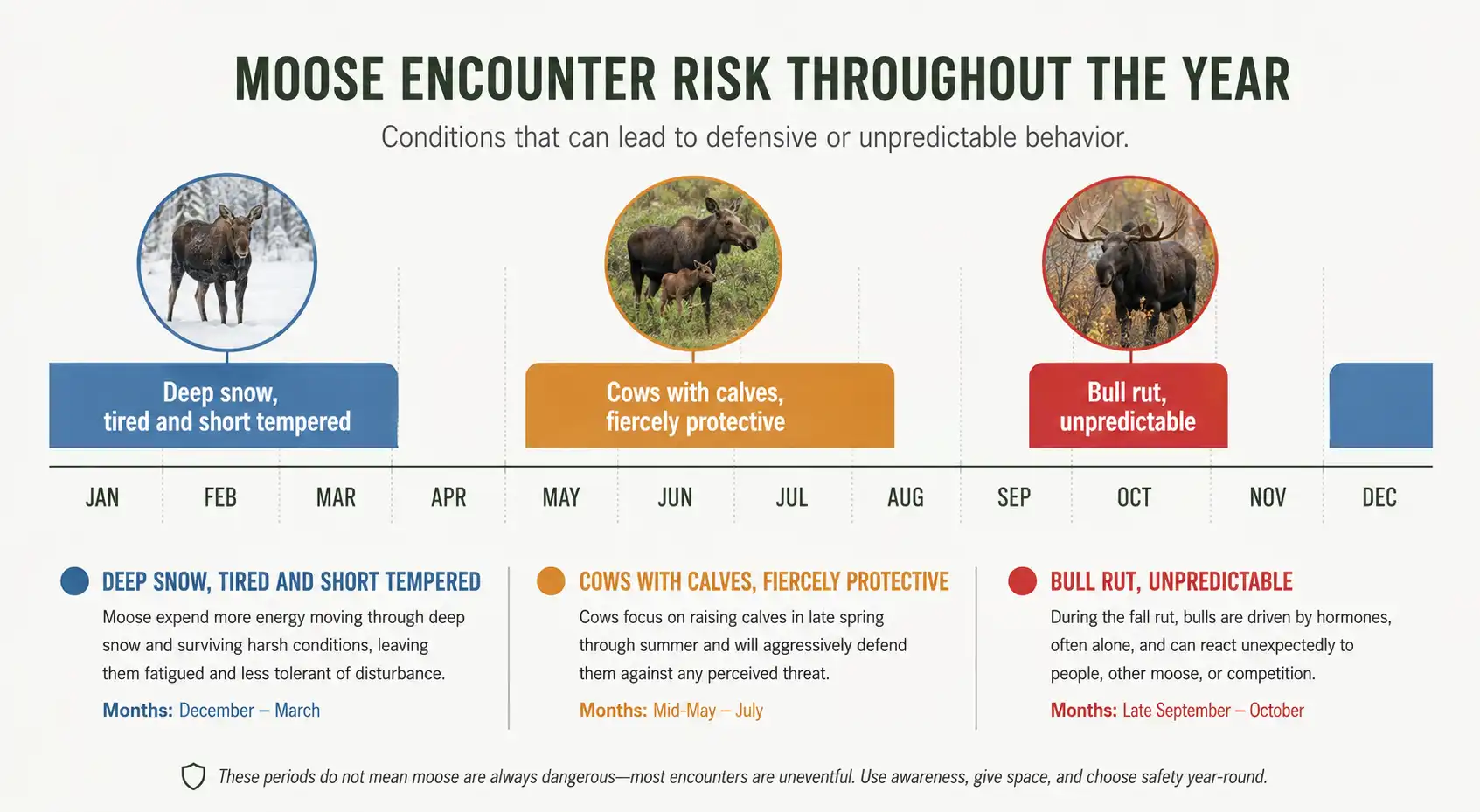
Three periods stand out, and each has a different cause behind it.
Late spring and summer, mid-May through July. Cows give birth in mid-May and early June, after which they defend calves aggressively. If you spot a calf on its own, back out fast, because you may have stepped between it and its mother.
Fall rut, late September and October. Bulls turn unpredictable during the mating season. They charge people, dogs, and occasionally vehicles.
Deep winter. Moose burn through their reserves in heavy snow and grow short-tempered as a result. They also walk packed hiking trails to save energy, which puts them exactly where you are. Anchorage biologists field extra charge reports every late winter for that reason.
Does bear spray work on a moose?
Yes, bear spray does deter moose, and wildlife agencies list it as a legitimate last resort. Both the Interagency Grizzly Bear Committee and BearWise note that bear spray works on large mammals beyond bears, moose included. Alaska Fish and Game adds that pepper spray will often move a moose along, or at least offer some protection during a charge.
Treat spray as a backup rather than a plan. Distance and cover still come first. Also, use it only when an animal actually threatens you, since spraying a calm moose counts as wildlife harassment in several states and may trigger the charge you hoped to avoid.
Two practical notes. Wind direction matters, so avoid firing into a headwind. Height matters as well, because a moose carries its head six feet up, so aim toward the front of the animal instead of at the ground. None of that helps when the canister sits buried in your pack, which is why clipping the can somewhere you can grab it is worth sorting out before you reach the trailhead.
What if a moose is blocking the trail?
Look for a way around first, keeping a wide berth as you go. When no route exists, be patient. Alaska Fish and Game says a moose will usually move along on its own, although it can take half an hour or more.
Keep a large tree, boulder, or snow berm between you and the animal while you wait. Never approach a moose whose only escape route runs toward you, and always leave yourself a clear exit.
Also, do not try to scare it off. Yelling, throwing objects, and hazing a moose are all dangerous, and in Colorado hazing is illegal on top of that. Moose that live around people ignore noise anyway.
How can you avoid a moose encounter altogether?
Most encounters end quietly because the hiker spotted the moose early. Early warning really is the whole game.
- Make noise on blind corners and through thick brush, and skip the headphones.
- Hike in daylight, then stay extra alert at dawn and dusk when moose move most.
- Scan willows, creek edges, and pond margins, since moose feed in wet, brushy ground.
- Read the trailhead signs, because agencies post warnings after incidents and those notices stay current.
- Watch for sign. Hand-sized tracks, oversized droppings, and branches browsed six to eight feet up all point to moose nearby.
- Travel in a group when you can, as groups get noticed sooner.
Route choice helps as well. Picking a line with clear sightlines is part of thinking a day hike through before you set off, and that same planning sorts out your bailout options.
Where might you run into a moose?
Alaska holds the largest population at roughly 175,000 animals, and Maine ranks second. Moose also live in New Hampshire, Vermont, New York, Massachusetts, Minnesota, Michigan, Wisconsin, Montana, Wyoming, Colorado, Utah, Idaho, Washington, and North Dakota. Canada has them almost everywhere, while Scandinavia and Russia hold large numbers too.
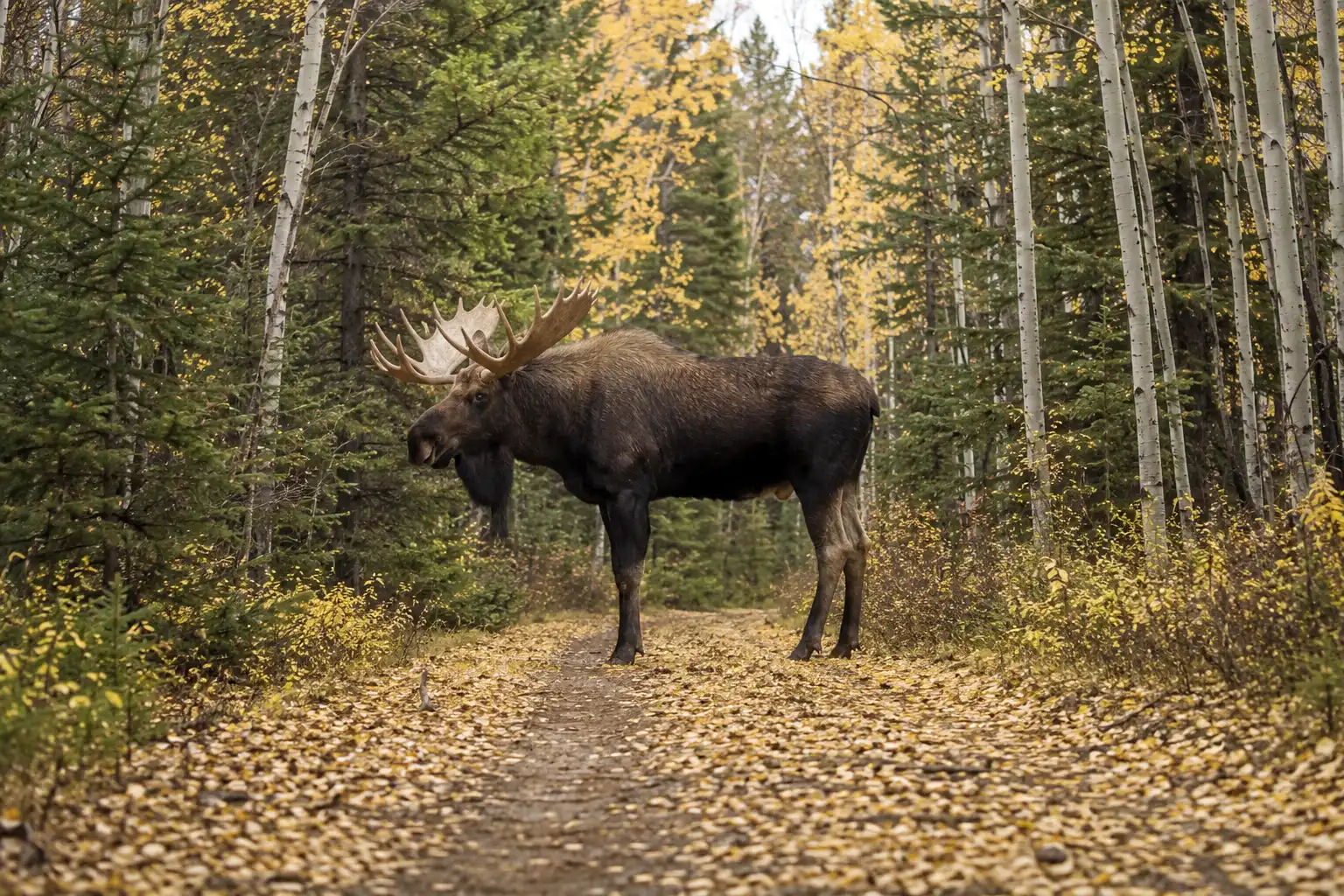
Size explains the caution. An Alaska bull can reach 1,600 pounds and stand over seven feet at the shoulder, and moose run up to 35 mph. Outrunning one in the open is not happening, so cover always beats speed.
Where this advice comes from
I should be straight with you. I hike the hills around Rangamati and Bandarban, and Bangladesh has no moose at all. Everything above comes from wildlife agency guidance, mainly Alaska Fish and Game and Colorado Parks and Wildlife, plus accounts from hikers who live in moose country.
What I do know firsthand is sharing a trail with an animal far bigger than me. Wild elephants move through the Chittagong Hill Tracts, and every local grows up with one rule about them: give them room and go the other way. Moose biologists repeat that same rule almost word for word.
FAQs about Moose on the Trail

Are moose more dangerous than bears?
Should you play dead with a moose?
Can a moose kill a person?
Will a moose chase me?
What does it mean when a moose walks slowly toward me?
Bottom lines
Moose injure more hikers than most people expect, and nearly every incident traces back to one thing: somebody got too close. Give a moose 25 yards or more, watch its ears and hackles, then leave the area the moment it reacts to you. Leash your dog as well, since dogs sit behind most attacks. If a moose charges, run and put a tree between you. If it knocks you down, curl up and stay still. Those few habits cover almost every moose encounter you will ever have.