What to Look for in Hiking Pants: Fabric, Fit, and Features

Comfort on the trail comes from a short list of specifics, not from luck. This guide walks through fabric, fit, construction, weather features, and the small details that separate trail pants from ordinary pants. Everything here comes from buying, wearing, and wearing out pants in the Bandarban hills.
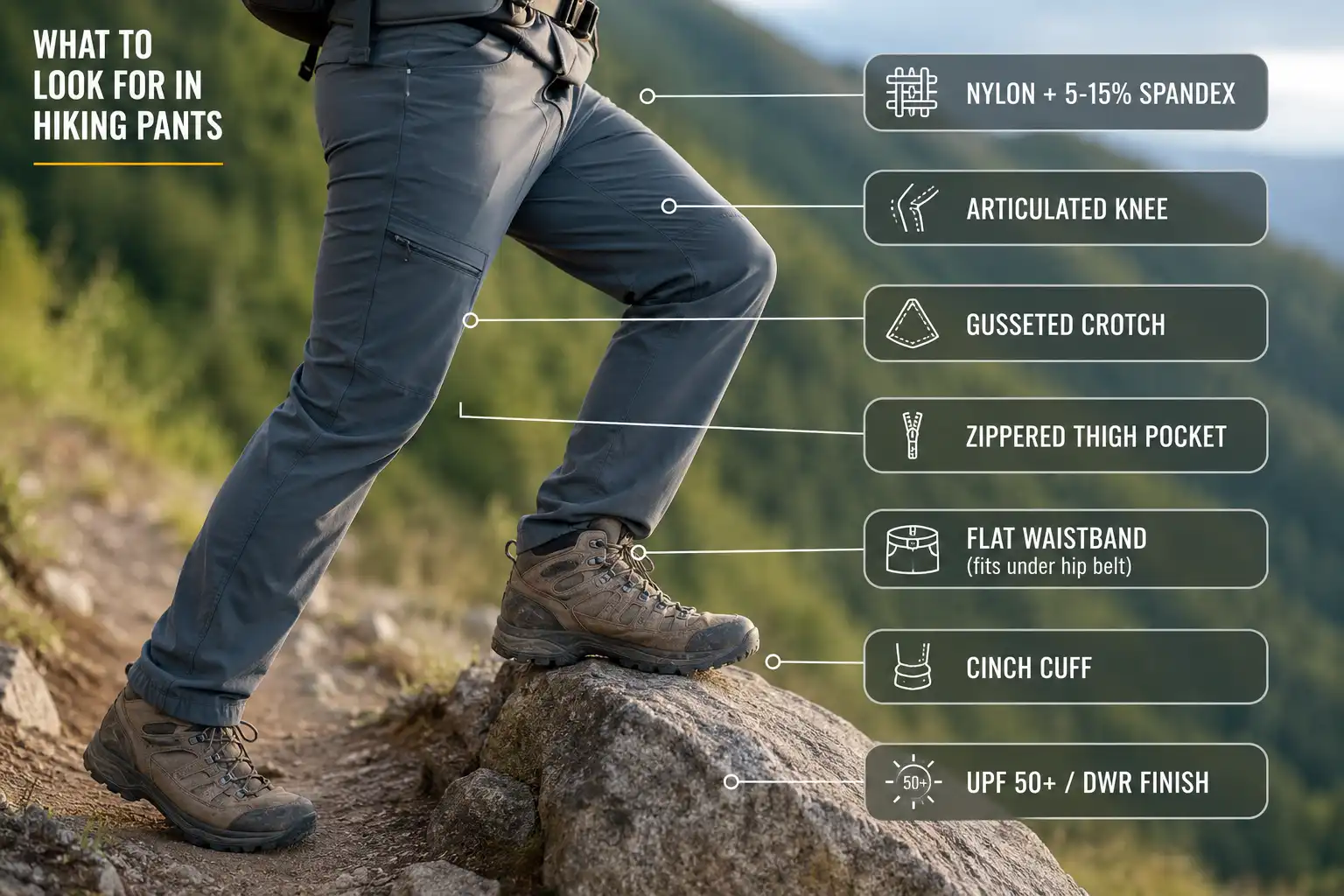
Look for a nylon or polyester blend with roughly 5 to 15 percent spandex. Then check for a gusseted crotch, articulated knees, a flat waistband, one zippered pocket, and a DWR finish. Skip cotton and denim entirely.
What fabric works best for hiking pants?
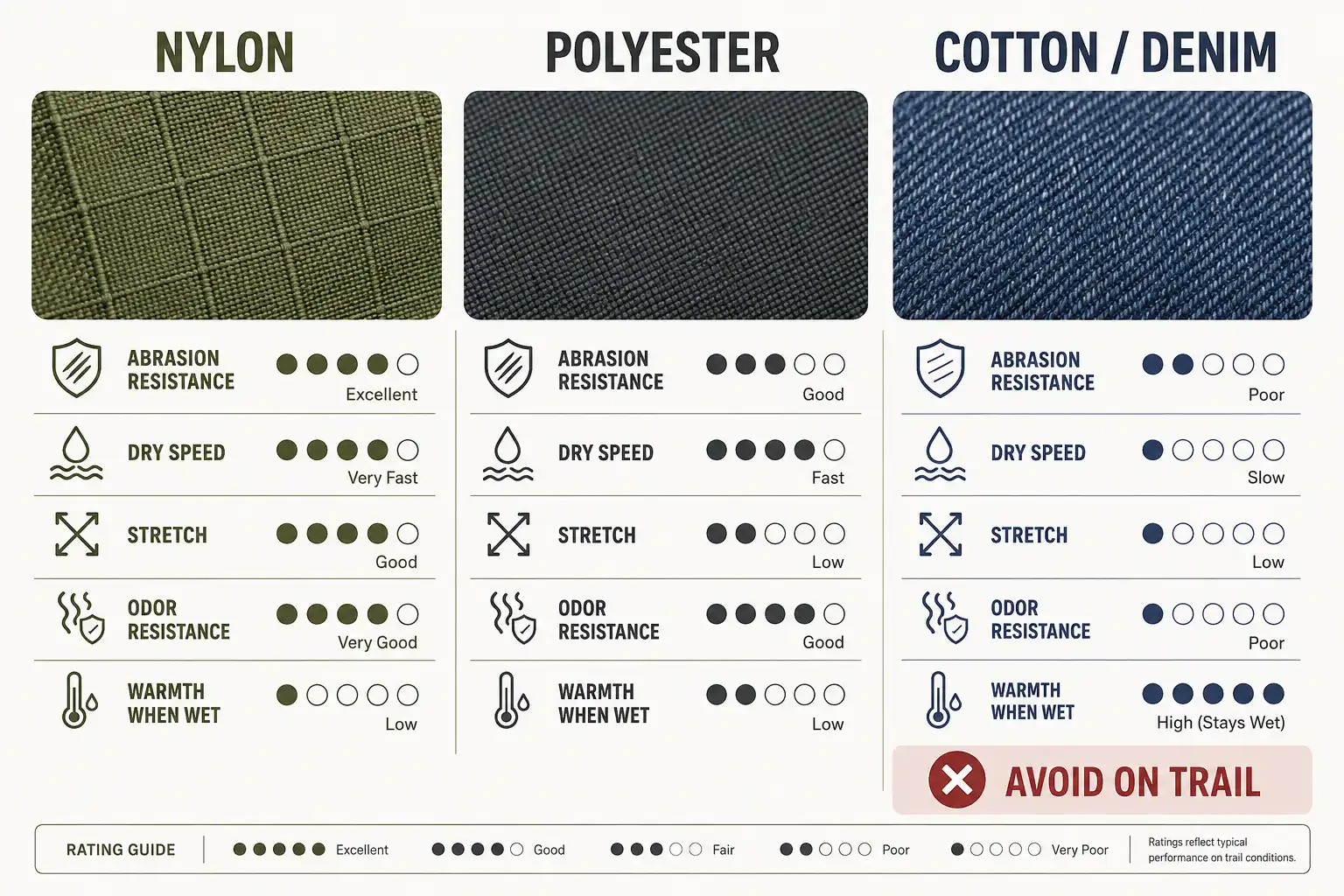
Nylon, polyester, or a blend of the two works best, usually with a little spandex added for stretch. Both fibers wick sweat, dry fast, and resist abrasion far better than natural fabrics. Almost every serious pant on the market runs 85 percent or more of one or both.
Nylon
Nylon is the tougher fiber. It handles abrasion and tearing better, so it survives rock, scree, and thorny brush. On its own, though, nylon barely stretches, which is why brands blend it with spandex. For scrambling or thick undergrowth, start with nylon.
Polyester
Polyester dries faster and usually costs less. It also has mechanical stretch, meaning the weave flexes without added elastic fibers. The trade-off is abrasion resistance, which sits a step below nylon. Polyester holds odor more stubbornly too, because the fiber attracts skin oils rather than water. That same trait shows up in shirts and base layers. So understand how polyester performs as a hiking fabric before building a whole kit around it.
Spandex and elastane
Spandex supplies the stretch, and most good hiking pants land between 4 and 14 percent. That small share does a lot of work on steep ground. Below roughly 4 percent, the fabric binds on high steps. Above about 15 percent, pants start behaving like leggings and snag more easily on branches.
Softshell blends
Softshell simply means a woven blend of nylon or polyester with elastane, usually finished with water repellency. These pants block wind, stretch well, and shrug off drizzle. However, they weigh more than a plain lightweight nylon pant. I save mine for cooler, windier days.
Why is cotton bad for hiking pants?
Cotton fails on the trail because it soaks up sweat and rain, holds that moisture against your skin, and takes hours to dry. Wet cotton also pulls heat out of you quickly. On a cool ridge, that shifts from uncomfortable to genuinely risky.
Denim behaves the same way, only heavier. Jeans stiffen when wet, chafe at the inner thigh, and add weight to every step. I learned that on a wet-season walk near Kaptai and spent the entire return leg peeling damp denim off my legs.
Blends deserve the same caution. A pant listed at 60 percent cotton still behaves mostly like cotton.
How should hiking pants fit?
Hiking pants should sit close enough to stay clear of brush, yet loose enough for a full high step without the fabric pulling. Too baggy and the legs flap, snag, and add weight. Go too tight, however, and you get chafing, restricted movement, and faster wear at the knees and seat.
Test the fit before buying. Squat down completely. Then step up onto something knee-height. If the fabric strains across your thigh, or the waistband drops at the back, those pants are wrong for you.
Inseam length matters as much as waist size. Pants that pool over your boots collect mud and catch your heels on descents. Many brands offer short, regular, and long inseams, so check that before ordering online. Cuts also vary widely between brands. In practice, choosing trail clothing that fits women properly comes down to rise and hip shaping more than waist number.
Which construction details actually matter?
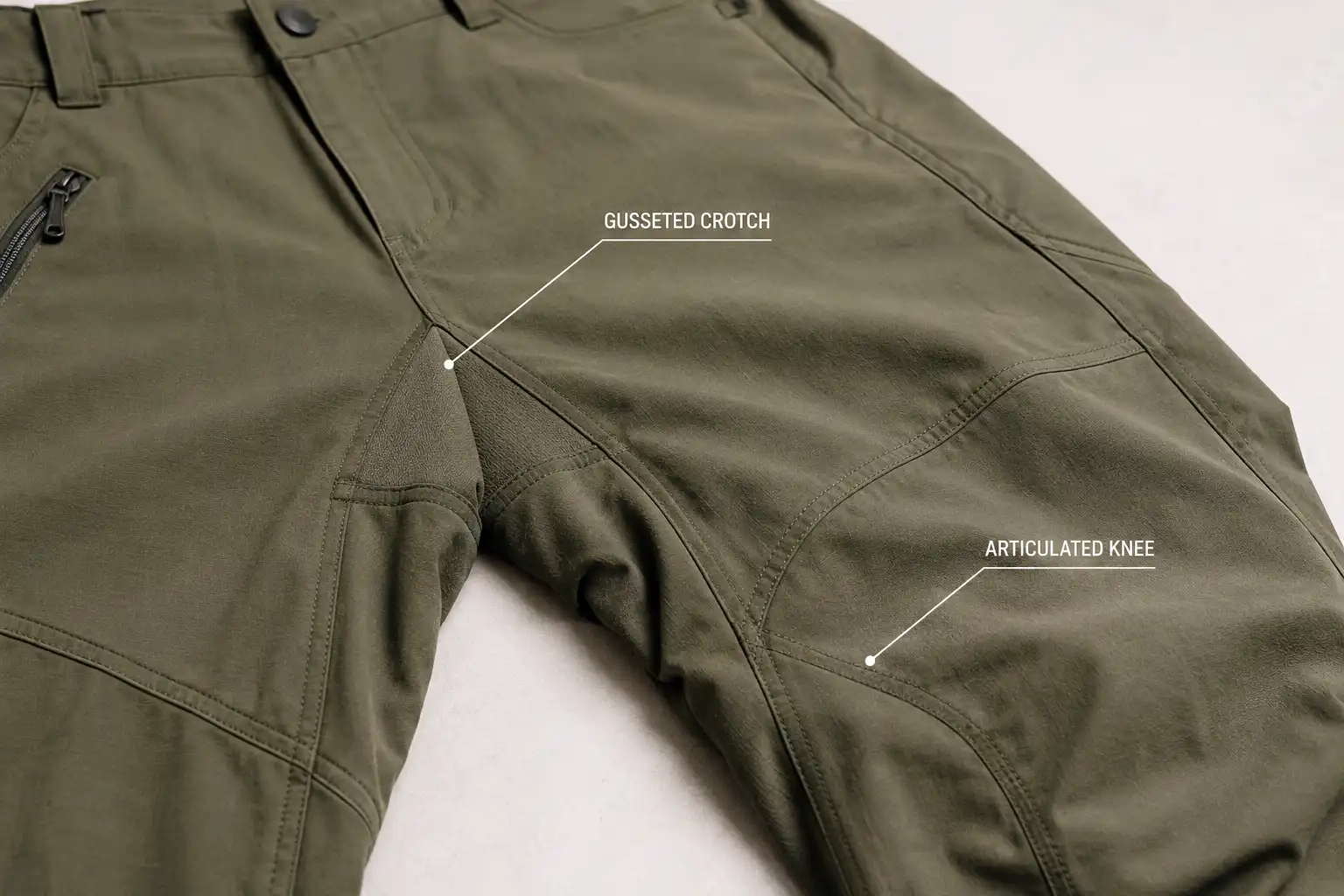
Three details matter most: a gusseted crotch, articulated knees, and reinforced panels. Each one affects how the pants move and how long they last.
Gusseted crotch
A gusset adds a diamond or triangular panel of fabric where four seams normally meet. That removes the pressure point that makes ordinary pants pull when you high-step. It also prevents blowouts, since that junction splits first on cheap pants.
Articulated knees
Articulated knees use extra seams to pre-shape the fabric into a bent position. You notice the difference immediately on a steep climb. Without articulation, the knee pulls tight on every stride and wears through faster.
Reinforced panels
Better pants add a tougher weave at the knees, seat, and cuffs. Those three spots absorb the most abuse from kneeling, sitting on rock, and boot rub. Reinforcement adds a little weight, but on rough terrain it pays for itself.
What waistband works best under a backpack?
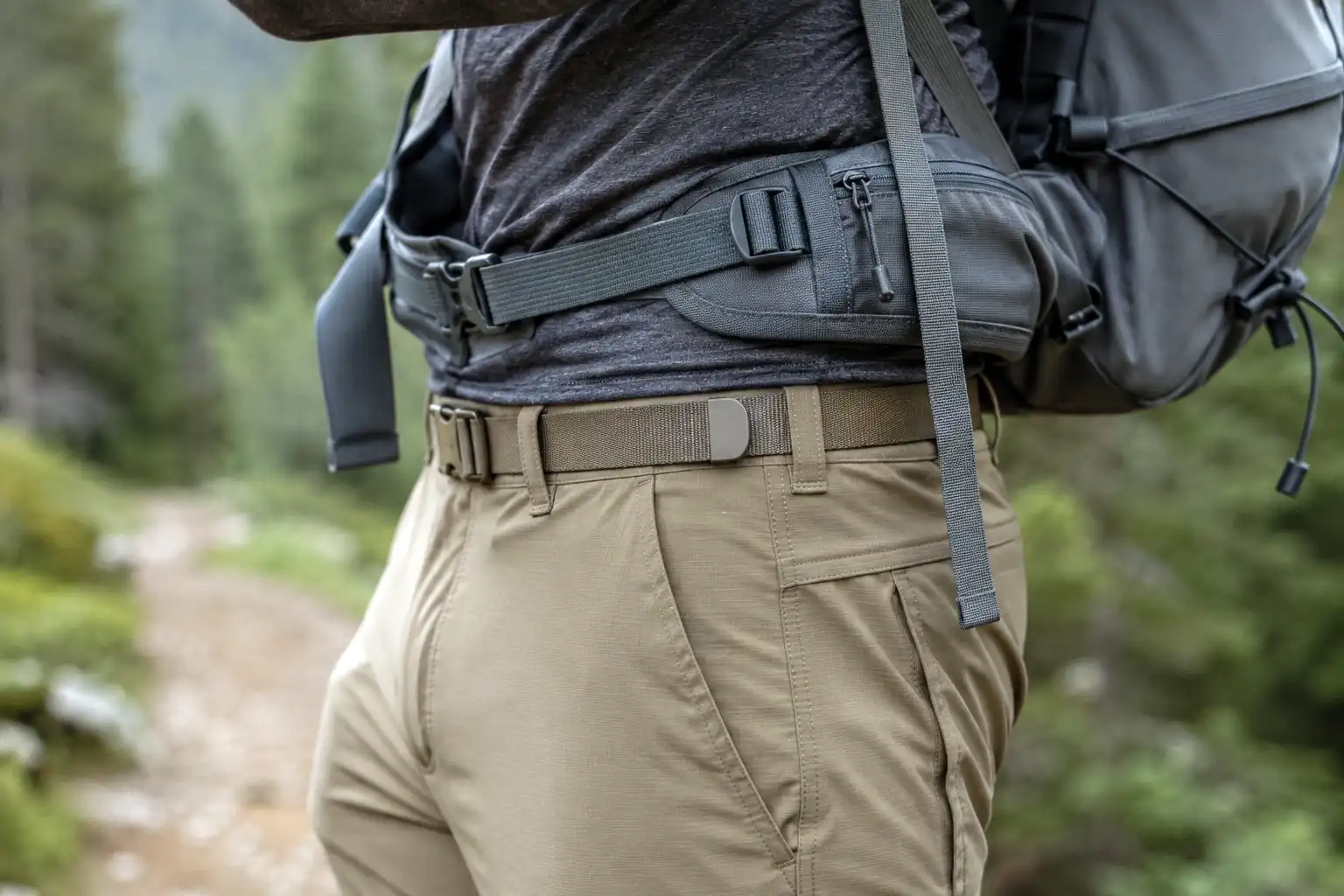
A flat, low-bulk waistband works best, because a loaded hip belt presses on it for hours at a time. Thick belt loops, chunky buttons, and stacked seams all create hot spots that turn into rubbed skin by afternoon.
Look for one of three setups: an integrated webbing belt, an internal drawcord, or a partially elasticized back panel. Each adjusts the fit without adding hardware under the hip belt. An integrated belt also saves you from packing a separate one.
Skip a heavy leather belt. It bunches under the pack and digs in on long climbs.
Which pockets do you actually need?
You need one zippered pocket at minimum, ideally on the thigh, plus two hand pockets. Pocket count matters far less than pocket security. Anything that flaps open will empty itself the first time you scramble or sit down on a boulder.
A thigh pocket sized for a phone earns its place. It stays reachable with a pack on, and it does not press into your hip. Hand pockets, meanwhile, become almost useless once a hip belt covers them.
Mesh pocket bags help in hot weather, since they vent instead of trapping heat. On sandy or dusty ground, though, they let grit straight through.
Do hiking pants need to be waterproof?
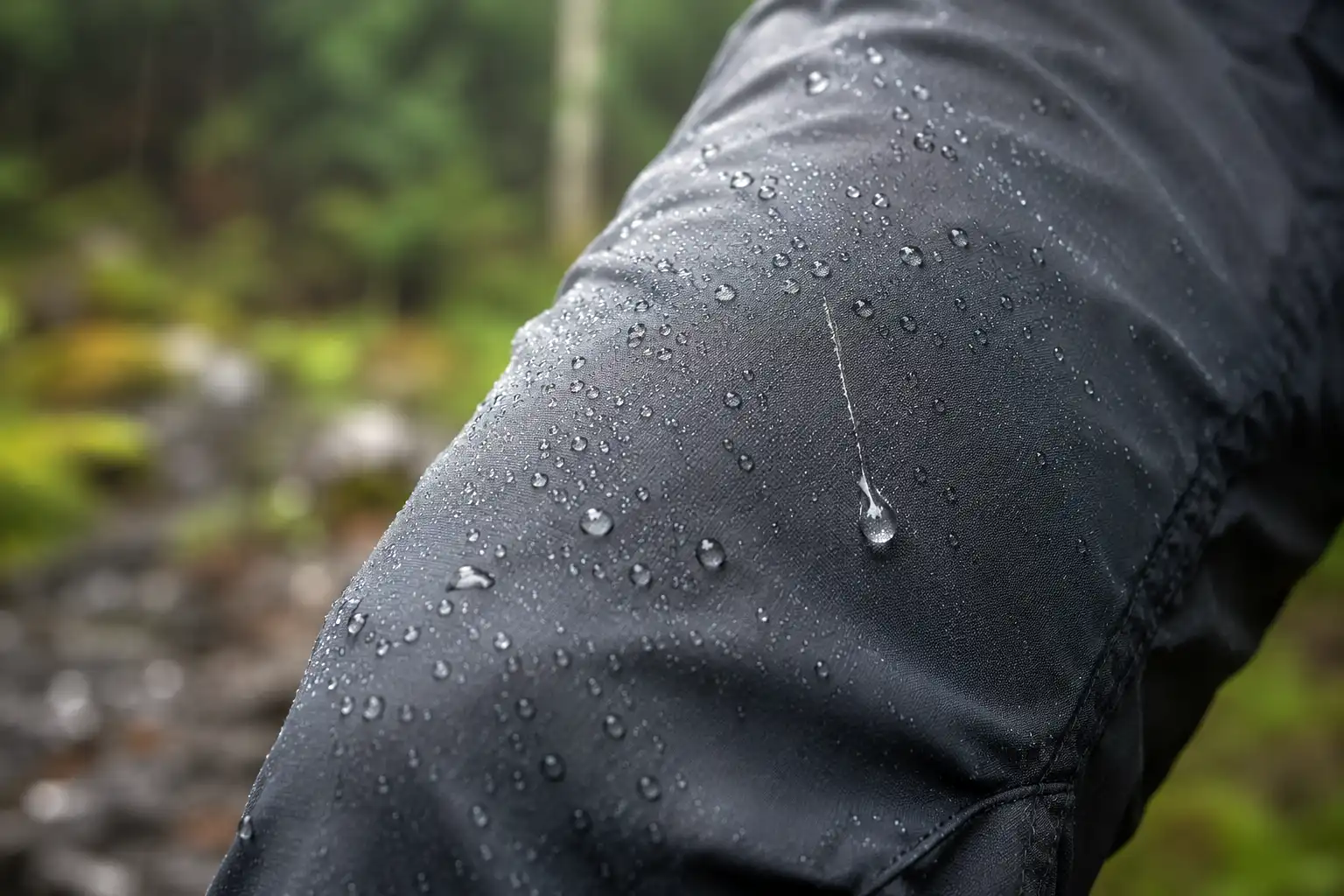
No, hiking pants do not need to be waterproof, and almost none of them are. Good pants carry a DWR finish instead, short for durable water repellent. That finish makes light rain bead up and roll off rather than soak in.
DWR handles drizzle, dew, and splash from a creek crossing. Sustained rain will still soak through. For that you want separate rain pants worn over the top, and keeping those two jobs separate also keeps your hiking pants breathable. My approach to staying dry in the rain without overheating covers when to pull that layer on.
DWR wears off, too. It fades first at the knees, seat, and lower thighs, exactly where abrasion is highest. A wash-in treatment restores it, and a low-heat tumble dry helps reactivate whatever remains.
How much sun protection do hiking pants give?
Most technical hiking pants carry a UPF rating somewhere between 30 and 50 plus. UPF 30 blocks roughly 97 percent of UV radiation, while UPF 50 blocks about 98 percent. The Skin Cancer Foundation rates UPF 30 to 49 as very good protection and UPF 50 plus as excellent.
That gap sounds trivial, yet the math says otherwise. UPF 30 transmits 3.3 percent of UV; UPF 50 transmits 2 percent. Across a full day above the treeline, the difference accumulates.
Two things weaken any rating. Wet fabric transmits more UV than dry fabric. Stretched fabric does the same, because the weave opens up. Very tight pants on a hot day therefore protect less than the tag suggests.
Covered legs still beat bare legs by a wide margin. For reference, a plain white cotton tee rates around UPF 5 to 7, so ordinary clothing offers little real defense. Pair rated pants with proper sunscreen for high-altitude trails on everything the fabric leaves uncovered.
Are convertible hiking pants worth it?
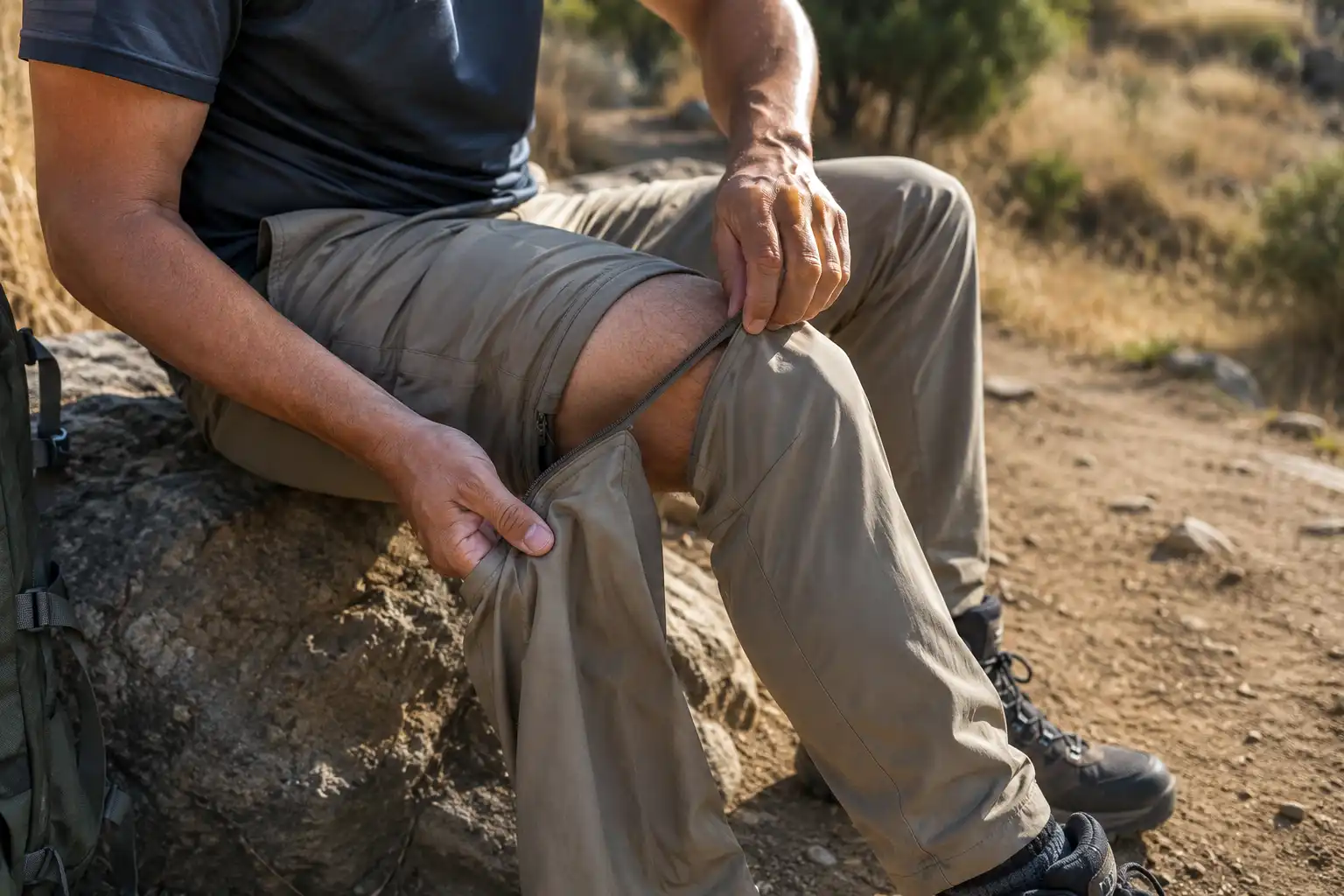
Convertible pants are worth it if your mornings run cold and your afternoons run hot, and you would otherwise carry shorts as well. Zip-off legs give you two garments in one and cut pack weight.
They carry trade-offs, though. Zippers add weight and bulk. The knee area often fits baggy, because the same fabric has to work as pants and as shorts. On many models you also have to remove your boots to take the legs off, which is a real nuisance mid-trail.
Roll-up pants with a button tab solve part of the problem without any zippers. They never become true shorts, but they vent your calves in seconds. For humid Bandarban trails, I reach for roll-ups far more often.
What about cuffs and hems?
Cuffs should cinch or close down, because open hems catch on brush, ride up over boots, and let debris in. A simple elastic drawcord or snap tab at the ankle fixes all three problems at once.
Boot hooks help on wet ground by holding the hem over your laces. Ankle zippers make pants easier to pull on over boots. Neither feature is essential, yet both save time.
How much should hiking pants weigh?
Most three-season hiking pants weigh between 8 and 15 ounces, roughly 225 to 425 grams. Ultralight models sit near the bottom of that range, while reinforced softshells sit at the top.
Weight tracks with durability and warmth. An 8-ounce pant breathes beautifully and packs down tiny, but it will not survive much granite. A 14-ounce softshell blocks wind and shrugs off brush, yet it feels hot in humid air. Choose for where you actually hike, not where you hope to hike someday.
Should you buy insect-treated pants?
Insect-treated pants make sense in tick country and heavy mosquito zones. The treatment is permethrin, and the CDC recommends permethrin-treated clothing as one layer of tick prevention alongside skin repellent and daily tick checks.
Factory-treated garments hold protection through far more washes than a home spray does. Insect Shield states its bonded treatment lasts the expected lifetime of the garment, up to about 70 launderings for apparel. A do-it-yourself spray such as Sawyer’s typically survives around six washes before it needs reapplying.
Two cautions matter here. Permethrin is highly toxic to cats, so keep treated clothing away from them, especially while it is still damp. Public health guidance in Canada also limits treated clothing to people over 16. Treated pants reduce bites; they never eliminate them, so keep your mosquito defenses on the trail layered.
How do you match hiking pants to your conditions?
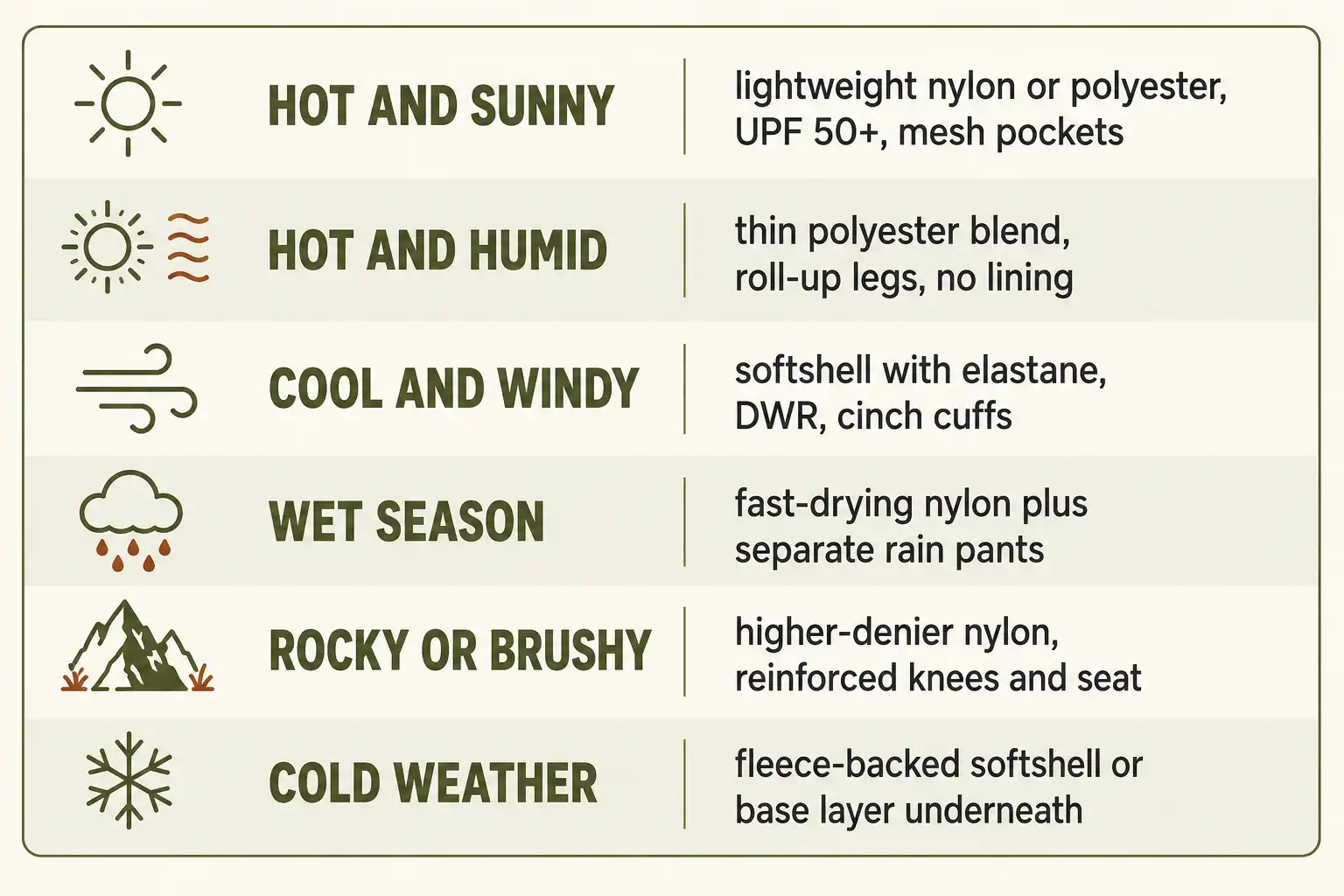
Match the pant to the terrain and season rather than to a general idea of hiking. Here is the shorthand I use:
| Conditions | What to look for |
|---|---|
| Hot and sunny | Lightweight nylon or polyester, UPF 50 plus, mesh pocket bags, relaxed cut |
| Hot and humid | Thin polyester blend, roll-up legs, no lining |
| Cool and windy | Softshell with elastane, DWR finish, cinch cuffs |
| Wet season | Fast-drying nylon plus separate rain pants |
| Rocky or brushy | Higher-denier nylon, reinforced knees and seat |
| Cold weather | Fleece-backed softshell, or a base layer underneath |
My cold-weather knowledge stops where the frost line starts, since Bangladesh gives me no snow to test in. So treat that last row as sourced from gear testers, not my own trips. From experience, though, I can confirm that a softshell over a thin base layer handles wind well. That is also the core idea behind layering for cold wind on the trail.
How much should hiking pants cost?
Solid hiking pants generally run from about 60 to 150 US dollars at full price, with technical alpine models climbing higher. Prices move constantly, so treat that as a rough band and check current listings yourself.
Below roughly 50 dollars, something usually gets cut: stretch content, gusseting, or pocket security. Above 150, you mostly pay for specialized fabrics and lower weight. The middle of the range serves most hikers well.
Buy off-season when you can. Last year’s colorways drop hard once new stock arrives.
Which mistakes should you avoid?
Buying for looks first is the most common mistake. A slim urban cut photographs nicely, then binds on the first steep section.
Ignoring inseam comes next. Plenty of hikers size the waist carefully and simply accept whatever leg length shows up in the box.
Treating DWR as waterproofing ranks third, and discovering the difference during a downpour is miserable. Finally, some people buy a single pair for every condition. One pant rarely covers humid jungle and windy ridgeline equally well.
How do you make hiking pants last?
Wash them cold, on a gentle cycle, turned inside out. Skip fabric softener completely, because it coats the fibers and kills both wicking and water repellency.
Tumble dry on low occasionally. Gentle heat helps reactivate the DWR finish. Never iron permethrin-treated pants, since heat breaks down the bonded treatment.
Repair small tears early. Patching a two-inch rip costs almost nothing, while a blown-out seat means a new pair.
FAQs about Hiking Pant

Can you hike in leggings instead of pants?
Are cargo pockets useful for hiking?
Do hiking pants shrink?
How long do hiking pants last?
The bottom line
Getting hiking pants right comes down to five things: a nylon or polyester blend with some spandex, a gusseted crotch, articulated knees, a flat waistband, and at least one secure pocket. Add UPF 50 plus and a DWR finish when your conditions call for them. Then try them on, squat, and take a big step before you commit. Do that much, and you will stop thinking about your pants once you start moving. That is exactly the point.