Are Hokas Good for Hiking? What They Do Well and Where They Fail

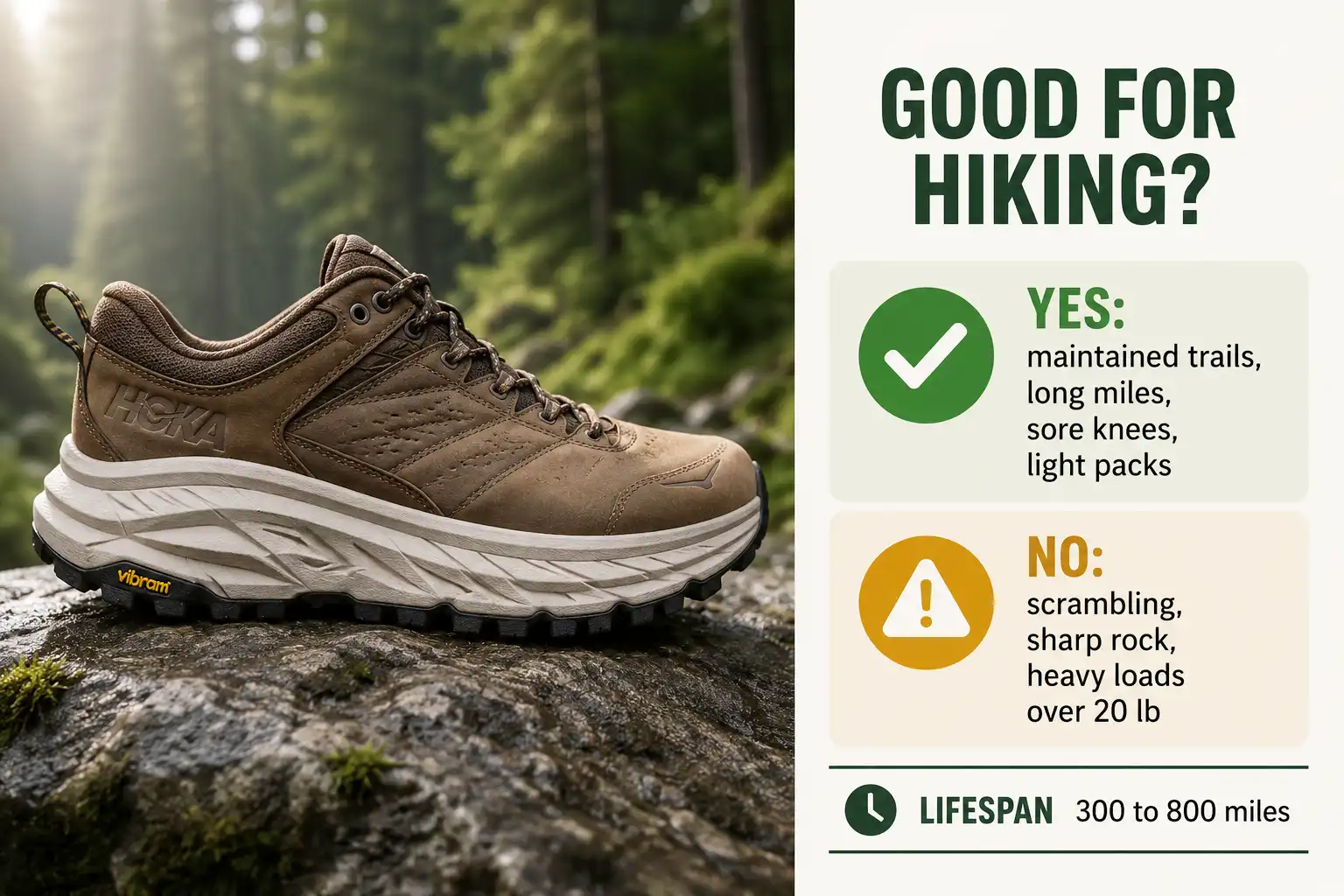
Hokas hike well, but the answer changes with the model and the terrain. Below I cover which Hokas suit hiking and how the thick cushioning behaves on rough ground. I also cover how long a pair lasts, plus who should pick something firmer instead.
Hokas work well for hiking on maintained trails, forest paths, dirt roads, and long approach walks where comfort matters more than precision. Hoka’s hiking-specific models grip wet rock properly because they use Vibram Megagrip outsoles. However, the tall midsoles cut your feel for the ground, so technical scrambling still favors something firmer and lower.
What makes a Hoka different from a normal hiking shoe?
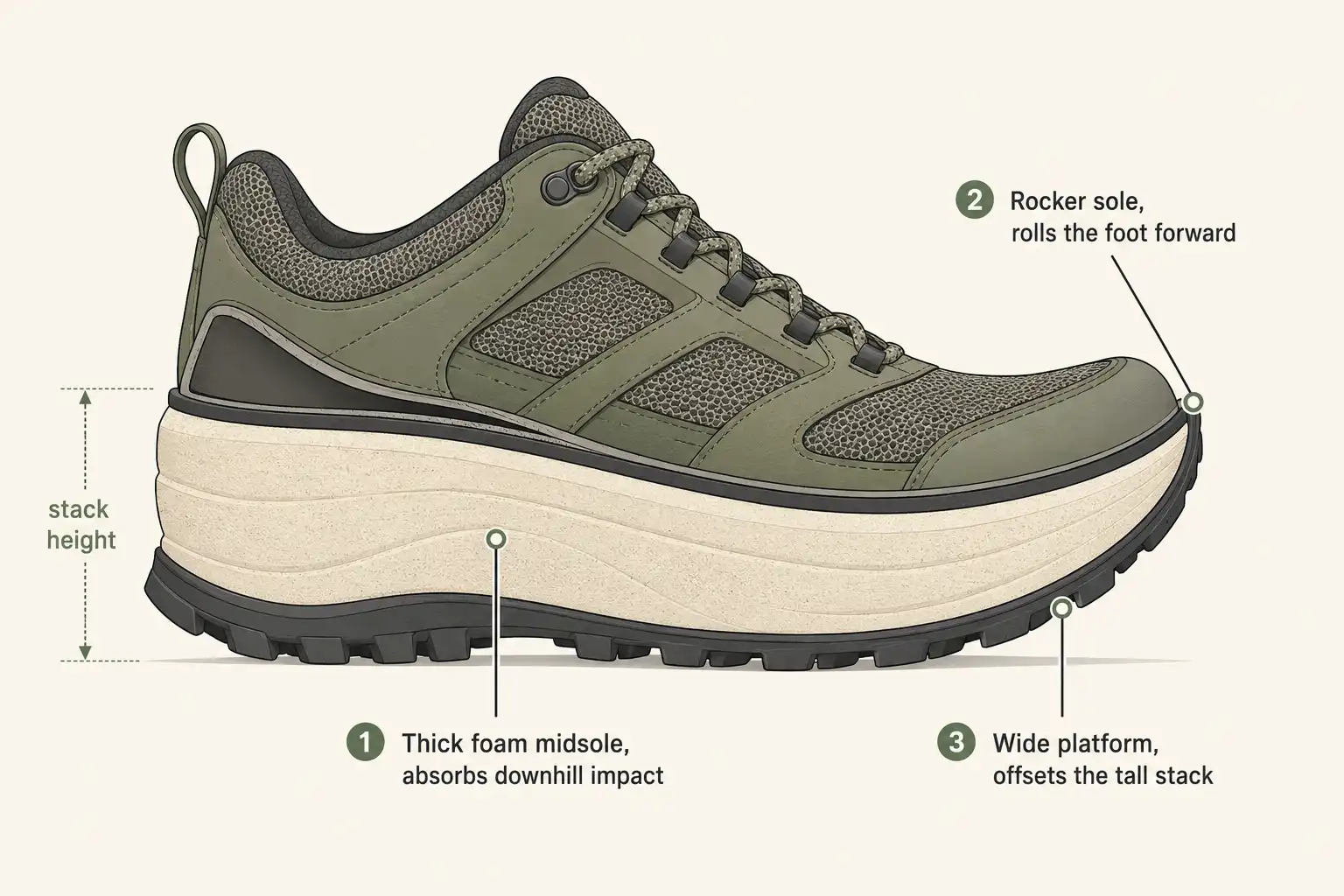
Hoka builds shoes around thick foam and a curved sole. Two former Salomon employees launched the brand in 2009, and Deckers owns it today. Three features define every pair.
Maximal cushioning. A Hoka midsole holds far more foam than a standard hiking shoe. That foam absorbs impact instead of passing it up into your knees and hips.
Meta-Rocker geometry. The sole curves upward at the toe. As a result, your foot rolls forward through each step instead of flexing hard at the ball, which saves energy across a long day.
Wide platform. The midsole flares out wider than your foot. Hoka added that width on purpose, because tall foam on a narrow base would feel tippy.
Traditional hiking shoes take the opposite route. They use firmer foam, a lower stack, and stiffer shanks so you can read the ground under you. Minimalist and zero-drop trail shoes push that idea further still, with almost no foam at all. Hoka sits at the far opposite end of the same scale.
Learn more: Hiking in Jeans
Which Hoka models are built for hiking?
Hoka splits its trail lineup into hiking models and trail running models. Both see trail duty, but they handle wear very differently.
| Model | Best for | Cut | Weather |
|---|---|---|---|
| Anacapa 2 Low GTX | Day hikes, faster pace | Low | Waterproof |
| Anacapa 2 Mid GTX | Day hikes, light packs | Mid | Waterproof |
| Anacapa Breeze | Hot and humid hiking | Low and mid | Breathable, not waterproof |
| Kaha 3 Low GTX | Long days with support | Low | Waterproof |
| Kaha 3 GTX | Backpacking, heavy loads | Mid | Waterproof |
| Speedgoat 7 | Fast hiking, thru-hiking | Low | Mesh, GTX version available |
| Trail Code GTX | Casual mid-cut hiking | Mid | Waterproof |
Anacapa: the day hiking pick
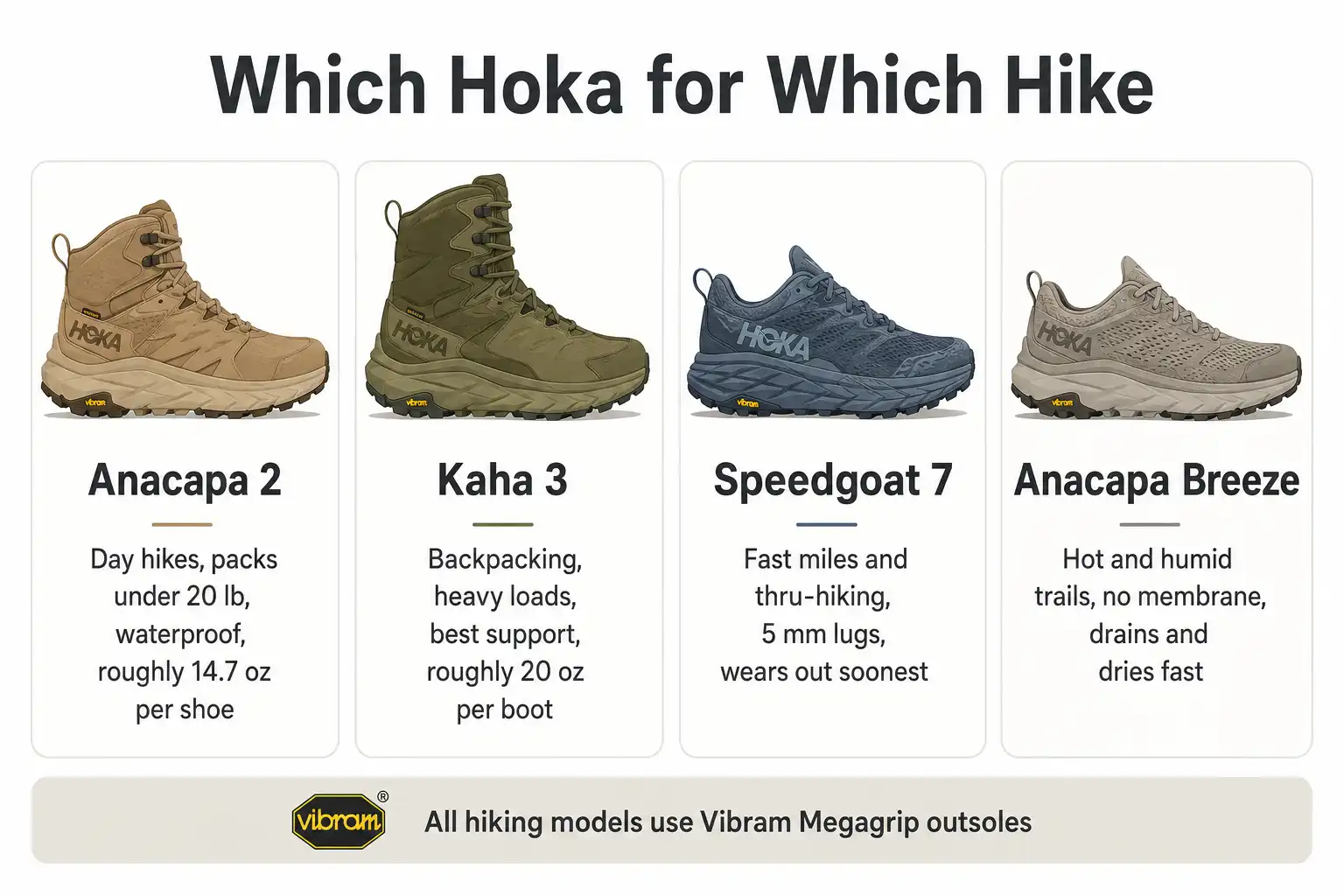
The Anacapa 2 is the model Hoka points most day hikers toward. It pairs a leather and mesh upper with a firmer midsole than Hoka’s running shoes, plus a Vibram Megagrip outsole. Reviewers weigh the Mid GTX near 14.7 ounces per shoe, which is light for a waterproof boot. It also carries the American Podiatric Medical Association Seal of Acceptance.
One warning for 2026 buyers. Anacapa 2 stock has thinned at several retailers, and Hoka has not confirmed an Anacapa 3.
Kaha: the backpacking pick
The Kaha 3 GTX is Hoka’s most supportive hiker, so choose it when you carry weight. It uses a dual-density sugarcane EVA midsole, nubuck leather, and a one-piece Vibram Megagrip outsole with 4mm lugs. Testers weigh it near 20 ounces per boot.
Independent lab testing recorded some of the highest shock absorption figures of any hiking boot here. That same testing flagged very poor breathability, though. Sweat builds fast inside it.
Speedgoat: the trail runner hikers adopted
The Speedgoat is a trail running shoe, yet plenty of hikers wear it as their main trail shoe. Its 5mm Vibram Megagrip lugs bite into loose dirt. Hoka then released the Speedgoat 7 in early 2026 with firmer, more stable foam than the 6 used.
Durability is the catch. A mesh upper snags and tears, while the softer midsole flattens much sooner than the Anacapa’s.
Anacapa Breeze: for heat and humidity
The Breeze drops the Gore-Tex membrane and swaps in a ventilated knit upper. Here in the Chittagong Hill Tracts, that choice beats waterproofing outright. Our trails cross streams constantly through monsoon, so a sealed boot just fills up and stays wet. I pick drainage and airflow over a membrane every time in this climate.
Where do Hokas perform well on the trail?
Hokas shine on long, repetitive miles over reasonable ground. Here is where the design earns its price.
Joint protection on descents. Downhill pounding is what wrecks most hikers. That thick foam takes a real bite out of the impact, which helps a lot if you already struggle with sore knees on steep descents.
Long distances. Once you pass 15 miles in a day, fatigue in your feet becomes the limiting factor. Hoka’s whole design targets exactly that problem.
Traction on wet rock. Vibram Megagrip is genuinely one of the best rubber compounds available. Both the Anacapa and Kaha use it.
Weight for the protection offered. A Kaha 3 weighs around 20 ounces per boot while a comparable Salomon Quest 4 sits far heavier. So you get burly cushioning without a burly boot.
Foot conditions. Hikers with plantar fasciitis, arthritis, or old foot injuries often report real relief in Hokas. The cushioning does the work their tissue no longer wants to do.
Where do Hokas fall short?
Hokas struggle on technical, uneven, and rocky terrain. The same foam that protects you also separates you from the trail.
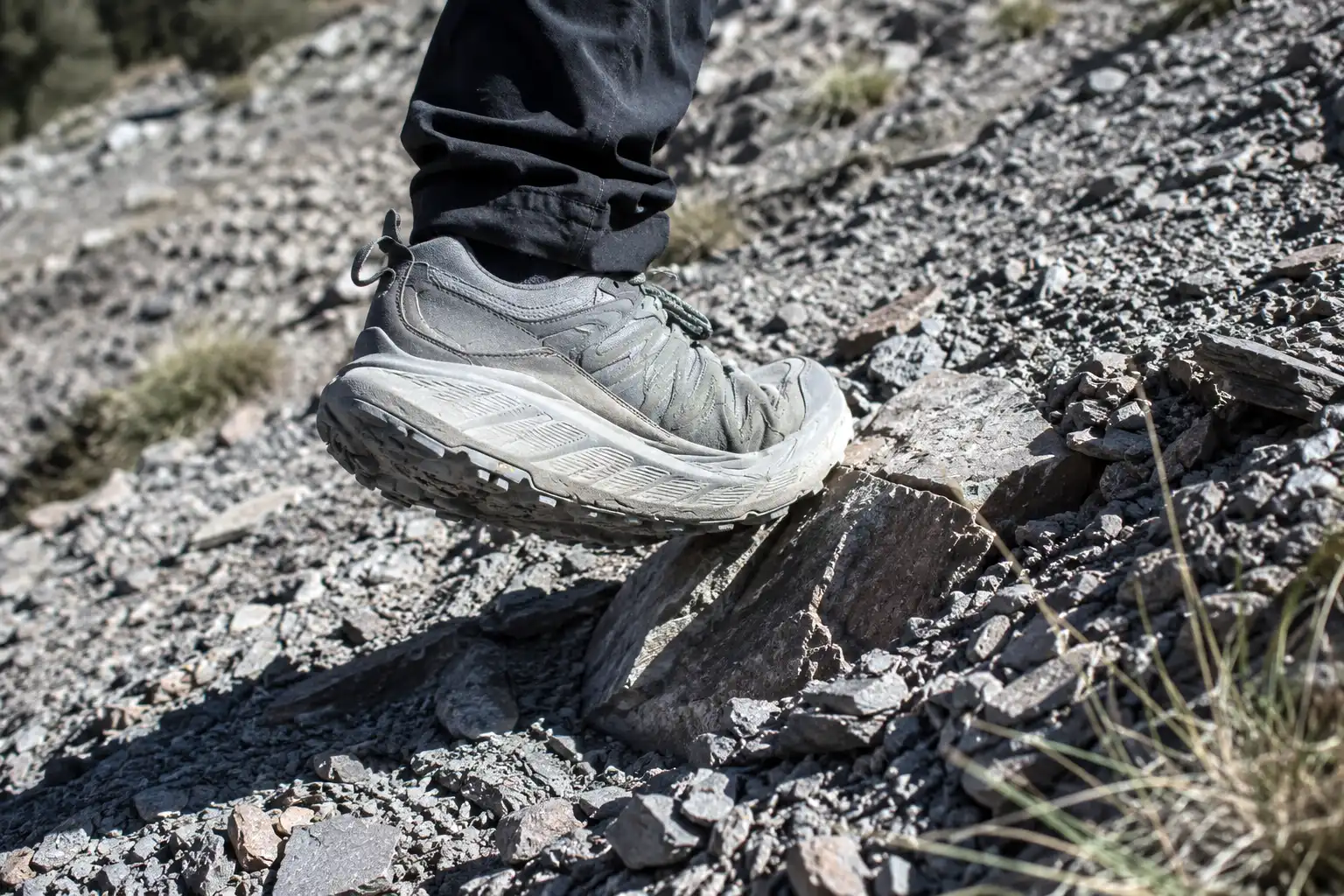
Reduced ground feel. Thick foam blunts the feedback your feet use to react. On loose scree or slick roots, you notice the delay. If your route involves genuine hands-on scrambling sections, a lower and firmer shoe serves you better.
Higher center of gravity. Tall stack means your ankle sits further from the ground. Hoka’s wide platform offsets much of this, but not all of it. Hikers with a history of ankle rolls should test carefully before committing to a big trip.
Soft foam under sharp rock. Trail running Hokas like the Speedgoat offer thin underfoot protection despite the stack. Sharp rock still comes through.
Poor breathability in Gore-Tex models. The Kaha 3 in particular traps heat. In warm, humid weather that means damp feet, and damp feet mean blisters. Better socks help a little, but they cannot fix a boot that refuses to vent.
Price. Most Hoka hikers land between roughly $155 and $240 at US retail. Verify current pricing before you buy, since it shifts often.
How long do Hokas last for hiking?
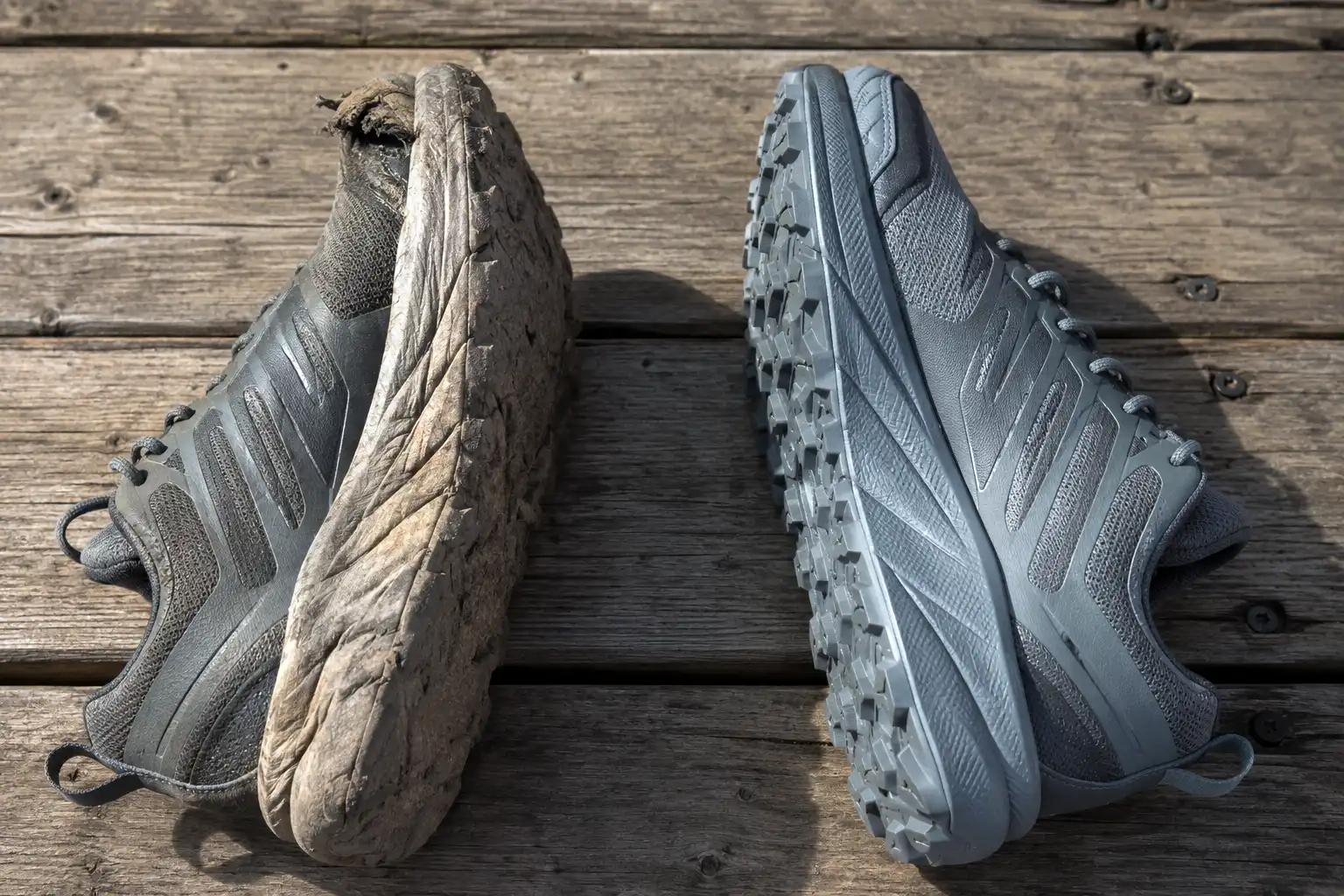
Hoka hiking boots last roughly 500 to 800 miles, while Hoka trail runners often give out between 300 and 500. Foam compression, not tread wear, usually ends the shoe first. Once the midsole packs out, the cushioning that justified the purchase simply disappears.
Model choice drives this heavily. The Anacapa uses firmer foam and a leather upper, so it outlasts the Speedgoat by a wide margin. One long-distance tester finished a 300-mile High Sierra section in Hoka Challengers and reported the tread worn and the midsole finished by the end.
Abrasive terrain accelerates everything. Granite, sharp limestone, and the loose rock we get on Bandarban ridge routes chew through outsoles faster than packed forest trail does. Delamination, where the rubber outsole peels away from the foam, shows up in owner reports too.
Watch for three signs of a dead pair. First, the midsole feels flat instead of springy. Second, the outsole lugs round off. Third, your feet ache after distances that never bothered you before. That lifespan sits below what well-built leather boots typically deliver. So it is a fair trade only if you value the comfort more.
Do Hokas fit well for hiking?
Most Hokas run true to length but vary a lot in width and volume. Sizing therefore needs attention before a big trip.
The Speedgoat fits snug and narrow through the midfoot. Meanwhile the Kaha runs roomier with more toe box volume, and the Anacapa sits between them, though it stays narrower than the Kaha. Hoka does not offer wide widths across the Anacapa boot line, which frustrates plenty of hikers.
Half a size up is the common recommendation for hiking, because feet swell over long days and descents push your toes forward. Anyone with broad feet should weigh the wider trail shoe options built for that shape before settling on a Hoka.
Try them on late in the day with your hiking socks on. That single habit prevents most fit mistakes.
Are Hokas good for hiking with a heavy backpack?
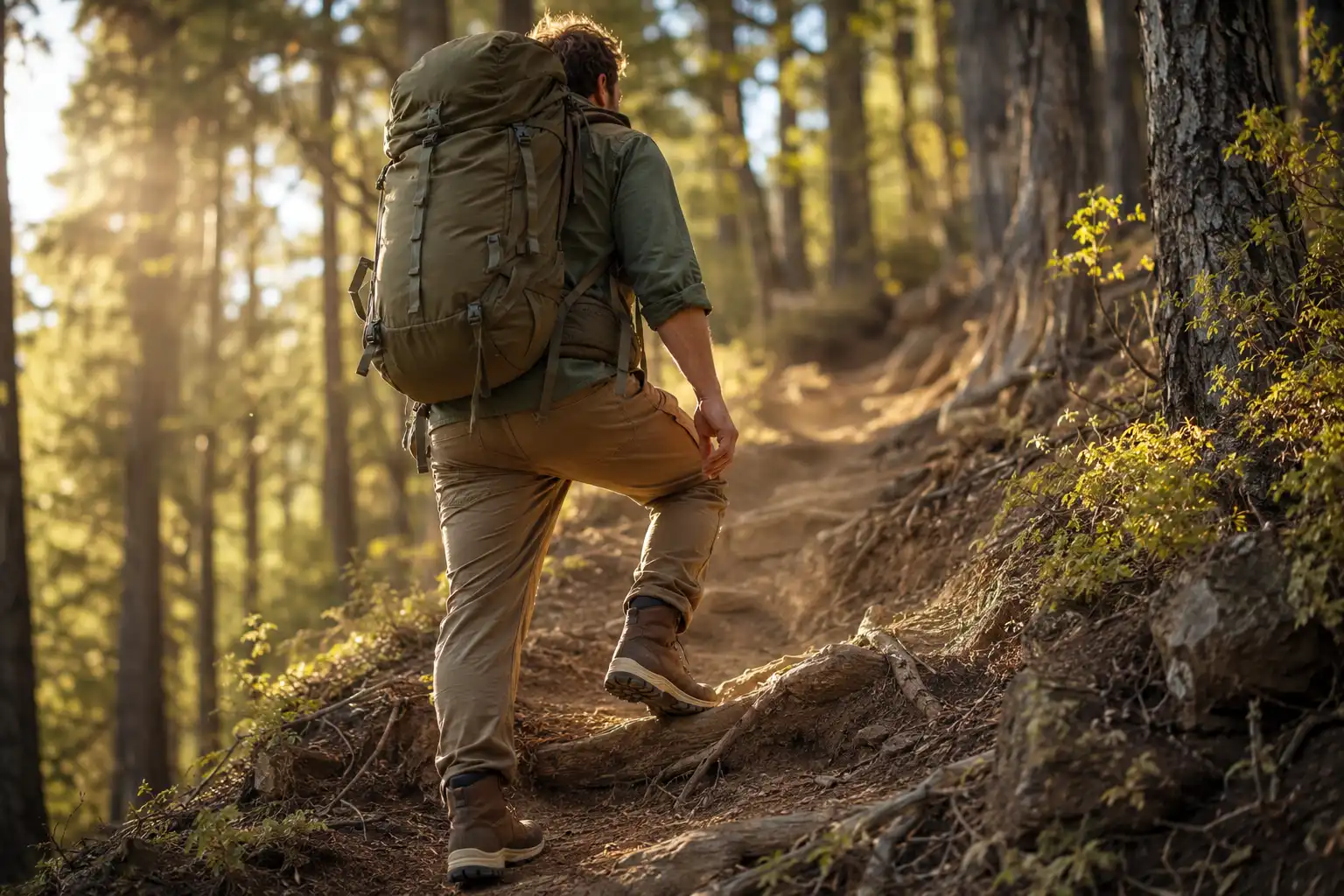
Only the Kaha handles genuinely heavy loads well. Its stiffer chassis, three ankle lacing hooks, and denser midsole resist collapsing under weight in a way the lighter Hokas do not.
Load compresses foam. That is simple physics. So a 35-pound pack squashes a soft midsole further with every step, which drops both the cushioning and the stability you paid for. The Speedgoat especially gets unstable under a heavy load on side-sloping trail.
For pack weights under about 20 pounds, the Anacapa Mid does fine. Above that, step up to the Kaha 3 or accept a traditional backpacking boot with a proper shank.
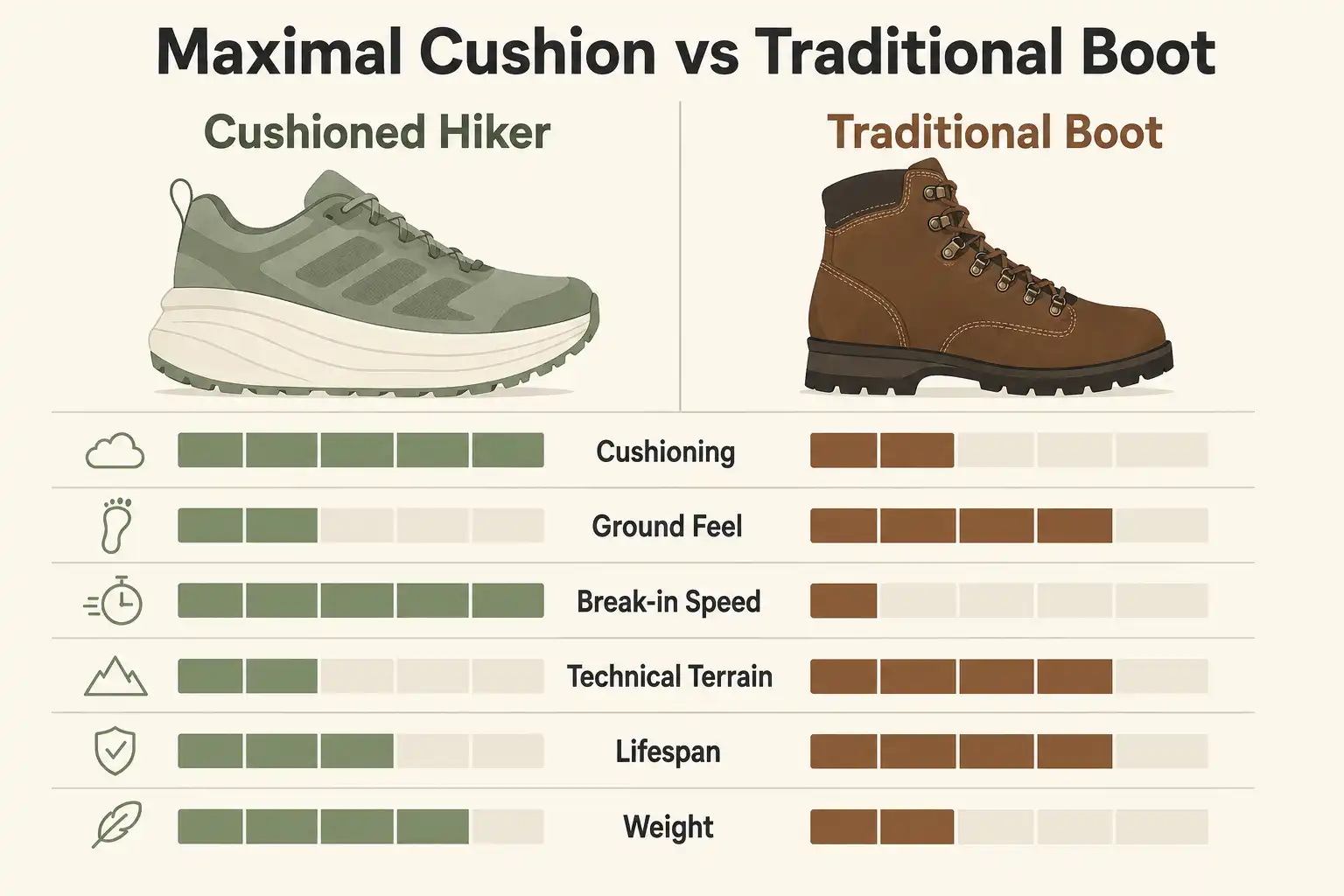
Hoka versus traditional hiking boots
| Factor | Hoka hikers | Traditional boots |
|---|---|---|
| Cushioning | Very high | Moderate |
| Ground feel | Low | Higher |
| Break-in time | Short | Often long |
| Technical terrain | Weaker | Stronger |
| Lifespan | 500 to 800 miles | Often 1000 plus |
| Weight | Light for the cushion | Usually heavier |
Break-in is the underrated advantage here. A stiff leather backpacking boot can take weeks of short walks before it stops raising hot spots. Hokas feel comfortable almost immediately, so they suit anyone with a trip already on the calendar.
Should you buy Hokas for hiking?
Buy Hokas if you hike long distances on maintained trails. They also make sense if your knees ache after descents, or if you want boot-level comfort without boot-level weight. The Anacapa 2 covers day hiking. The Kaha 3 covers backpacking. Speedgoats cover fast, light miles.
Skip Hokas if your hiking regularly involves scrambling, off-trail travel, or sharp technical rock. Skip them too if you have unstable ankles that have never adapted to a tall platform, or if you need maximum durability per dollar.
I hike mostly in the Bandarban and Rangamati hills, where trails turn steep, wet, and loose. Honestly, I lean toward lower and firmer shoes on those routes. On long, graded approaches though, I understand exactly why so many hikers refuse to wear anything else.
FAQs

Can you hike in regular Hoka running shoes like the Clifton or Bondi?
Are Hokas waterproof?
Do Hokas cause ankle injuries?
Are Hokas good for beginners?
Which Hoka is best for thru-hiking?
The bottom line
Hokas earn their reputation on long, moderate trails where cushioning saves your legs. The Anacapa 2 suits day hikers, the Kaha 3 handles packs, and the Speedgoat covers fast miles at the cost of durability. Just match the model to your terrain. If your trails stay rough, technical, or rocky, a firmer and lower shoe will still serve you better, and no amount of foam changes that.