Can You Zip Two Sleeping Bags Together? Here’s How to Tell

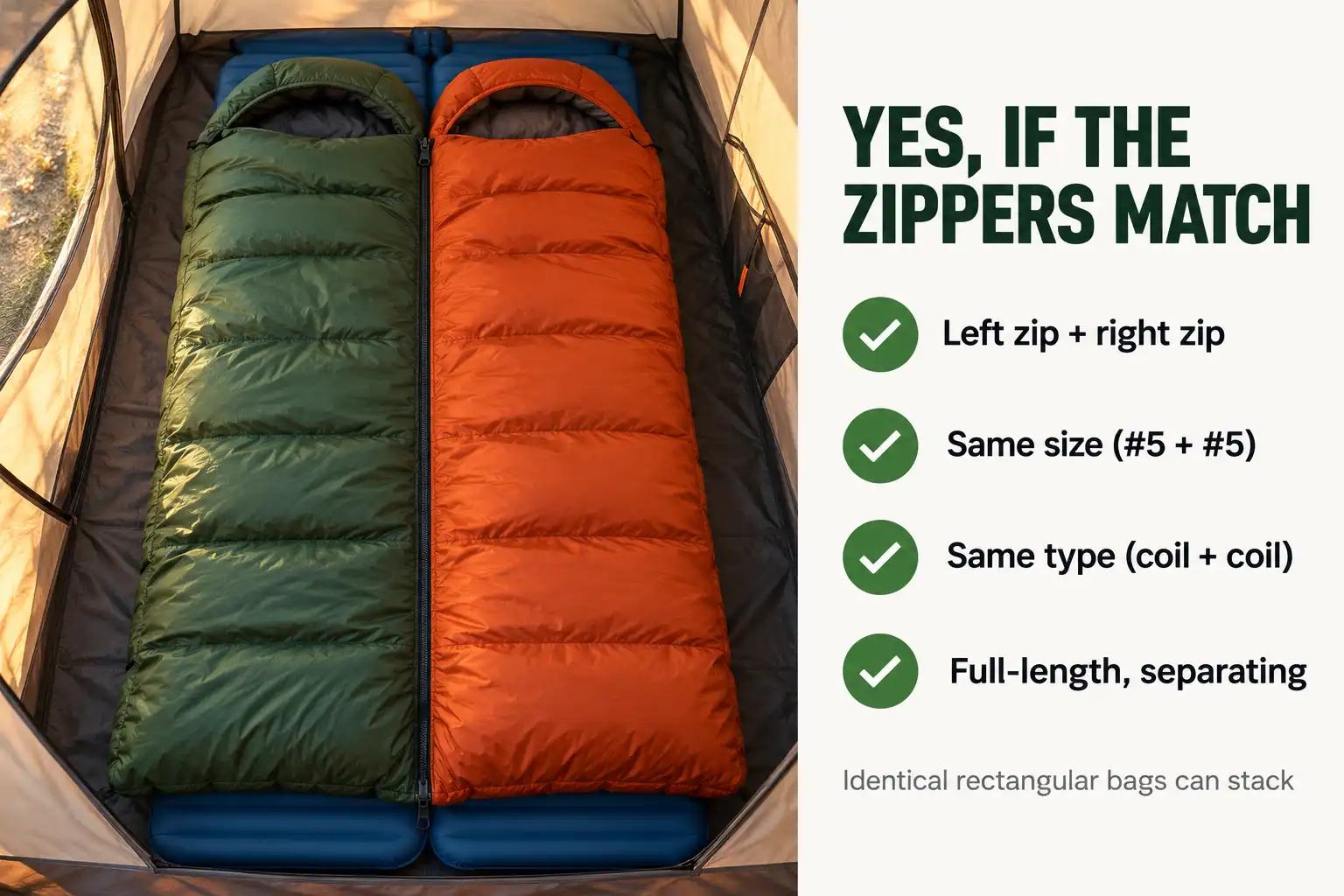
Yes, you can zip two sleeping bags together, but only when the zippers match. I learned that near Nilgiri one chilly December night, when a friend’s bag and mine refused to pair. So below, I’ll walk you through checking your bags, joining them, and working around a mismatch.
Two sleeping bags zip together when their zippers match in four ways. The zippers sit on opposite sides (one left zip, one right zip). They also share the same size number and zipper type. Finally, each one runs full length, so it splits apart at the foot like a jacket zipper. Identical rectangular bags bend the first rule, since you can stack them and zip around the edges.
What Two Sleeping Bags Need to Zip Together
Four zipper details have to line up. If even one is off, the bags won’t join, however hard you pull.
Zippers on opposite sides
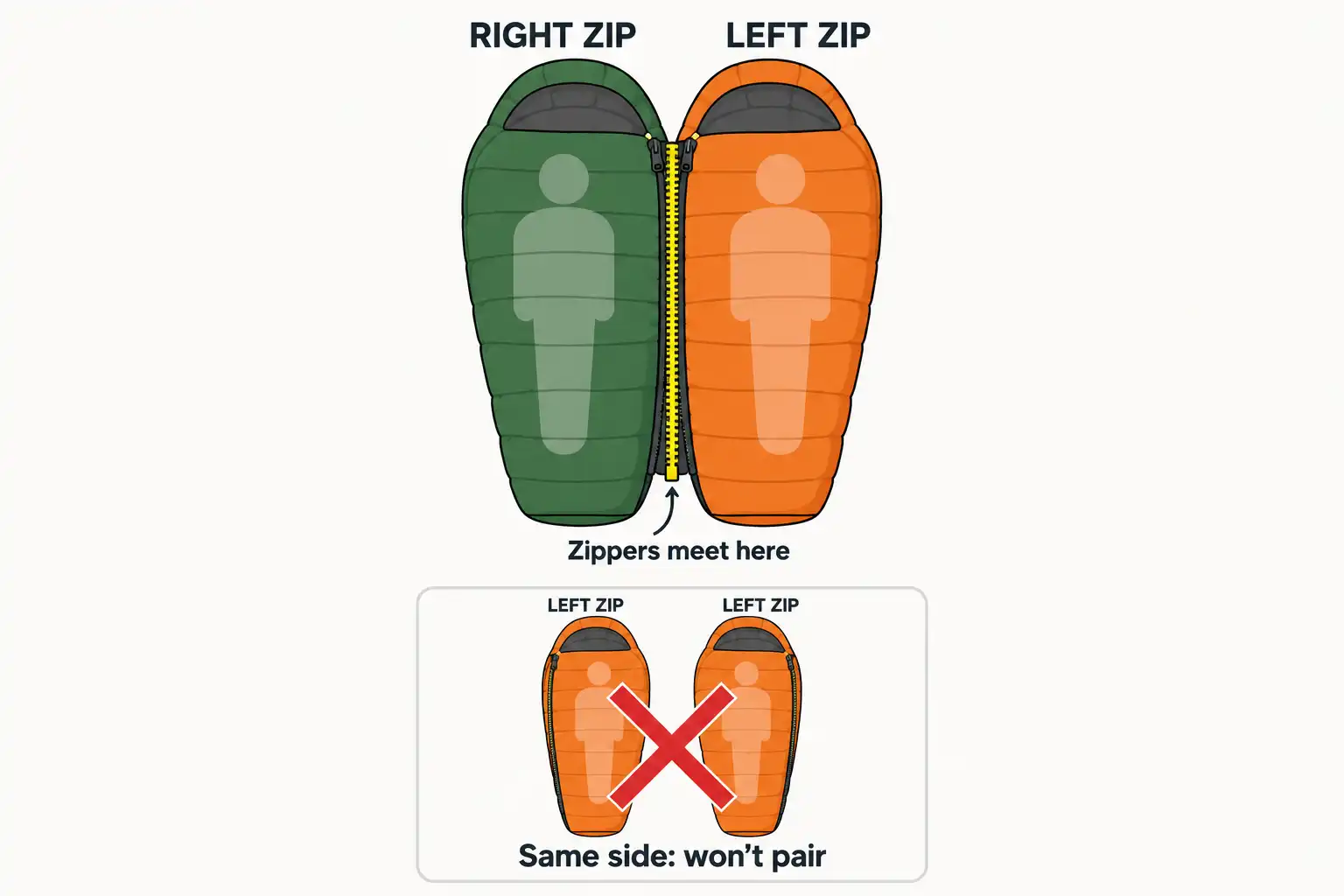
Bags that join side by side need one left-zip bag and one right-zip bag. The side refers to where the zipper sits when you’re inside the bag. So the person on the left takes the right-zip bag, and both zippers meet in the middle. With two left-zip mummy bags, one of you would have to sleep with the hood facing the ground.
The same zipper size
Zippers come in numbered sizes, and both bags need the same number. Big Agnes lists #3, #5, and #8 as the common sleeping bag sizes. A #5 slider simply can’t grip #8 coils, even when the bags look alike.
The same zipper type
Most sleeping bags use coil zippers. However, a coil won’t lock into a molded-tooth or metal zipper, even at the same size number. The coils also need to face the same direction. Sea to Summit points this out when it explains pairing its bags with other brands.
Full-length zippers that separate
Each zipper has to run the full length of the bag and come completely apart at the bottom. Half-zip bags can’t pair at all. Sea to Summit also says its wraparound-zip bags won’t couple with other bags.
How to Check If Your Two Bags Will Pair
You can check all of this at home in a few minutes. I always do it before a trip, because finding a mismatch at camp after dark is no fun.
- Read the labels. Look for “left zip” or “right zip” on the tag, the stuff sack, or the product page. Identical rectangular bags can skip this check, since they stack.
- Flip each slider over. Most makers stamp the size number on the back, so you can read it in seconds.
- Unzip both bags all the way. Then make sure each zipper splits into two separate halves at the foot.
- Compare the joining edges. Each edge that meets needs a slider on one bag and a plain pin end on the other. So if two sliders face each other, the bags won’t pair.
- Test a short stretch. Start the zipper and pull it up about a foot. When it jams or the coils split behind the slider, stop right there.
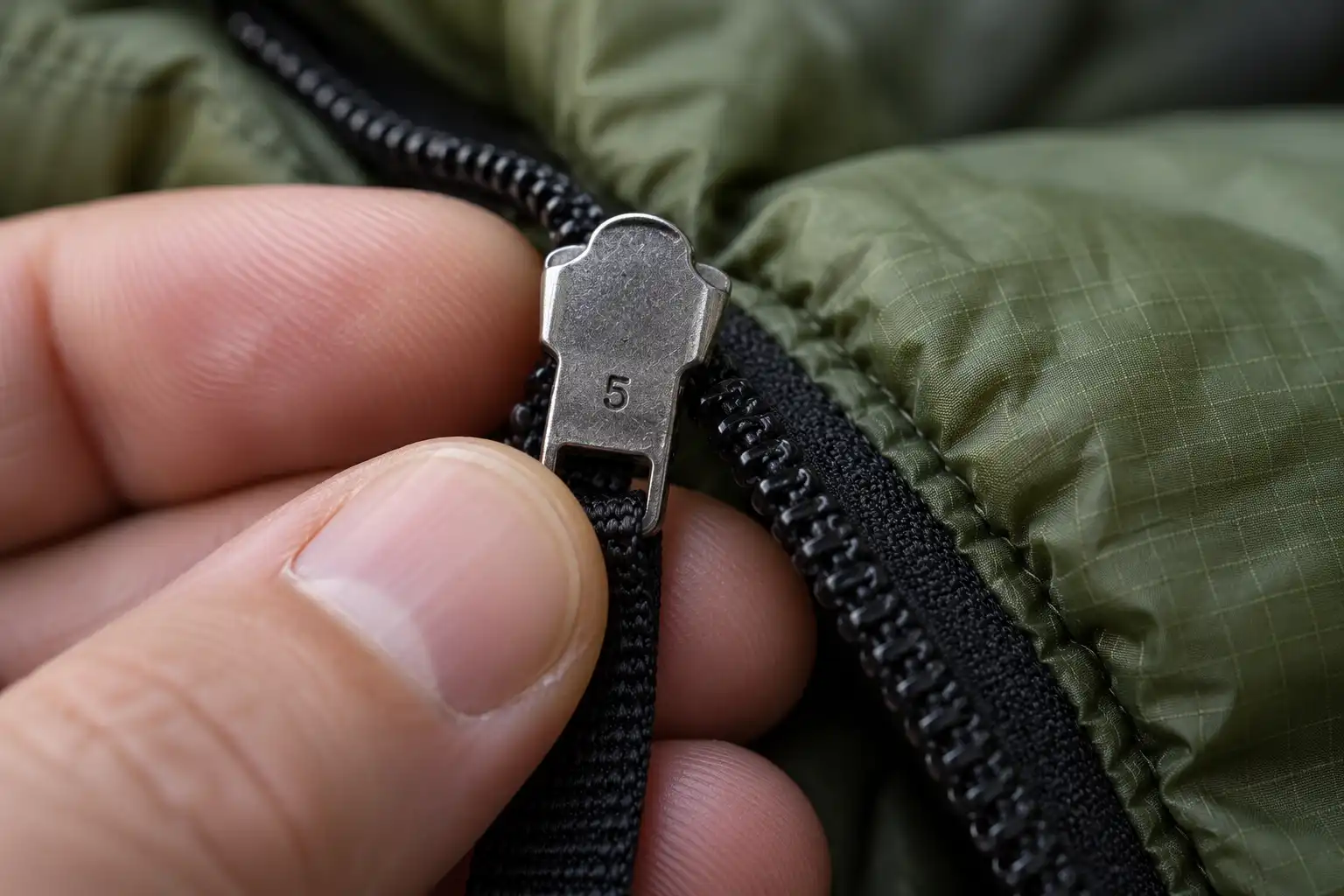
Never force a stuck slider, because Sea to Summit warns it can damage the slider or the zipper track.
Which Sleeping Bags Zip Together Most Easily?
Identical rectangular bags pair most easily, followed by left-zip and right-zip mummy bags from the same product line. Mixed brands and shapes are the hardest to match.
Rectangular bags
Two identical rectangular bags don’t even need opposite zippers, because you can stack them (steps below). Coleman’s support team recommends buying both at the same time, in the same size and style. They also suggest skipping bags with a pillow cuff, since one sleeper ends up with the cuff on top.
Some rectangular models come in left and right versions instead. Coleman’s Heritage Big and Tall is one, and those pairs join side by side.
Mummy bags
Mummy bags need a true left-zip and right-zip pair, joined side by side. Because of the hood and the tapered foot, you can’t stack or flip them. I’d buy the same model in both zip sides. In some lines, the women’s version zips on the opposite side. Sea to Summit’s Ascent (left zip) and Women’s Ascent (right zip) are one example.
Mixed lengths, shapes, and brands
Different lengths can work when the zippers line up, and some brands design their bags that way. Mixed brands don’t always pair, though. Sea to Summit, for example, says another brand’s bag may pair with theirs if size and tooth direction match. Meanwhile, a mummy bag and a random rectangular bag rarely line up well, so test any mixed pair at home.
How to Zip Two Sleeping Bags Together
Left-zip and right-zip bags join side by side, while identical rectangular bags can also stack.
Side by side (left-zip and right-zip pairs)
- Set up your pads first, so you zip the bags in their final spot.
- Unzip both bags until each zipper splits apart at the foot.
- Lay the bags side by side, with the right-zip bag on the left.
- Join the bottom layers. Slide the pin into the slider on the other bag, then zip from the foot to the shoulders.
- After that, connect the top layers the same way. Stop short of the top so you can climb in.
- Get in, and then close the last stretch from inside.
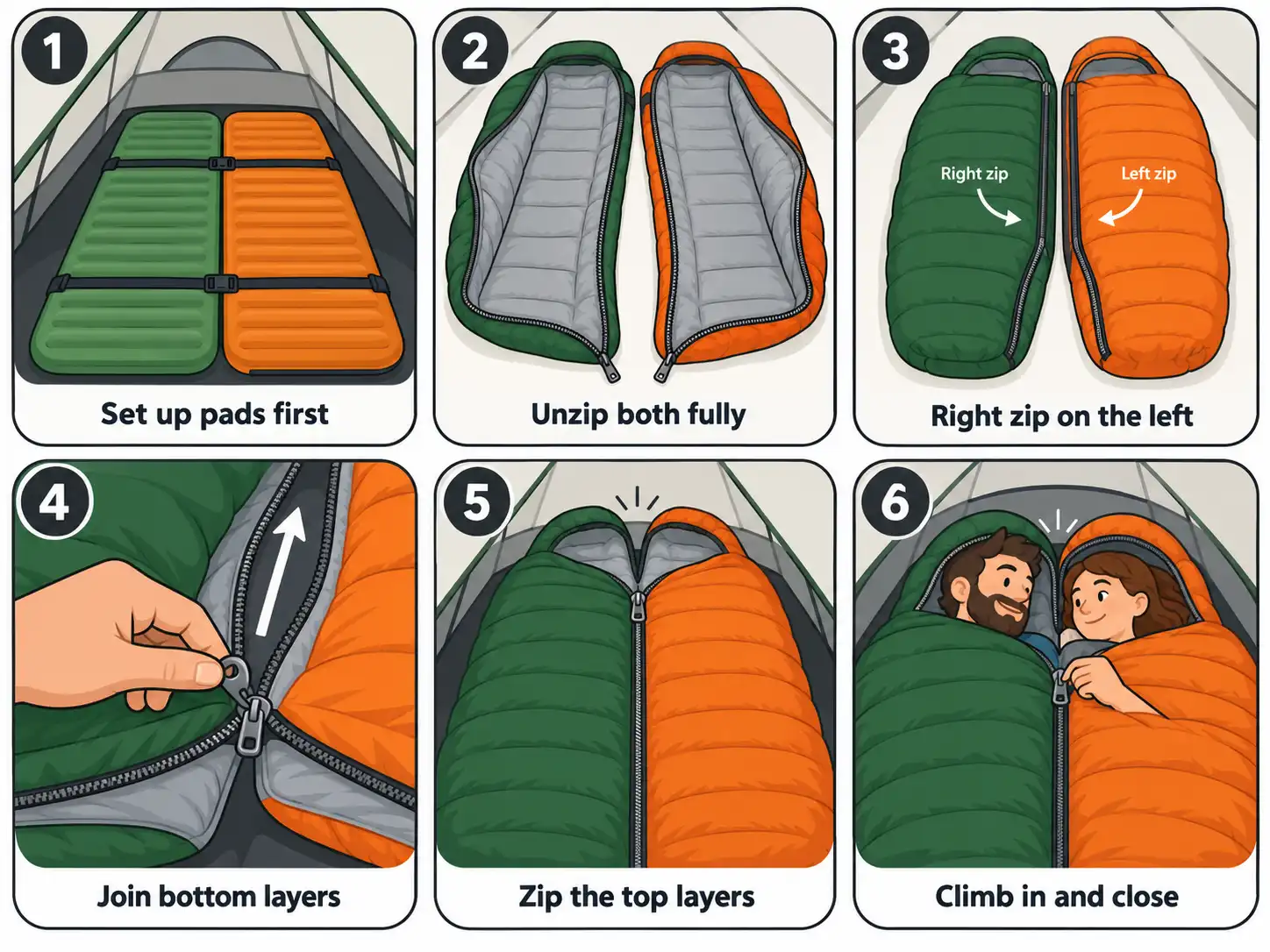
Big Agnes describes the same order in its guide: the bottom zipper first, then the top.
Stacked (identical rectangular bags)
- Unzip both bags fully. Then pull each slider all the way down and free the pin end.
- Open both bags flat.
- Lay one on top of the other, with the liners facing each other and the shells outside.
- Push the pin from one bag fully into the slider on the other bag. If the zipper has two sliders, the pin goes through both.
- Pull the slider and zip the bags closed along the edges.
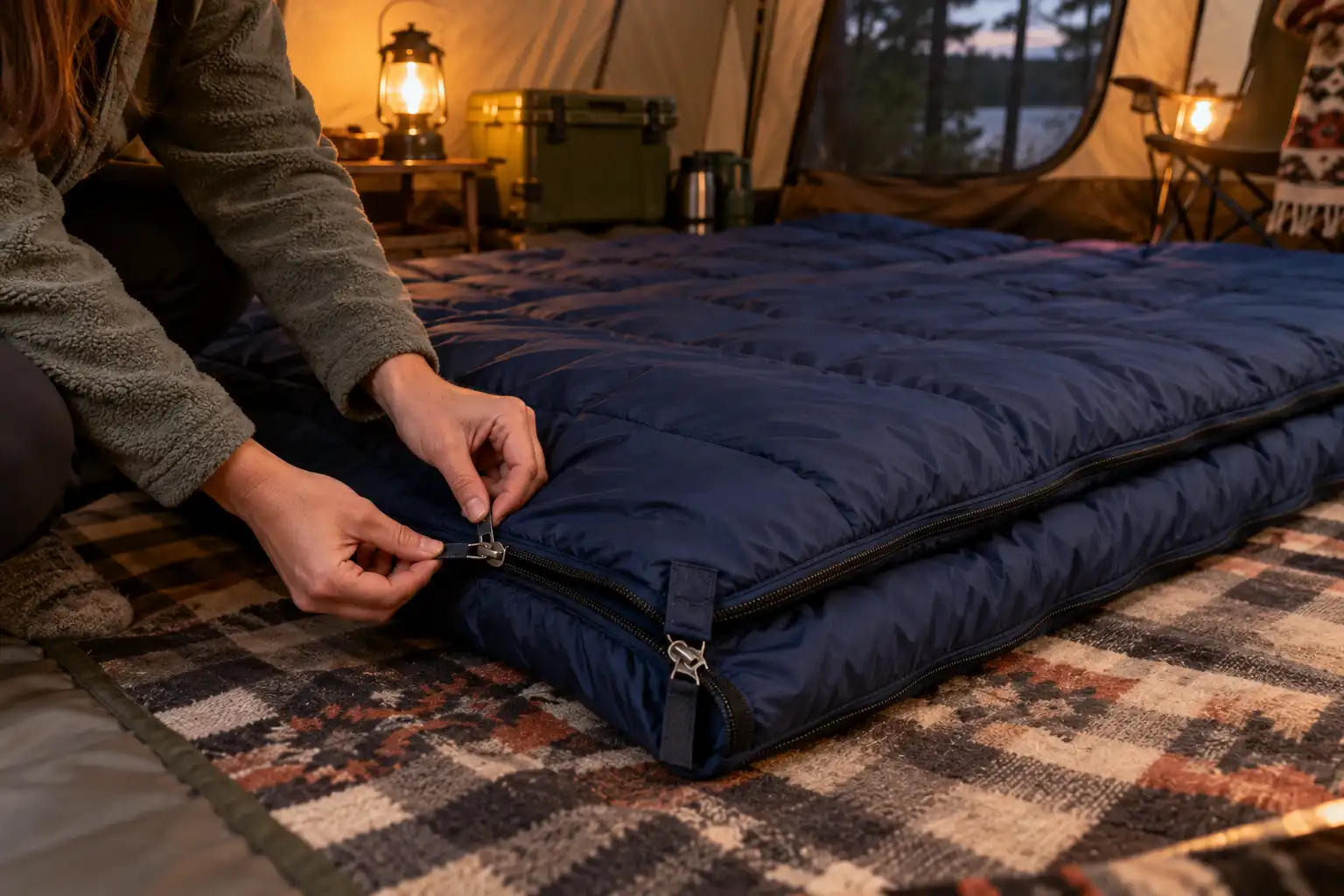
You end up with one wide bag, with one sleeping bag as the base and the other as the cover.
Is a Zipped Double Sleeping Bag Warmer?
It can be, but not always. Two bodies do share heat. But a double bag also has more air to warm, a wide opening at the shoulders, and often a zipper down the middle. Many couples find it cozy on mild nights and drafty on cold ones.
That matters because a sleeping bag holds warmth by trapping the air your body heats. So every time one of you rolls over, the cover lifts and some of that warm air escapes. The gap between your shoulders leaks heat all night as well.
I’ve felt both sides of this. On a mild winter night by Kaptai Lake, a zipped double felt like a real bed. However, on a windy night in the Bandarban hills, the same setup kept pulling cold air in at the shoulders.
There’s a real upside, though. You share heat, you get room to move, and each bag still works alone on solo trips. The trade-offs are drafts and the fact that one restless sleeper wakes the other.
Tips for Sleeping Warm in Two Zipped Bags
These habits keep a zipped double warm for me, even on cool hill nights.
- Match and strap your pads. Because pads of the same thickness sit level, no ridge or cold gap forms down the middle. Then a coupler strap holds them together, or you can use one wide double pad instead.
- Insulate an air mattress. On an air mattress, the air inside cools overnight and pulls heat from your back. So lay a blanket over it before the bags go down. Adding insulation above and below the air mattress works even better.
- Close the shoulder gap. Tuck the top edge in around your necks. Also, a fleece jacket laid across the gap between you blocks a lot of cold air.
- Wear a beanie. A rectangular double has no hood, so your head needs its own cover.
- Put the warmer bag on top when stacking. That’s because your weight squashes the bottom bag, and flattened insulation adds little warmth.
- Mix ratings if you sleep differently. Side by side, each person sleeps mostly under their own bag. So a warm sleeper and a cold sleeper can use different temperature ratings, as long as the zippers match.
- Air it out every morning. Body moisture builds up overnight, and damp bedding in humid weather won’t dry inside a stuff sack. Open the bag flat for 10 to 20 minutes before packing.

What to Do When Your Bags Won’t Zip Together
A mismatch doesn’t mean you have to sleep apart. So I’d try these fixes in order, starting with the quickest.
- Make a flat double. When both bags open flat, lay one down as the base and spread the other on top like a comforter. It won’t seal out drafts, but on warm nights it’s plenty.
- Fix a worn slider. Sometimes the specs match, but a tired slider still won’t hold the coils together. So squeezing or replacing the slider is a quick sleeping bag zipper fix.
- Buy a matching partner bag. Get the same model in the opposite zip side, or a second identical rectangular bag. Then test the pair at home before your trip.
- Ask a repair shop. When nothing else works, a gear repair shop can sew in a new zipper that matches the other bag.
- Switch to a double bag or a two-person quilt. A true double bag has no center zipper, so it usually seals better. Two zip-together bags stay more flexible, though, since each one works alone. Meanwhile, backpacking couples often pick a two-person quilt over two pads to save weight. If you’re weighing a quilt against a sleeping bag, drafts are the main trade-off.
FAQs About Zipping Sleeping Bags Together
Will a zipped double fit in a two-person tent?
Yes, if both bags already fit side by side. Zipping them together doesn’t add width. A big rectangular pair can still crowd a small backpacking tent, though. So I size up when two people share a tent with their gear.
Can you zip a down bag to a synthetic bag?
Yes, as long as the zippers match. The fill has nothing to do with pairing. Still, expect each side to feel a bit different in warmth.
Can a kid’s sleeping bag zip to an adult’s bag?
Usually not well. A kid’s bag is shorter, so its zipper ends well before the adult bag’s does. Even when the size numbers match, that leaves an open gap near the adult’s chest and shoulders.
Final Thoughts
Two sleeping bags zip together when their zippers match on side, size, type, and length. Check yours at home with the slider stamps and a short test zip before you pack. Mummy bags need a left and right pair joined side by side, while identical rectangular bags can simply stack. Once you’re set up, strap your pads together and block the gap at your shoulders. And if your bags still won’t pair, a flat double or a matching partner bag gets you through the night.