Can You Hike in the Everglades National Park? Trails, Fees, Seasons

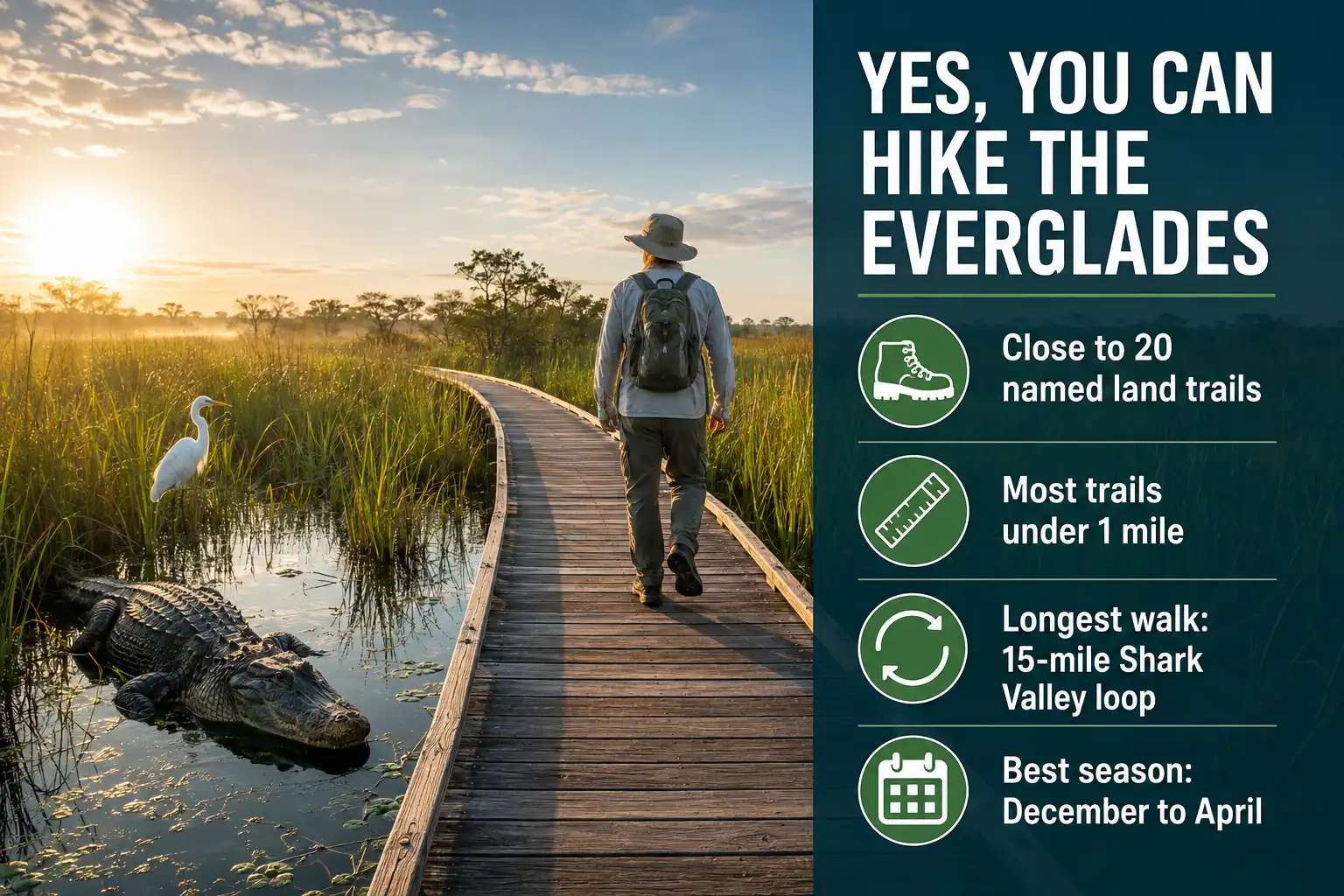
Everglades National Park sits at sea level, and most of it is water. So people reasonably wonder whether hiking there is even possible. It is, though the walking looks nothing like a mountain trip. Below I cover the trails, the seasons, the fees, and the safety rules you actually need.
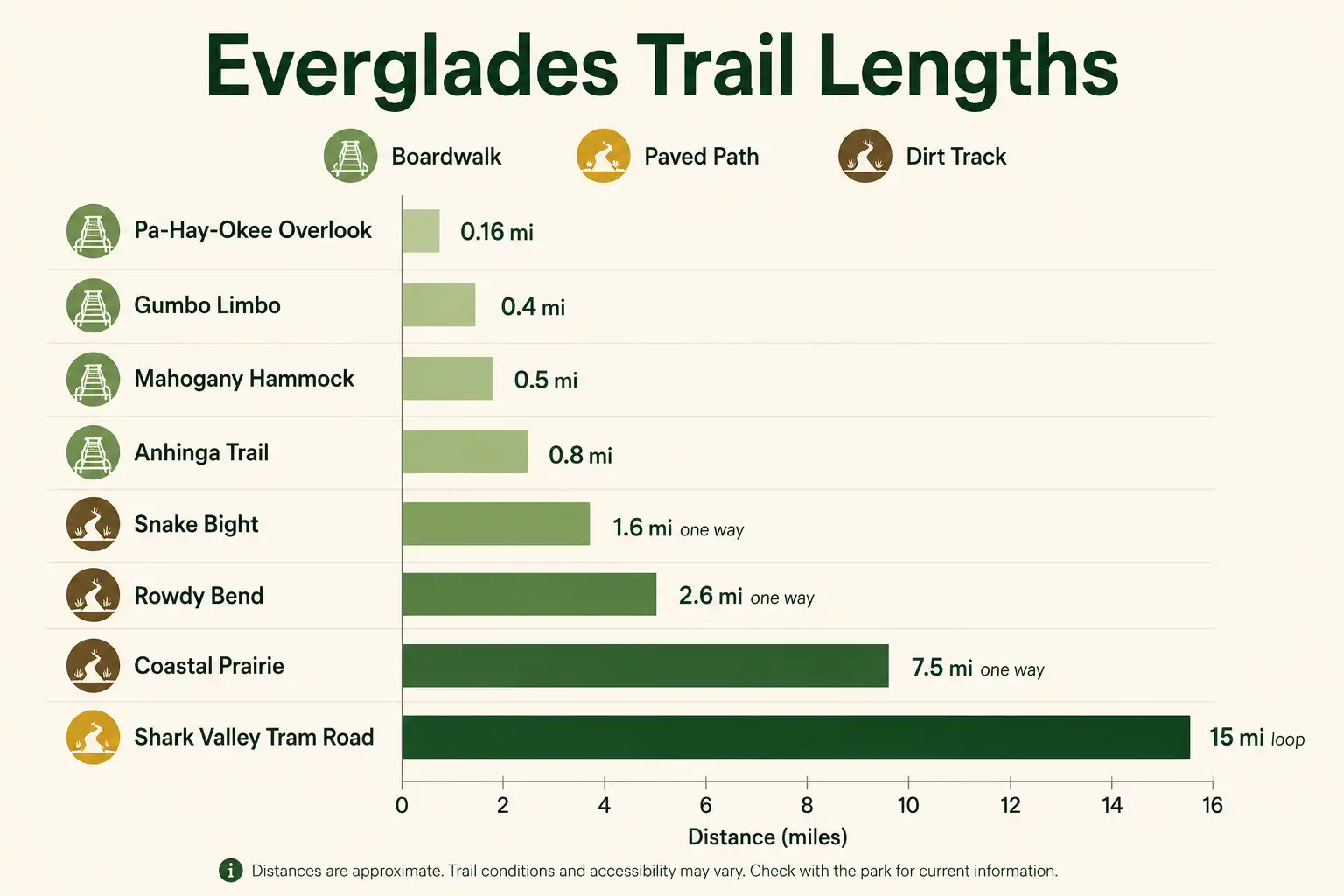
Yes, you can hike in Everglades National Park. The park has boardwalks, short paved loops, and unpaved trails that run several miles. Most named trails sit under one mile. A few, such as the Coastal Prairie Trail and the Shark Valley Tram Road, run well past seven miles. Day hiking needs no permit.
What kind of hiking does the Everglades offer?
The Everglades offers flat, low-mileage walking on boardwalks, paved loops, and old road beds, with almost no elevation change anywhere in the park. There are no climbs and no switchbacks. In fact, the main park road crosses a marked high point called Rock Reef Pass at three feet above sea level.
Then there is the one real climb, and it is a staircase. The Shark Valley Observation Tower platform, halfway around the 15-mile loop road, gives you the highest spot you can reach on foot. Everything else stays within a few feet of the water table.
Because the ground never rises, what makes a hike hard here changes completely. Distance and terrain are not the problem. Instead, the difficulty comes from heat, humidity, biting insects, open sun, and mud. So a two-mile walk in August can wear you down more than a six-mile walk in January.
Trails also cross five distinct habitats, which is the real reason to walk them. You get sawgrass marsh, tropical hardwood hammock, pine rockland, coastal prairie, and mangrove forest, often within a short drive of each other. Wildlife sits close to the path in most of them.
One rule catches visitors off guard. Pets cannot go on any trail in the park, so plan around that before you drive down.
Where can you hike in Everglades National Park?
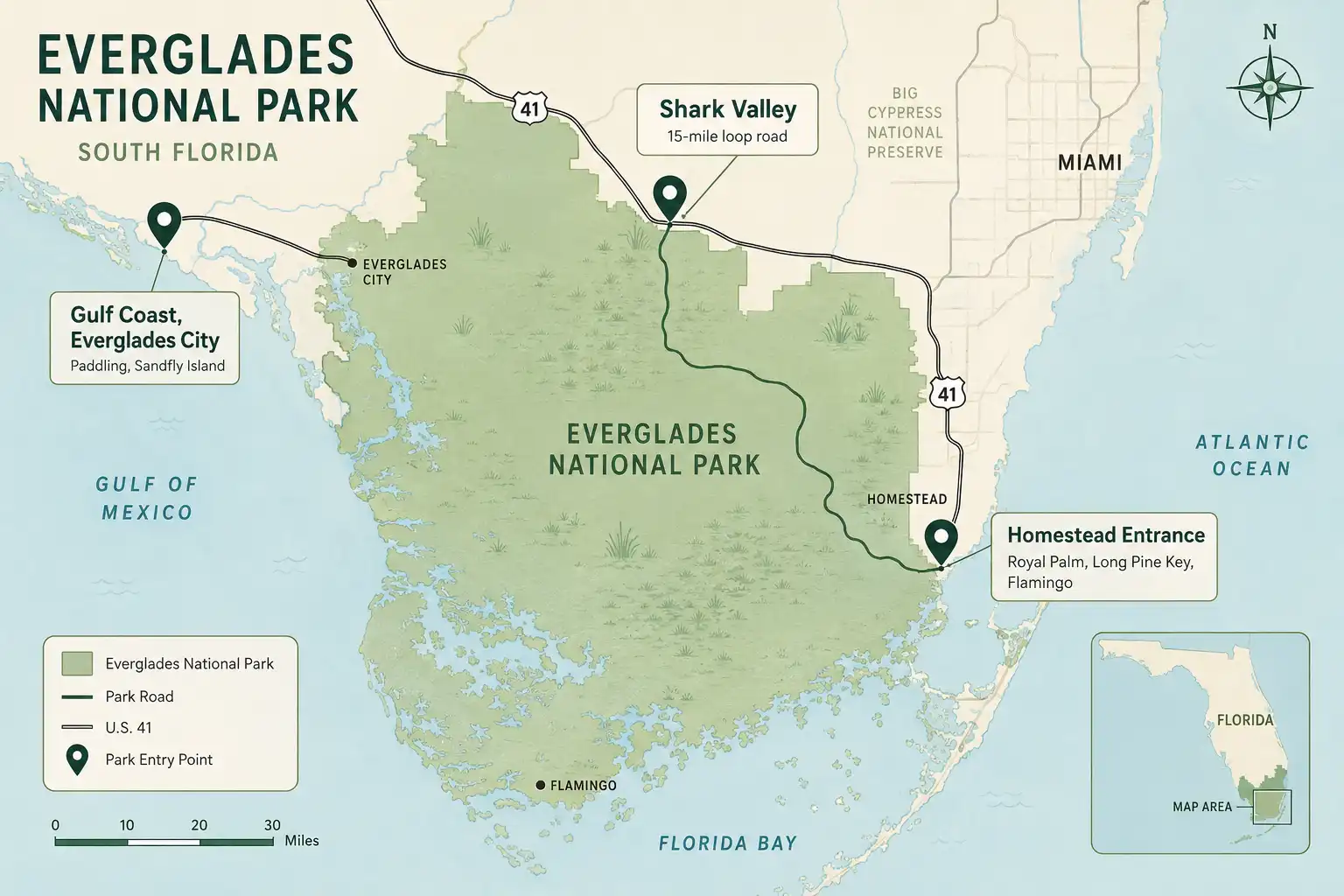
Three road-accessible areas hold nearly all the trails: the Homestead side, Shark Valley off U.S. 41, and the Gulf Coast at Everglades City.
Homestead entrance. This is the main gateway, and it holds the most trails. Royal Palm sits four miles past the Ernest F. Coe Visitor Center, so it gives you the Anhinga and Gumbo Limbo trails within a few minutes of parking. Farther down the main road you reach Long Pine Key, the Pineland Trail, Pa-Hay-Okee Overlook, and Mahogany Hammock. Finally, at road’s end, the Flamingo area and its Guy Bradley Visitor Center open up nine more trails along Florida Bay.
Shark Valley. Located on U.S. 41 west of Miami, Shark Valley has just three walking routes. However, one of them is the 15-mile paved tram road loop, which doubles as the longest continuous walking surface in the park.
Gulf Coast. This section near Everglades City centers on paddling rather than hiking. Its only land trail runs on Sandfly Island, a 0.9-mile path roughly 1.5 miles from the visitor center site. Since no road reaches it, you need a canoe, kayak, or motorboat to get there.
Which short trails are best for a first visit?
Anhinga Trail is the best first walk in the park, followed by Gumbo Limbo, Mahogany Hammock, Pa-Hay-Okee Overlook, and West Lake. All five stay short and flat, and all five work for wheelchairs.
| Trail | Round trip | Surface | Area |
|---|---|---|---|
| Anhinga Trail | 0.8 mile | Paved and boardwalk | Royal Palm |
| Gumbo Limbo Trail | 0.4 mile | Paved | Royal Palm |
| Pineland Trail | 0.4 mile | Paved loop | Pine Island |
| Pa-Hay-Okee Overlook | 0.16 mile | Boardwalk | Pine Island |
| Mahogany Hammock Trail | 0.5 mile | Boardwalk | Pine Island |
| West Lake Trail | 0.5 mile | Boardwalk | Flamingo |
| Bobcat Boardwalk | About 0.5 mile | Boardwalk | Shark Valley |
Anhinga Trail runs through Taylor Slough and a sawgrass marsh. During the dry season the slough shrinks, so alligators, anhingas, herons, egrets, and turtles crowd into whatever water is left. As a result, winter mornings there deliver more wildlife per step than anywhere else in the park.
Gumbo Limbo starts from the same parking lot, though it feels completely different. Shaded hardwood hammock covers the whole loop, with royal palms and gumbo limbo trees overhead. Therefore it makes a good follow-up once the sun gets strong.
Mahogany Hammock is a boardwalk loop 20 miles from the main entrance, and it holds the largest living mahogany tree in the United States. Meanwhile, Pa-Hay-Okee Overlook takes barely ten minutes. Still, it gives you the widest view of the sawgrass prairie you will get without a tower.
What are the longer hikes in the Everglades?
The longest walking routes are the 15-mile Shark Valley Tram Road loop, the 7.5-mile Coastal Prairie Trail, and the Long Pine Key network with more than 22 miles of connecting trails.
Shark Valley Tram Road. A flat, paved, 15-mile loop open 24 hours a day. Trams and bikes share it, so expect company. Most walkers go two or three miles out and turn back, although the observation tower sits at the halfway point if you want the full distance.
Long Pine Key Trails. More than 22 miles of connecting paths through pine rockland and hammock. The main line runs seven miles west from the Long Pine Key campground to Pine Glades Lake. Bikes work well here too.
Snake Bight Trail. 1.6 miles one way through tropical hardwood hammock, ending at a boardwalk on Florida Bay. Time your arrival near high tide, because that is when the bird watching peaks.
Rowdy Bend Trail. 2.6 miles one way along an overgrown old road bed through buttonwoods and coastal prairie.
Coastal Prairie Trail. 7.5 miles one way from the back of Loop C at Flamingo Campground to Clubhouse Beach. Camping at the far end needs a wilderness permit.
One caution matters here. The Park Service lists Coastal Prairie, Snake Bight, Rowdy Bend, Christian Point, Bear Lake, and the Long Pine Key bike trail as passable but unmaintained, since they cross critical habitat for the Cape Sable thoroughwort and two endangered butterflies. Therefore you travel them at your own risk, with overgrown vegetation and rough footing.
When is the best time to hike in the Everglades?
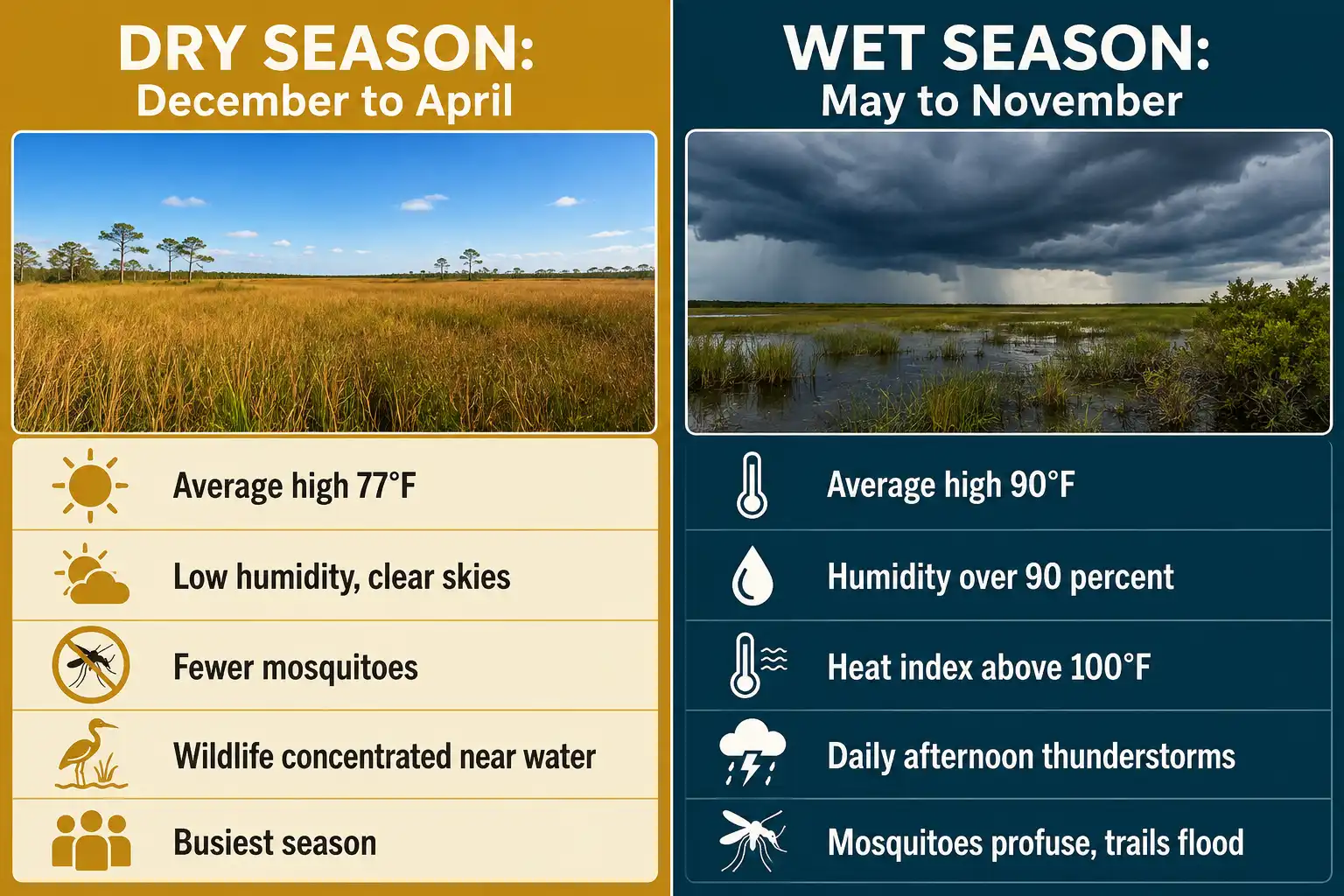
December through April is the best time to hike the Everglades. The Park Service calls this the dry season, and it brings average highs near 77°F, lows near 53°F, low humidity, and clear skies.
Water levels drop through those months, so wildlife concentrates around whatever water remains. Mosquitoes thin out too, although they still bite at dusk and dawn. This is also the busiest stretch of the year. Therefore parking at Royal Palm and Shark Valley fills early on weekends.
The wet season runs roughly May through November, and it changes the park completely. Average highs reach 90°F, humidity climbs above 90 percent, and the heat index passes 100°F. Afternoon thunderstorms arrive almost daily. Meanwhile mosquitoes and biting flies turn profuse, and unpaved trails flood or turn to sticky marl mud.
Hurricane season overlaps June through November, which adds closure risk on top of the heat. Because of that, I would treat any summer trip as boardwalks and early mornings only.
The same trade-off shows up when picking the right season for a destination trip, since cheaper months and quieter trails usually mean worse weather.
I hike the hills around Kaptai and Rangamati during our monsoon, so I know what heat plus humidity does to a schedule. In short, it cuts your pace roughly in half. Anyone walking here in July needs the same habits that make hiking safely when the heat gets extreme possible: early starts, salt, and shade breaks.
Do you need a permit to hike in the Everglades?
Day hiking needs no permit. You only pay the park entrance fee, and that fee then covers all park entrances for seven consecutive days.
| Pass | Cost | Notes |
|---|---|---|
| Private vehicle | $35 | Covers driver and passengers, 7 days |
| Motorcycle | $30 | Up to 2 motorcycles, 4 passengers, 7 days |
| Per person on foot or bike | $20 | Ages 16 and up, 7 days |
| Everglades annual pass | $70 | 12 months, unlimited visits |
| America the Beautiful annual | $80 | US citizens and residents |
Children under 16 enter free. In addition, non-US residents aged 16 and older currently pay a $100 per person fee on top of the standard entrance fee, unless they enter with an Annual or America the Beautiful pass. Non-resident America the Beautiful passes run $250.
Also worth knowing: the park takes no cash anywhere. So bring a credit or debit card, or buy a digital pass in advance and show it on your phone.
Overnight trips work differently. All backcountry camping needs a wilderness permit, which costs a $21 administrative fee plus $2 per person per night. You can reserve through Recreation.gov on a rolling basis three months ahead, and your confirmation email then serves as the permit. Keep in mind that most wilderness campsites sit on water routes rather than trails.
Prices and rules do change, though, so confirm current fees on the park’s official fees page before you drive down.
Is hiking in the Everglades safe with alligators around?
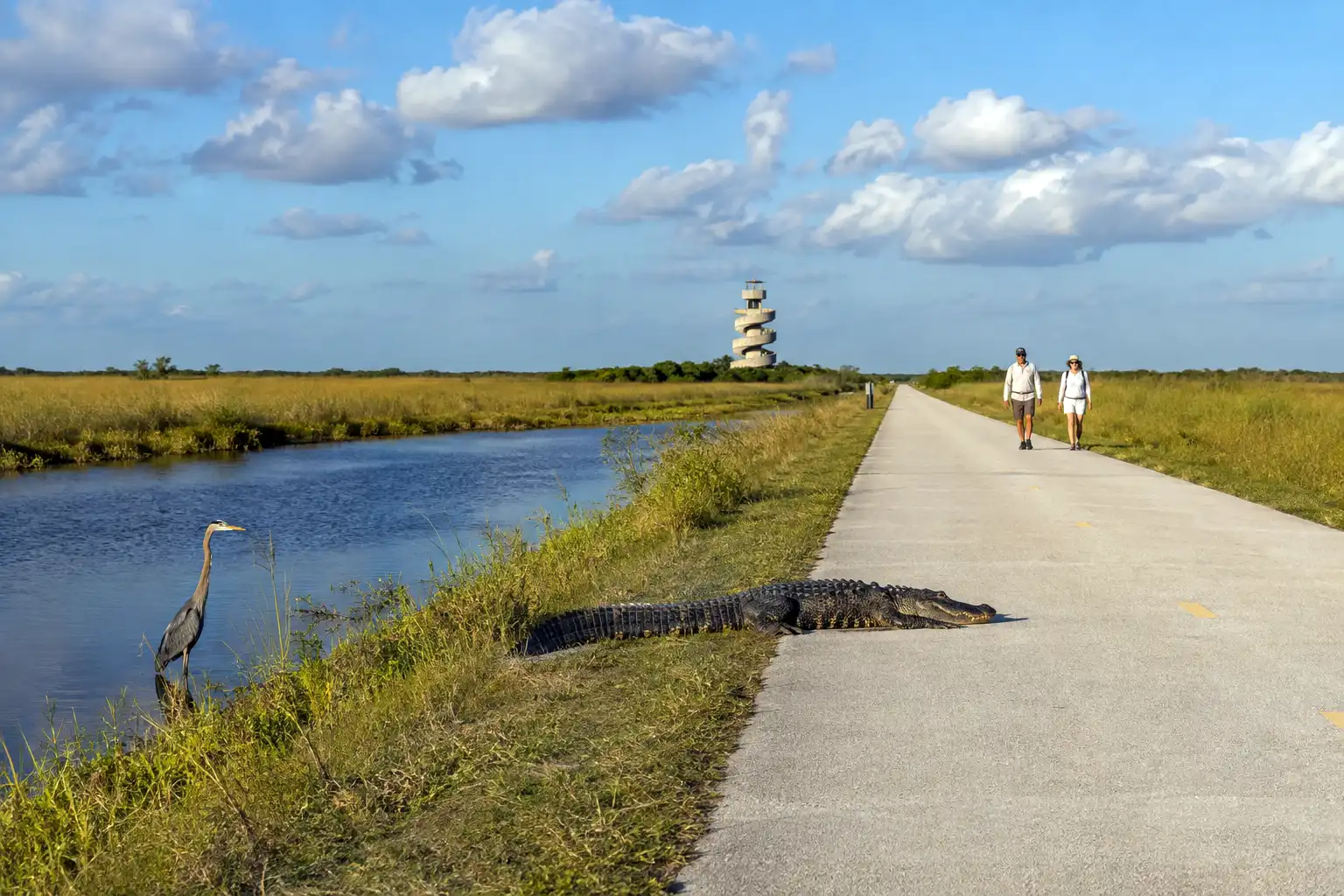
Yes, hiking here is safe as long as you keep your distance and stay on the trail. Park guidance puts a safe wildlife viewing distance at roughly 15 to 20 feet, and most bites follow someone ignoring that.
Alligators sun themselves right beside boardwalks at Anhinga, and they sometimes lie on the pavement at Shark Valley. When one blocks the path, turn around instead of squeezing past. Also, never stand between an alligator and the water, because that cuts off its escape route.
The park prohibits feeding any wildlife. Once an animal stops avoiding people, it usually ends up removed. Therefore keep food packed and pack out every scrap.
This is the only place where alligators and American crocodiles share territory. Crocodiles turn up mostly around Flamingo and Florida Bay, though the same distance rule applies.
Four venomous snakes live in South Florida: the eastern diamondback rattlesnake, the dusky pygmy rattlesnake, the Florida cottonmouth, and the eastern coral snake. So watch your feet on unpaved trails and in tall grass. Knowing what to do after a snake bite also matters more than identifying the species correctly.
Lightning deserves equal respect. Park guidance stays simple here: if you hear thunder or see lightning, get to cover immediately.
What should you pack for a hike in the Everglades?
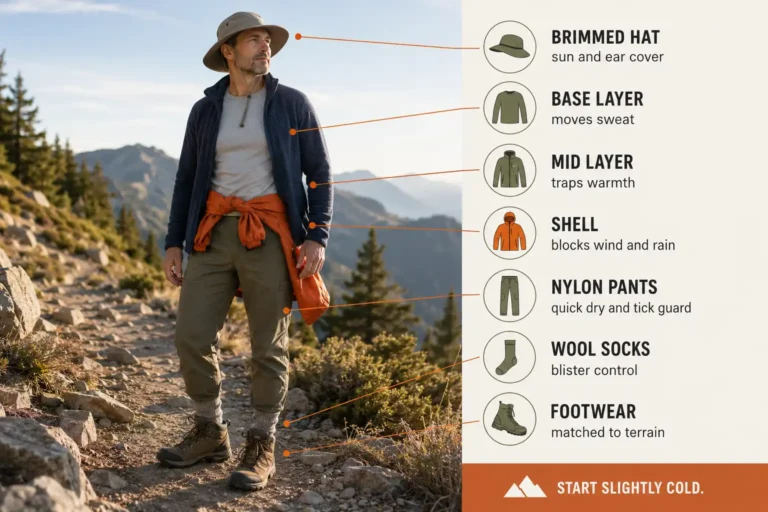
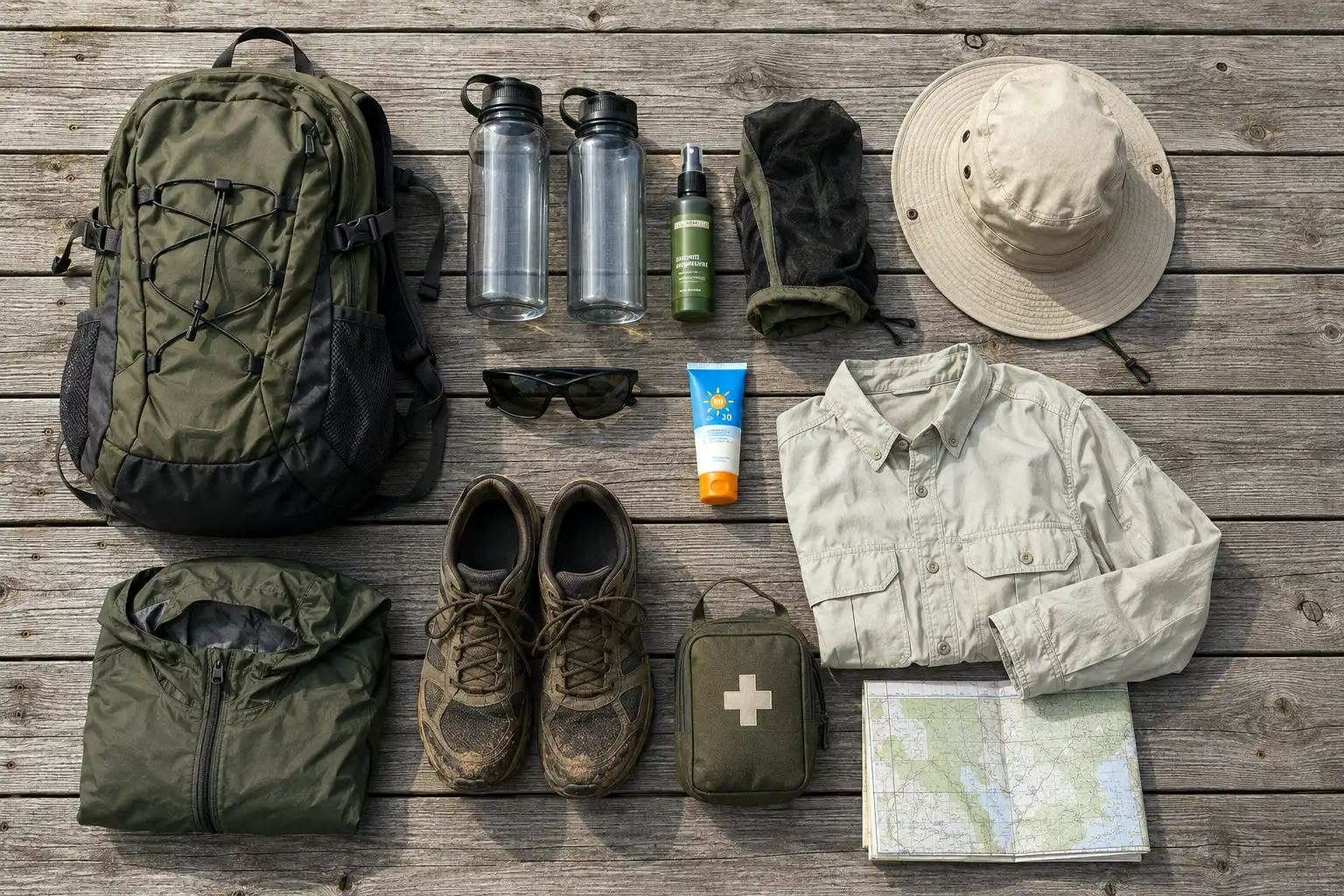
Water, sun protection, and insect protection matter more than anything else. No trail here has drinking water, so carry everything you need from the trailhead.
- Water. At least two liters for a short outing, and more for anything past three miles.
- Insect repellent. Add a head net or bug jacket during the wet season, because the Park Service recommends both.
- Long, light sleeves and pants. Better than sunscreen alone against sun and mosquitoes.
- Wide-brim hat and sunglasses. Shade turns rare once you leave the hammock trails.
- Closed-toe lace-up shoes. Choose a pair you do not mind soaking in mud.
- Light rain shell. Storms build fast between May and November.
- Offline map. Cell coverage gets patchy on the road toward Flamingo.
- Small first aid kit. Blister care, tweezers, and antihistamine cover most trail problems.
Weight distribution still matters on flat ground. Packing a day pack the right way keeps the load off your shoulders across a long, hot walk.
Mosquitoes draw the most complaints here, and the Guy Bradley Visitor Center even keeps a mosquito meter on display. Repellent choice and timing decide how the day goes, so sort out keeping mosquitoes off you on the trail before you set out.
Can you walk off the boardwalks into the water?
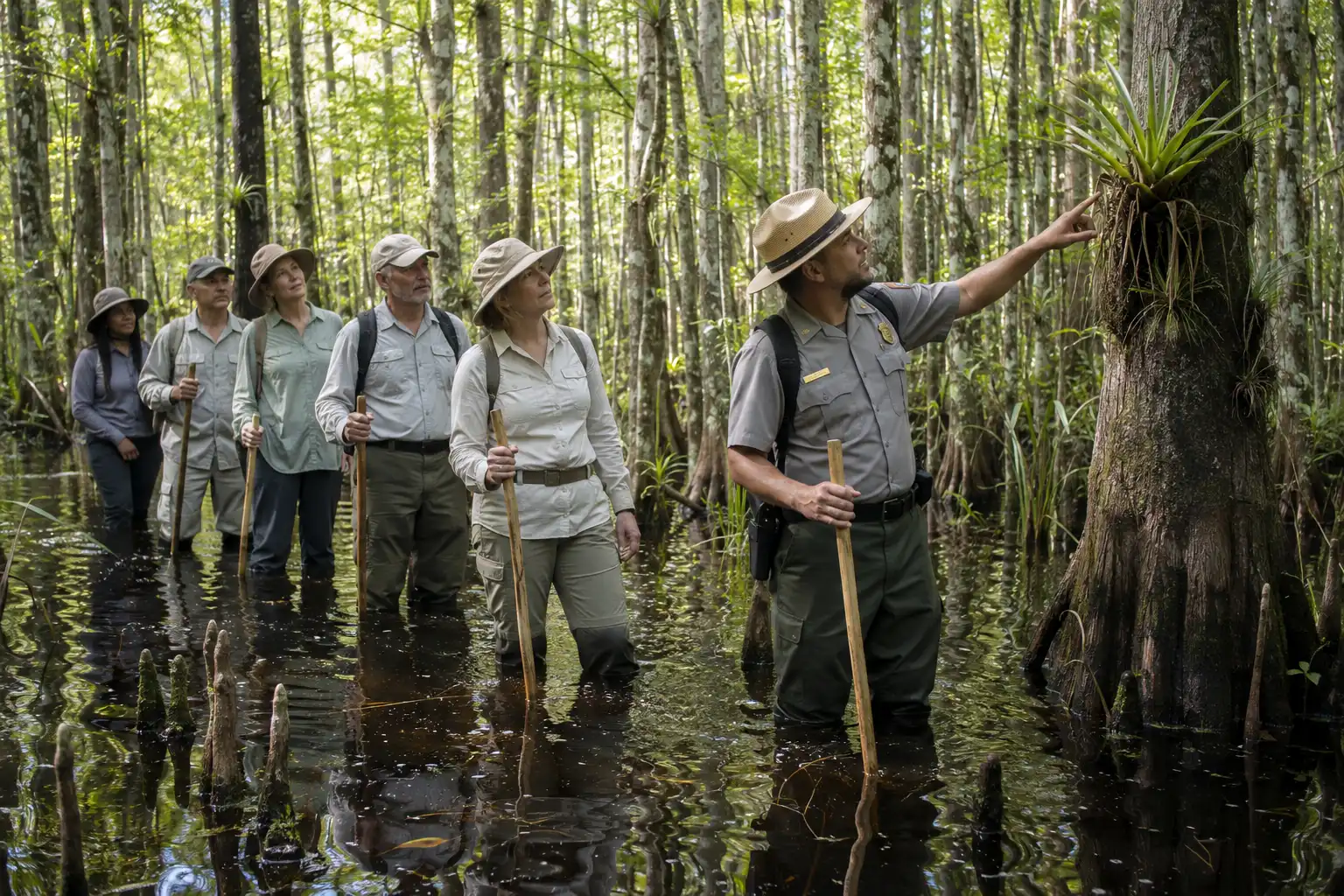
Yes, on ranger-led wet walks, often called slough slogs. Rangers take small groups off-trail into shallow sloughs and cypress domes, where the water runs anywhere from ankle deep to waist deep.
Requirements stay strict for good reason. You need long pants, closed-toe lace-up shoes, and a hiking pole, which the park usually supplies. Participants must also be older than 12. Slip-on shoes and sandals come off in the mud, so lace them properly.
The park runs these programs mainly during the dry season at Shark Valley. Meanwhile, the Everglades Institute offers paid wet walks from the Royal Palm area on a longer schedule. Check the park calendar before you count on a date.
Wet feet cause blisters faster than anything else on a hike. Since you finish a slog soaked, bring dry socks and shoes for the drive back. Damp skin also rubs raw quickly, so stopping blisters before they start matters more here than on a dry trail.
Where can you hike longer distances near the Everglades?
Big Cypress National Preserve, directly north of Shark Valley, holds the southern terminus of the Florida National Scenic Trail. That is where serious mileage starts.
The trail begins at the Oasis Visitor Center on U.S. 41, then runs roughly 36 miles north to the preserve boundary. You also need a backcountry permit to camp at the trail campsites along the way.
Conditions swing hard by season. During the rainy months the route can sit under three to four feet of water, and vegetation grows over the path. In the dry season, on the other hand, there may be no water at all, so you carry every liter. Most hikers therefore target mid-December through early March.
This is a demanding walk rather than a casual one. Footing turns rough, blazes go sparse in places, and progress often drops to about a mile per hour in the wet sections.
FAQs About Everglades Hiking

How many hiking trails does Everglades National Park have?
Can you hike the Everglades in one day?
Is Shark Valley or Royal Palm better for hiking?
Do you need a guide to hike in the Everglades?
Are Everglades trails flooded in summer?
Final thoughts
Hiking the Everglades rewards patience rather than mileage. You will not gain elevation or cover big distances, though you will walk within a few feet of alligators, wading birds, and habitats found nowhere else in the country. Go between December and April if you can, start early, carry more water than feels necessary, and treat repellent as required gear. Then take the short trails slowly, because standing still is where this park pays you back.