How Long Does It Take to Hike Mount Rainier? 2026 Times and Fees

Mount Rainier means different things to different hikers. Some want the 14,411 foot summit. Others want one hard day on the mountain, or the long loop around its base. This guide gives you honest timing for every option, plus the 2026 fees and the closures that could reshape your plan.
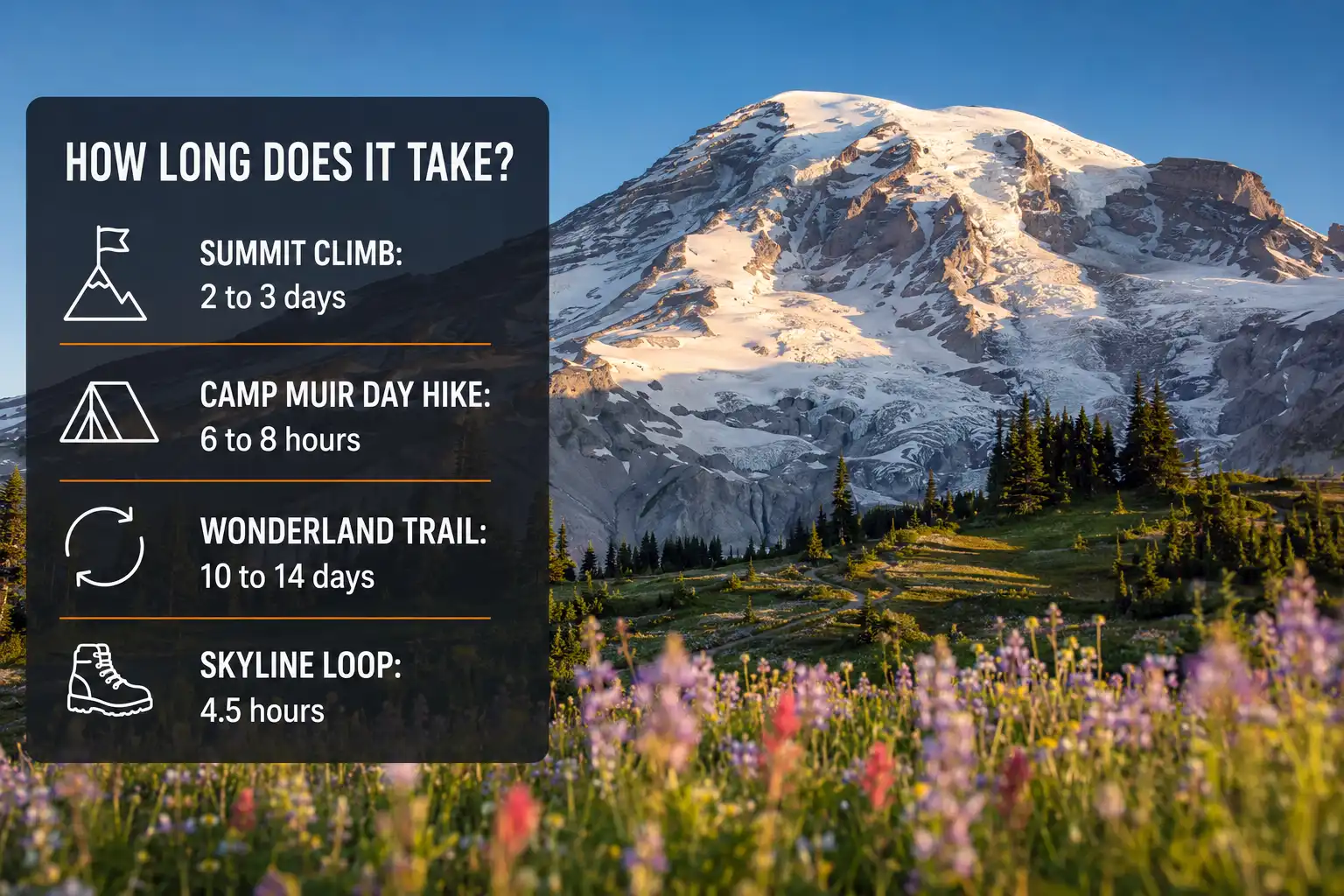
Most climbers reach the summit in two to three days. The Camp Muir day hike runs 6 to 8 hours round trip. Meanwhile, the 93 mile Wonderland Trail takes 10 to 14 days. Short trails near Paradise range from 35 minutes to about 4.5 hours.
How long does it take to climb to the summit of Mount Rainier?
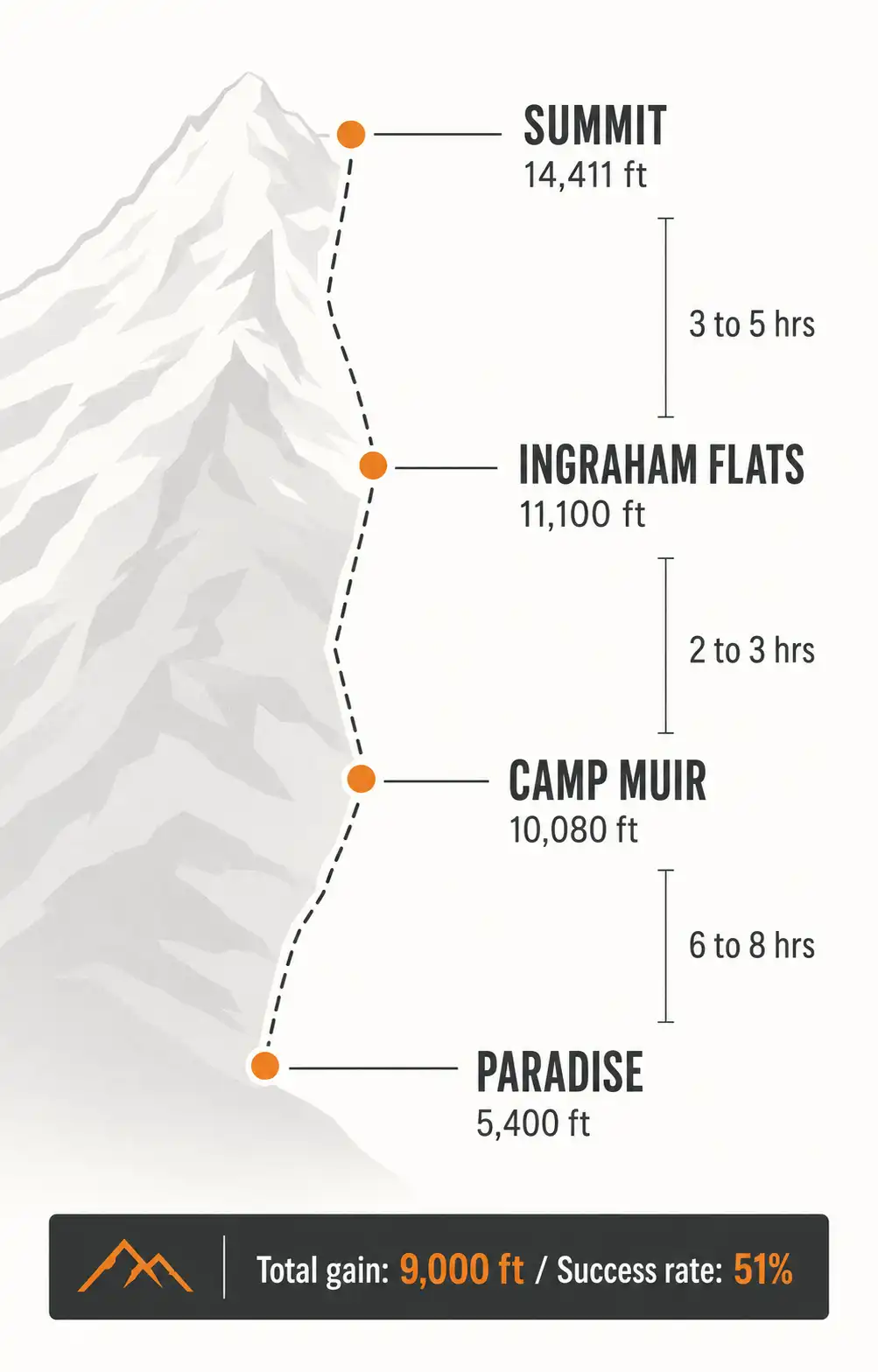
Most people summit Mount Rainier in two to three days. Park climbing rangers put the average time on the standard Disappointment Cleaver route at one to three days. That route covers 8 to 9 miles and gains about 9,000 feet.
Two days is the compressed version. You hike to Camp Muir on day one and sleep a few hours. Then you push for the summit overnight and descend all the way to the car on day two.
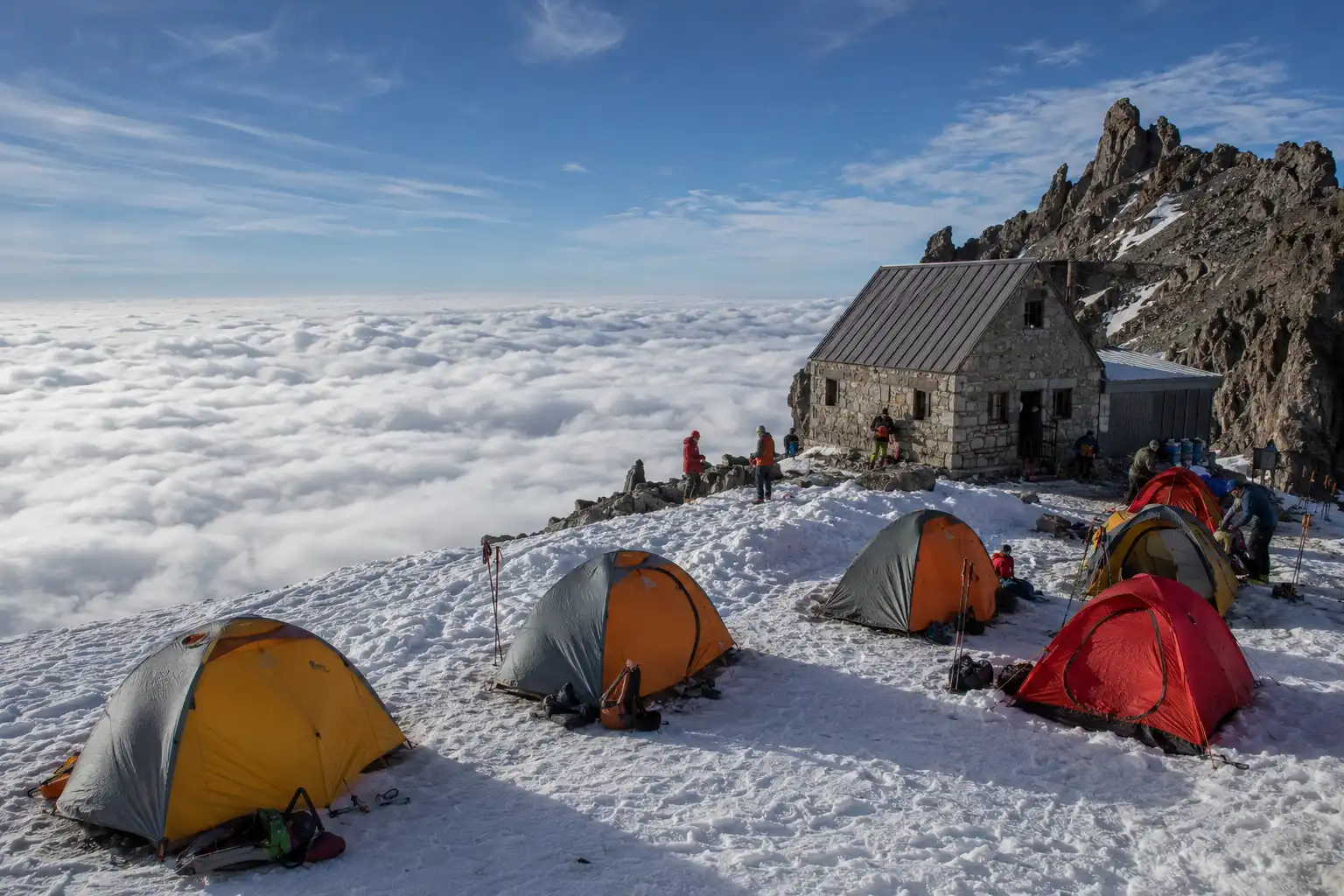
Three days splits that load. Teams move from Camp Muir up to a higher camp at Ingraham Flats around 11,100 feet, which shortens summit day considerably.
Guide services stretch the same route further. Programs run anywhere from two to five days, and the extra time goes into skills training and acclimatization rather than extra climbing. Northwest guide companies commonly sell four day trips because the added rest genuinely raises summit odds.
Speaking of odds, roughly 7,600 people attempt Rainier each year and about 51% reach the top. So plan your calendar with a spare day. Weather turns teams around often, and a fixed flight home the next morning puts pressure on decisions that should stay purely about safety.
How long does each stage of the summit climb take?
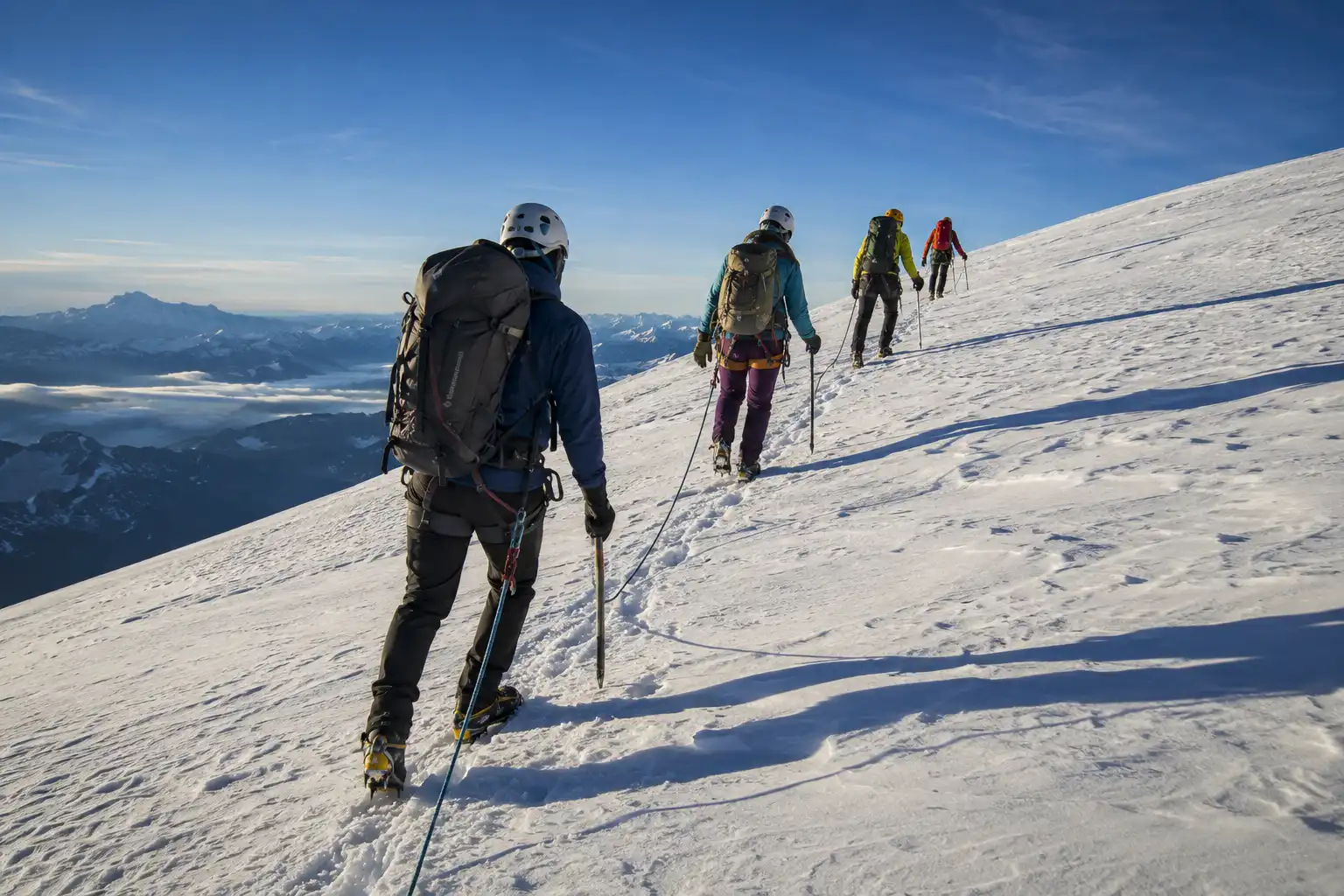
Summit day itself usually runs 10 to 14 hours. Here is how the standard route breaks down, using timing published by the park and The Mountaineers.
| Stage | Elevation | Typical time |
|---|---|---|
| Paradise to Camp Muir | 5,400 to 10,080 ft | 6 to 8 hours |
| Camp Muir to summit | 10,080 to 14,411 ft | 5 to 8 hours |
| Summit back to Camp Muir | descending 4,330 ft | 2 to 3 hours |
| Camp Muir to Paradise | descending 4,680 ft | 3 to 4 hours |
Teams leave high camp somewhere between midnight and 2 a.m. That timing is not for drama. Snow bridges hold better when frozen, and afternoon sun loosens rockfall on the cleaver, so getting up and down early matters.
Descent is faster than the climb but harder on the body. After 12 hours of climbing, quads and knees take a beating on the way down. Most climbers therefore lean on hiking poles to take pressure off the knees over the final few thousand feet.
Also know: Mount Monadnock Hiking Time
Can you climb Mount Rainier in one day?
Yes, but very few climbers do it. Fit mountaineers occasionally complete a car to car push from Paradise in a single day. Park rangers also include one day ascents in their route timing. Still, that means roughly 9,000 feet of gain and loss on glaciers inside about 16 to 20 hours.
For almost everyone else, that pace turns a hard climb into a dangerous one. Fatigue causes most bad decisions above Camp Muir, so the extra night is cheap insurance.
How long is the hike to Camp Muir?
The Camp Muir hike takes 6 to 8 hours round trip. It covers 9 miles with 4,680 feet of gain. At 10,080 feet, Camp Muir is also the highest point on Rainier you can reach without a climbing permit.
The first 2.3 miles follow the Skyline Trail to Pebble Creek. After that, the maintained trail ends and the Muir Snowfield begins. The final 2.2 miles climb about 2,900 feet on permanent snow, so you will walk on snow even in August.
That snowfield deserves respect. Whiteouts roll in fast, the route is unmarked, and navigation mistakes here have killed people. Therefore carry a map, compass, and GPS, and turn around when visibility drops.
Glare is the other issue. Sun bounces off the snowfield all day, so choosing sunglasses for glacier and snowfield conditions matters more here than on a forest trail. Sunburn also arrives from below as well as above.
How long do the popular day hikes at Mount Rainier take?
Most day hikes at Rainier take between 35 minutes and 4.5 hours. These are the published park times for the Paradise area, which stays open right now.
- Skyline Trail to Myrtle Falls: 1 mile, 100 feet of gain, about 35 minutes
- Nisqually Vista Trail: 1.2 miles, 200 feet, about 45 minutes
- Alta Vista: 1.75 miles, 600 feet, about 1 hour 15 minutes
- Deadhorse Creek and Moraine Trail: 2.5 miles, 400 feet, about 1 hour 45 minutes
- Bench and Snow Lakes: 2.5 miles, 700 feet, about 2 hours
- Lakes Trail Loop via Reflection Lake: 5 miles, 1,300 feet, about 4 hours
- Skyline Trail full loop: 5.5 miles, 1,700 feet, about 4.5 hours
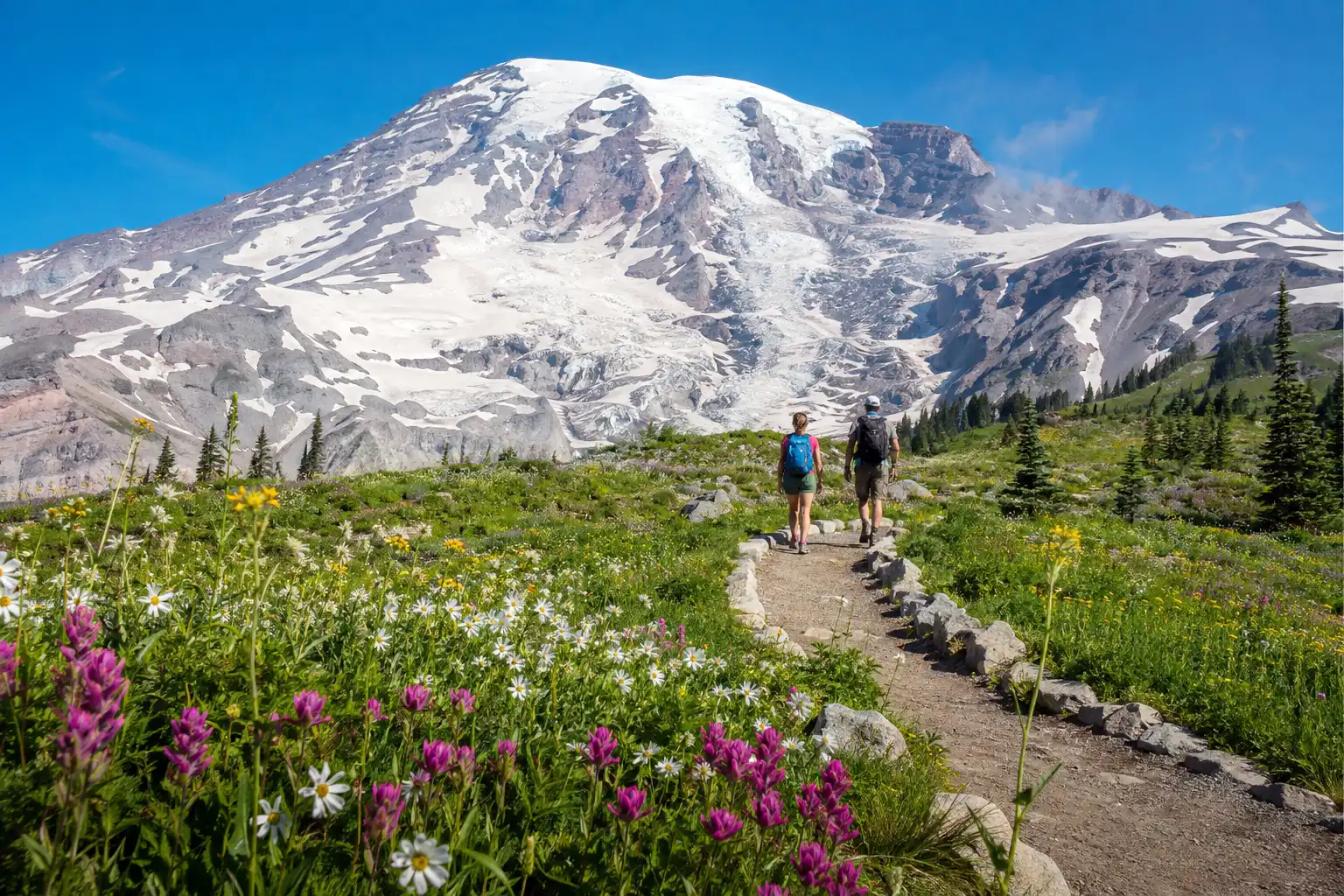
The Skyline loop is the one most visitors come for, and 4.5 hours is realistic if you stop for photos. Snow lingers on its upper sections into July, though, so early summer hikers should add time.
Sunrise area favorites like Burroughs Mountain and Mount Fremont Lookout normally take 4 to 6 hours. Right now you cannot reach them, and the closures section below explains why.
How long does the Wonderland Trail take?
The Wonderland Trail takes 10 to 14 days for most backpackers. The 93 mile loop circles the mountain with roughly 22,000 feet of cumulative gain, and the park caps wilderness reservations at 14 days.
Strong hikers finish in 7 to 9 days. Averages land around 9 to 10 days at 7 to 10 miles per day. That sounds gentle until you add daily climbs of 3,000 to 5,000 feet. Only 200 to 250 people complete the full loop each year.
A handful of fastpackers run it in about three days, averaging 31 miles daily. That approach also skips the permit process, since wilderness permits cover camping rather than walking.
Before you commit to a schedule, work out how many miles you can safely cover in a day with a loaded pack. Back to back big days on this loop punish anyone who planned around a single good day at home.
What makes the climb take longer than expected?
Six things stretch Rainier timelines more than anything else.
Pack weight. Summit climbers carry 30 to 40 pounds to high camp. Every extra pound slows the snowfield.
Snow conditions. Soft afternoon snow doubles the effort. Firm morning snow moves fast.
Weather. Rainier makes its own weather, and storms cancel more summit bids than fitness does. Here a shell built for mountaineering conditions earns its cost.
Altitude. Above 10,000 feet, most people slow noticeably. Because of that, preparing your body for thin air is the single best time saver available.
Crowds. Summer weekends create bottlenecks on the fixed lines up the cleaver, and rope teams wait their turn.
Late season route changes. As crevasses open in August and September, guides reroute around them and the line gets longer.
Nine thousand feet of gain is a big number. Measure it against what counts as a lot of elevation gain on an ordinary hike, then adjust your expectations upward.
What permits and fees do you need in 2026?
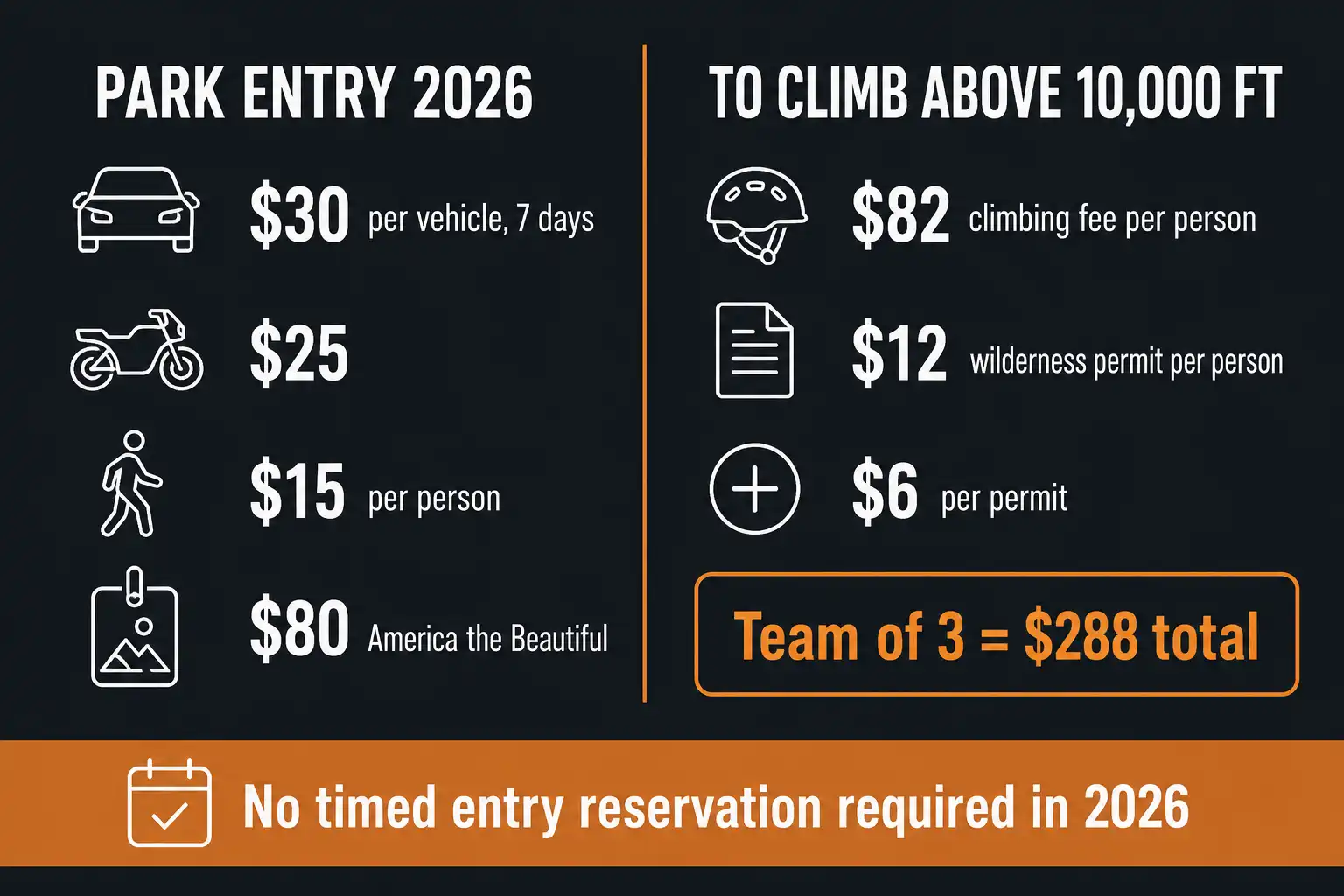
Entry costs $30 per vehicle for seven days, and Mount Rainier is not using timed entry reservations in 2026. The park dropped the 2024 and 2025 pilot program and now manages parking directly instead.
Current entrance rates:
- Private vehicle: $30 for seven days
- Motorcycle: $25
- Individual on foot or bicycle: $15
- America the Beautiful annual pass: $80
Climbing costs more. Every climber going above 10,000 feet or onto glaciers pays an $82 climbing cost recovery fee. On top of that sits a wilderness permit at $12 per person plus $6 per permit. A team of three therefore pays about $288 total, or roughly $96 each, excluding park entry.
One 2026 change matters: the climbing fee no longer covers your entire climbing season. So budget per trip rather than per year.
About two thirds of climbing permits open on Recreation.gov in advance, while a third stay reserved for walk ups within 24 hours. Either way, you must collect the permit in person at a ranger station.
Wonderland Trail permits work differently. An early access lottery runs in February and March, general on sale follows in late April, and remaining nights go first come first served.
What is closed at Mount Rainier right now?
Fire closures currently affect a large part of the park. The Grand Park 2 Fire started on August 7 about three miles north of Sunrise Visitor Center. As of late August 2026, crews had it roughly 67% contained.
Closed until further notice:
- Sunrise Road, Sunrise Visitor Center, and White River Road to SR 410
- White River Campground and all trails starting from those roads
- All trails in the Grand Park area
- Northern Loop Trail from Lake James to the Carbon Suspension Bridge
- Lake James and Yellowstone Cliffs backcountry camps
- Pinnacle Peak Trail and the surrounding ridge, due to a separate fire
Two more access problems affect planning. Ohanapecosh Campground and Visitor Center stay closed through 2026 for rehabilitation. Meanwhile, the Carbon River and Mowich Lake areas sit beyond the permanently closed SR 165 Fairfax Bridge, so cars cannot reach the Tolmie Peak trailhead.
Paradise and Longmire remain open through the Nisqually and Stevens Canyon entrances. A parkwide fire ban has also applied since June 26, meaning no campfires anywhere, including developed campgrounds.
Climbers should note one practical effect. The White River approach to the Emmons Winthrop route is unreachable during this closure, which pushes nearly everyone onto Disappointment Cleaver from Paradise. Check the park alerts page before you drive, because these conditions shift weekly.
When is the best time to hike Mount Rainier?
Mid July through early September gives you the best odds. Snow clears from most trails by mid July, the summit route stays maintained by guide services, and daylight runs long.
June works for lower trails, though upper Paradise routes still hold snow. By October, the snow returns and Sunrise Road closes for winter. Whatever month you choose, remember the Muir Snowfield keeps its snow year round.
How long should you train before climbing Rainier?
Give yourself three to six months of focused preparation. Rainier is not technical on the standard route. Even so, it demands sustained uphill work with a heavy pack at altitude, and no gear substitutes for conditioning.
Guide services recommend climbing an easier Cascade volcano first. The park suggests Mount St Helens, Mount Hood, Mount Adams, Mount Shasta, or Mount Baker as sensible warm ups before Disappointment Cleaver.
I have not climbed Rainier myself. My trekking is in the Bandarban hills, where Saka Haphong and Keokradong top out far below Camp Muir. Still, the pattern holds everywhere I have hiked: people underestimate cumulative elevation gain and overestimate what fresh legs will do on day two. Everything above comes from park route briefs, published trail times, and current guide service itineraries rather than my own boots on that mountain.
FAQs on Mount Rainier Hiking Times

Is Mount Rainier a hike or a climb?
Do you need a guide to climb Mount Rainier?
How hard is the Camp Muir hike for a beginner?
What is the summit success rate on Mount Rainier?
Can you hike Mount Rainier in winter?
Bottom line
Your answer depends on which Rainier you mean. Two to three days gets you the summit. Camp Muir takes 6 to 8 hours, while the Wonderland Trail takes 10 to 14 days. Build in a spare day regardless, because weather here rewrites schedules constantly. Then check the park alerts page before you leave home, since fire closures have reshaped access across the northeast side this season.