How Long Does It Take to Hike Mount Everest? Full Timeline

Most people asking this want one of two answers. Either the time to stand on the summit, or the time to walk to Base Camp. Below I cover both, plus the 2026 permit rules, summit day hours, and the speed records that changed this year.
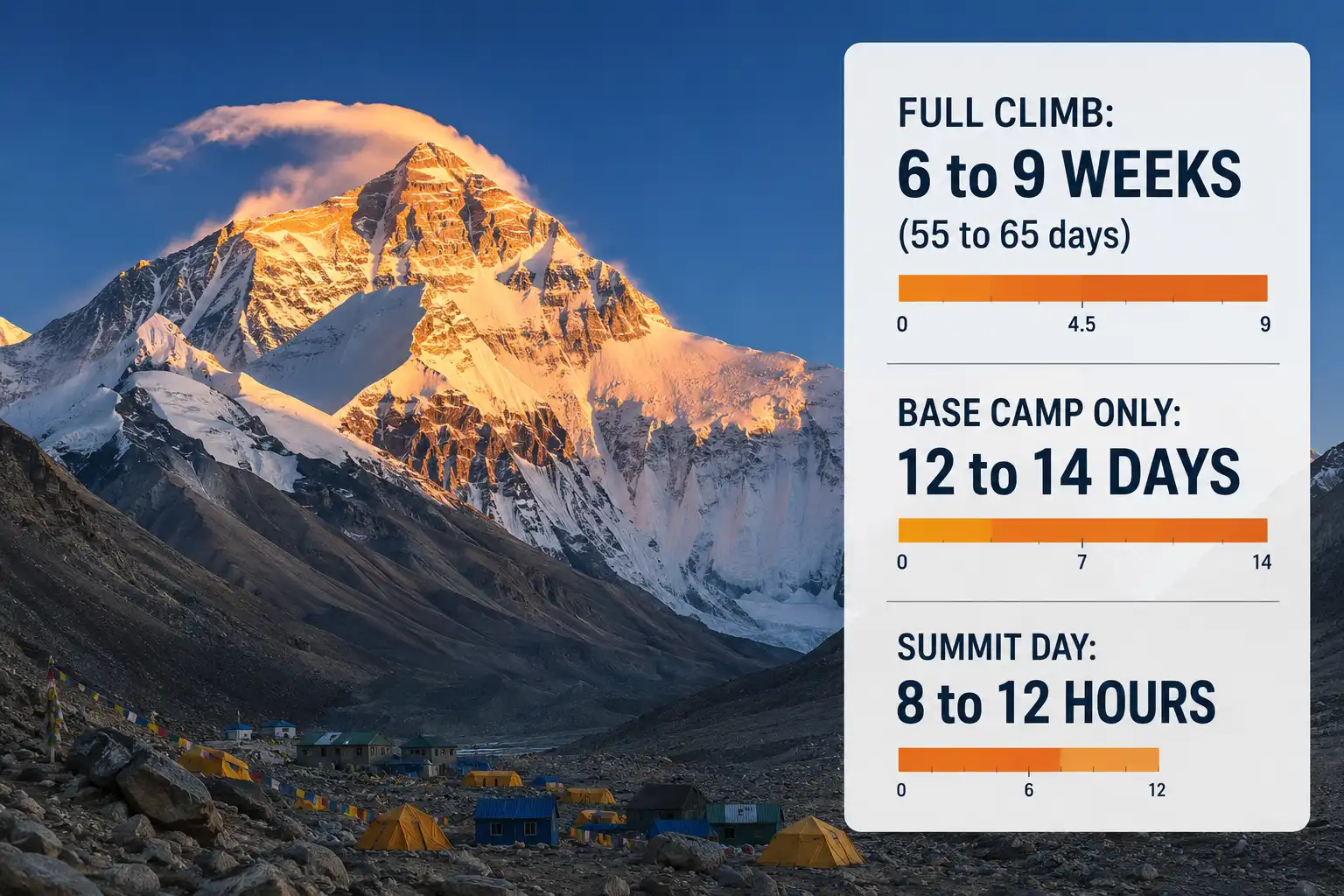
A full Mount Everest climb takes 6 to 9 weeks, so plan on roughly 55 to 65 days from landing in Kathmandu to flying home. Summit day alone runs 8 to 12 hours from the highest camp. If you only want Base Camp, however, the walk takes 12 to 14 days.
One thing worth clearing up first. Reaching the top of Everest is not hiking. Above Base Camp you need crampons, fixed ropes, ladder crossings, a down suit, and bottled oxygen. The trek to Base Camp is walking. Everything above it is mountaineering.
The Everest expedition timeline, phase by phase
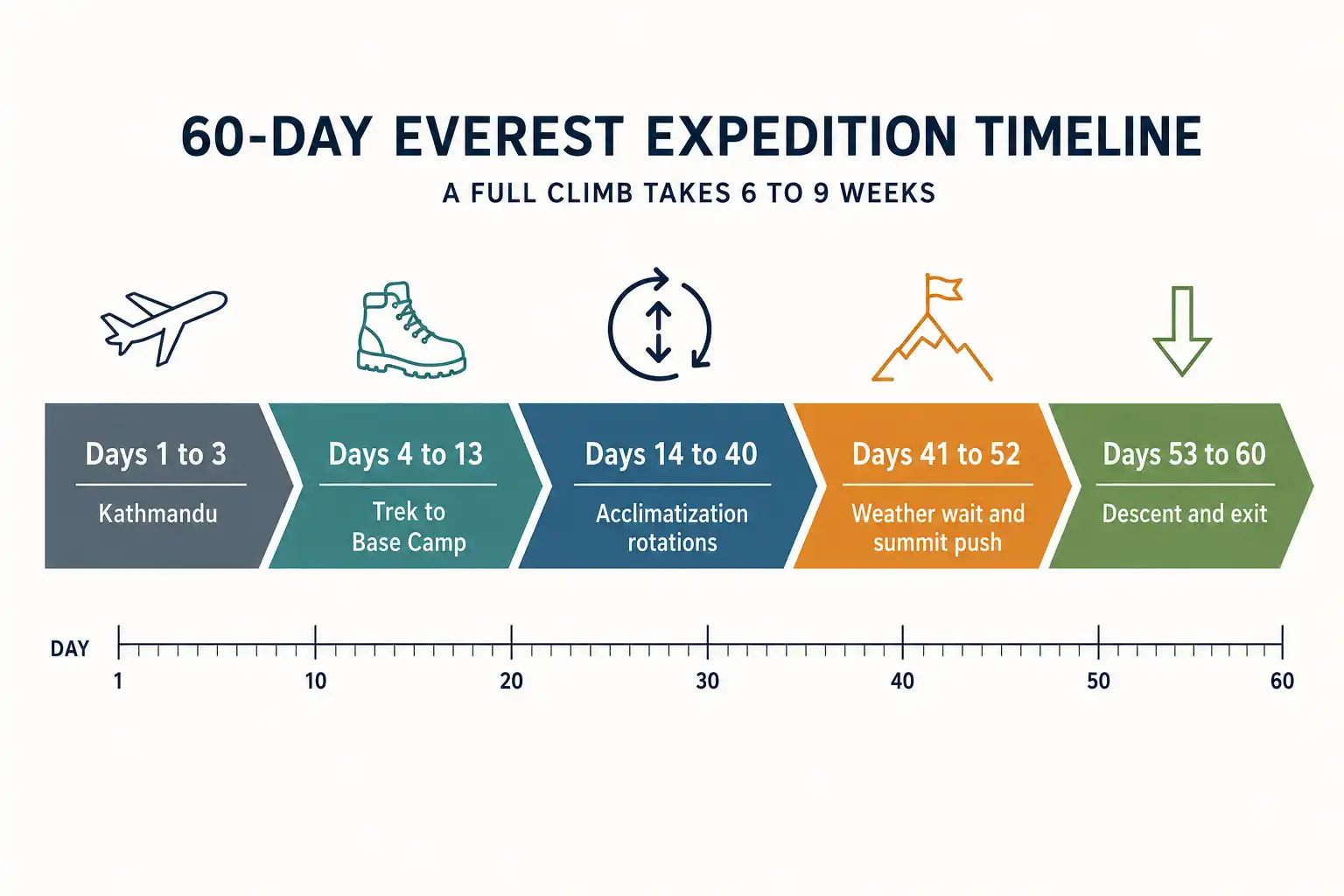
A standard South Col expedition breaks into five phases. Here is how the days usually fall.
- Days 1 to 3, Kathmandu. Permits, medical paperwork, gear checks, and team briefings.
- Days 4 to 13, trek to Base Camp. You fly to Lukla, then walk up the Khumbu valley to Base Camp at 5,364 m (17,598 ft). Teams move slowly on purpose.
- Days 14 to 40, acclimatization rotations. Climbers go up to Camp 1, Camp 2, and Camp 3, then drop back to Base Camp to recover. Most teams repeat this two or three times.
- Days 41 to 52, weather wait and summit push. Teams sit at Base Camp watching forecasts, then move when the jet stream lifts.
- Days 53 to 60, descent and exit. Camp breakdown, waste carry-out, the walk back to Lukla, and the flight to Kathmandu.
Some operators run 55-day trips. Others stretch past 70 when storms stall the mountain. Furthermore, helicopter shuttles now trim several days off the approach for teams that pay for them.
Also know: Hiking Duration for Enchanted Rock
Why does climbing Everest take two months?
Everest takes two months because your body needs weeks to build extra red blood cells, and because the safe weather window is short. At the summit, the air holds about a third of the oxygen you get at sea level. No level of fitness skips that adjustment.
Acclimatization eats most of the calendar. Climbers ascend, sleep high, then descend to recover, and each cycle pushes the body a little further. Rushing it invites pulmonary or cerebral edema, both of which kill quickly.
Weather controls the rest. The jet stream parks over the summit for most of the year and only lifts for a few days at a time, usually in May. In 2026, about 80 percent of the season’s 1,008 summits happened between May 17 and May 26. That is the whole window in a nutshell.
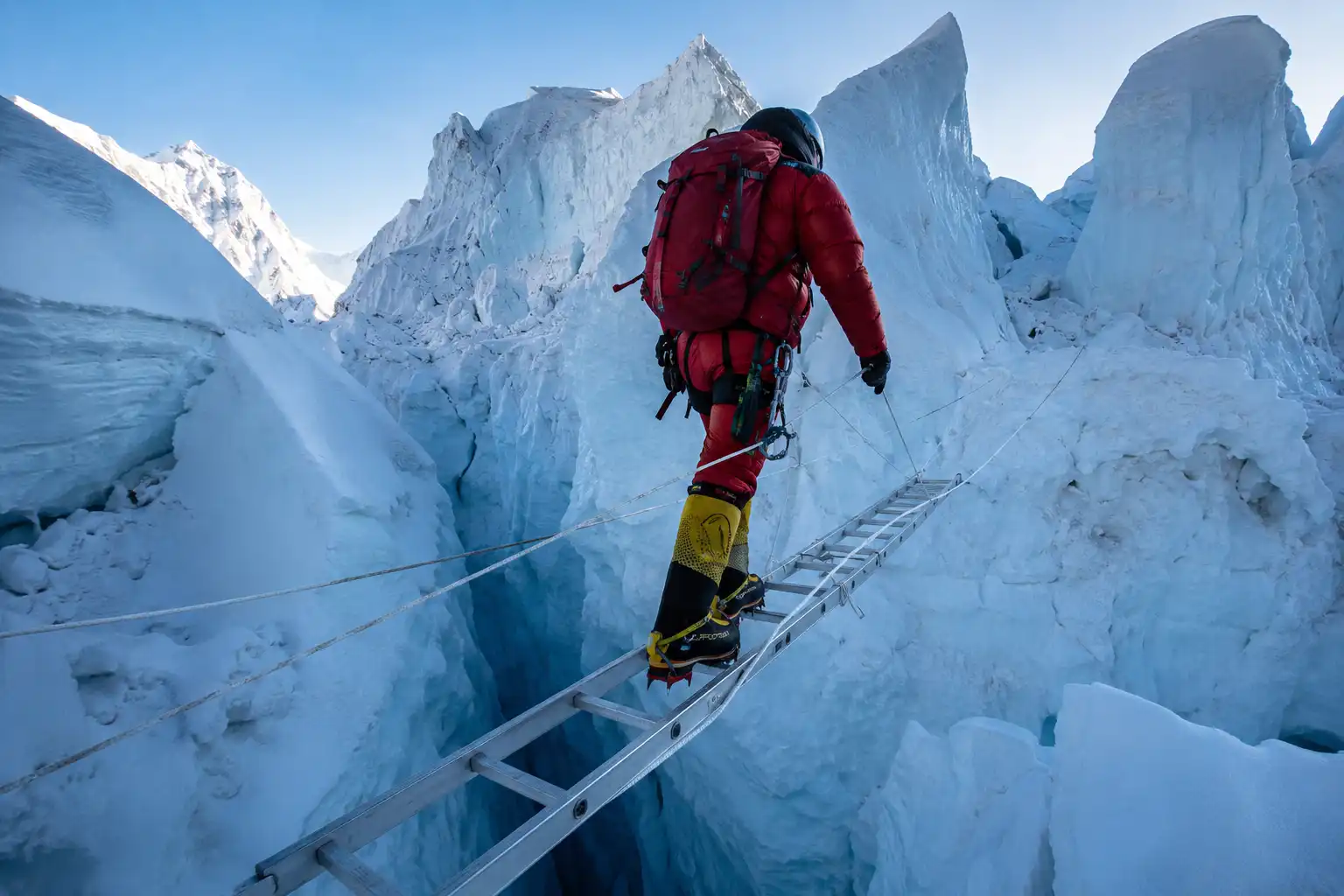
Logistics add more time. Sherpa teams fix ropes, stock oxygen at the high camps, and rebuild the Khumbu Icefall route as the glacier shifts underneath it.
How long is the summit push from Base Camp?
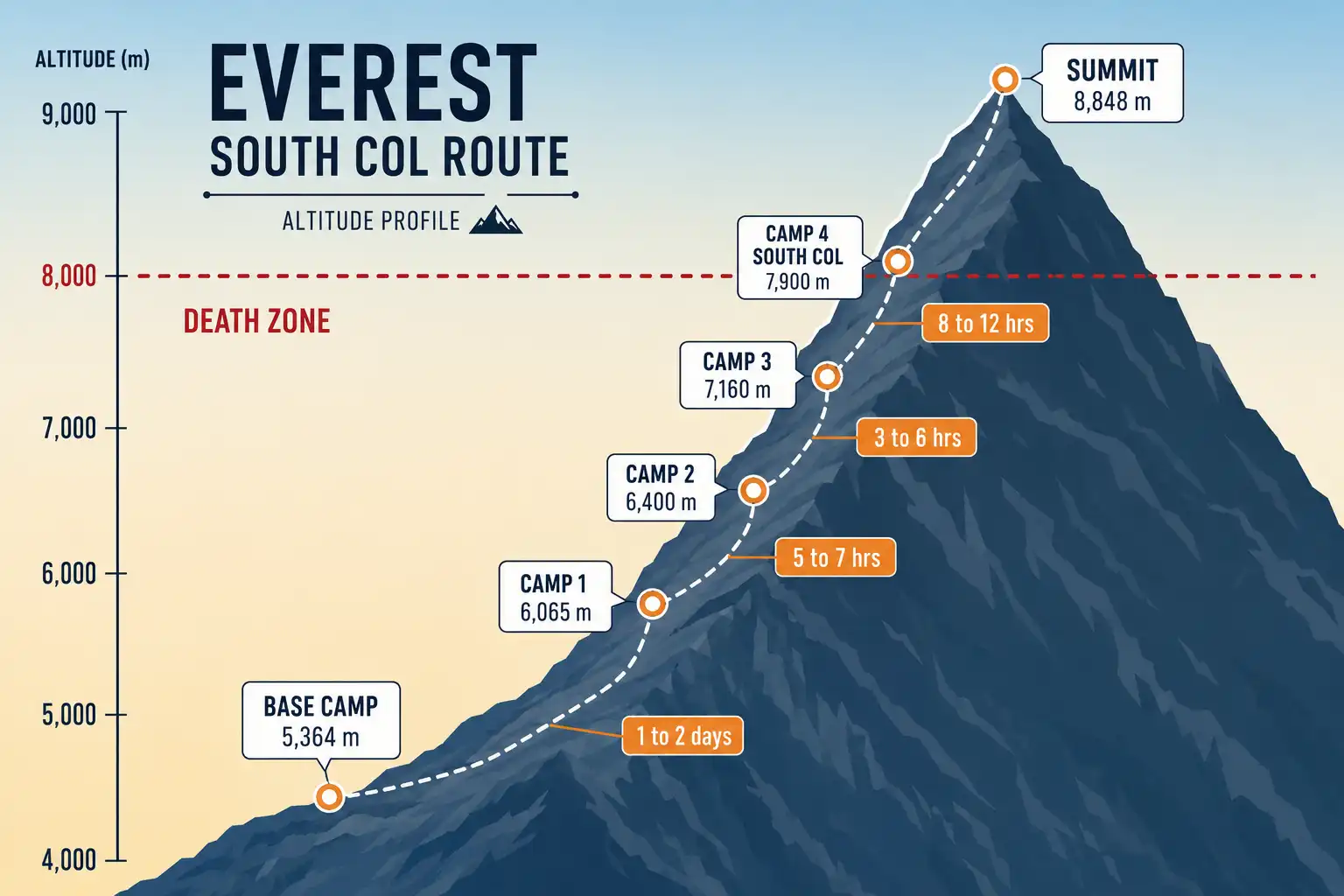
The summit push takes 4 to 7 days round trip from Base Camp. Teams climb through the same camps they used during rotations, but this time they keep going.
- Base Camp to Camp 2 (6,400 m): 1 to 2 days through the Khumbu Icefall
- Camp 2 to Camp 3 (7,160 m): 5 to 7 hours up the Lhotse Face
- Camp 3 to Camp 4, the South Col (7,900 m): 3 to 6 hours
- Camp 4 to the summit (8,848.86 m): 8 to 12 hours
- Summit back to Camp 4: 3 to 5 hours
- Camp 4 back to Base Camp: 1 to 2 days
Many strong climbers now skip a night at Camp 3 and push straight from Camp 2 to Camp 4. Therefore the whole cycle can shrink to four days. Knowing how the camps on Everest are spaced makes those numbers easier to picture, because each one marks a step deeper into thin air.
How long does summit day take?
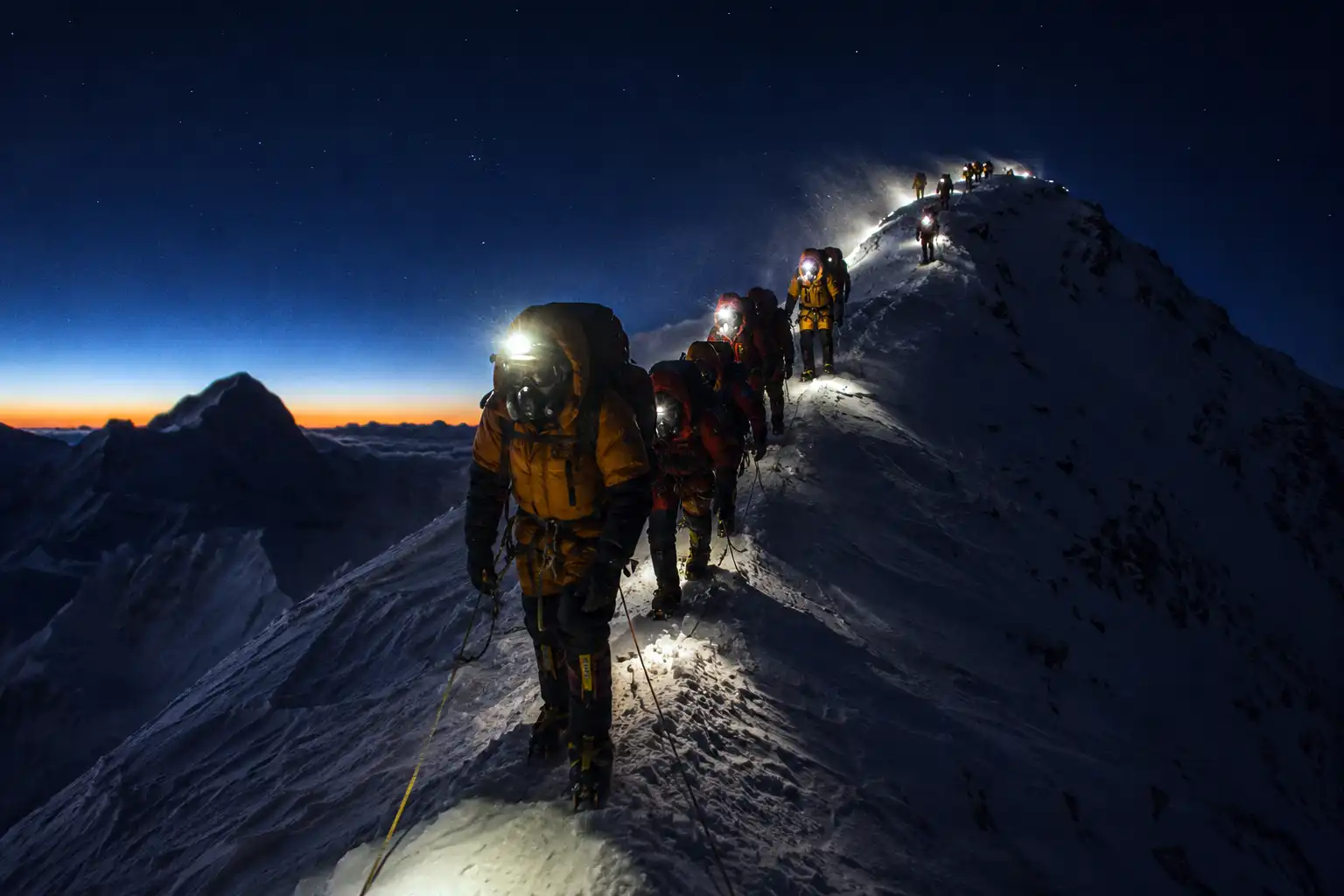
Summit day takes 8 to 12 hours from Camp 4 to the top, then another 3 to 5 hours back down, so most climbers are moving for 12 to 17 hours straight. Teams usually leave the South Col around 10 p.m. so they reach the summit at first light.
The night runs in stages. Climbers reach the Balcony at 8,400 m after roughly 4 to 6 hours, swap oxygen bottles, then continue to the South Summit and across the Hillary Step section. After that, a short snow ridge leads to the top.
Most teams set a hard turnaround time, often around midday. Anyone still below the summit at that hour goes down. Late summits are where things go wrong, because climbers run out of oxygen and daylight on the descent while already exhausted.
Above 8,000 m, the body cannot recover at all. Teams therefore try to keep total time in that zone under 48 hours.
What is the fastest anyone has climbed Mount Everest?
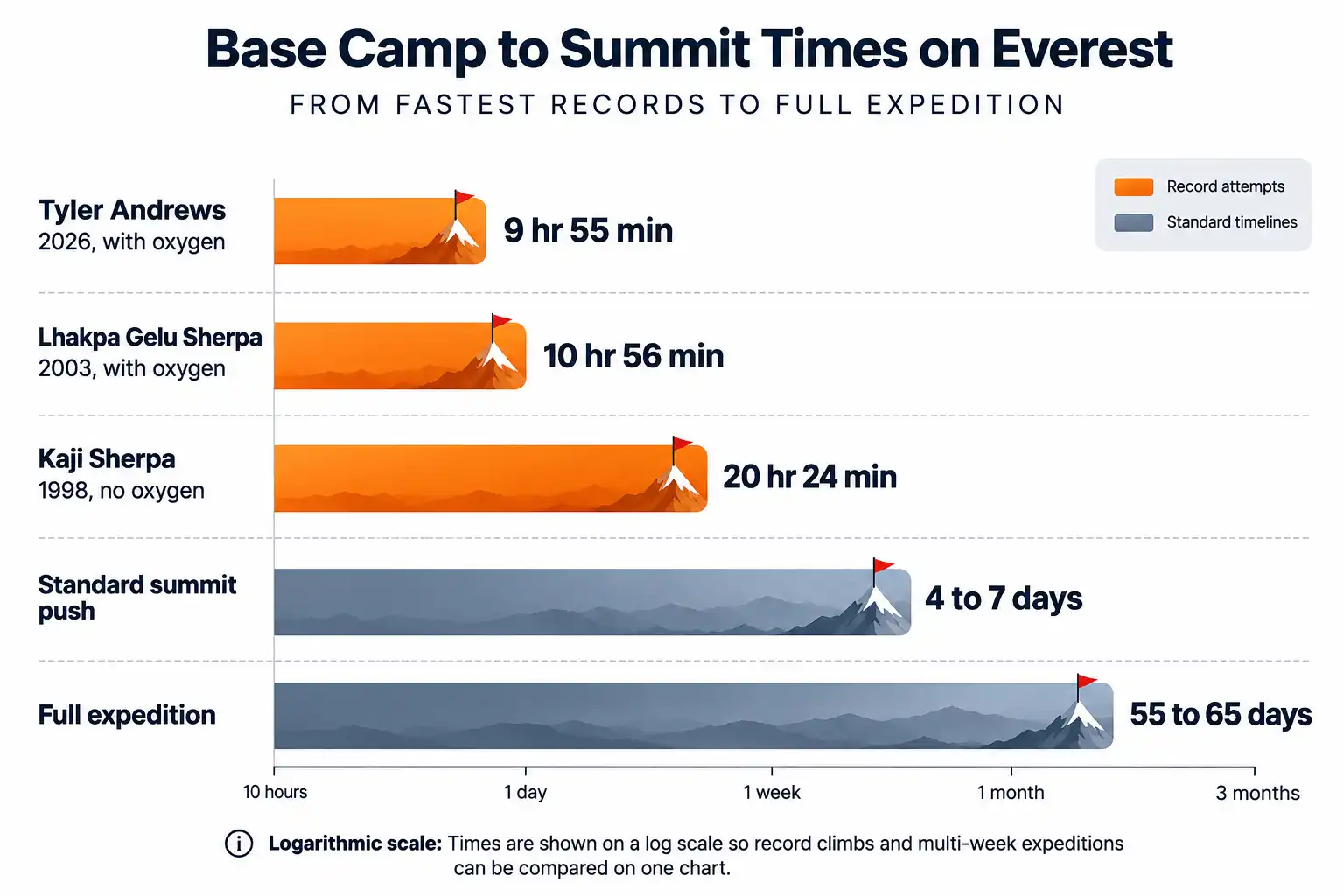
The current record is 9 hours 55 minutes 43 seconds, set by American ultrarunner Tyler Andrews on May 28, 2026, climbing from Base Camp to the summit with supplemental oxygen. He also took the round trip mark at 16 hours 32 minutes.
Andrews broke a time that had held for 23 years. Lhakpa Gelu Sherpa climbed the same route in 10 hours 56 minutes 46 seconds back in 2003. Without bottled oxygen, meanwhile, Kaji Sherpa’s 1998 ascent of 20 hours 24 minutes still stands.
These are all fastest known time efforts, and the rules behind them matter as much as the clock. Every one of these climbers acclimatized on the mountain for weeks first.
One more result is worth knowing. In May 2025, four British climbers went from London to the summit and home again in under seven days after pre-treating with xenon gas and hypoxic tents. The organizer warned people not to copy it.
How the 2026 rules changed the schedule
Nepal tightened its Everest rules in 2025 and 2026, and two changes affect timing directly. Your permit now costs $15,000 for the spring season, up from $11,000. It also runs 55 days instead of 75.
That shorter validity matters. A 60-day itinerary no longer fits inside one permit, so teams have compressed the approach with helicopter transfers and pre-acclimatization at home.
Other current requirements:
- A licensed Nepali guide for every two climbers above 8,000 m
- A medical certificate issued within 30 days of applying
- Rescue and repatriation insurance of roughly $37,500
- Waste carried down from Camp 2 and above, plus a garbage deposit
- Solo and unsupported attempts banned
Two more points to watch. The Tibet side stayed closed to foreign climbers through the 2026 season, which pushed everyone onto the South Col. Nepal’s National Assembly also passed a bill requiring a previous 7,000 m summit inside Nepal before an Everest permit, though it was still awaiting final approval as of mid-2026.
Rules shift between seasons, so confirm everything with your operator before booking.
How long do you need to train first?
Plan on at least a year of focused training, and realistically 2 to 5 years of climbing progression before an operator will take you. Reputable companies want prior summits on 6,000 m and 7,000 m peaks, and many prefer an 8,000 m climb like Manaslu or Cho Oyu first.
Nepal’s pending 7,000 m rule would make that progression a legal requirement rather than a suggestion. Baruntse, Himlung Himal, and Pumori are the peaks most teams use for it.
The physical side takes months of steady work. Building an aerobic base for thin air is the starting point, followed by weighted carries, long back-to-back days, and time above 4,000 m.
What if you just want Base Camp instead?
Base Camp takes 12 to 14 days round trip from Lukla, and it needs no ropes or technical skill. Roughly 80 miles of walking, two rest days, and a slow ascent profile.
That trek is what most travelers actually mean when they ask about hiking Everest. The standard 12-day itinerary from Lukla shows where each rest day falls and how many hours you walk daily. It also helps to check how high Base Camp really sits before you commit, since 17,598 feet affects sleep and appetite more than most people expect.
Budget matters too. Once you price out what a Base Camp trip costs, the gap becomes obvious, since an expedition runs thirty times higher or more.
FAQs about Hiking Mount Everest

Can you hike Mount Everest without climbing experience?
How many days do climbers spend above 8,000 meters?
Can you climb Everest in one week?
What month do most people summit?
Does the north side take less time?
Final thoughts
So, how long does it take to hike Mount Everest? Give it 6 to 9 weeks for the summit, or 12 to 14 days if Base Camp is the goal. Almost none of that time is spent climbing. It goes to red blood cells, weather forecasts, and patience at Base Camp. The 2026 rules squeezed permits down to 55 days, which makes planning tighter than it used to be. Check current requirements with your operator before you book anything.