How Long Does It Take to Hike Mount Timpanogos?

Mount Timpanogos takes far longer than most first timers expect. People ask me about this hike constantly, so I pulled the numbers from the Forest Service, the local rescue team, and dozens of trip reports.
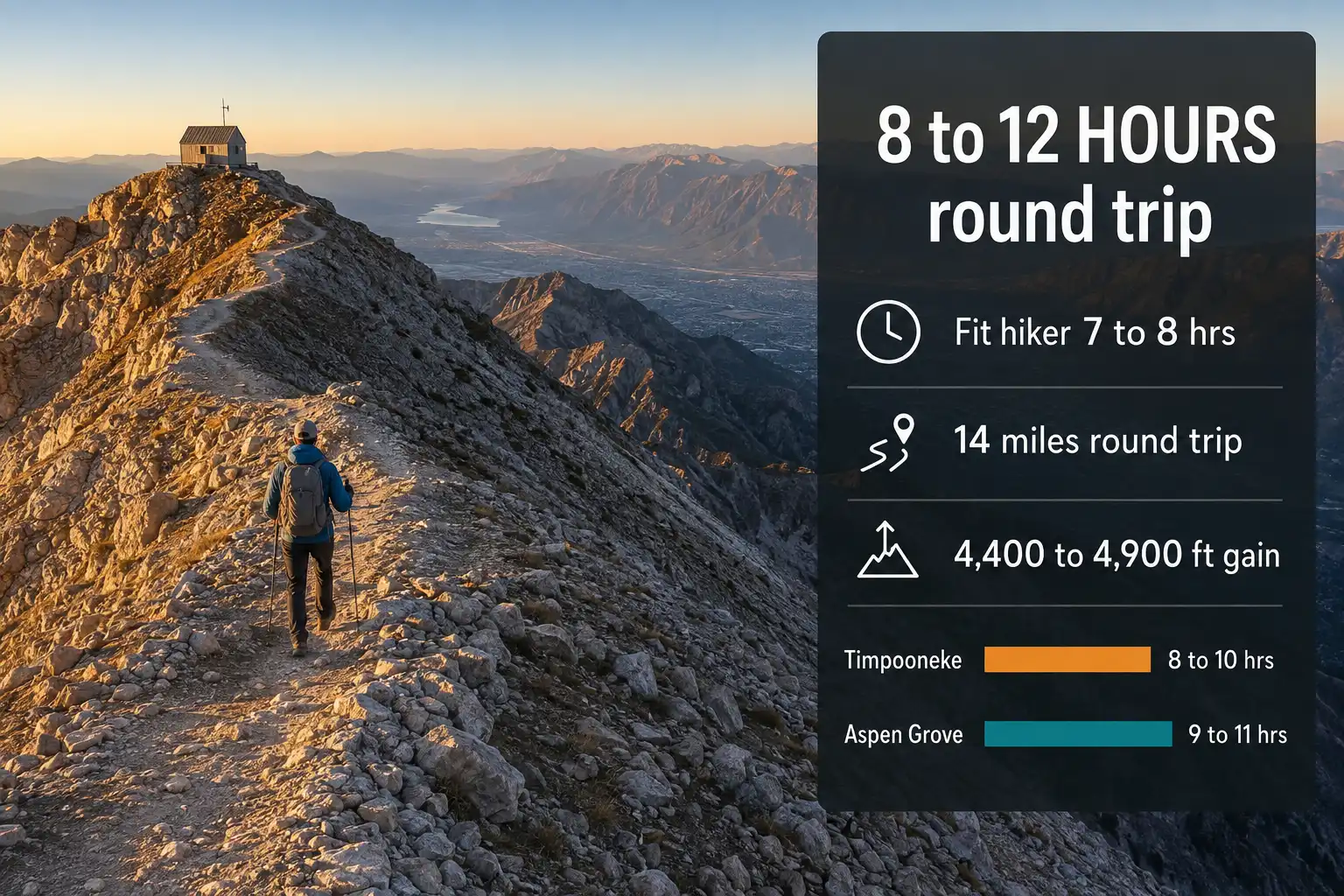
Most hikers finish Mount Timpanogos in 8 to 12 hours round trip, including breaks and summit time. Fit, fast hikers get down in 7 to 8 hours. Beginners and large groups regularly need 12 hours or more. Both trails run roughly 14 miles with 4,400 to 4,900 feet of climbing.
What is the average Mount Timpanogos hike time?
The average round trip sits at 8 to 10 hours for a reasonably fit hiker moving at a steady pace. That figure already includes short rest stops and about 20 minutes at the top. However, your actual time swings a lot based on fitness, group size, and how much snow sits on the upper mountain.
Here is what different hikers typically post:
| Hiker type | Ascent | Descent | Total with breaks |
|---|---|---|---|
| Trail runner, very fit | 2.5 to 3.5 hrs | 2 to 2.5 hrs | 5 to 6 hrs |
| Strong regular hiker | 4 to 4.5 hrs | 3 to 3.5 hrs | 7 to 8 hrs |
| Average day hiker | 5 to 6 hrs | 3.5 to 4.5 hrs | 9 to 11 hrs |
| Beginner or group of six plus | 6 to 7 hrs | 4.5 to 5.5 hrs | 12 to 14 hrs |
Published times vary because published trail lengths vary too. Different GPS tracks put the routes anywhere from 13.5 to 16 miles. For planning, treat 14 to 15 miles as the working number and budget accordingly.
How long does the Timpooneke Trail take?
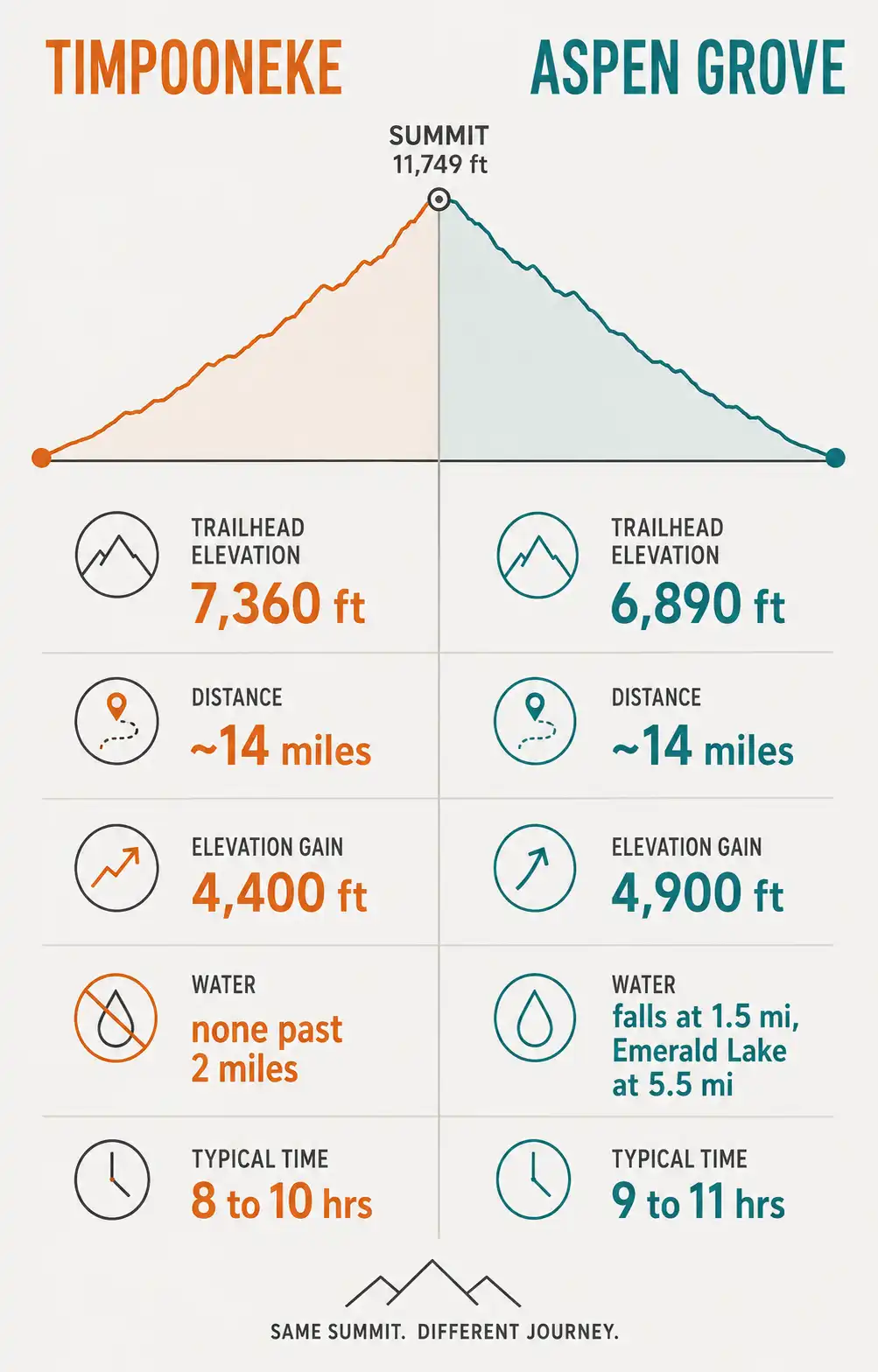
Timpooneke takes most hikers 8 to 10 hours round trip. The trailhead starts high, at roughly 7,360 feet. Meanwhile, the Timpanogos Emergency Response Team lists the route at about 14 miles with around 4,400 feet of gain. Because the grade stays gentler for longer, this side is the faster of the two for almost everyone.
| Landmark | Miles from trailhead | Typical time up |
|---|---|---|
| Scout Falls junction | 1.4 | 40 to 50 min |
| Timpanogos Basin | 4.4 to 4.9 | 2.5 to 3 hrs |
| Timp Saddle, about 11,000 ft | 6.3 | 4 to 4.5 hrs |
| Summit, about 11,750 ft | 7 | 4.5 to 5.5 hrs |
The first four miles feel deceptively easy. Then the switchbacks out of the basin steepen sharply. Above the saddle, the last stretch climbs 600 to 700 feet in barely half a mile. Most people spend 30 to 45 minutes on that final push alone.
Also know: Mount Rainier Hiking Times
How long does the Aspen Grove Trail take?
Aspen Grove usually adds 30 to 60 minutes compared with Timpooneke. Distance stays close to 14 miles, but the trailhead sits lower at about 6,890 feet, so you climb closer to 4,900 feet. That extra vertical shows up in your legs and on your watch.
| Landmark | Miles from trailhead | Typical time up |
|---|---|---|
| First and Second Falls | 1 to 1.5 | 30 to 45 min |
| Top of Primrose Cirque | 3.5 | 2 to 2.5 hrs |
| Hidden Lakes area | 4.3 | 3 to 3.5 hrs |
| Emerald Lake, about 10,380 ft | 5.5 | 3.5 to 4.5 hrs |
| Timp Saddle | 6.5 | 5 to 5.5 hrs |
| Summit | 7.2 | 5.5 to 6.5 hrs |
Aspen Grove does have one timing advantage. Water sits along the route at First and Second Falls and again at Emerald Lake, so you can filter instead of hauling every liter. Filtering costs you ten minutes and saves several pounds of pack weight.
Which trail is faster, Timpooneke or Aspen Grove?
Timpooneke is faster for most hikers, typically by 30 to 60 minutes. It starts about 470 feet higher, climbs roughly 500 fewer vertical feet, and spreads its gain over gentler switchbacks. Aspen Grove climbs harder and earlier through Primrose Cirque, which burns legs before you reach the halfway point.
That said, Timpooneke fills up first. If you cannot get a parking spot there, the extra hour on Aspen Grove beats waiting around or walking two miles from an overflow turnout.
How long does the descent take?
Plan on 3 to 4.5 hours to get back down. Descent usually runs about 70 to 80 percent of your ascent time, which is slower than most people assume. Loose scree above the saddle and the talus crossing below the basin both force you to slow down.
Knees take a beating on this one. Trekking poles genuinely help here. Learning how poles take a load off your knees can save you 20 or 30 minutes over the full descent. Blisters slow people down even more, so sort your socks and lacing before you start.
What slows hikers down on Timpanogos?
Terrain slows people down more than fitness does. Six factors account for nearly all lost time here:
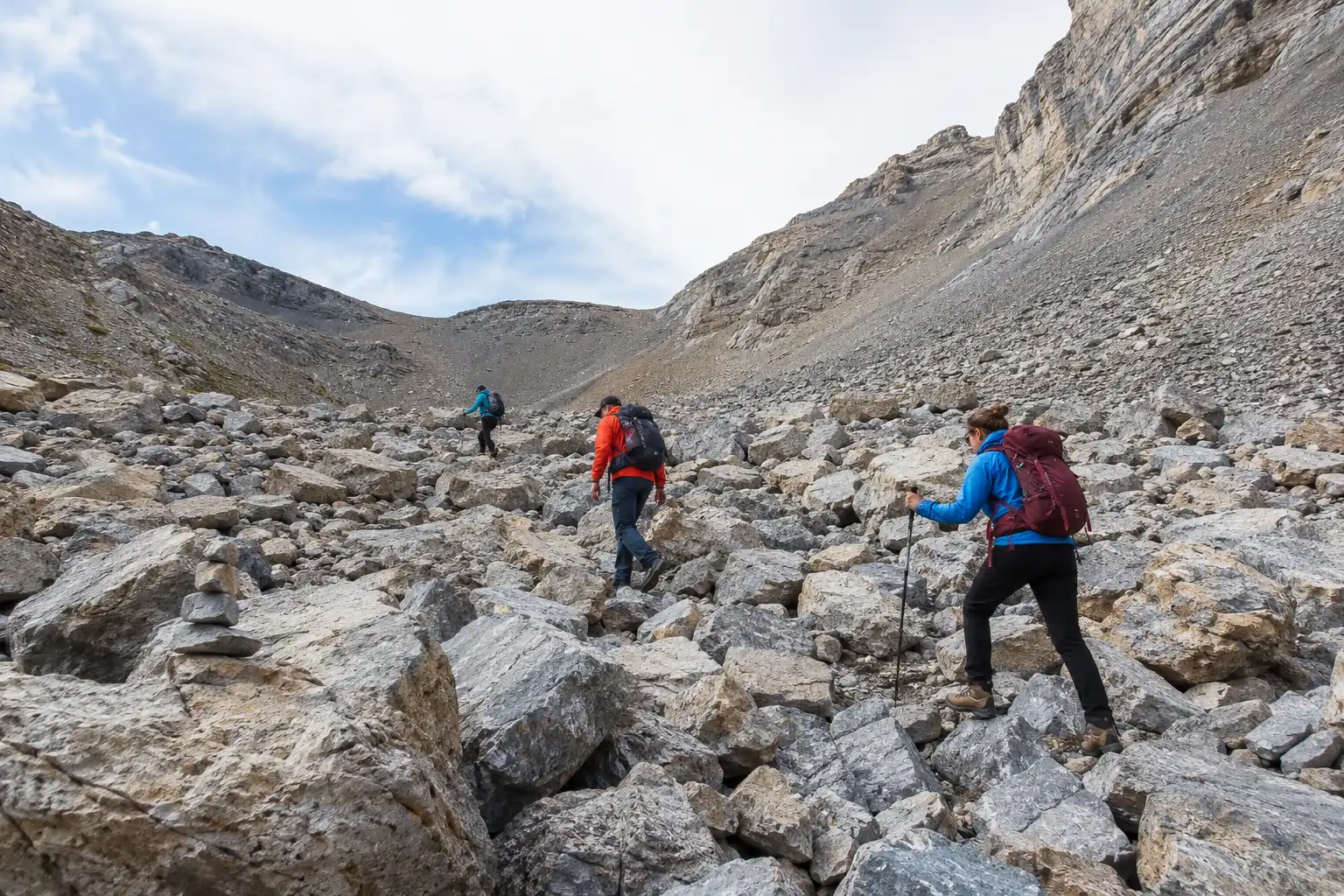
- The talus and boulder crossing. Roughly a mile of rock hopping below the saddle. Expect 30 minutes minimum, and longer if it is wet.
- The saddle push. Steep, loose, and exposed. Wind hits hard here, and many hikers stop to layer up.
- Altitude. The summit stands near 11,750 feet, and altitude sickness can affect anyone above 8,000 feet. Visitors from sea level slow noticeably above the basin.
- Crowds. Weekend traffic backs up on narrow switchbacks. Hundreds of hikers use these trails on a summer Saturday.
- Snow. Patches linger into July and sometimes August. Icy sections turn a 20 minute stretch into an hour.
- Water rationing. Timpooneke has no reliable water past two miles. Running short forces slow, miserable descents.
What time should you start hiking Timpanogos?
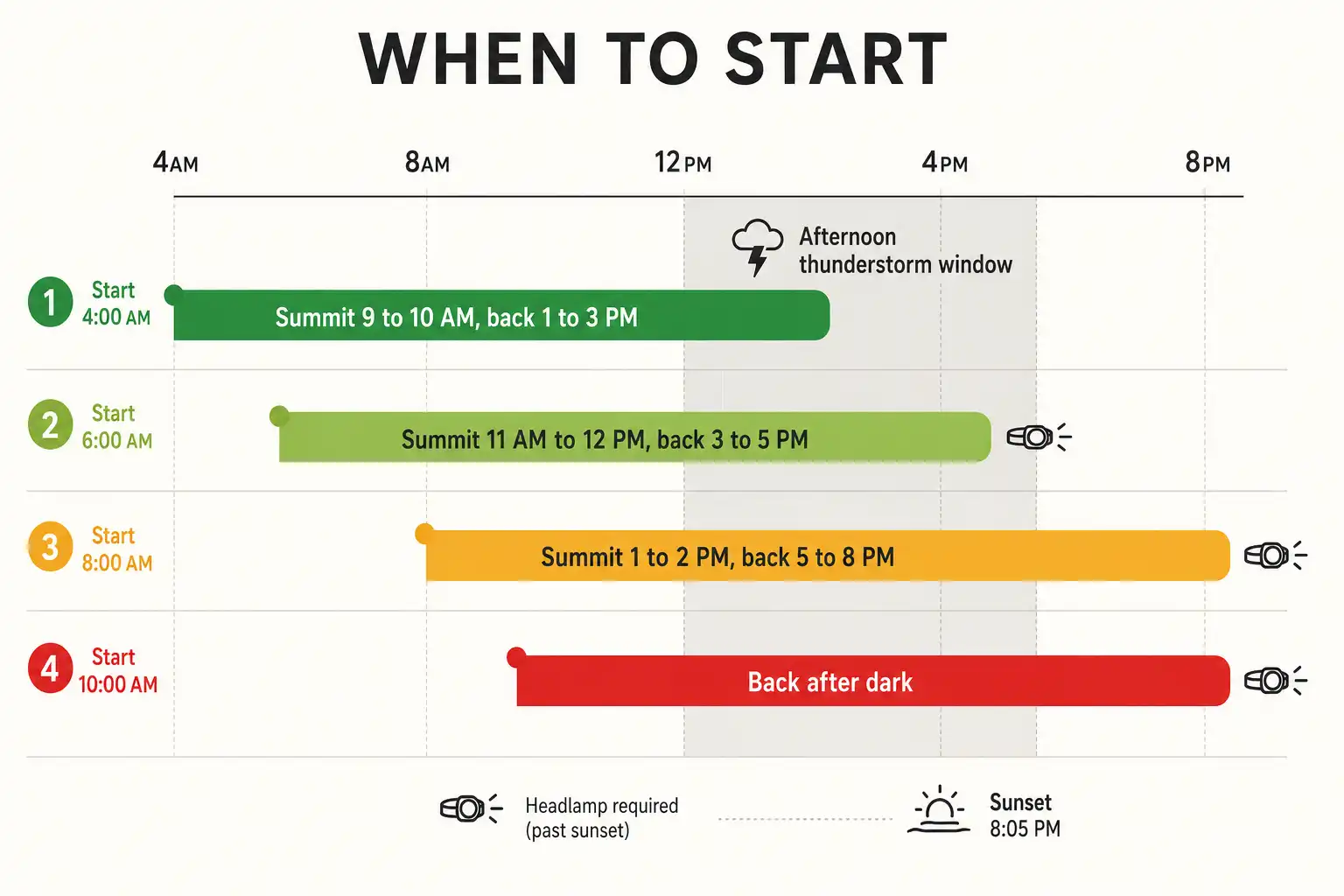
Start between 4:00 and 6:00 a.m. if you want a comfortable finish. Afternoon thunderstorms build regularly over the Wasatch in summer, and the ridge above the saddle offers zero shelter. A pre dawn start is standard practice here, not an extreme measure.
| Start time | Typical summit | Back at car | Verdict |
|---|---|---|---|
| 4:00 a.m. | 9:00 to 10:00 a.m. | 1:00 to 3:00 p.m. | Ideal, beats storms and heat |
| 6:00 a.m. | 11:00 a.m. to 12:00 p.m. | 3:00 to 5:00 p.m. | Solid for fit hikers |
| 8:00 a.m. | 1:00 to 2:00 p.m. | 5:00 to 8:00 p.m. | Risky, storm window |
| 10:00 a.m. | 3:00 p.m. or later | After dark | Skip it |
Set a hard turnaround time before you leave the car. If you are not at the saddle within five hours, turn around regardless of how close the summit looks. Carry a headlamp anyway, because finishing later than planned happens constantly. Practice moving safely in the dark with a headlamp before you actually need it.
Does the season change how long the hike takes?
Yes, and the swing is significant. Most years the trails clear enough for comfortable summit attempts around early July, and conditions stay good through September.
- Late May to June: Snow still covers the upper mountain. Add one to three hours, and bring microspikes. Snow bridges over creeks can collapse.
- July to September: Prime season. Standard 8 to 12 hour times apply. Wildflowers peak in the basin during August.
- October: Fast, cool hiking, but daylight shrinks and snow arrives without warning. Rescues for cold injuries happen in this window.
- November to May: The Alpine Loop road closes, typically in early November. Winter ascents require mountaineering skills and gear.
How can you finish Mount Timpanogos faster?
Train for the vertical, not the mileage. This hike stacks 4,400 to 4,900 feet into a single push. Therefore, what counts as heavy elevation gain matters far more than flat miles when you plan. Stair sessions and weighted hill repeats beat treadmill walking every time.
Four other adjustments make a measurable difference:
- Pace conservatively for the first two hours. Going out hot costs you an hour later. Good pacing on a long day hike is the single biggest time saver.
- Cut pack weight. Three liters of water plus layers is enough for most conditions.
- Eat on a schedule. Set a timer for every 45 minutes. Knowing what to eat on a long day hike keeps your energy flat instead of spiky.
- Acclimate if you can. Sleep a night at the Timpooneke campground first. Otherwise, training for hiking at altitude in the weeks before your trip helps.
Should you split Timpanogos into two days?
Split it if your group includes beginners, kids, or anyone uncomfortable with a 12 hour day. Camping in Timpanogos Basin or near Emerald Lake turns one brutal day into two manageable halves. You hike four to five hours up, camp, then summit at sunrise and descend fresh.
Two rules apply if you camp. The Forest Service bans fires year round in the Timpanogos Wilderness, and caps group size at 15 people. Water is also scarce in the basin, so carry what you need or plan a filter trip to Emerald Lake.
How permits and parking add time to your day
Budget an extra 30 to 90 minutes for access logistics. American Fork Canyon is a fee area. The Uinta-Wasatch-Cache recreation pass runs $10 for three days, $20 for seven days, or $60 annually. Alternatively, an America the Beautiful pass covers it.
Timpooneke also requires a timed entry ticket on Saturdays, Sundays, and certain holidays during peak season, roughly July through mid October, from midnight to noon. Tickets release 30 days ahead on Recreation.gov, with a smaller batch two days out. The reservation holder must be present in the vehicle.
Parking is the real time sink. Timpooneke fills before 6:00 a.m. on summer weekends, and overflow parking at Pine Hollow or Salamander Flat adds 1.5 to 2 miles each way to your hike. That alone can tack on 90 minutes.
FAQs about Mount Timpanogos Hike Time

Can a beginner hike Mount Timpanogos in one day?
How long does it take to reach Emerald Lake?
Is Mount Timpanogos harder than it looks from the valley?
Do I need a headlamp if I start at sunrise?
Final thoughts
Give Mount Timpanogos a full day and treat 10 hours as your working estimate. Start early, watch the weather, and set a turnaround time you will actually respect. I have not hiked Timp myself. My own long days happen on Keokradong and Saka Haphong back home in the Bandarban hills. However, the pattern holds everywhere: the hikers who finish comfortably are the ones who planned for the slow version of themselves.