Are Duck Boots Good for Hiking? What They Handle and What They Don’t

Duck boots show up everywhere once the ground turns wet. Rubber bottom, leather top, waterproof by design. So people naturally ask whether a pair can handle a trail. I dug into the construction, the tread, the support, and what hikers report after actual miles in them.
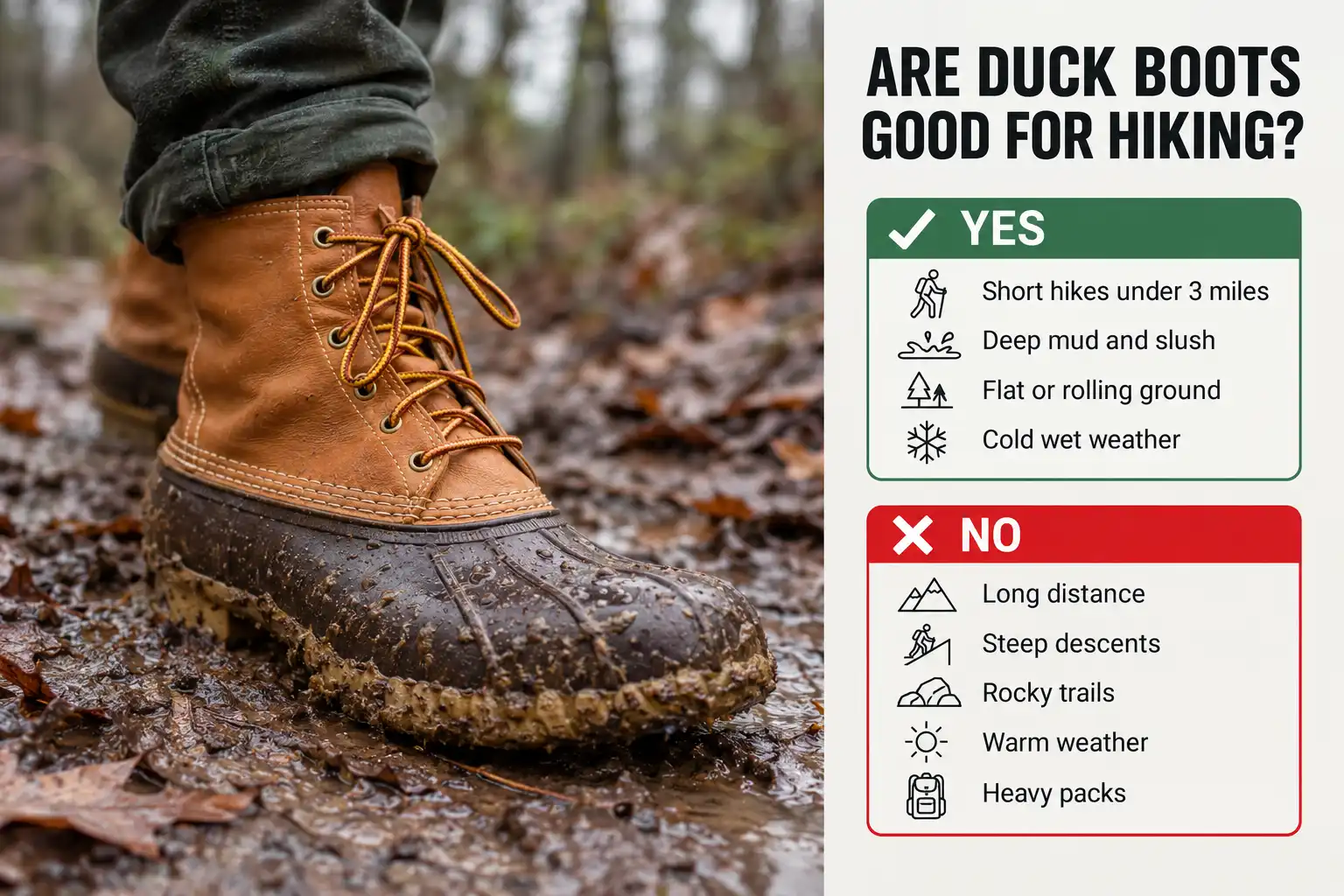
Duck boots work for short, flat, wet hikes in cool weather. They beat most hiking boots in deep mud and slush. However, they struggle on long distances, steep grades, rocky ground, and warm days. The reason is simple: almost no arch support, shallow tread, and zero breathability.
What exactly is a duck boot?
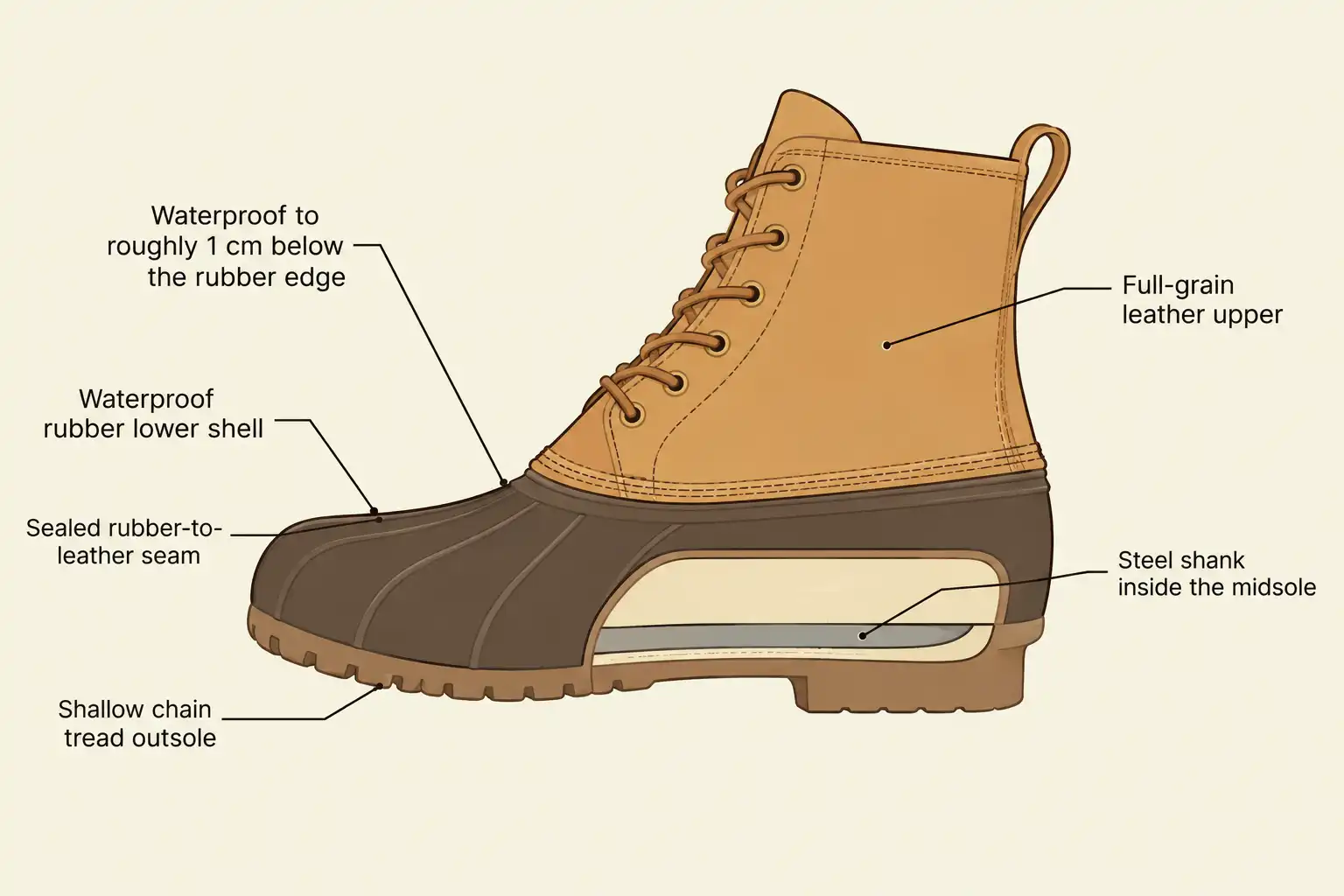
A duck boot combines a waterproof rubber lower shell with a leather or fabric upper stitched on above it. Leon Leonwood Bean built the first pair in 1911 after coming home from a Maine hunting trip with soaked feet. He wanted rubber protection underneath and leather comfort up top, so he had a cobbler join the two. That design became the Maine Hunting Shoe, then the Bean Boot, and eventually the whole duck boot category.
The seam where rubber meets leather gets sealed, which is why the lower half stays dry. L.L.Bean rates its classic boot as waterproof up to about one centimeter below the top edge of the rubber. Above that line, you are relying on treated leather, and leather soaks through eventually.
Two more numbers matter here. The 8-inch padded collar Bean Boot weighs roughly 3 pounds 12 ounces per pair. Most mid-cut hiking boots land closer to 2 pounds. Also, the classic outsole uses a shallow chain-link pattern rather than deep lugs, which changes everything about how the boot behaves on a slope.
When are duck boots actually good for hiking?
Duck boots are good for hiking when the route is short, the ground is wet, and the temperature is low. That combination plays directly to what the design does best.
Deep mud is the clearest win. A rubber shell sheds clay and muck that would soak straight through a fabric-and-leather hiker. During monsoon season around Kaptai, I have watched trail sections turn into ankle-deep slop for weeks at a time. Rubber-bottomed footwear is the only thing that keeps feet dry through that. Duck boots handle that same job while feeling less clumsy than full wellingtons.
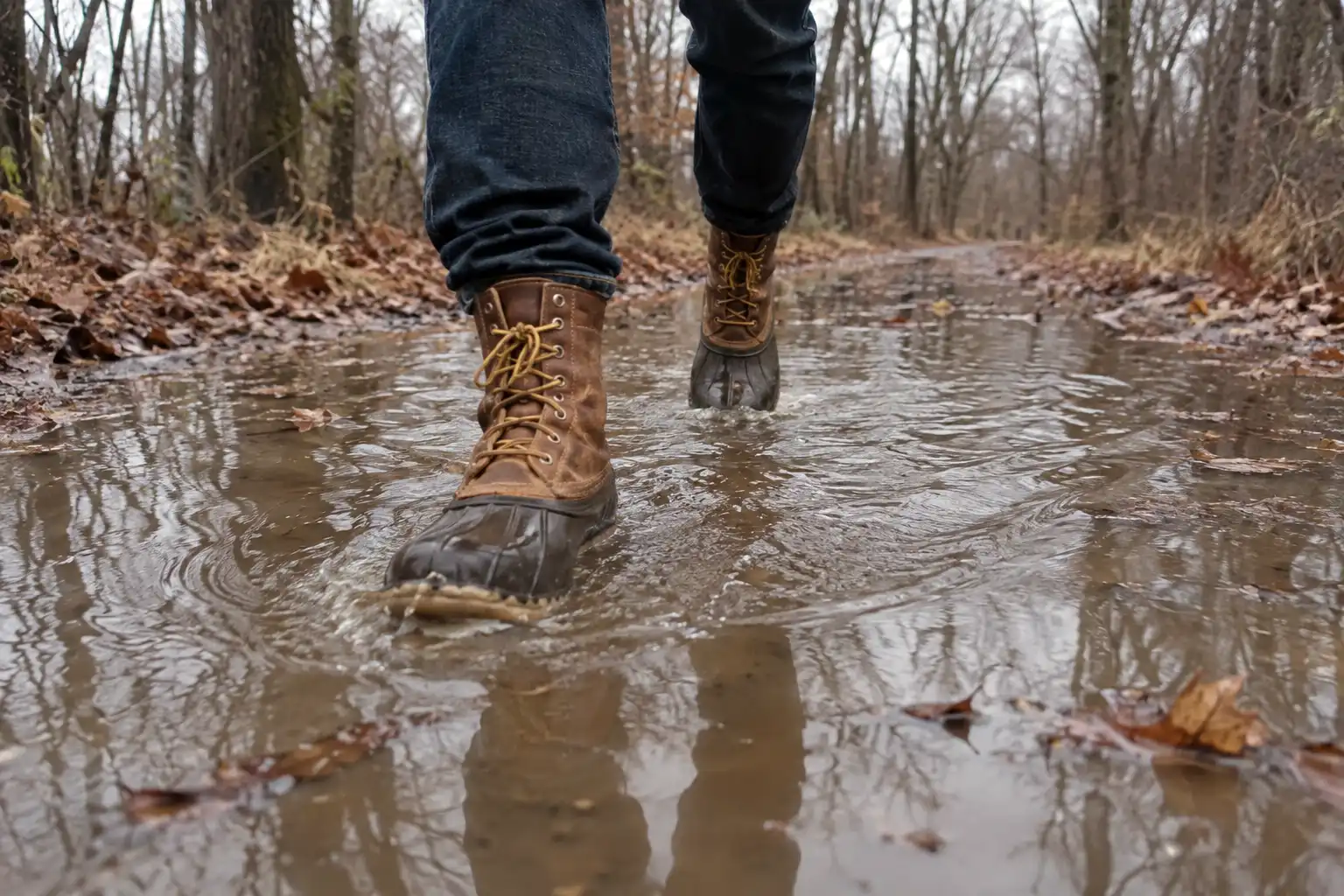
Flooded tracks and stream edges suit them too, as long as the water stays below that one-centimeter line. Slush works. Wet grass works. Cold marsh crossings work.
Distance is the limit. Under about three miles on rolling ground, most people finish comfortably. Past that, the missing arch support starts talking back.
They also earn their place as camp footwear. After a long day in wet boots, sliding into a dry pair to walk around a soggy campsite feels excellent. Plus, they pull on and off fast, which matters when you are ducking in and out of a tent.
When should you leave duck boots at home?
Leave duck boots at home for any hike involving real distance, steep terrain, loose rock, or warm weather. Each of those exposes a specific weakness rather than a general one.
Long mileage is the first problem. The footbed in a classic duck boot is thin, and the rubber sole flexes like a slipper. Consequently, your foot muscles do work that a supportive midsole should be doing. Hikers who push past four or five miles routinely report arch fatigue and sore feet the next day.
Steep ground is the second. Descending on a shallow chain tread over wet clay is how people fall. I have taken that slide myself in cheap rubber boots on a Bandarban hillside, and it happens faster than you can react.
Rocky trails punish them too. Without a stiff midsole, sharp stones telegraph straight through, and the soft rubber offers no edging control on ledges.
Warm weather might be the worst use case of all. Rubber does not breathe at all. Therefore your feet sweat, the sweat has nowhere to go, and you finish the hike with wet feet anyway. Heavy packs compound every one of these issues, so skip duck boots for backpacking entirely.
How does duck boot traction perform on trails?
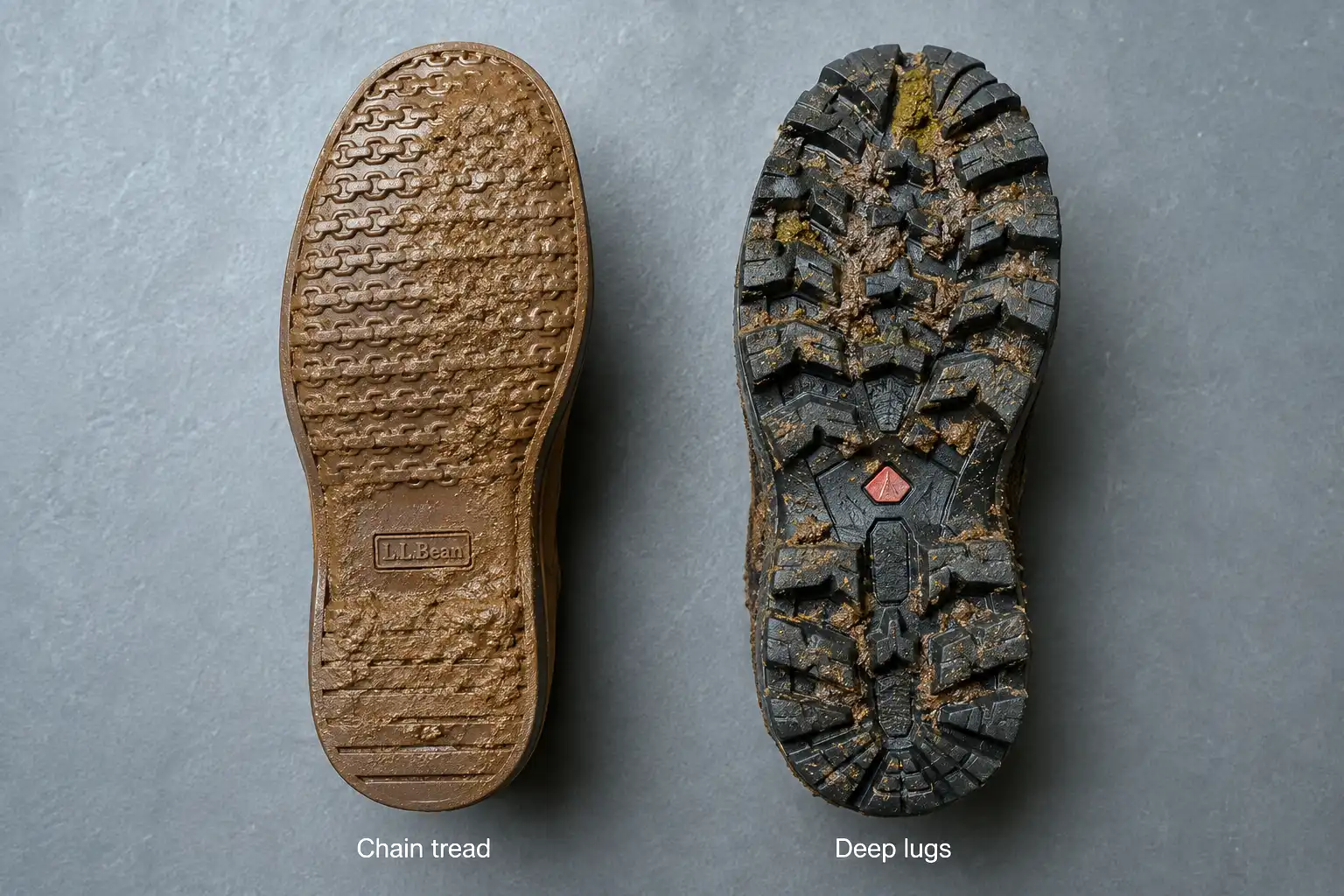
Duck boot traction is fine on flat mud and poor on slopes, wet rock, and roots. The classic chain-tread pattern is shallow by design, since it was built for marsh walking rather than climbing.
Shallow tread creates two separate problems. First, it packs solid with mud and then behaves like a smooth sole. Deep lugs shed mud between steps; a chain pattern does not. Second, it gives you very little bite when you angle across a hillside.
Long-time users are blunt about this. Hunters on forums describe the chain tread slipping on muddy hillsides and admit they moved to lugged boots after taking falls in the woods. One reviewer noted that after two years the chain pattern had worn smooth and traction on wet surfaces became unnerving.
Wear makes it worse over time. As the rubber heel rounds off, the little grip you started with disappears. L.L.Bean does resole its boots, though, which extends the life of an otherwise dead outsole.
Not every duck boot uses chain tread, thankfully. Muck, Kamik, and Georgia build models with proper lug outsoles, and Sperry uses siped rubber for wet grip. Those versions hold a slope far better than the heritage pattern does.
Do duck boots give enough support for hiking?
Duck boots give enough support for a walk and not enough for a hike. Support breaks down in three places: the arch, the heel, and the forefoot.
Arch support comes first. Several duck boots include a steel shank, including L.L.Bean’s 8-inch padded collar model, and that helps with torsional stiffness. Even so, the stock footbed offers almost nothing underneath your arch. Swapping in an aftermarket insole fixes most of this.
Heel hold is the bigger nuisance. These boots are cut roomy on purpose so you can wear thick socks, but roomy also means your heel lifts as you climb. Heel lift causes friction, and friction causes blisters. Some wearers report chafing right on the Achilles tendon after only a few miles. A few lacing tricks that lock the heel down help, though they cannot fully cancel out a loose fit.
Forefoot fit is the one you cannot adjust. Because the rubber toebox is molded as a single piece, the lace eyelets start higher up the boot than on a normal hiker. As a result, you can tighten around the ankle but never over the top of your foot. If the toe box is too roomy for you, no lacing method changes that.
Are duck boots warm enough for winter hiking?
Duck boots are warm enough for mild winter conditions and not for extended cold. Warmth depends entirely on which version you buy, since insulation varies widely across the lineup.
The uninsulated 6-inch models carry no insulation at all. They rely on thick socks and trapped air. Insulated versions typically use 200 grams of Thinsulate in the 8-inch men’s and 7-inch women’s sizes. Meanwhile, the taller 10-inch and 9-inch models step up to 400 grams. Shearling and flannel linings add more.
Here is the honest caveat. Reviewers of the insulated Bean Boot still report cold toes around 30°F while standing or walking slowly. Hiking generates heat, so you will run warmer than someone waiting at a bus stop, but these are not expedition boots.
Breathability is the real winter trap. Rubber traps every bit of sweat your foot produces. Damp socks then conduct heat away from your skin, and your feet get colder than they would have in a breathable boot. The same tradeoff shows up from the other direction when you consider how regular hiking boots handle snow.
I should be straight with you here: I hike in the hills of Rangamati and Bandarban, and snow is not part of my experience. This section rests on manufacturer specs and reports from hikers in cold climates rather than my own feet.
Duck boots vs hiking boots: what actually differs
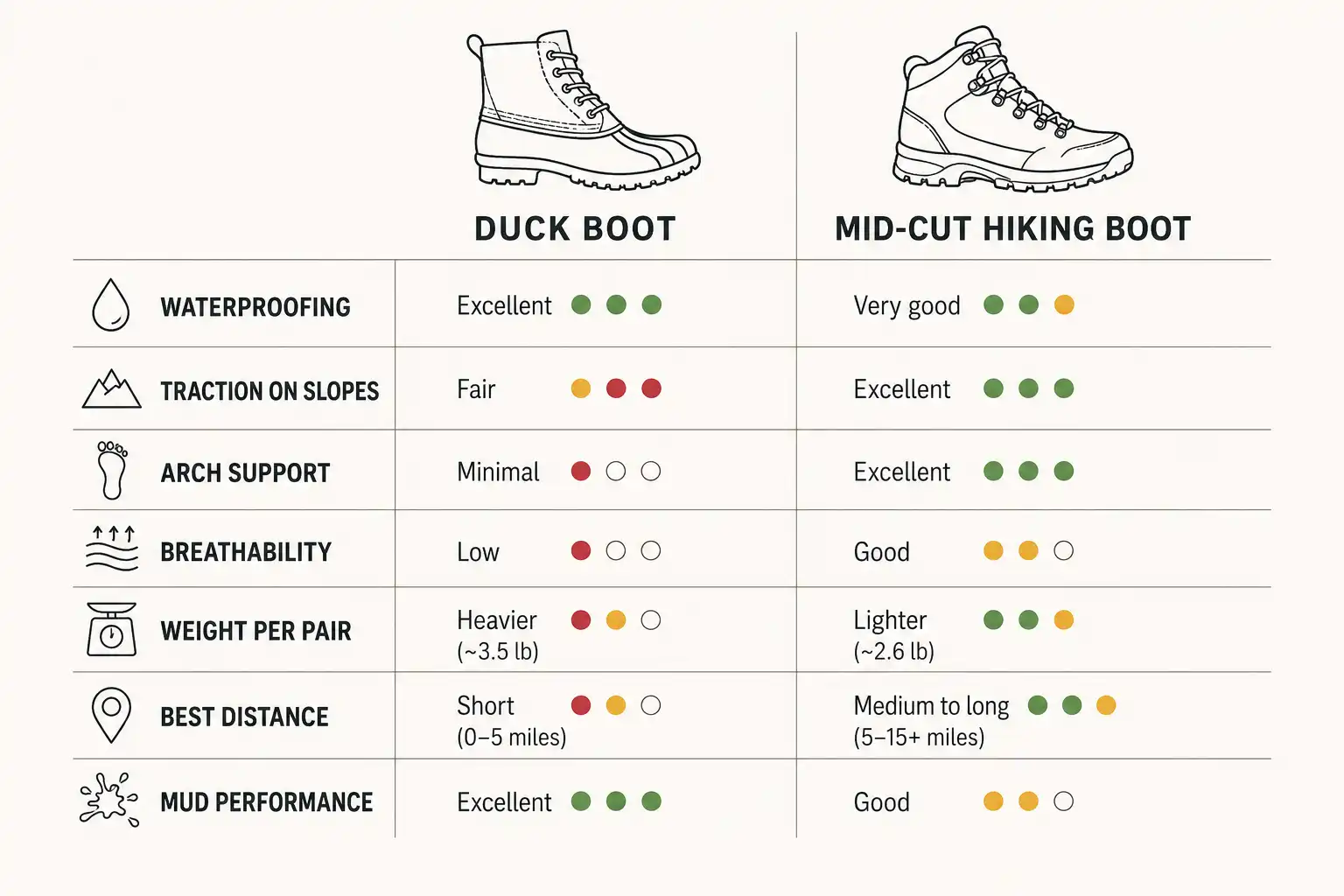
Duck boots win on waterproofing and lose on almost everything else that matters for covering ground. The table below sums up where each one lands.
| Feature | Duck boots | Hiking boots |
|---|---|---|
| Waterproofing | Excellent below the rubber line | Good, depends on membrane |
| Traction on slopes | Poor with chain tread | Strong with deep lugs |
| Arch support | Minimal without an insole | Built into the midsole |
| Breathability | None through the rubber | Moderate to good |
| Weight per pair | Around 3 lb 12 oz | Around 2 lb |
| Best distance | Under 3 miles | All day |
| Warm weather use | Poor | Good |
| Mud performance | Excellent | Moderate |
The pattern is consistent. Duck boots solve one problem extremely well and ignore the rest. That same logic applies when choosing between boots and shoes for the trail. Match the footwear to the terrain, not to the weather forecast alone.
How can you hike more comfortably in duck boots?
You can hike more comfortably in duck boots by fixing the fit, the footbed, and the sock before you fix anything else. Five adjustments deliver most of the improvement.
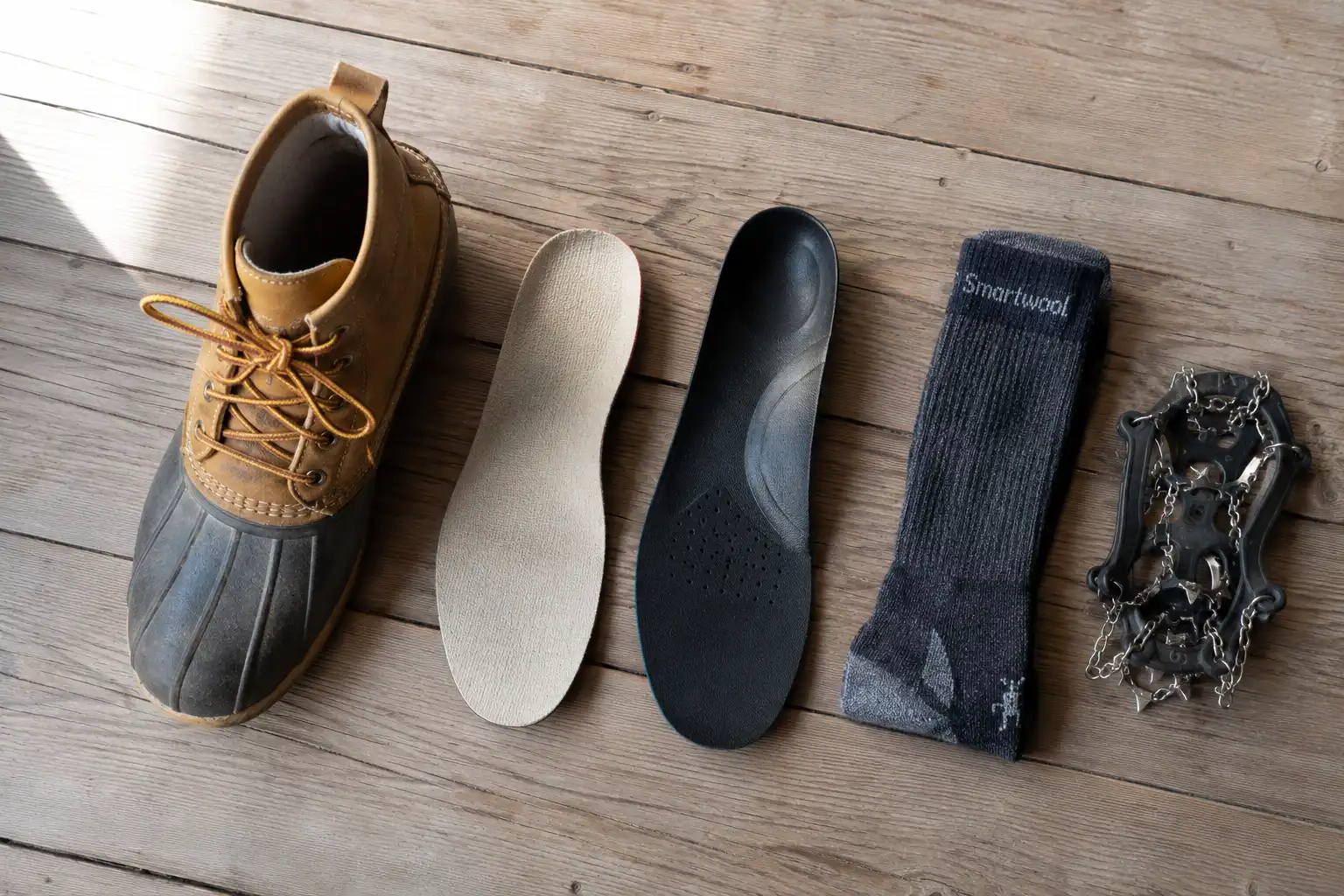
Size them correctly. Duck boots run large on purpose. L.L.Bean advises ordering one full size down with light or midweight socks, and 1.5 sizes down if you normally wear a half size. With heavyweight socks, whole-size wearers order their normal size. Getting this wrong guarantees heel slip.
Replace the insole. This single change does more than anything else. A firm aftermarket insole with a deep heel cup adds the arch support the boot never had. It also tightens up the extra volume.
Choose the sock deliberately. Merino wool handles the moisture that rubber traps far better than cotton does. Since duck boots do not breathe, sock choice carries extra weight, and picking socks that cut down blister risk is worth the effort.
Break them in first. New leather uppers run stiff. Gear testers specifically warn against taking a fresh pair straight onto a long walk, so wear them around town for a week or two beforehand.
Add traction when ice appears. Chain tread on ice is genuinely dangerous. Microspikes solve it cheaply.
Finally, keep the leather treated. Rubber lasts, but the upper needs care, and re-waterproofing leather without ruining it takes ten minutes a season.
Which duck boots handle trails best?
The most trail-capable duck boots pair a lugged outsole with a shank and a mid-height shaft. Four features separate a hiking-friendly pair from a fashion pair.
Start with the outsole. Skip the heritage chain tread and look for deep, multi-directional lugs that shed mud. Muck’s Originals line and Kamik’s lugged models both go this direction, and Sperry’s siped rubber performs respectably on wet surfaces.
Next, confirm there is a shank. A steel or fiberglass shank stops the boot twisting underfoot on uneven ground, which matters more than most buyers realize.
Then pick your height. An 8-inch shaft with a padded collar protects your ankle from lace friction and gives you more waterproof depth than a 6-inch cut. Several wearers of the plain 6-inch version report it rubbing the ankle bone raw.
Finally, match insulation to your actual conditions instead of buying the warmest option available. Overinsulated boots in mild weather just make your feet sweat. If your winters are wet rather than frigid, the uninsulated version with wool socks usually serves you better.
FAQs about Duck Boots for Hiking

Can you hike long distances in duck boots?
Are duck boots good for hiking in snow?
Do duck boots cause blisters?
Are duck boots better than rain boots for hiking?
How do duck boots compare to other casual boots on trail?
The verdict
Duck boots deserve a spot in your gear closet, just not the spot you might be hoping for. Buy them for muddy shoulder-season walks, wet camp chores, flooded farm tracks, and cold days when keeping your feet dry beats everything else. Then reach for a proper hiking boot when the trail climbs, the rocks appear, or the miles add up. Add a good insole, size down properly, and pick a lugged outsole if you can. Do that, and a pair of duck boots will serve you well inside their limits.