Are Chacos Good for Hiking? Grip, Weight, Fit and Limits

Chacos turn up on trails everywhere, from river crossings to dry canyon routes. Still, plenty of hikers wonder whether a sandal can handle a full day of walking. So this guide covers what Chacos do well, where they fall short, which model fits hiking best, and how to size them.
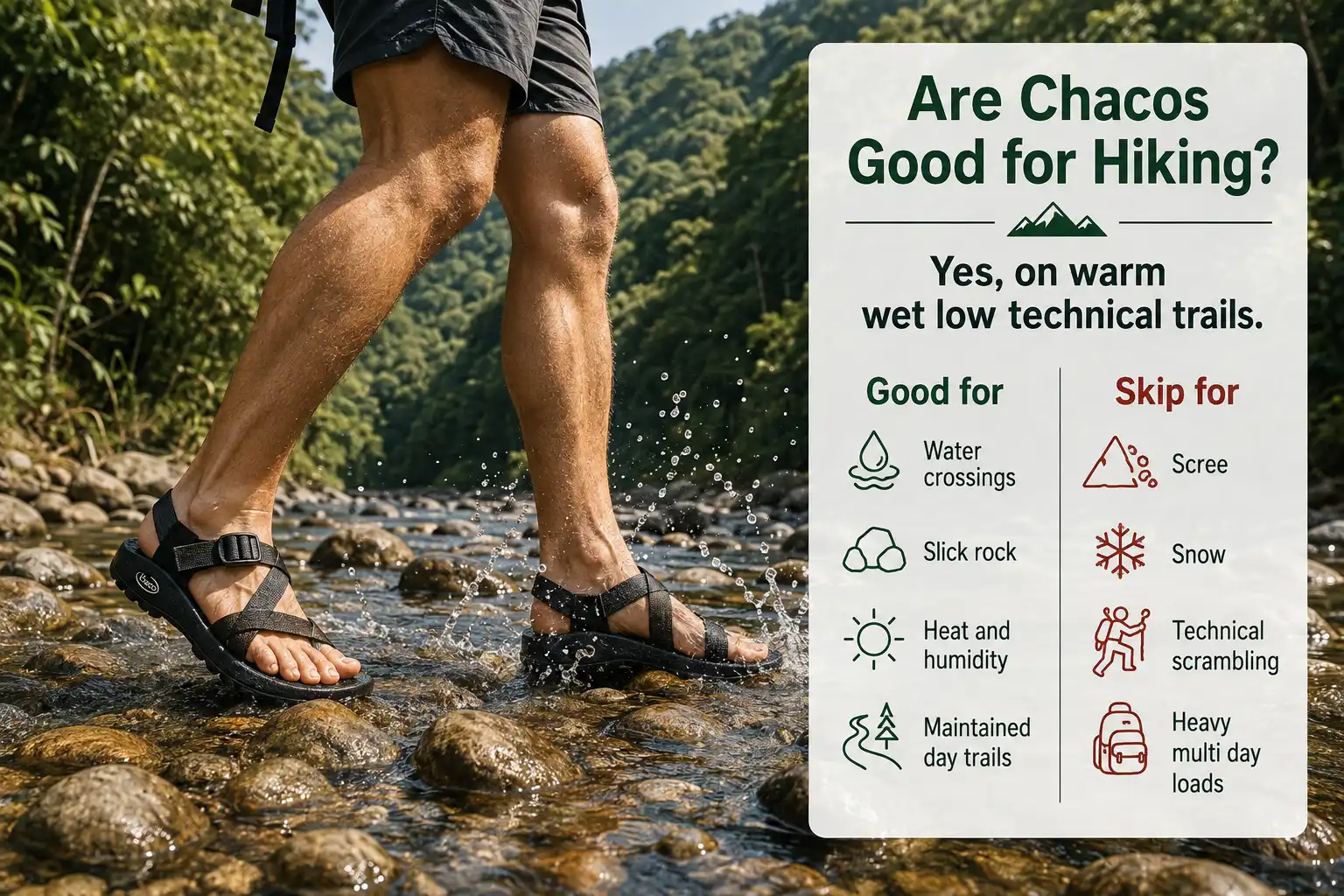
Yes, Chacos are good for hiking on the right terrain. They grip wet rock, drain instantly, and support your arch better than almost any other sandal. However, they give you zero toe protection and weigh more than most rivals. Therefore, loose rock, cold trails, and heavy packs still call for closed shoes.
What makes Chacos work on a trail?
Three parts do the work: the strap, the footbed, and the outsole.
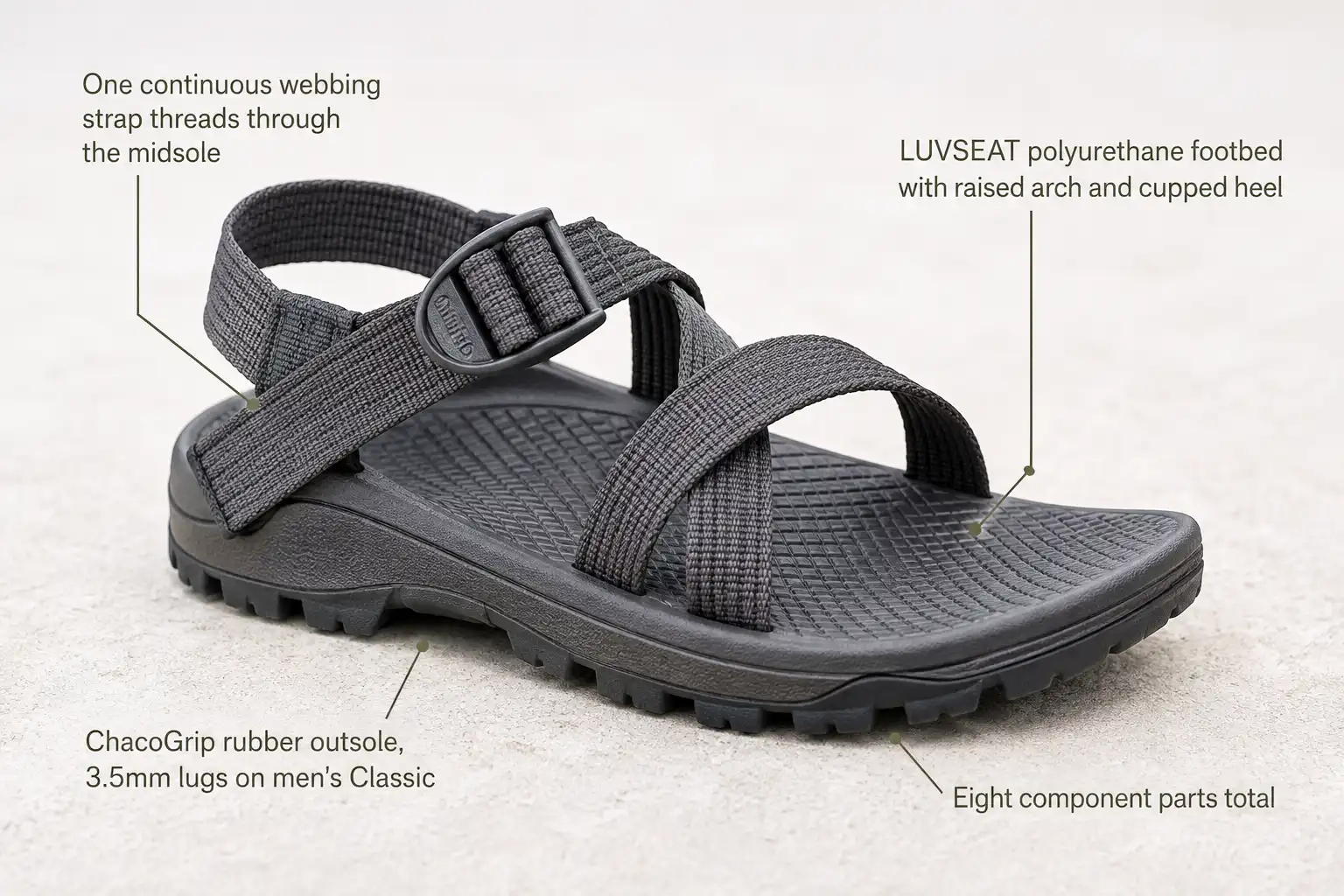
The upper is one continuous length of polyester jacquard webbing. It threads through the midsole and wraps your entire foot, so a single pull tunes the fit from toes to heel. Because there is no Velcro, nothing loses grip after a muddy season.
Underneath sits the LUVSEAT polyurethane footbed. Chaco shapes it with a raised arch and a cupped heel, and the brand states that the American Podiatric Medical Association certifies it. Polyurethane also resists packing out, so the shape you feel on day one stays there for years. EVA foam, by comparison, softens much faster.
The outsole uses Chaco’s own ChacoGrip rubber. Men’s Classic models run 3.5mm lugs, while women’s run 3mm. Those lugs channel water away, which is why river guides adopted these sandals in the first place.
Finally, the whole Classic sandal uses only eight component parts. Fewer parts mean fewer failure points on trail. That simplicity also makes the sandal repairable, which matters more than most buyers expect.
Read next: Hiking Boots in Snow
When are Chacos the right choice for hiking?
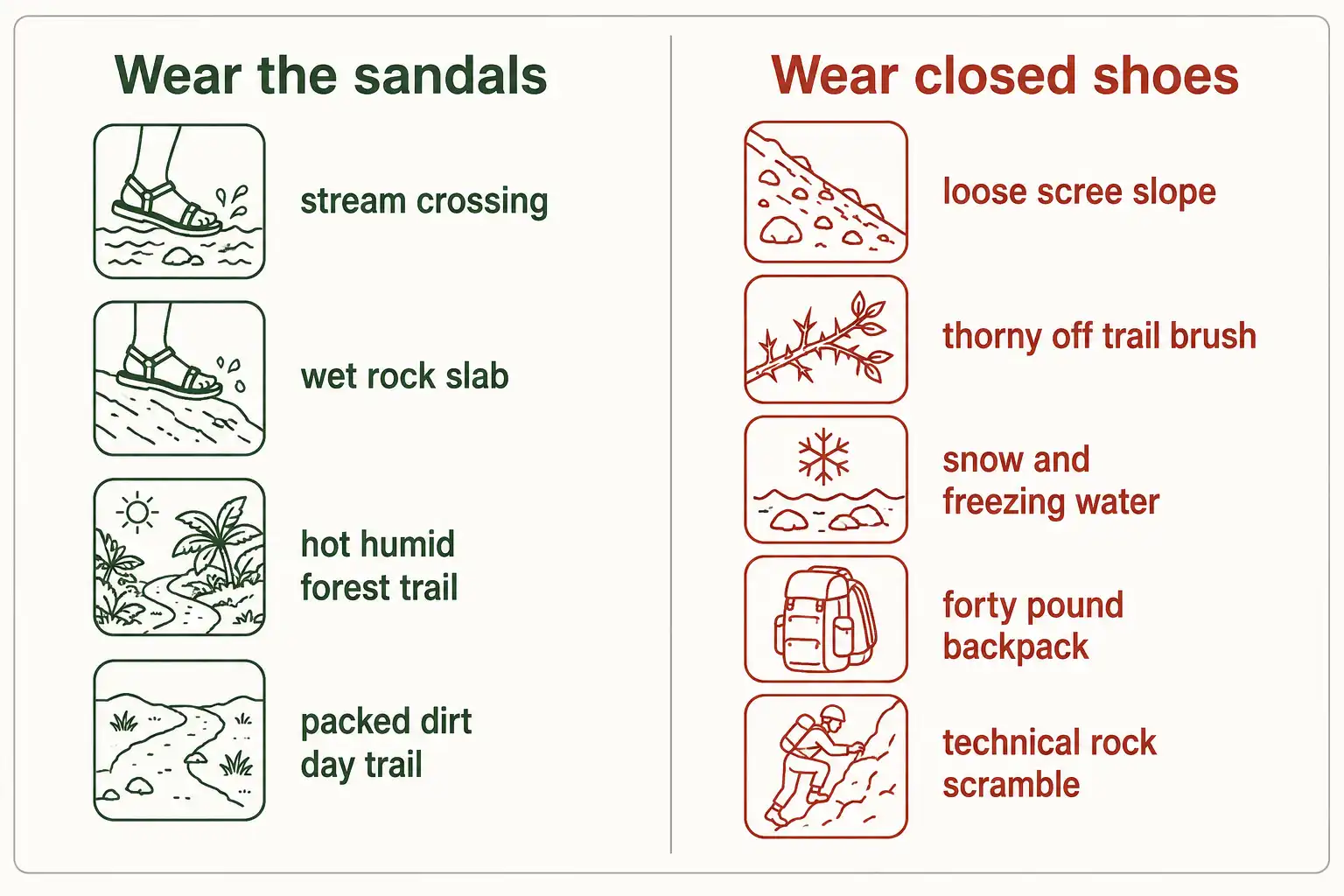
Chacos shine on warm, wet, and low technical trails. Here are the situations where I reach for a sandal instead of a shoe.
Repeated water crossings. Sandals drain in seconds, so you stop wasting time changing footwear. On the waterfall routes near Bandarban, half the walking happens inside the stream bed itself. Wet boots on those trails stay wet for two days.
Slick rock and river beds. Chaco built ChacoGrip for exactly this surface. Deep lugs plus sticky rubber beat the flat tread of a casual sandal by a wide margin.
Heat and humidity. Open uppers move air across your skin all day. Fungal problems drop too, since your feet never sit in a damp sock. If you struggle with summer trails, dressing for hot weather hikes matters just as much as your footwear choice.
Maintained day trails. Packed dirt, gravel paths, and stone steps suit a sandal fine.
Travel between trips. One pair covers town walking, beach days, and easy hikes, which saves luggage space.
Camp shoes, sometimes. Chacos feel great after a long day. Still, they are heavy for that job, so most backpackers pick something lighter.
Around Kaptai the monsoon turns every trail into a stream for months. Sandals earn their place there in a way they never would on a dry alpine ridge.
When should you leave them at home?
Skip Chacos when the terrain can hit your bare skin or your feet can get cold.
Loose rock and scree. Gravel slides straight under the arch and grinds against the footbed. Sharp stone also finds your toes fast.
Off trail brush. Thorns, roots, and stubble punish exposed feet. In leech country I stay in closed shoes and gaiters, full stop.
Cold weather. Circulation drops fast once cold water hits bare toes. Snow and freezing streams need real insulation, so check how hiking shoes cope with snow before you commit to sandals in shoulder season.
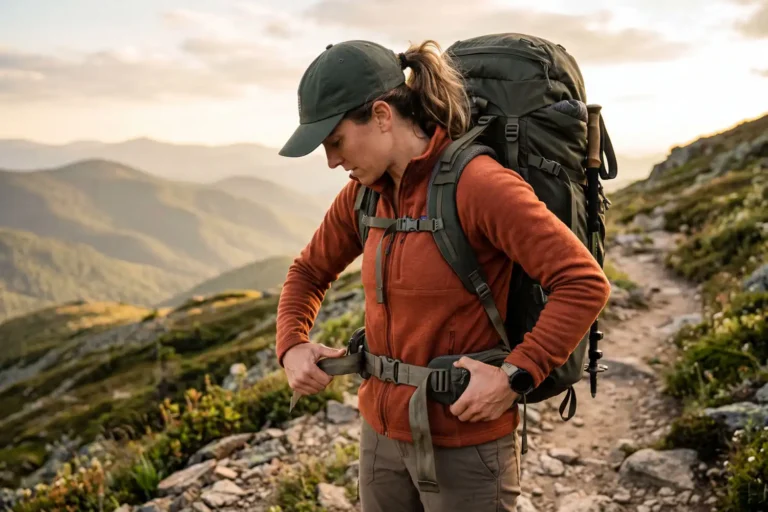
Heavy multi day loads. A 40 pound pack pushes your foot forward and sideways with every step. Straps handle that, but your toes take the impact on every rock you clip.
Technical scrambling. Edging on small holds needs a stiff, closed toe. Approach shoes exist for that reason.
Snake and insect zones. Ankle cover matters where you cannot see the ground.
One more honest limit: the toe box has no bumper at all. Stubbing a toe at speed on a root can end your hike. I have seen it happen twice on group treks, and both times the sandal was not the problem, the exposed toe was.
How heavy are Chacos compared to other hiking sandals?
Chacos are the heaviest mainstream hiking sandal, and testers confirm it. The Inertia weighed a men’s Z/1 Classic at 403 grams per sandal, roughly 14 ounces. For comparison, they measured the Teva Hurricane XLT2 at 283 grams, the Bedrock Cairn Evo at 221 grams, and the Teva Original Universal at 184 grams.
CleverHiker, which tests hiking sandals across thousands of trail miles, also ranks the Z/1 Classic as the heaviest design on its list.
That weight buys something, though. The dense polyurethane midsole gives stability that thin foam cannot match on uneven ground. Meanwhile it also outlasts foam by years.
So the trade is simple. If you count grams, consider minimalist footwear on trail or a lighter sandal instead. If you want support and a sandal that survives a decade, the extra ounces make sense.
Do Chacos need breaking in?
Yes, and the break-in period is longer than most footwear. The polyurethane footbed feels stiff and the arch feels aggressive out of the box. Testers commonly report two weeks of regular wear before the sandal softens.
New straps cause the other problem. Fresh webbing sits stiff, so it rubs hot spots across the top of the foot and around the toe loop.
Here is how I would break in a new pair:
- Wear them around the house for a few days first.
- Then walk two to three miles on flat ground.
- Next, soak them and walk while wet, since wet webbing conforms faster.
- Finally, take a short hike with a light pack before any big trip.
Never take brand new Chacos on a 10 mile trail. Blisters on day one will ruin the rest of the week.
Which Chaco model works best for hiking?
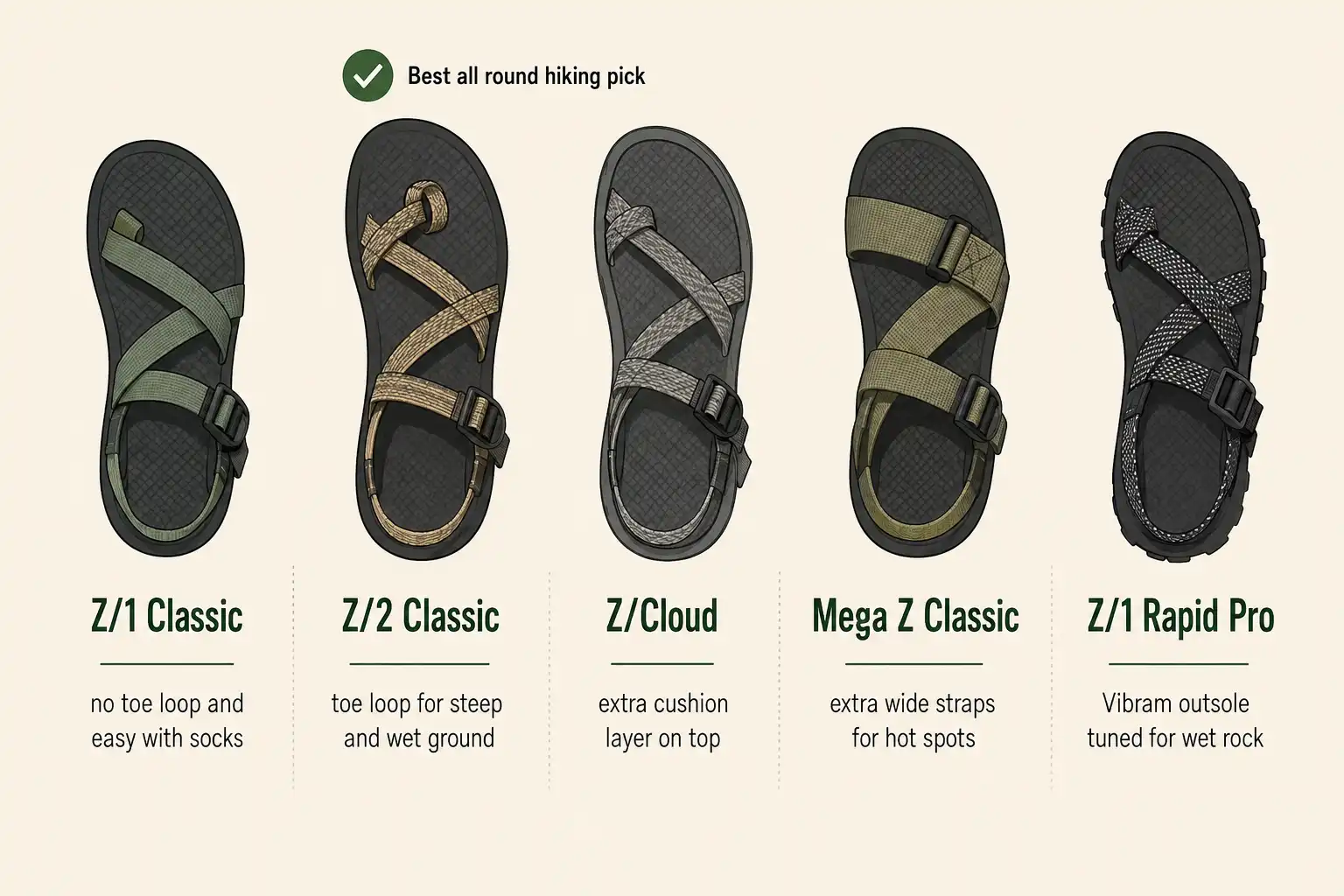
The Z/1 Classic and Z/2 Classic remain the strongest hiking picks. Both share the same footbed, webbing, and outsole. Only the toe loop differs.
Z/1 Classic. No toe loop, faster on and off, easier with socks. Chaco recommends it for high arches or high insteps, because a toe loop adds tension there.
Z/2 Classic. Adds a toe loop. That loop stops your foot sliding forward on steep descents and in moving water, so it suits river hiking and steep hill trails.
Z/Cloud. Same platform with a soft cushion layer on top. Choose it if the Classic footbed feels too firm.
Mega Z Classic. Wider straps spread pressure across the foot. Good for people who get strap hot spots.
Z/1 Rapid Pro. Uses a Vibram outsole built with Chaco for wet rock. Chaco claims six times the grip of rival adventure sandals on wet river rock. That figure comes from the brand, not an independent test, so treat it as a hint rather than proof.
For general hiking I would pick the Z/2 Classic. The toe loop earns its keep on descents.
How should Chacos fit for hiking?
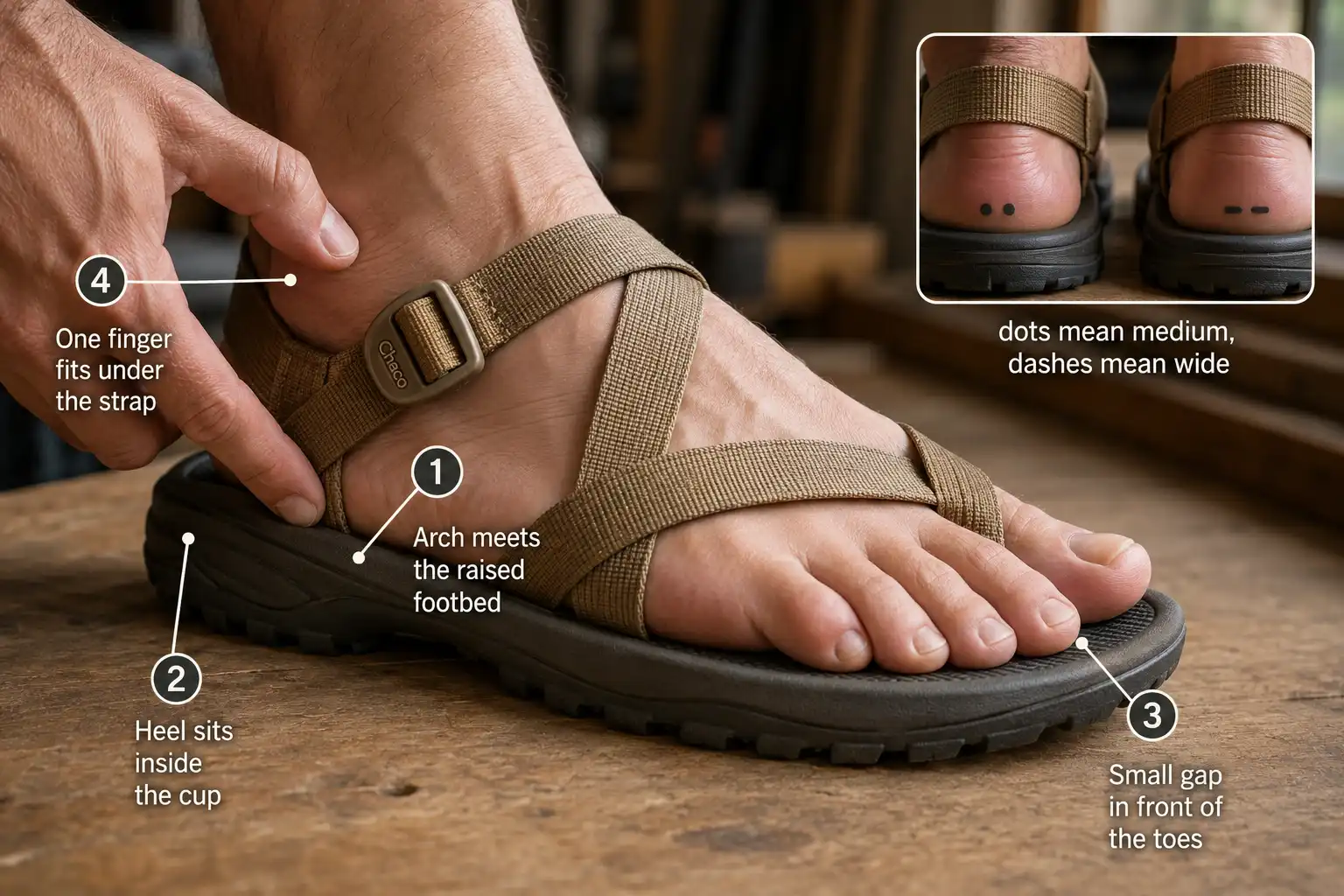
Chacos should hold your arch in place with no toe overhang and no heel slide.
Chaco builds Z sandals in whole sizes only. Their sizing also uses a heel to ball measurement rather than plain foot length. Because of that, a Brannock device at a store beats a printed chart. Note that advice on half sizes conflicts. Chaco’s own guide tells half size wearers to move up to the next whole size, while several retailers suggest moving down. Since both fits exist in practice, try a pair in person for your first purchase.
Check these five points:
- Your arch should meet the raised part of the footbed, not sit in front of it.
- The heel cup should hold your heel without letting it slide sideways.
- Toes should stay on the footbed with a small gap at the front.
- Nothing should hang over either edge of the sole.
- Straps should feel snug, with room to slide one finger underneath.
Width matters as much as length. Chaco marks width on the back of the heel, where dots mean medium and dashes mean wide. Also worth knowing, the brand originally sold medium and narrow, then relabeled those as wide and medium. As a result, plenty of standard width people actually need Chaco’s wide. The same care pays off with fit rules for hiking shoes, so measure once and buy properly.
How do you stop blisters when hiking in Chacos?
Grit is the main cause, so rinse it out often. Sand trapped between webbing and skin acts like sandpaper on every stride.
These habits keep my feet intact on sandal hikes:
- Rinse your feet and straps at each stream. Then rerun the straps once so the grit falls out.
- Tighten the straps before long descents. Loose webbing lets the foot slide and shear.
- Tape known hot spots in advance. Zinc oxide tape holds even when damp.
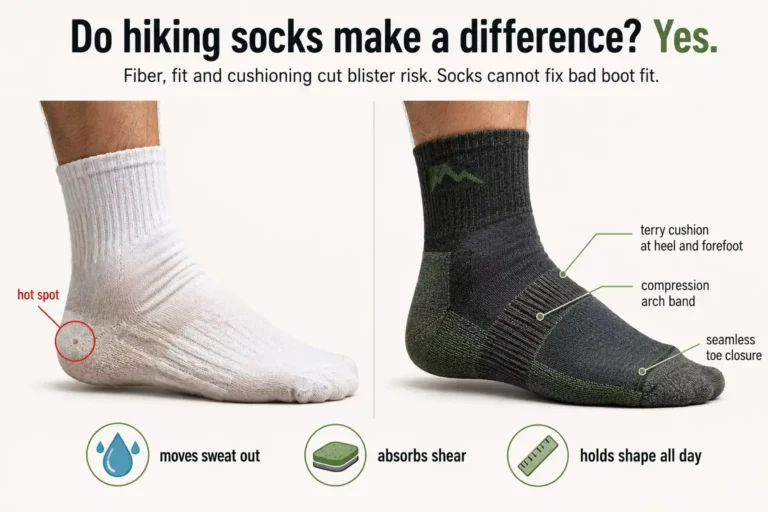
- Wear socks in cool or dusty conditions. Merino works fine with Chacos, and a proper hiking sock also cuts friction.
- Dry your feet at breaks. Wet skin blisters faster than dry skin.
Beyond footwear, stopping blisters before they start comes down to taping, lubricant, and dry skin.
Are Chacos good for long distance hiking?
Some hikers thru-hike in them, but most people should not start there. A CleverHiker gear analyst thru-hiked the Arizona Trail in Z/1 Classics. Another editor there climbed more than 150 Colorado peaks above 13,000 feet in his pair. Clearly the sandals can go the distance.
Your feet, however, need conditioning first. Sandal hiking loads the small stabilizing muscles differently than a shoe does. Sun exposure also adds up, so apply sunscreen to the top of your feet and reapply after water.
Build up gradually. Try day hikes first, then an overnight, and only then a longer route.
How long do Chacos last and can you repair them?
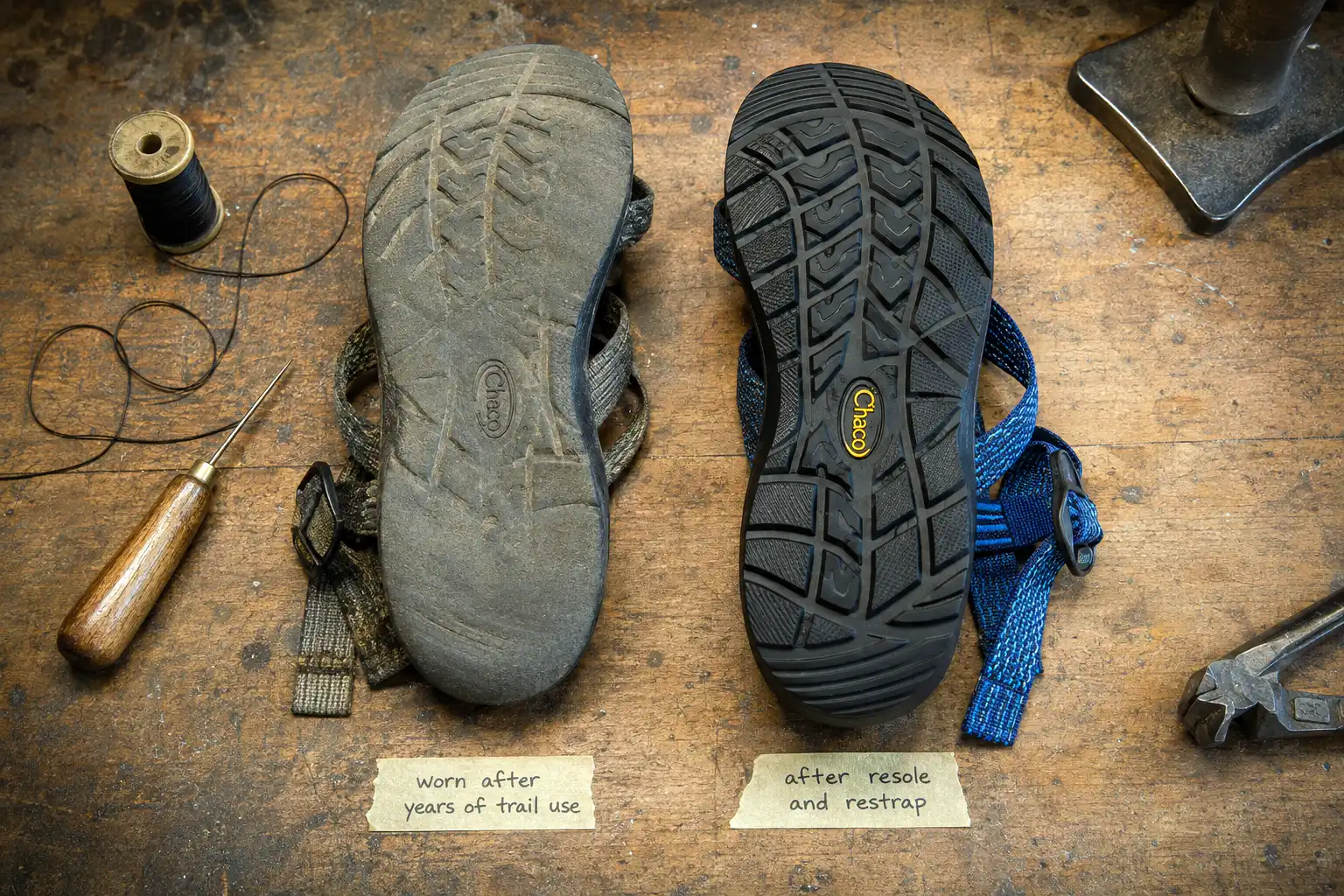
Chacos routinely last several years, and Chaco repairs them at its own facility in Michigan through the ReChaco program.
The service handles resoles, new straps, buckle replacement, strap length changes, stuck straps, and toe tightening. Turnaround runs about two weeks after they receive your sandals, and the cost depends on which parts you fix. Chaco also waits to charge your card until a technician confirms the work.
Warranty coverage is narrower than the repair program. Chaco covers defects in materials and workmanship, yet normal wear such as thinning soles, faded color, and strap wear at the channels falls outside it. Sizing complaints sit outside the policy too. Repairs done by anyone else void the warranty.
So a worn outsole does not mean a dead sandal. Instead of buying new, most owners resole once and keep hiking.
Chacos or hiking shoes: which should you pick?
Pick Chacos for wet, warm, low technical trails. Pick shoes for everything rougher.
| Factor | Chacos | Hiking shoes |
|---|---|---|
| Water crossings | Drain instantly | Stay wet for hours |
| Toe protection | None | Full |
| Support with a heavy pack | Moderate | High |
| Hot weather comfort | Excellent | Average |
| Loose rock and scree | Poor | Good |
| Break-in time | About two weeks | Days to weeks |
| Repairability | Resole and restrap available | Usually replace |
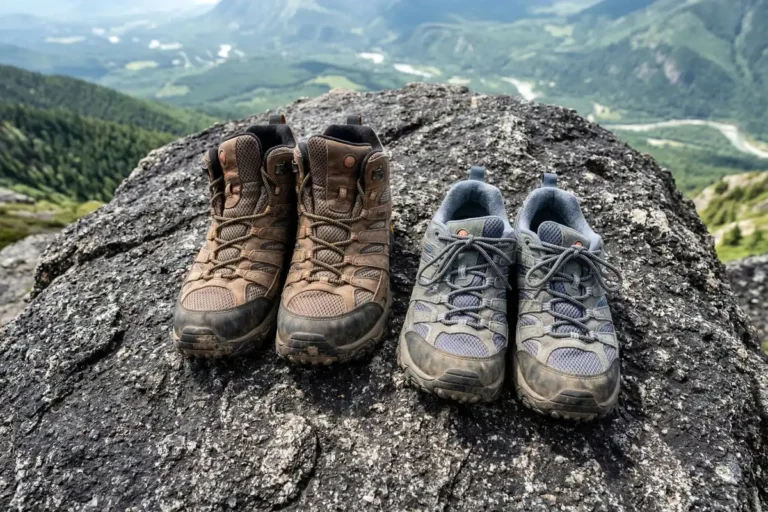
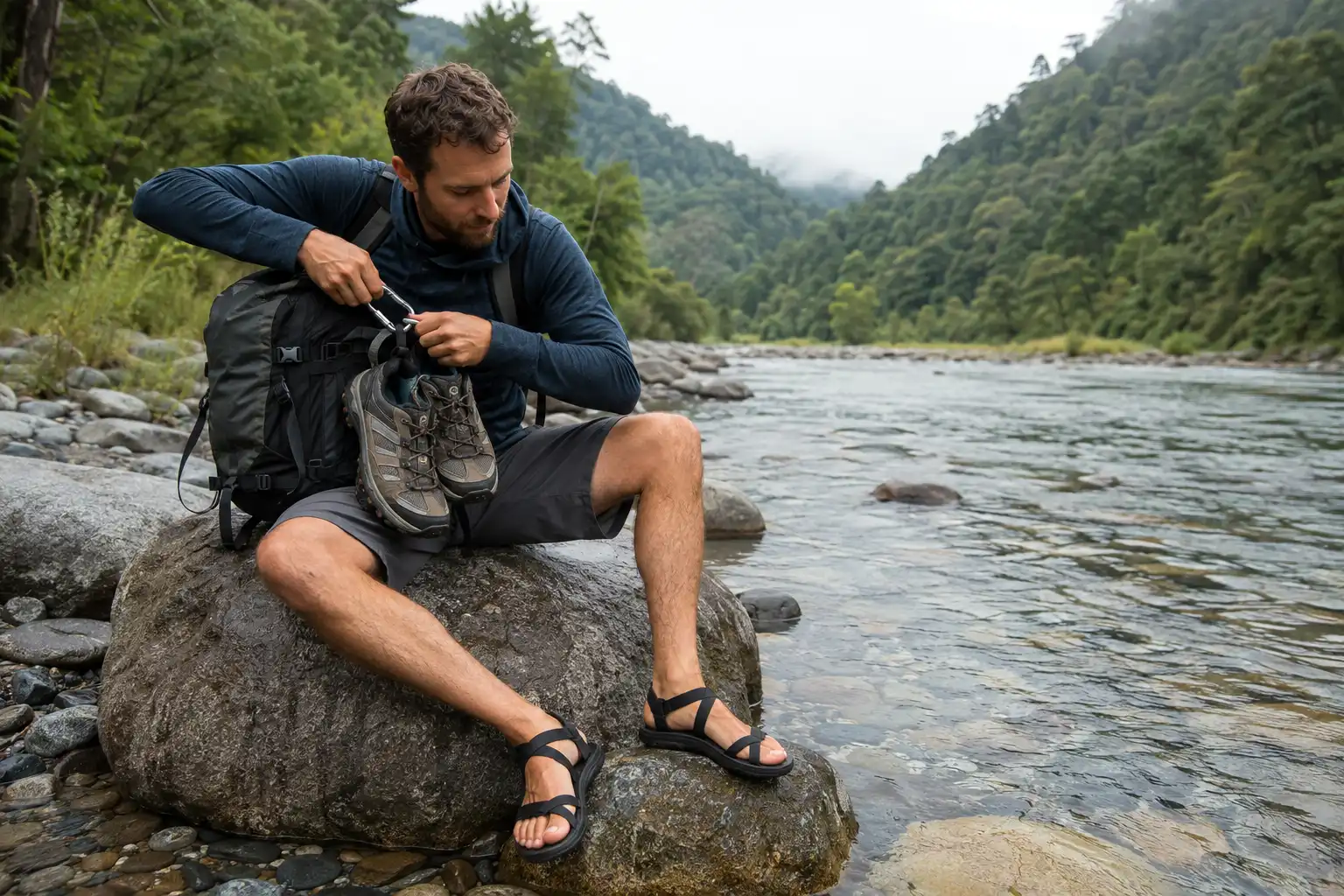
Many hikers carry both. I often wear shoes on the approach, then switch to sandals for the stream section. If you are still weighing your first pair of trail footwear, choosing between boots and shoes is the better starting point.
FAQs on Hiking in Chacos

Can you wear socks with Chacos?
Do Chacos have real arch support?
Are Chacos good for wide feet?
Can you hike in Chacos in the rain?
Do Chacos hurt at first?
The bottom lines
Chacos are good hiking sandals, not universal hiking footwear. Take them on warm trails with water crossings, packed dirt, and slick rock, and they perform better than any shoe. Take them onto scree, snow, or a technical scramble, and you will regret the exposed toes. Buy the Z/2 Classic if you hike steep or wet ground, break them in slowly, and keep grit out of the straps. Do that, and one pair will serve you for years.