Can a Sleeping Pad Be Too Warm? When It Happens and How to Fix It

A warm sleeping pad is great on a cold night. On a hot, sticky night, though, many campers wake up with a damp back and blame the pad. I camp in Bangladesh’s humid hills, so I deal with this often. Here’s when a sleeping pad can be too warm and what to do about it.
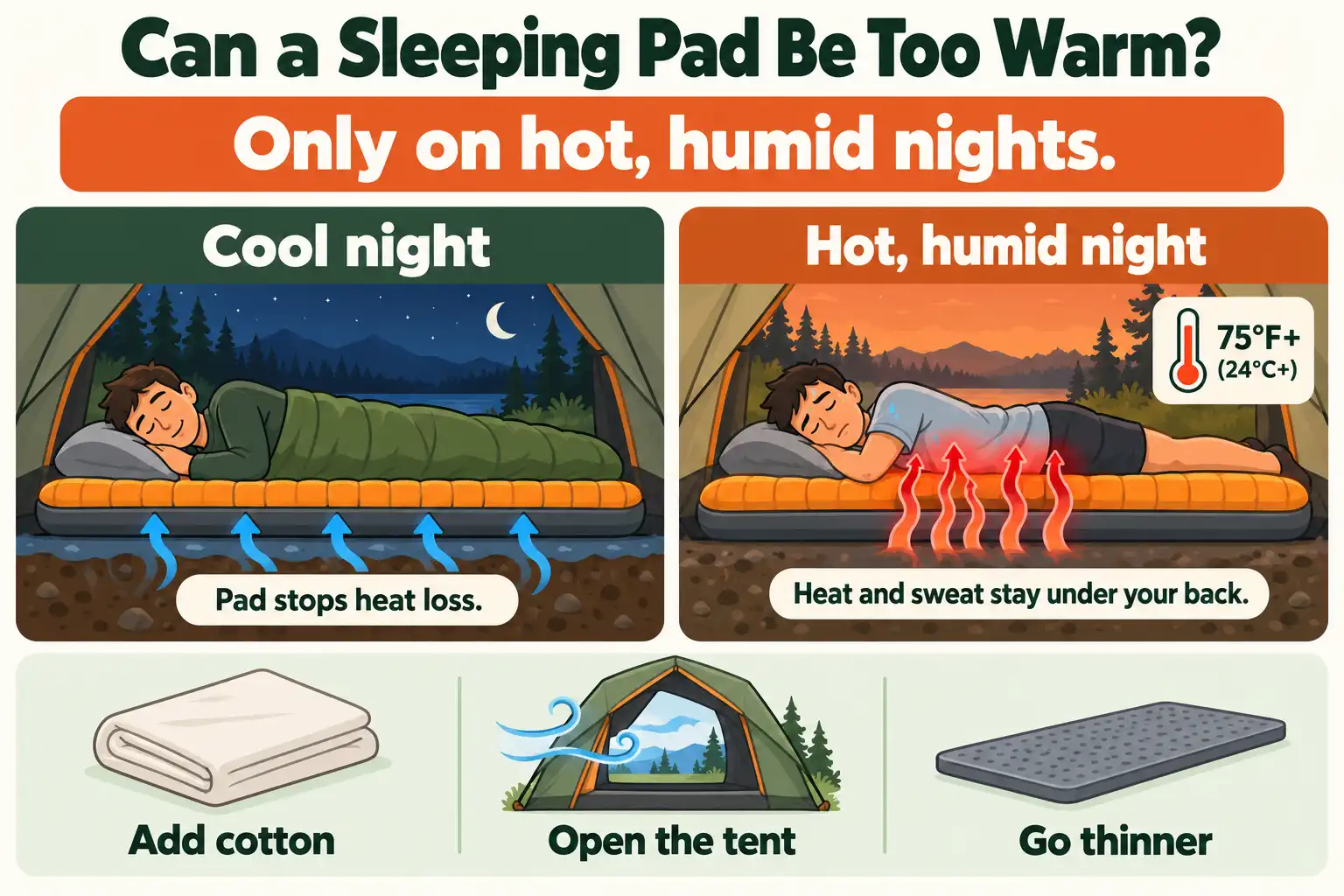
Yes, but only in a narrow set of conditions. A sleeping pad doesn’t make heat. It only slows the heat your body loses to the ground. So on hot, humid nights, a high R-value pad can hold heat and sweat against your back. When you overheat on most nights, however, your sleeping bag or a stuffy tent is the bigger cause.
How Does a Sleeping Pad Keep You Warm?
A sleeping pad keeps you warm by putting a layer of trapped air, foam, or insulating fill between your body and the ground. That layer slows the flow of heat from your back into the earth.
This matters because any ground cooler than your body keeps drawing warmth away, and at night nearly all ground is cooler. Your sleeping bag can’t stop this alone. The way a sleeping bag holds heat depends on loft, and your weight crushes that loft flat underneath you.
What R-value means
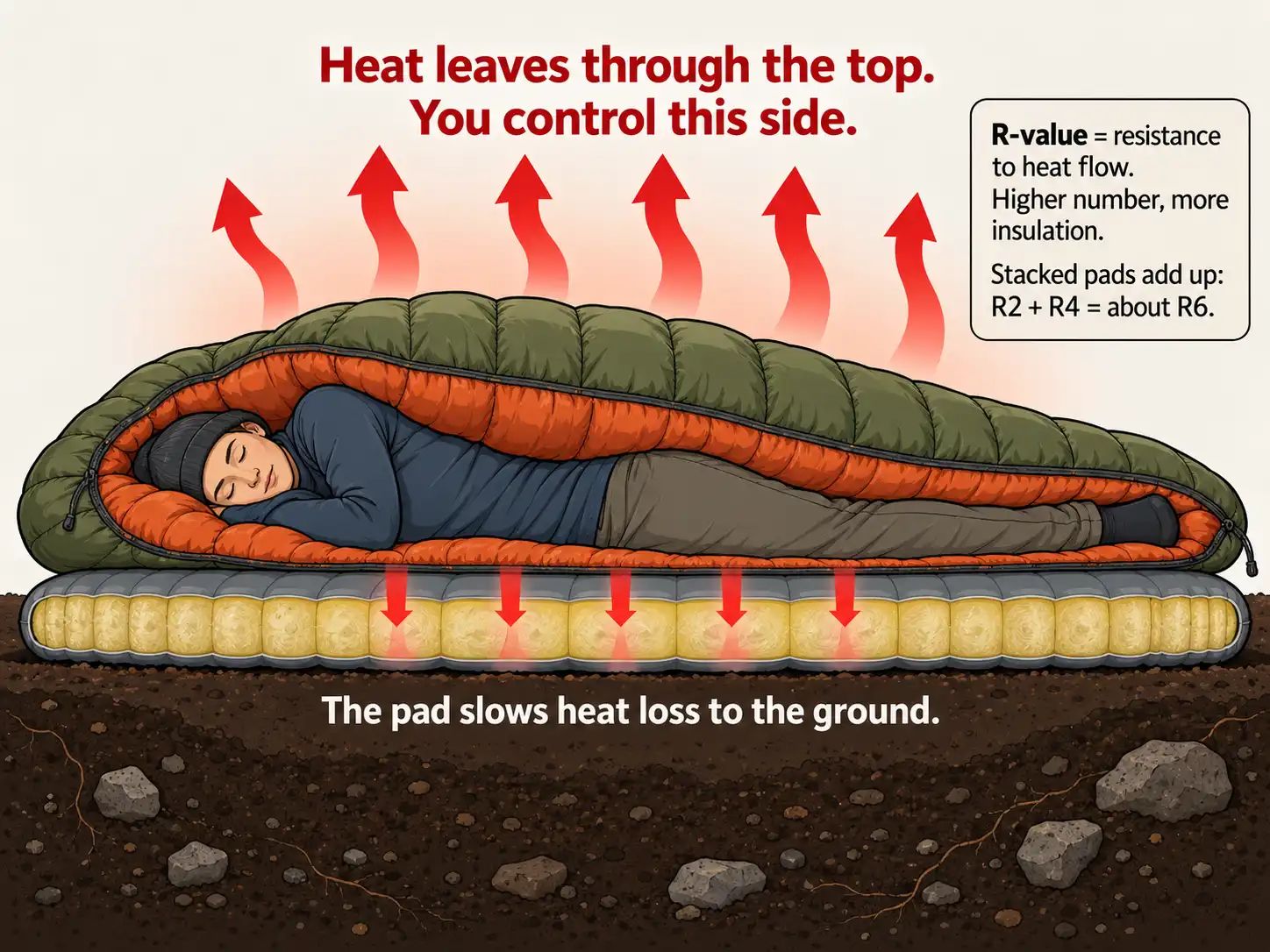
R-value measures how well a pad resists heat flowing from your body into the ground. A higher number means more resistance. Most big brands now rate pads with the same lab test, called ASTM F3340. As a result, you can compare an R4 pad from one brand with an R4 pad from another.
In that test, the pad sits between a warm plate and a cold plate. Then the lab measures how much energy it takes to keep the warm plate at body temperature. Some budget brands still post their own estimates, so look for “ASTM F3340” next to the number.
R-values also add up. So an R2 foam pad under an R4 air pad gives you roughly R6.
Does a High R-Value Pad Make You Overheat?
Usually not, because a pad only insulates the part of your body pressed against it. Meanwhile, the rest of you sheds heat into the air through your bag, clothes, and tent, and you control that side with a zipper.
Sleeping bag ratings also assume a warm pad. REI says it tests its own bags on a surface equal to about R5.4, which is winter-pad territory. So an R5 pad doesn’t push your bag past its label. It simply lets the bag perform as rated.
Your bed at home makes the same point. A thick mattress insulates you far more than any camping pad, yet most of us never swap it out for summer.
The ground temperature matters, too. Heat only flows from warm to cool, so warmer ground pulls less heat from your body. That leaves the pad with less heat to block. Sun-baked sand or rock can stay warm for hours after dark, and then R-value barely matters.
That’s why plenty of backpackers use one insulated pad all year and adjust their top layers instead. In my experience, the pad only becomes the real problem when heat and humidity team up.
When Can a Sleeping Pad Make You Too Warm?
A sleeping pad can make you too warm on hot, humid nights, mostly when it has a high R-value. On those nights, the ground is often still a bit cooler than your skin. A thin pad lets some extra body heat drain into it. However, a thick insulated pad blocks that path, so the heat stays with you.
At least one pad maker agrees. NEMO’s director of engineering recommends a low R-value pad in very warm weather, so your body can shed more heat.
From what I’ve seen, four things usually stack up when a pad feels too warm:
- Warm nights: when lows stay above about 70°F (21°C), your body sheds heat more slowly.
- Humid air: sweat can’t evaporate well in muggy air, so it pools under your back.
- Slick pad fabric: most pads use coated nylon or polyester, so that moisture has nowhere to go.
- Too much on top: a warm bag and a closed tent trap heat, leaving your body few ways to dump it.
On humid pre-monsoon nights in Bandarban, I’ve woken up on an insulated air pad with my shirt soaked across the shoulders. Still, my chest and legs felt fine.

Is It Your Pad or Your Sleeping Bag?
It’s likely your pad if only your back gets sweaty. However, if you feel hot all over, your sleeping bag, clothes, or tent is the bigger cause.
A quick test settles it. Unzip your bag fully, or lie on top of it, for 15 to 20 minutes. If you cool off, the bag was the problem. On the other hand, if your back still feels damp and sticky, the pad is the likely cause.
Also watch for the hot-then-cold pattern. You start the night too warm, sweat into your clothes, and then wake up chilled before dawn as the air cools. Wet fabric pulls heat from your body fast, so venting early beats sweating early.
Sweat also builds up in your gear over a multi-day trip. So it pays to air everything out each morning and follow a few habits for keeping your bedding dry on humid trips.
What R-Value Do You Need for Summer Camping?
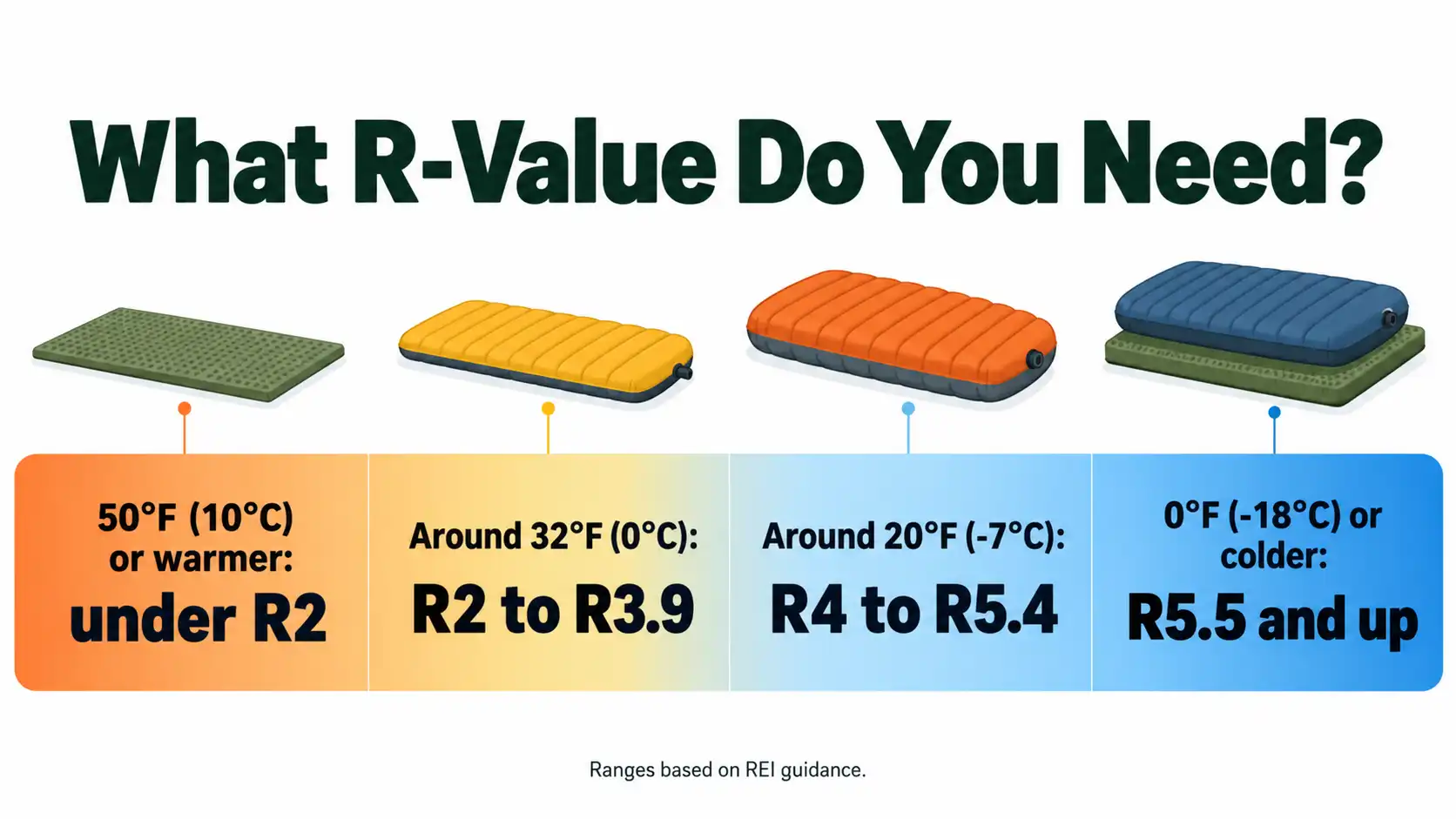
For summer nights that stay above 50°F (10°C), a pad under R2 is enough, according to REI’s sleeping pad guidelines. If you sleep warm, REI adds that a pad around R2 or R3 can cover most seasons.
| Expected nighttime low | R-value REI suggests | Common pad types |
|---|---|---|
| 50°F (10°C) or warmer | Under 2 | Uninsulated air pad or thin foam sheet |
| Around 32°F (0°C) | 2 to 3.9 | Closed-cell foam (about R2) or a three-season air pad |
| Around 20°F (-7°C) | 4 to 5.4 | Insulated air pad or self-inflating pad |
| 0°F (-18°C) or colder | 5.5 and up | Winter air pad, or two pads stacked |
The pad types in the last column are my own examples. Keep in mind that these ranges are about staying warm enough, not about staying cool. So on hot, humid trips, I pick a pad near the bottom of the range for the coldest night I expect. A thin pad plus a light layer for the cool hours before dawn beats an R6 pad in a muggy forest.
Can You Use a Winter Sleeping Pad in Summer?
Yes, you can use a winter sleeping pad in summer, and it works fine on most summer nights. In fact, some campers use one warm pad all year so they don’t have to buy two.
There’s a sensible limit, though. SectionHiker once asked Therm-a-Rest about using its winter XTherm pad (then rated R6.9) in summer. The brand’s pad category manager said he wouldn’t recommend it once nights stay above 75°F (24°C). He also called it a matter of personal preference. Meanwhile, SectionHiker’s Philip Werner figures a mid-range R4.2 pad stays comfortable on nights up to about 85°F (29°C).
Heat isn’t the only trade-off. A winter pad usually weighs more, packs bigger, and costs more to replace if a thorn punctures it. That’s why I save my warmest pad for cold trips.
If you can only own one pad, pick a three-season pad around R3 to R4.5. Then, when winter comes, slide a cheap foam pad underneath and add the two R-values together.
How to Stay Cool on a Warm Sleeping Pad
To stay cool on a warm pad, cut insulation on top, add a breathable layer under your back, and get air moving. Here’s what works for me:
- Ditch the bag: sleep on top of it, or switch to a light sheet or a quilt instead of a full sleeping bag. REI calls quilts a great fit for summer camping and warm sleepers.
- Cover the pad with cotton: a thin cotton sheet or towel soaks up the sweat that slick pad fabric can’t. I use a gamchha, the thin checked cotton towel found in most Bangladeshi homes, because it dries fast and weighs almost nothing.
- Open up the tent: roll back the rainfly when rain isn’t likely, open both doors, and pitch where you’ll catch a breeze. Leave the mesh zipped, though, because keeping insects out of your tent matters even more in humid places.
- Dress light: a loose, thin shirt lets more air reach your skin than a snug base layer.
- Cool off before bed: rinse your face, neck, and arms, or wipe them with a damp cloth, so you start the night cooler.

Better Setups for Very Hot Nights
On very hot nights, the coolest setups use a thinner pad or get you off the ground. Each option lets more body heat escape.
- A thin or uninsulated pad: most closed-cell foam pads sit around R2, and uninsulated air pads often go lower. Either one lets the ground take a little heat off your back when it’s cooler than you.
- A camping cot: air moves freely under a cot, which feels great on a hot night. Still, that same airflow makes cots chilly in cool weather, so weigh a cot against a pad before you buy.
- A hammock: air flows around you on every side, so it’s hard to beat on a muggy night. Once nights cool off, though, you’ll want a pad in your hammock to block the chill underneath.

FAQs
Is an R7 sleeping pad too warm for summer?
Not on most summer nights. An R7 pad mainly turns sticky once humid nights stay above about 75°F (24°C). In the mountains, where summer nights often drop into the 40s or 50s °F (about 4 to 15°C), it works well.
Can a summer sleeping pad be too cold?
Yes, a pad under R2 can feel cold once nights drop below about 50°F (10°C), even in summer. Mountain camps and deserts often cool off that much after dark, so plan around the forecast low, not the daytime high.
Is a foam pad cooler than an air pad?
Usually, yes. A closed-cell foam pad sleeps cooler than an insulated air pad because most foam pads sit around R2. An uninsulated air pad, however, can be cooler still.
Should you stack two pads in summer?
No, stacking pads only adds R-value, so it makes your bed warmer. The one exception is a thin foam pad under an air pad to protect it from thorns and sharp rocks.
Should You Worry About a Pad Being Too Warm?
Not much. On most nights, a warmer pad simply means better sleep. It only turns into a problem when hot, humid air meets a high R-value pad and a closed tent.
Even then, the fixes are cheap and easy: sleep on top of your bag, put cotton under your back, and open the tent. For sticky places like the Gulf Coast in July or Bandarban in April, keep a thin pad or a hammock just for those trips.