Can You Hike the Appalachian Trail in 3 Months? Daily Miles, Pace Plan, and Permits

Three months sounds like a long time. On the Appalachian Trail, it is not much at all. This guide covers the daily mileage a 90 day thru-hike demands, who can hold that pace, how the calendar limits your start date, and what usually goes wrong along the way.
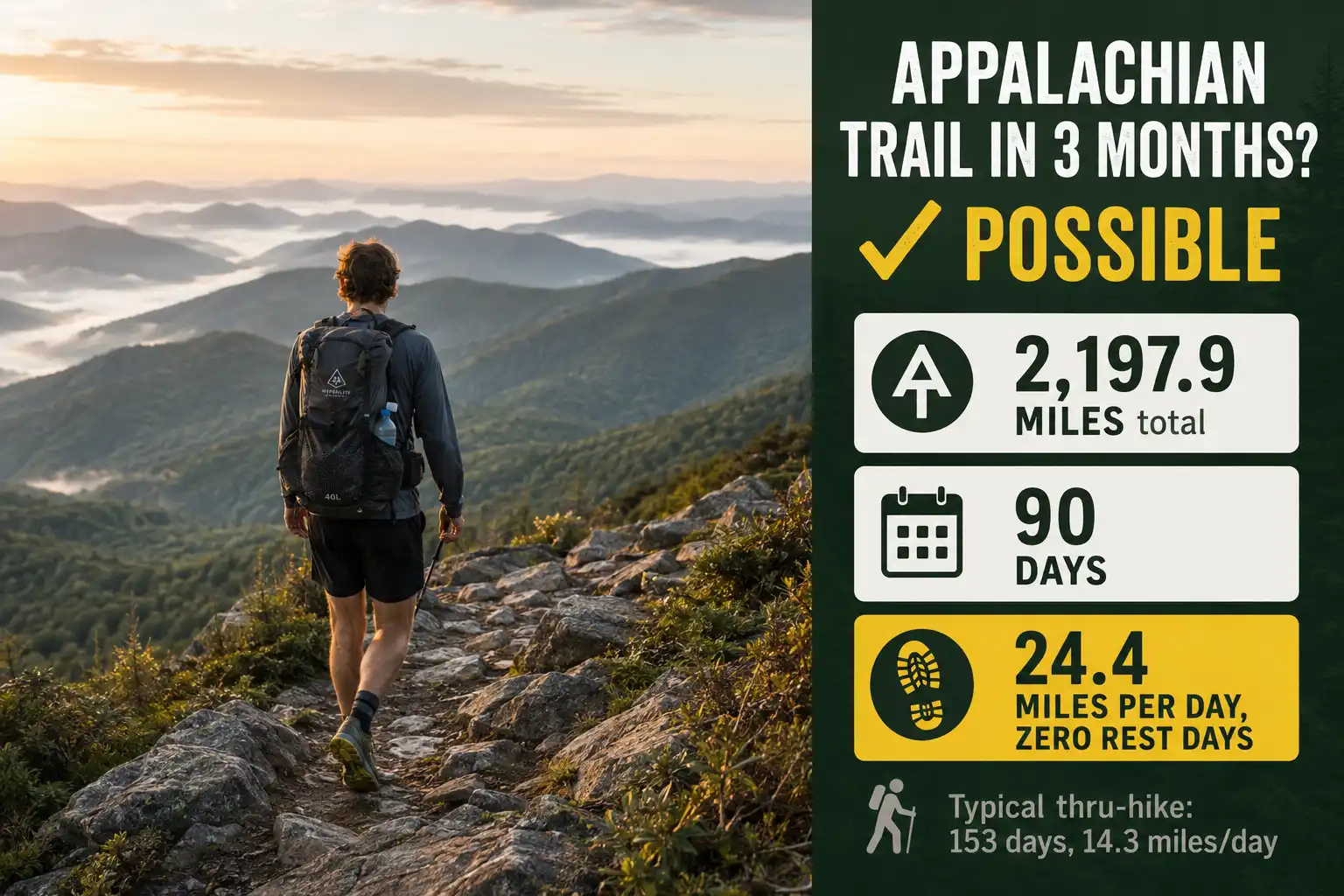
Yes, you can hike the Appalachian Trail in 3 months, but very few hikers manage it. The trail runs 2,197.9 miles in 2026. Ninety days means averaging about 24.4 miles per day with no rest days at all. Most thru-hikers take roughly five months instead.
How long is the Appalachian Trail?
The Appalachian Trail measures 2,197.9 miles in 2026, according to the Appalachian Trail Conservancy. It runs from Springer Mountain in Georgia to Katahdin in Maine, crossing 14 states along the way. The ATC also puts total elevation gain and loss at roughly 464,500 feet, with the high point at Kuwohi in Great Smoky Mountains National Park at 6,643 feet.
That official number is not what you actually walk, though. Four temporary detours apply in 2026, and none of them count toward the official mileage. Storm damage from Hurricane Helene caused two of them. Side trips to water sources, shelters, and road crossings add more distance on top. Therefore, plan your schedule around a figure a few percent higher than 2,197.9.
Read next: How Hard Is It to Hike Camelback Mountain
What daily mileage does a 3 month Appalachian Trail hike require?
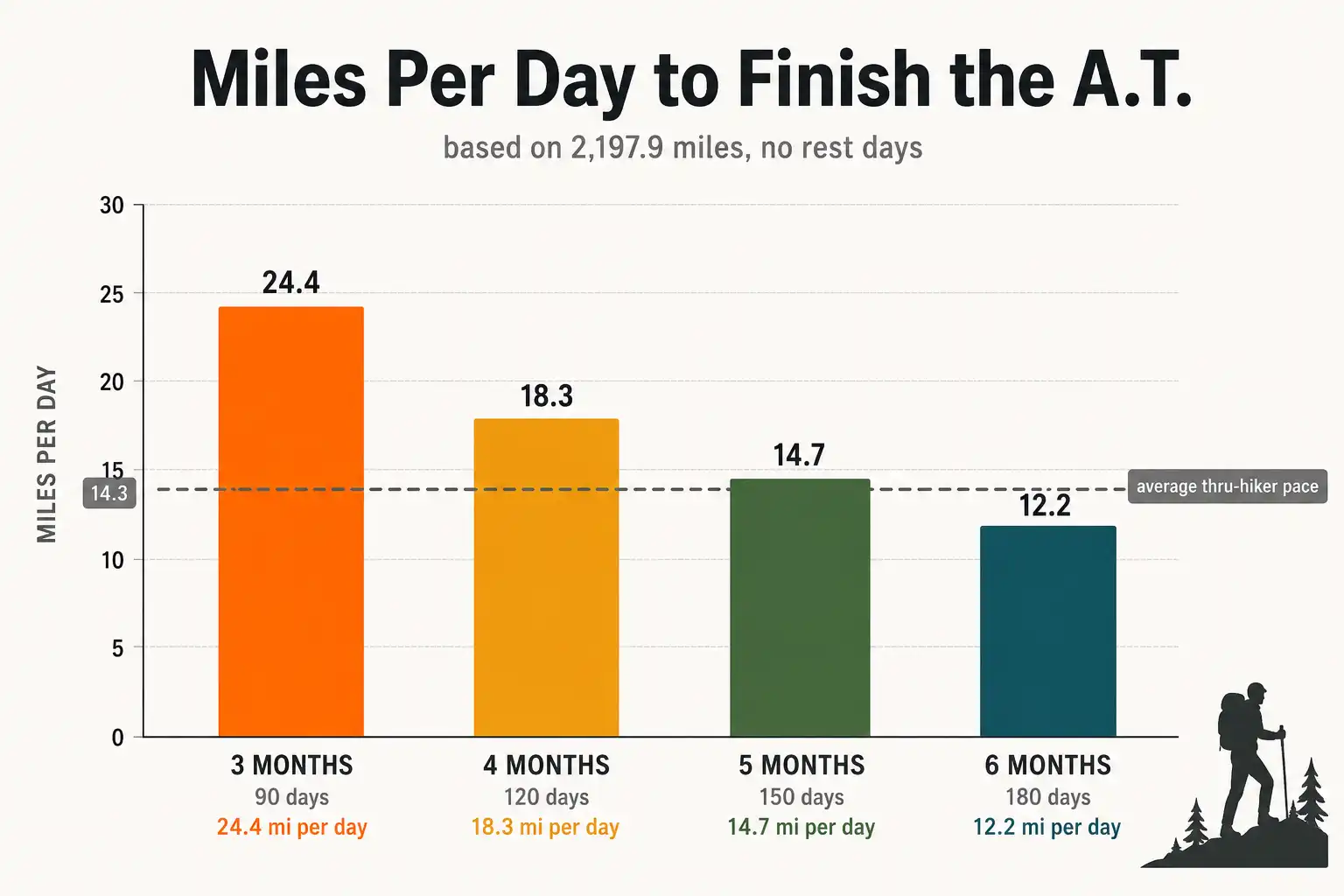
A 3 month thru-hike requires about 24.4 miles per day, every single day, with zero rest days. Three calendar months run 90 to 92 days. Divide 2,197.9 by 90 and you land on 24.4.
Rest days change that math fast. Take just six zero days across the whole trail and your hiking-day average climbs to 26.2 miles. Take twelve and it jumps past 28.
| Finish time | Total days | Miles per day, no rest days |
|---|---|---|
| 3 months | 90 | 24.4 |
| 4 months | 120 | 18.3 |
| 5 months | 150 | 14.7 |
| 6 months | 180 | 12.2 |
Before you commit to a number like that, it helps to understand how far you can safely cover in one day and what happens when you repeat it for three months.
How long does the average Appalachian Trail thru-hike take?
Most thru-hikers finish in five to seven months. The Trek’s 2025 thru-hiker survey put the average completed hike at 153 days, with an overall average of 14.3 miles per day. The most commonly reported daily mileage was 15.
So a 90 day finish is roughly 40 percent faster than typical. Meanwhile, more than 3,000 people attempt a thru-hike each year, and ATC figures put completion somewhere near 28 to 32 percent depending on direction. In other words, most hikers do not finish at any pace, let alone a fast one.
Has anyone hiked the Appalachian Trail in 3 months?
Yes, and quite a few have gone considerably faster. The speed records sit well under half of a 90 day schedule.
Tara Dower set the overall fastest known time in 2024, covering the trail southbound in 40 days, 18 hours, and 5 minutes. She averaged more than 50 miles a day with a support crew. Then in September 2025, Jeff Garmire set the self-supported record in under 46 days.
Those are speed attempts, not ordinary backpacking. Closer to normal: in The Trek’s 2025 survey, two hikers reported finishing in 64 days. A 90 day hike therefore sits between the record attempts and the typical thru-hike. It is rare, but it is not unheard of.
Who can realistically finish the AT in 90 days?
A 90 day schedule suits hikers who already cover 25 mile days comfortably before they set foot on Springer Mountain. Everyone else should plan more time.
Here is an honest prerequisite list:
- You can already hike 20 to 25 miles on rough ground, back to back, for four or five days straight
- Your base weight sits under about 15 pounds
- You have finished a long trail before, or you carry serious ultrarunning volume
- You plan to take no more than a handful of rest days
- You have the budget and flexibility to keep town stops short
Notice what is missing from that list. Most hikers spend their first three or four weeks building trail legs at 10 to 15 miles a day. A 90 day schedule leaves no room for that ramp. Instead, you need to arrive fit enough to hike 22 miles on day one.
Why is a 90 day schedule harder than the math suggests?
A 90 day schedule is harder than the math suggests because the trail does not hand out 24 mile days evenly. Northern New England slows almost everyone down, so the southern half has to carry the whole schedule.
Run the numbers yourself. New Hampshire and Maine together cover about 442 miles. Even strong hikers usually drop to 15 or 16 miles a day through the White Mountains and southern Maine. At 16 a day, those 442 miles consume 27 or 28 days. That leaves roughly 62 days for the remaining 1,756 miles, which works out to 28 miles per day through Georgia, Virginia, and Pennsylvania.
Twenty-eight mile days for two straight months is a very different proposition from 24.
Town stops eat into it further. Every resupply costs hours. Pennsylvania’s rocks slow people down even on flat ground. In addition, camping rules through the White Mountains restrict where you can legally stop, so your day sometimes ends earlier or later than your legs would prefer.
Does the calendar allow a 3 month thru-hike?
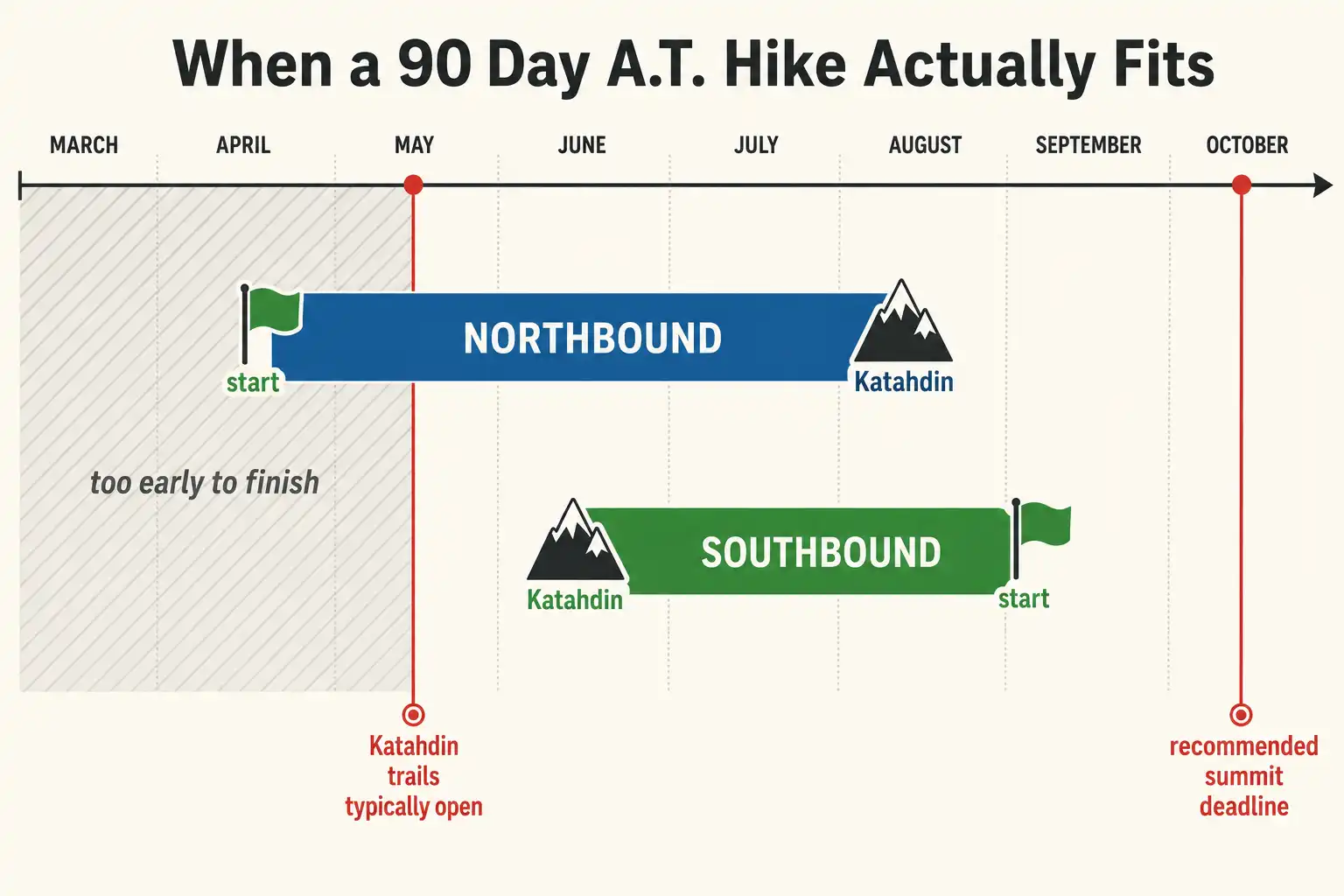
Only inside a narrow window, and Katahdin controls both ends of it. Baxter State Park opens for camping around May 15, but the trails up Katahdin usually open later, often near Memorial Day. At the far end of the season, the ATC recommends summiting before October 15.
For northbounders, that rules out an early March start. Ninety days from March 1 puts you at Katahdin in late May, possibly before the mountain opens at all. An April or May start works far better. Leave April 1 and you finish near June 30. Leave May 1 and you finish around July 30, though you will then walk the mid-Atlantic in full summer heat.
Southbound offers one clean advantage and one serious problem. You can leave Katahdin in early June, finish in late August, and skip most of the crowds. However, you hit the hardest terrain in Maine and New Hampshire during your first three weeks, before your legs are anywhere near ready.
How should you plan your daily miles by section?
Plan low through New England and high everywhere else. Terrain sets your ceiling, not willpower.
These rough targets support a 90 day pace:
- Springer Mountain to Damascus (about 470 miles): 24 to 26 miles a day
- Virginia (about 550 miles): 28 to 30 miles a day, since the grades here are the friendliest on the trail
- Harpers Ferry through Pennsylvania (about 270 miles): 26 to 28 miles a day, though rocks will punish your feet
- New Jersey through Vermont (about 450 miles): 24 to 26 miles a day
- White Mountains and Maine (about 442 miles): 14 to 18 miles a day
State mileages shift slightly every year as sections get rerouted, so treat these as planning figures rather than exact splits. Banking miles in Virginia matters most. Fall behind there and New England will not give the time back. Careful pacing across a long hike matters more on this schedule than on any other.
How do you train for a 3 month thru-hike?
Train with weight, on hills, for months before you start. Ninety day hikers do not build fitness on trail. They show up with it already.
- Build to back-to-back 20 mile days with a loaded pack during your final two months
- Add hill repeats and long descents, because descending breaks people faster than climbing does
- Strength train hips, glutes, and calves twice a week
- Complete at least one three day, 60 mile weekend before you commit to the schedule
I have not walked the AT myself. What I do know comes from stacking long days in the Bandarban hills, and the pattern holds anywhere. Three hard days in a row teach you far more than one heroic day. On the Keokradong and Nafakhum routes, the descents always hurt more the next morning than the climbs did. Building the right fitness base for multi-day backpacking is what separates a fast finish from an early exit.
What gear setup supports 24 mile days?
Light gear, cushioned shoes, and a fast camp routine. A heavy pack does not just slow you down. It also compounds injury risk across 90 straight days of walking.
- Base weight: aim for under 15 pounds, which is where most fast hikers land
- Footwear: trail runners suit this mileage better than boots for most people, and expect to replace them every 400 to 500 miles
- Poles: they take real load off your knees on long descents
- Shelter: something you can pitch in five minutes, in the dark, while tired
- Food: high-calorie, no-cook options can save you close to an hour a day
Getting pack weight down to a sensible number pays off more on this schedule than any other single gear decision.

What is the biggest risk of a 90 day AT hike?
Overuse injury, without question. The ATC states plainly that injuries are the number one reason thru-hikers do not finish, and most of those injuries come from doing too much too soon.
Survey data supports that. The Trek reported that 54 percent of thru-hikers experienced some kind of injury, while about 5 percent had to end their hike because of one. Plantar fasciitis has topped the list two years running. Shin splints, tendinitis, and stress fractures follow closely behind.
A 90 day schedule strips away your recovery margin. On a five month hike, you can drop to 8 miles for three days and still finish comfortably. On a 90 day hike, three slow days leaves you 50 miles behind.
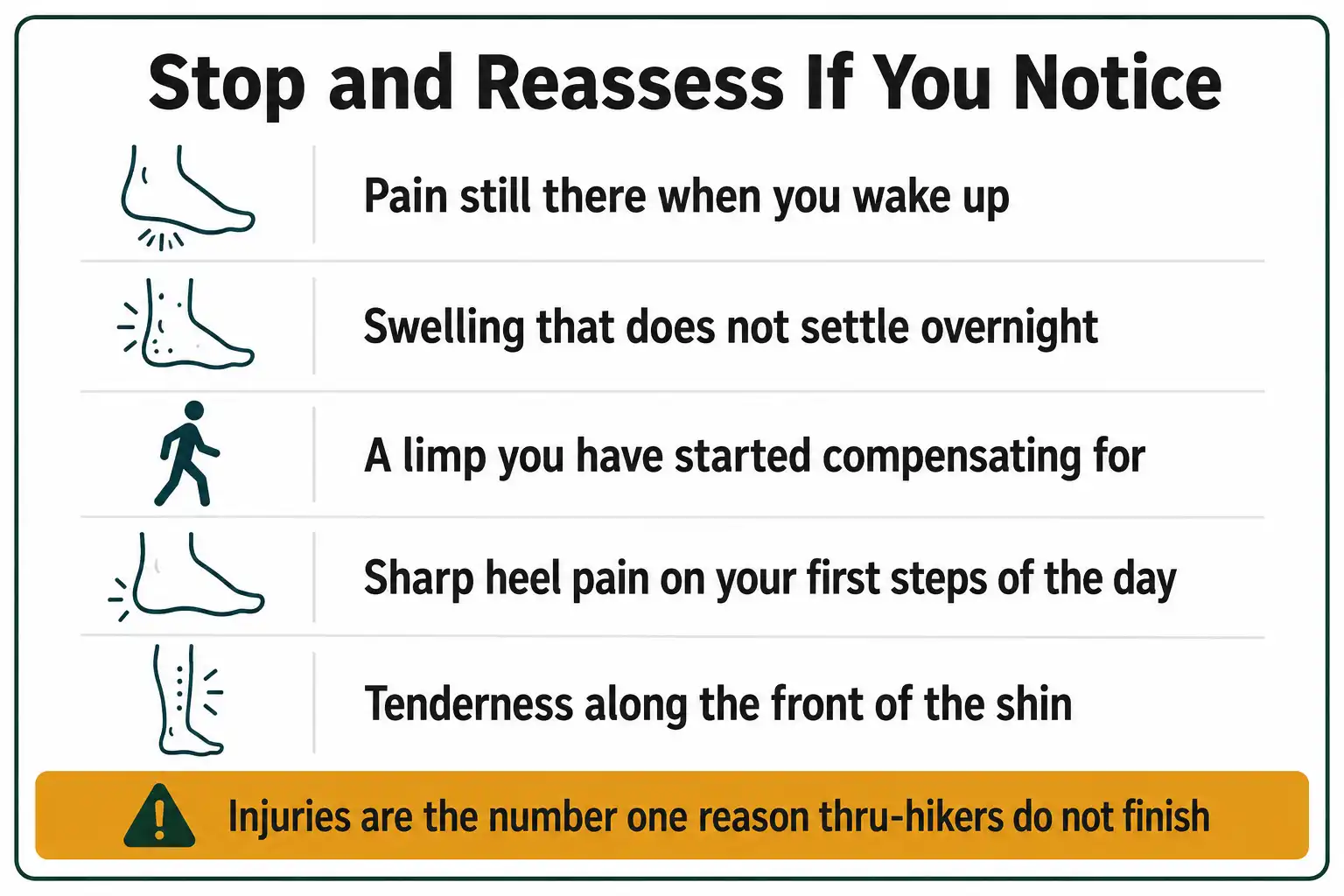
Respect these warning signs: pain that is still present when you wake up, swelling that does not settle overnight, and any limp you have started compensating for. Managing knee pain on steep descents early keeps small problems small. Checking your feet daily and stopping blisters before they form matters just as much at this mileage.
What permits do you need on the Appalachian Trail?
No single permit covers the whole trail. According to the ATC, three places require one: Great Smoky Mountains National Park, Shenandoah National Park, and Baxter State Park.
- Great Smoky Mountains: an AT thru-hiker permit, purchased online in advance, gives you 8 days and 7 nights to cross the park. Recent listings put the fee near $44.50.
- Shenandoah: a backcountry camping permit, obtained through Recreation.gov since 2024. Recent sources list roughly $15 per person.
- Baxter State Park: a free AT hiker permit card, collected in person at the Katahdin Stream Campground ranger station. The Birches, the long-distance hiker site, costs $10 and holds 12 people on a first come, first served basis.
The ATC also runs ATCamp, a voluntary registration platform. It is not a reservation system, but it does show you which start dates are already crowded. All these fees and rules change, so confirm them directly before you leave.
What should you do if 3 months does not work?
Add a month. Four months drops you to 18.3 miles a day, which is demanding but achievable for a fit hiker with genuine backpacking experience. That single change removes most of the injury pressure and most of the calendar stress too.
A few other options work well:
- Flip-flop: start at Harpers Ferry, hike north to Katahdin, then return and walk south to Springer. This spreads out the crowds and widens your weather window.
- Long section hike: 800 to 1,000 well-hiked miles beats a rushed 2,200 every time.
- Southbound in 100 to 110 days: still fast, still finished before October, but with usable margin.
If you fall behind partway through, you still have a move. Flip up to Katahdin, summit it, then hike back south to close your gap. The ATC counts any completion of all trail miles within 12 months, so the thru-hike still stands.
FAQs on Hiking the Appalachian Trail in 3 months

How many miles a day do you need to hike the AT in 3 months?
What is the fastest anyone has hiked the Appalachian Trail?
Can a first-time backpacker hike the AT in 3 months?
How much does a 3 month Appalachian Trail hike cost?
Final thoughts
Three months on the Appalachian Trail is possible, and a small number of people do it every year. Still, it remains a specialist’s hike. You need roughly 24 miles a day for 90 straight days, a start date that lines up with Katahdin’s season, and enough fitness to skip the usual break-in period entirely. If you already hike big miles, plan for 28 mile days through the south and slow, honest miles in New England. If you don’t, take four or five months and enjoy the trail far more.