How Long Does It Take to Hike Mount Fuji? 2026 Trail Times

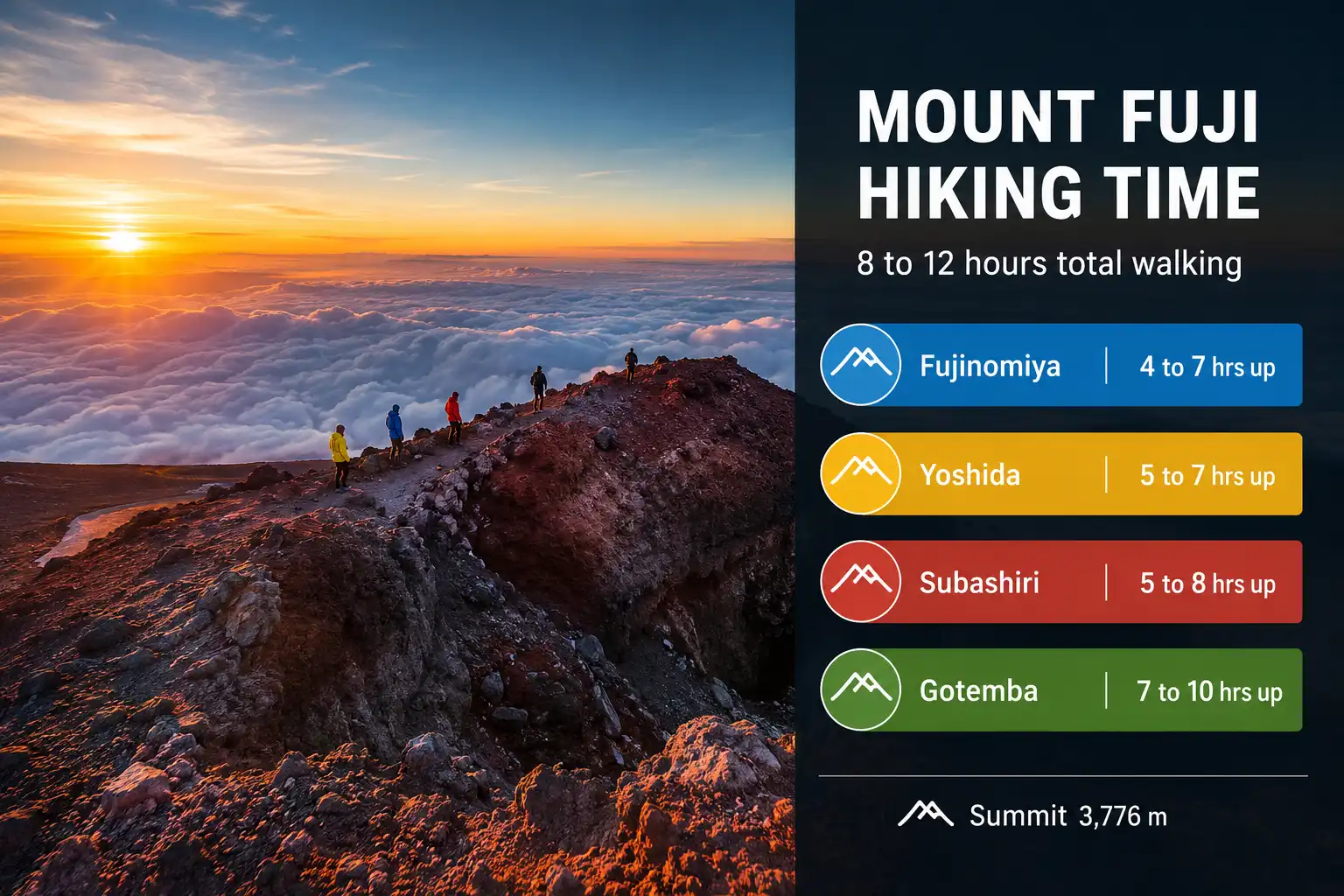
Mount Fuji takes most people 8 to 12 hours of walking, split between the way up and the way down. Your trail choice moves that number a lot. Below I break down the timing for all four routes and the two day plan.
Hiking Mount Fuji takes 8 to 12 hours of walking for most climbers. The ascent runs 4 to 10 hours depending on the route, while the descent runs 2 to 6 hours. Most people split that across two days with a night in a mountain hut near the top.
Here are the official time ranges for all four trails:
| Trail | 5th Station height | Ascent | Descent | Total walking |
|---|---|---|---|---|
| Fujinomiya | about 2,400 m | 4 to 7 hours | 2 to 4 hours | 6 to 11 hours |
| Yoshida | about 2,300 m | 5 to 7 hours | 3 to 5 hours | 8 to 12 hours |
| Subashiri | about 2,000 m | 5 to 8 hours | 3 to 5 hours | 8 to 13 hours |
| Gotemba | about 1,440 m | 7 to 10 hours | 3 to 6 hours | 10 to 16 hours |
Those figures cover moving time only. Therefore you need to add rest stops, meals, toilet queues, and photo breaks on top. In practice, most first timers spend one to two extra hours on the mountain beyond the official estimate.
The summit sits at 3,776 meters. Every trail starts at a paved 5th Station roughly halfway up. Nobody walks from sea level anymore, unless they pick the old pilgrimage route from the base.
Know more: Mount Everest Hiking Time
Which Mount Fuji trail is fastest?
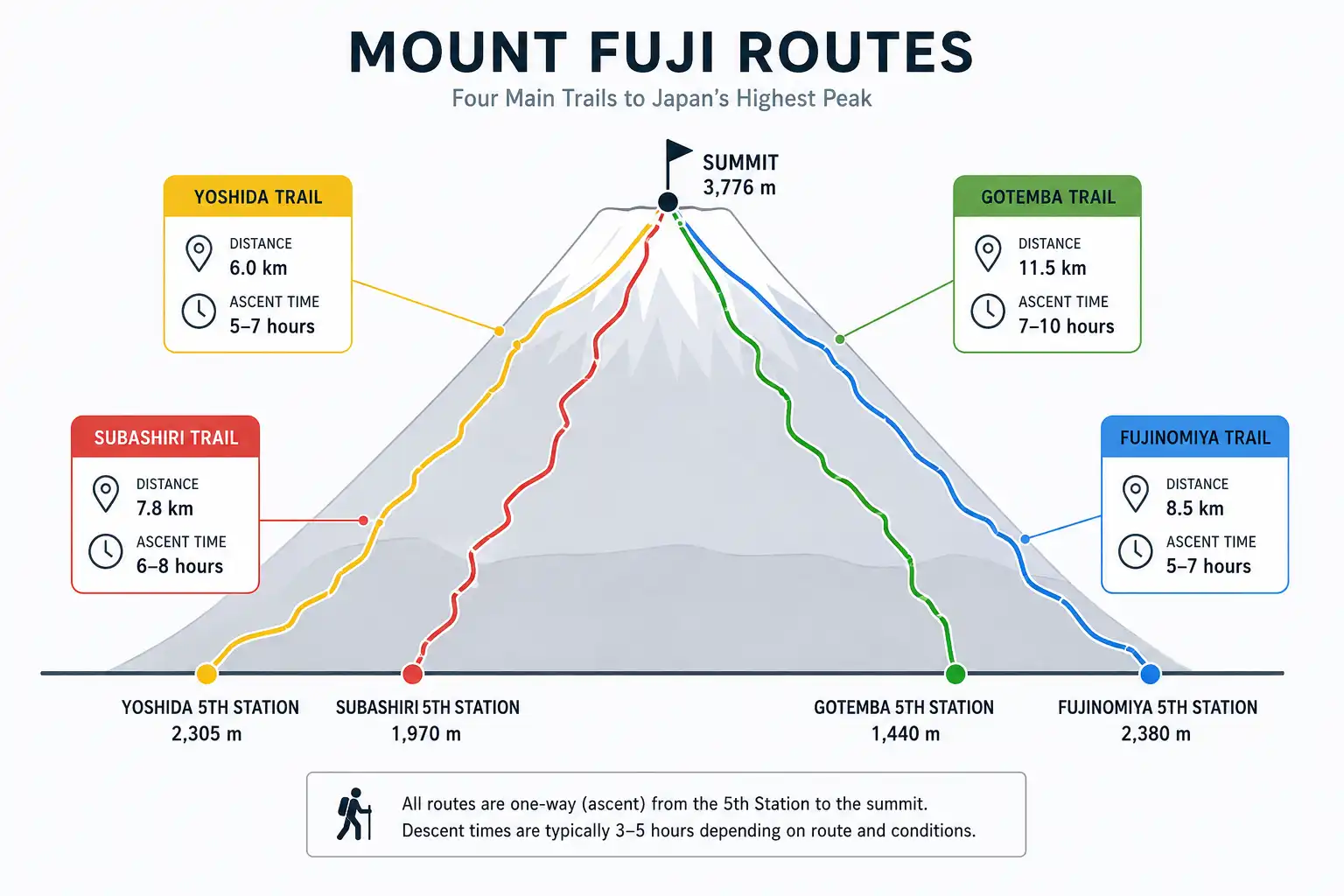
Fujinomiya is the fastest route, at 4 to 7 hours up and 2 to 4 hours down. Its 5th Station sits highest at about 2,400 meters, and the trail covers only 4.3 kilometers to the crater rim. Short does not mean easy, though. The gradient is steep, and the same narrow path handles both directions, so traffic slows you down.
Yoshida ranks second for speed and first for support. The trail runs 6.8 kilometers from a 2,305 meter trailhead, with separate paths for going up and coming down. Roughly six in ten climbers use it, mainly because buses run straight there from Shinjuku.
Subashiri starts lower at about 2,000 meters and runs 6.9 kilometers up through forest before it merges with Yoshida near the 8th Station. Times land close to Yoshida, but the merge point creates queues before dawn.
Gotemba is the slowest by a wide margin. Its 5th Station sits at just 1,440 meters, and the climb covers 10.5 kilometers with around 2,300 meters of vertical gain. That is a serious day out, and it helps to know what counts as a lot of elevation gain before you commit. Huts are few, and there is no first aid station on route.
How long does the Yoshida Trail take section by section?
The Yoshida Trail takes about six hours in stages, and the middle third eats most of that time. Here is how the climb usually breaks up:
- 5th Station to 6th Station: 30 to 45 minutes on a flat, wide path.
- 6th to 7th Station: about 60 to 90 minutes of zigzag switchbacks.
- 7th to 8th Station: over 100 minutes, climbing from 2,700 m to 3,100 m on rock.
- 8th Station to summit: 90 minutes to 2.5 hours on loose scree.
Plan around the 7th to 8th stretch. This is the longest single push and the point where thin air starts to bite. Slow down here rather than after you feel bad.
The final section between the 8th Station and the crater rim is also the busiest, because Yoshida and Subashiri traffic combines there. Before sunrise on an August weekend, climbers sometimes stand in line. As a result, a 90 minute stretch can stretch past two hours through no fault of your own.
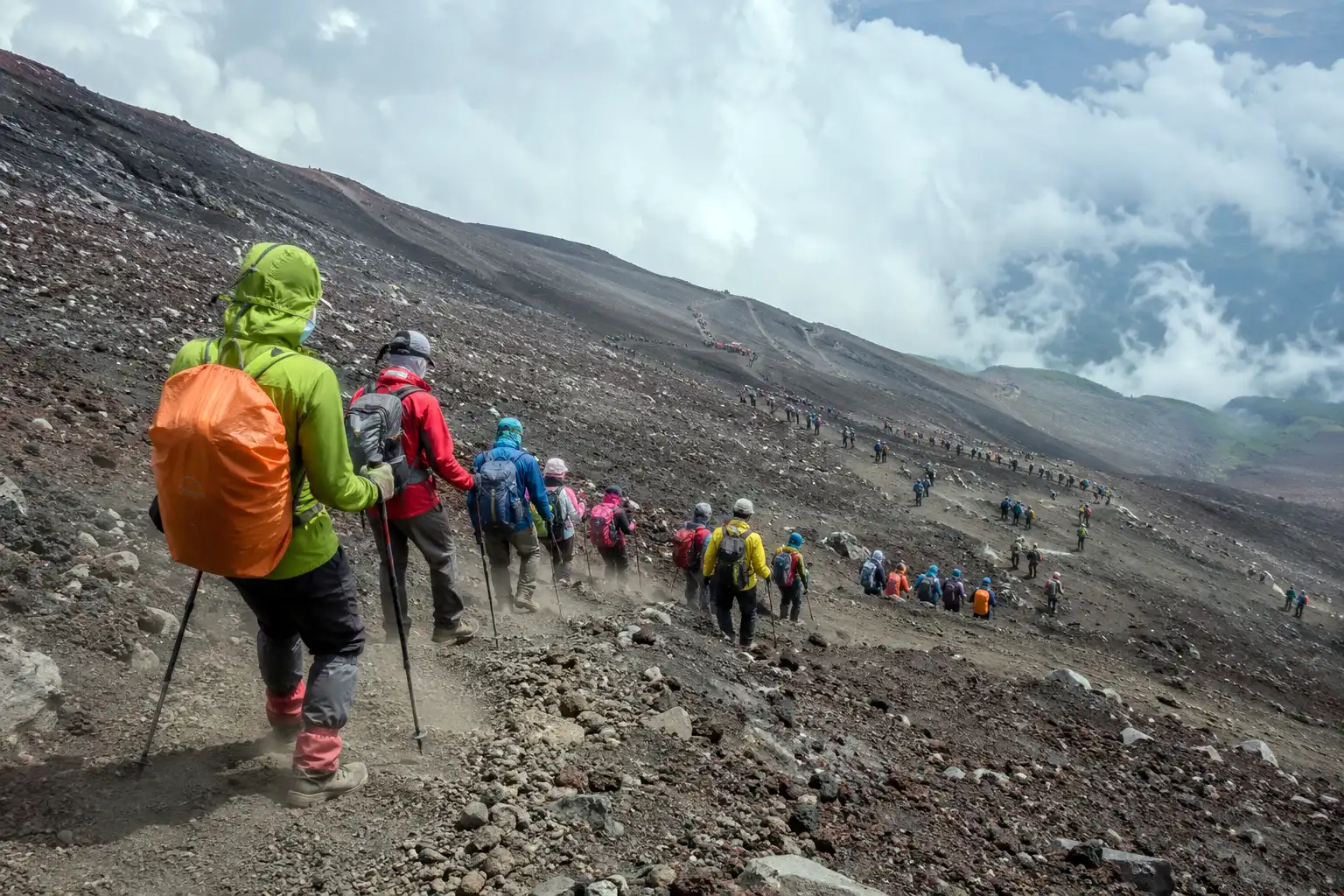
Descent on Yoshida follows a separate sandy track. Most people take 3 to 4 hours, and it feels longer than it sounds because the surface is loose volcanic gravel with no shade.
How long does the two day climb take?
The standard two day climb takes about 12 to 14 hours on the mountain, spread over roughly 24 hours door to door. Local authorities recommend this format, and the gate rules now push almost everyone toward it.
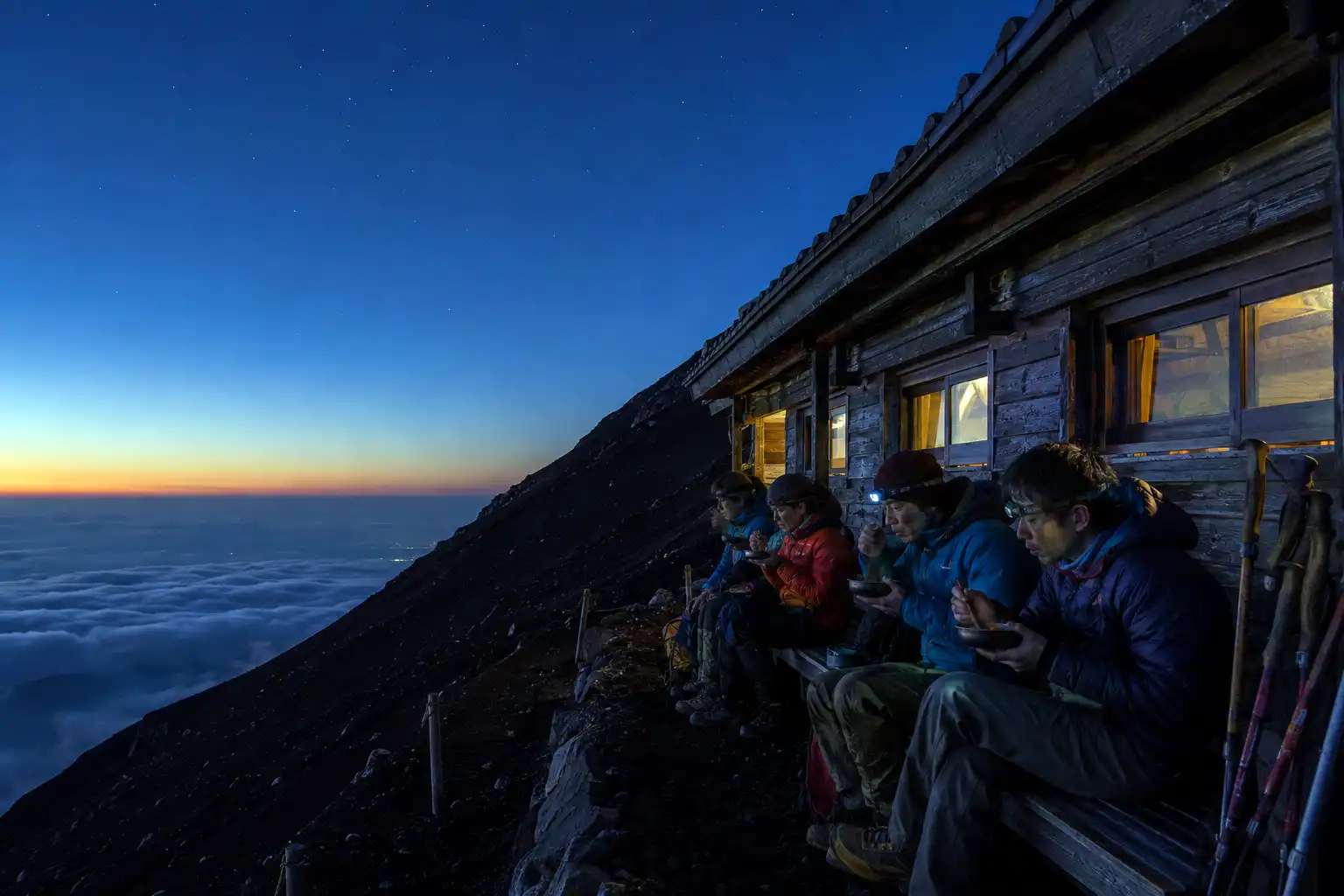
Day one runs 3 to 5 hours. Reach the 5th Station by late morning and rest 30 to 60 minutes so your body settles. Then climb to a hut at the 7th or 8th Station. Check in usually happens between 3 pm and 6 pm.
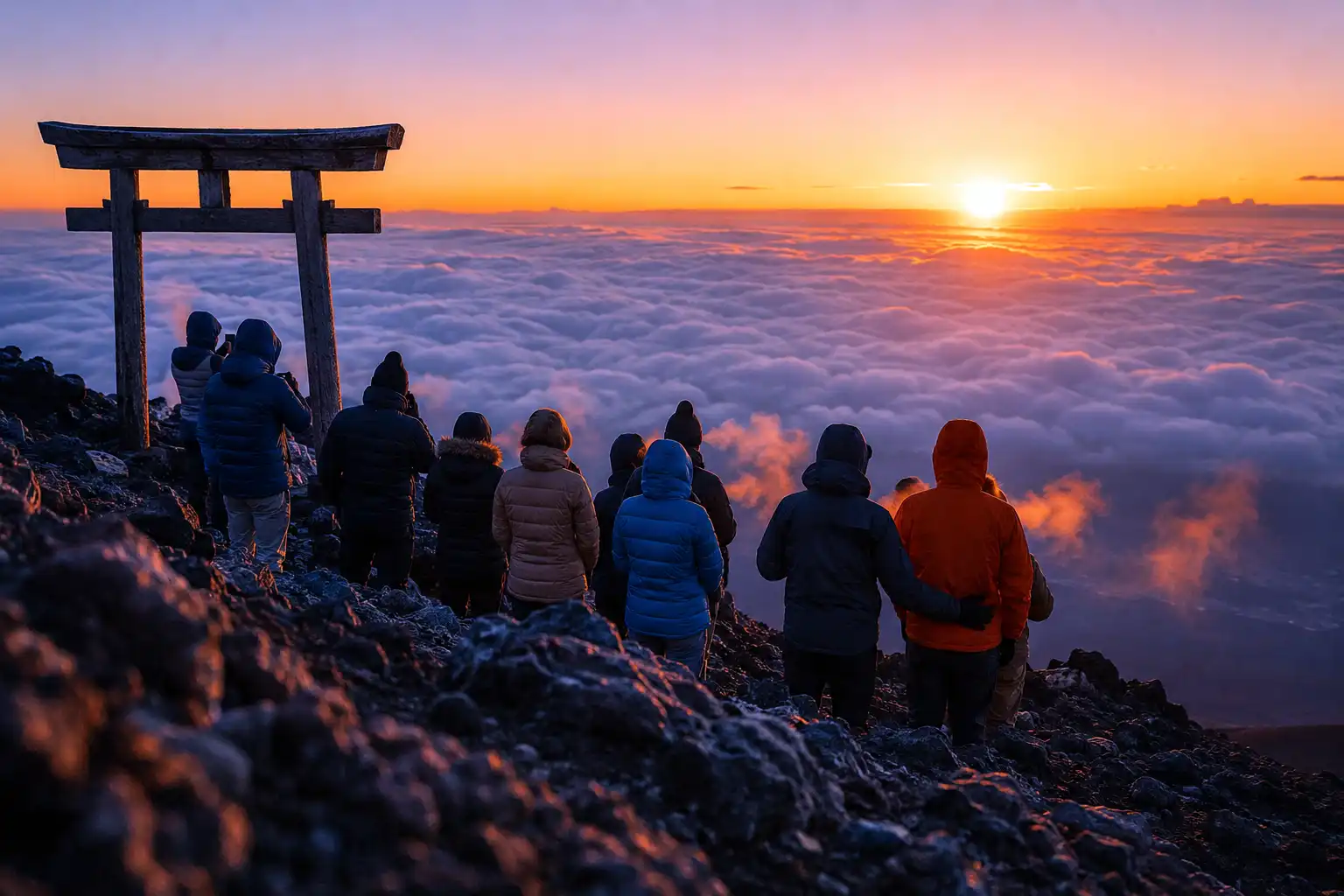
Day two runs 5 to 8 hours. Leave the hut around 1 am to 2 am and reach the summit before the 4:30 am sunrise. After an hour up top, you start down.
Huts cost roughly 10,000 to 15,000 yen per person with two meals. Sleeping space is communal and short, so treat it as rest rather than a full night. Even so, that pause makes a real difference to how your body handles 3,776 meters.
Because the early start happens in full dark, your light matters. Trails are crowded but unlit, so check how many lumens a headlamp really needs before you pack.
Can you hike Mount Fuji in one day?
Yes, but only during daylight, and only if you are fit. A one day round trip takes 8 to 12 hours of walking plus travel at both ends. You must clear the 5th Station gate before 2 pm, so a realistic day means starting between 5 am and 8 am.
Overnight climbing straight through, once common, is now blocked. Gates on all four trails close from 2 pm to 3 am. Only climbers holding a confirmed mountain hut booking may pass during those hours. Authorities introduced this to stop exhausted hikers pushing to the top without rest.
One day climbs also carry a higher altitude sickness risk, since you gain around 1,400 vertical meters with no acclimatization. If you plan this route, training for high altitude hiking in the months before your trip pays off more than any piece of gear.
How much time does the crater rim walk add?
The crater rim walk adds about 90 minutes. Known as Ohachi-meguri, this roughly 3 kilometer loop circles the summit crater and passes Kengamine, the true 3,776 meter high point of Japan.
Here is the catch most people miss. Where the Yoshida Trail tops out is not the highest point. Kengamine sits over 40 minutes away around the rim. From the Fujinomiya summit, by contrast, it takes only about 20 minutes.
Weather decides whether this is worth it. Winds at the rim get fierce, and the loop closes in snow or heavy fog. Only add it when you have spare energy, spare water, and enough daylight left for the descent.
What makes the climb take longer than expected?
Four things stretch Fuji timings past the official numbers, and crowding tops the list.
Congestion. Around 200,000 people climb each summer. During Obon week in mid August and on Saturdays, the upper trail moves at a shuffle.
Altitude. Thin air slows everyone. Above the 8th Station most climbers drop to short, deliberate steps with frequent pauses.
Weather. Rain, wind, and fog all cut your pace. Fuji sits exposed with almost no shelter between huts.
Poor pacing. Starting fast is the classic error. Fuji punishes it hard, which is why pacing yourself over a long climb matters more here than raw fitness.
I have not climbed Fuji myself. My hill time is in the Bandarban ranges here in Bangladesh, on routes like Keokradong and Saka Haphong, where the pattern repeats exactly. People blow through the first two hours, then crawl the last three. The mountain sets the pace, not you.
How long is the whole trip from Tokyo?
A Fuji trip from Tokyo takes 24 to 36 hours door to door for the two day version. Transport adds several hours at each end.
- Shinjuku to Fuji Subaru Line 5th Station: about 150 minutes by direct highway bus, around 4,800 yen one way.
- Kawaguchiko Station to the 5th Station: about 50 minutes, around 2,000 yen one way.
- Gotemba Station to Subashiri 5th Station: about 60 minutes.
- Fujinomiya or Shin-Fuji Station to Fujinomiya 5th Station: 90 to 120 minutes.
Private cars cannot reach the Subaru Line, Subashiri, or Fujinomiya 5th Stations during the season. Shuttle buses run from lower parking lots instead, which adds another 30 to 60 minutes.
Last buses down leave earlier than most people expect, and night taxis are scarce. Therefore work backward from your return bus time, not forward from your start time.
What 2026 rules affect your timing?
Three 2026 rules directly shape your schedule, and all of them need handling before you arrive.
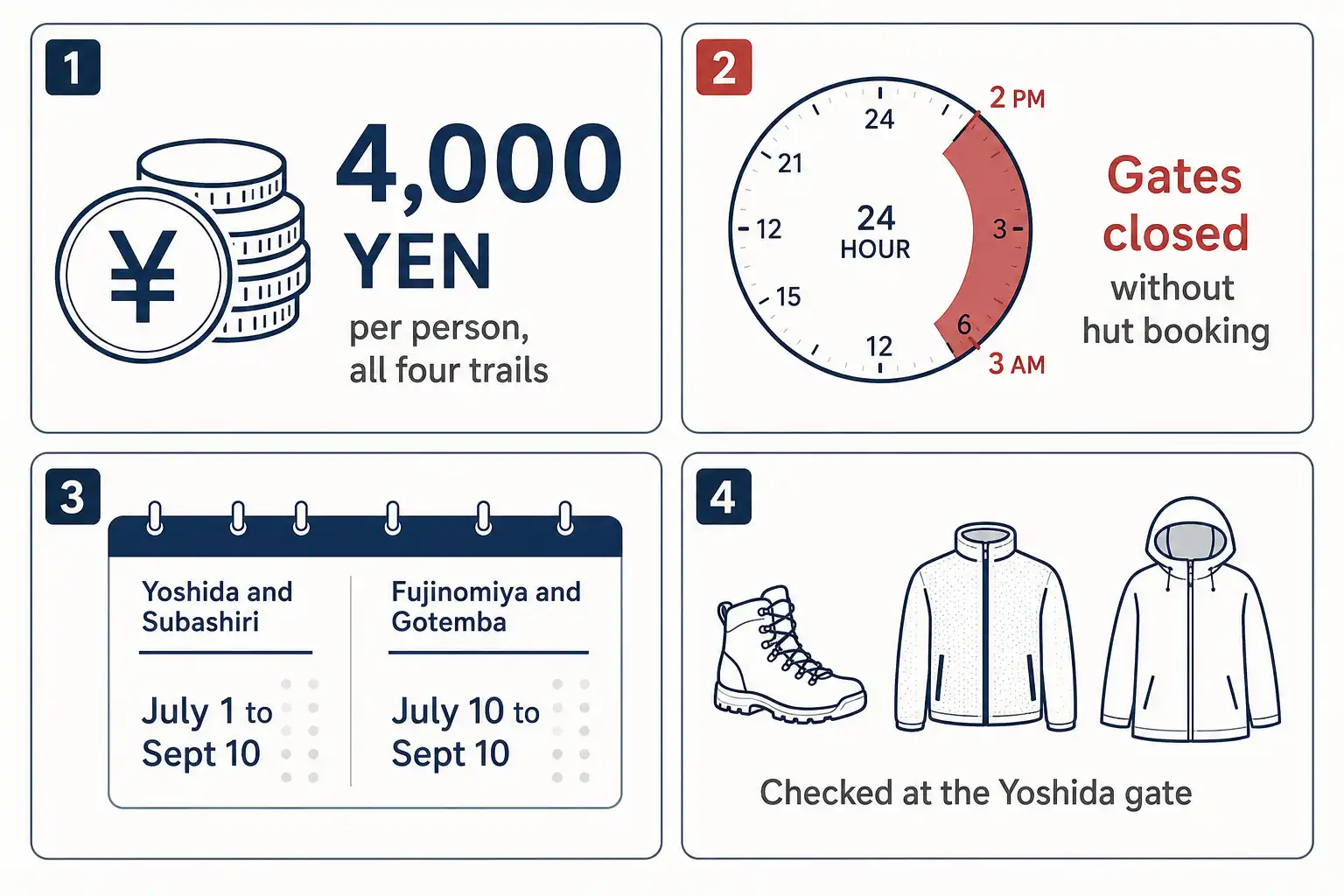
Season dates. Yoshida and Subashiri run July 1 to September 10. Fujinomiya and Gotemba run July 10 to September 10. Japan prohibits climbing above the 5th Stations outside these dates.
The 4,000 yen fee and registration. Every trail charges 4,000 yen per person. Yoshida bookings go through the Yamanashi system, while the three Shizuoka trails use the FUJI NAVI app, which includes a short safety course and quiz. On site registration takes about 30 minutes, so book ahead.
Gate hours and the daily cap. Gates close 2 pm to 3 am for anyone without a hut booking. Yoshida also caps day climbers at 4,000 per day.
Rangers check three items at the Yoshida gate: trekking shoes, cold weather clothing, and rainwear. Sneakers get turned back. That check is also a good reason to sort your footwear early. Stiff new boots and 10 hours of volcanic gravel make a painful pairing.
How should you plan your hours on the mountain?
Build your schedule backward from the last bus, then add a two hour buffer. Fuji timing goes wrong when people plan only the climb and forget the exit.
A few habits that keep the clock honest:
- Reach the 5th Station early and rest 30 to 60 minutes before starting.
- Target 300 vertical meters per hour rather than a fixed pace.
- Take a short break every hour, not every time you feel tired.
- Turn back if you fall two hours behind schedule.
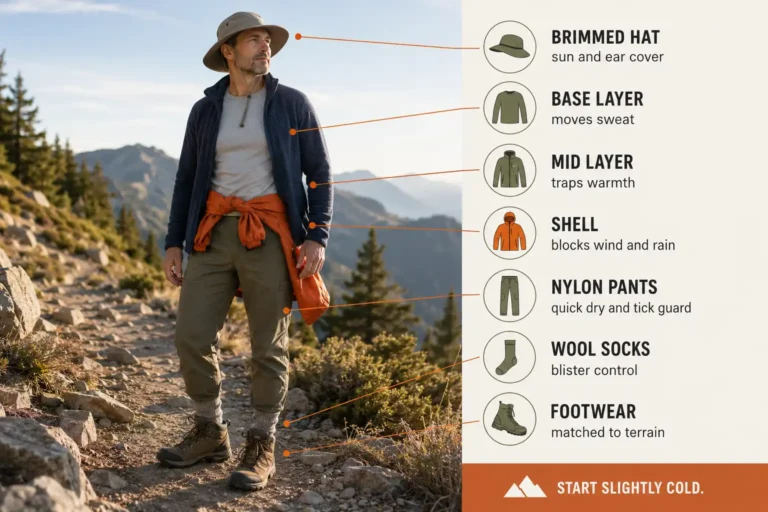
Summit temperatures drop below freezing before dawn, even in August, and wind makes it worse. Pack for that from the start. Good layering for cold wind on the trail decides whether your summit hour feels comfortable or miserable.
Finally, respect the descent. Three to five hours of downhill on loose gravel hammers your legs. In fact, knee pain on long downhill stretches is the complaint I hear most from people coming off big volcanoes. Poles help. Short steps help more.
FAQs about Mount Fuji Hiking Time

Is Mount Fuji harder than it looks?
How long does the descent take?
What time should I leave the hut for sunrise?
Can beginners climb Mount Fuji?
Do I need a guide for climb Mount Fuji?
Final thoughts
Plan on 8 to 12 hours of walking, and give yourself two days if you want the sunrise. Fujinomiya is fastest, Yoshida is best supported, and Gotemba is a full endurance day. Book your permit and hut before you fly, because the 2 pm gate rule leaves no room for improvisation. Above all, build in buffer time. The people who struggle on Fuji are rarely unfit. They simply ran out of hours.
Prices, bus fares, hut rates, and trail rules change season to season. Check the official Mt. Fuji climbing site before you book.