How to Hang a Hammock Without Trees

No trees at your site? Your hammock still works. I have hung mine off a vehicle on the bare shoreline of Kaptai Lake, and off poles on the open hilltops above Boga Lake. Below are the anchors that actually hold, plus the force math that tells you which ones will drop you.
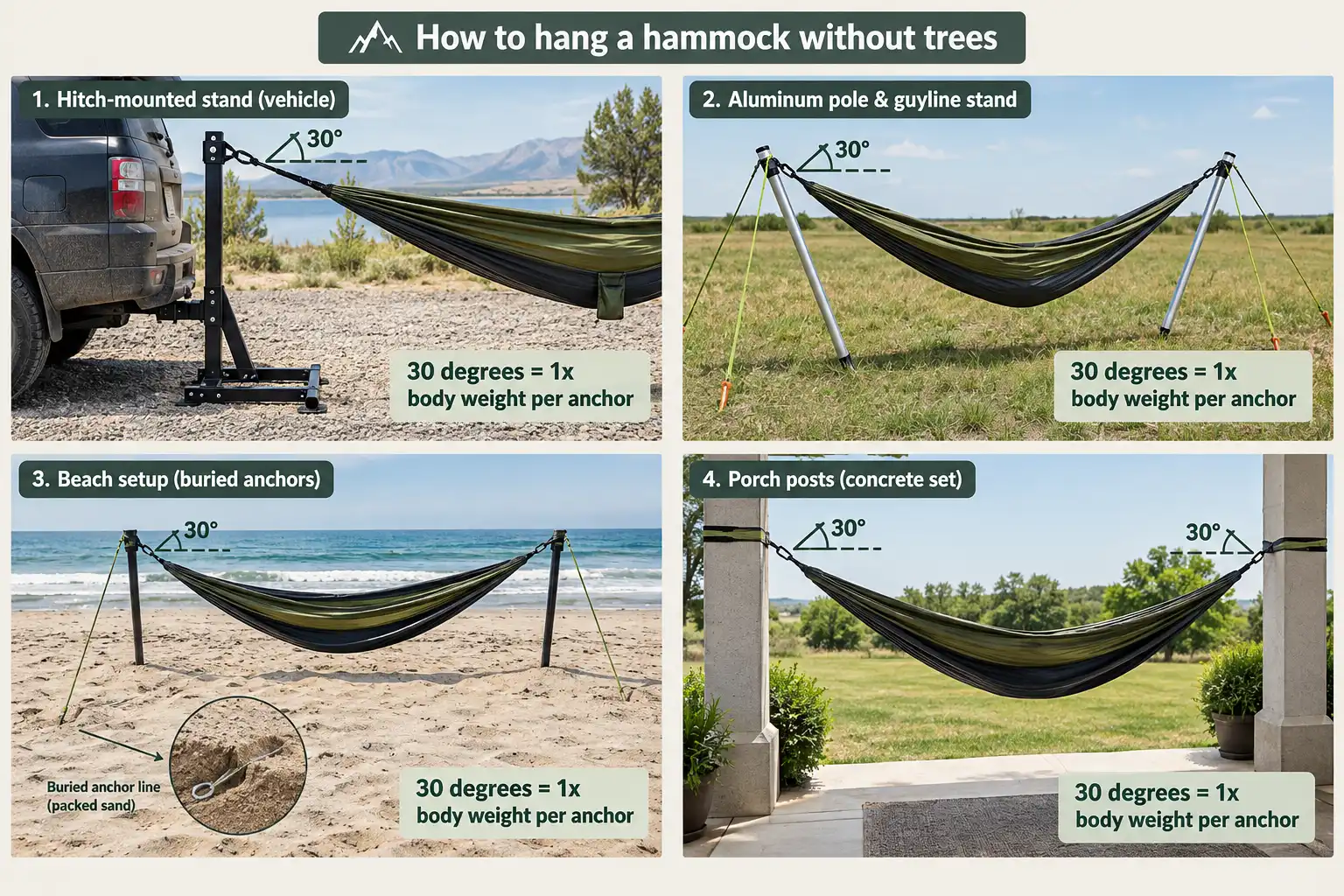
Hang a hammock without trees using a portable stand, a vehicle, posts set in concrete, big rocks, or deadman anchors buried in soft ground. Every anchor has to resist a sideways pull equal to your full body weight at a 30 degree hang. Then test it with your own weight before you commit to sleeping in it.
How much force does a hammock put on each anchor?
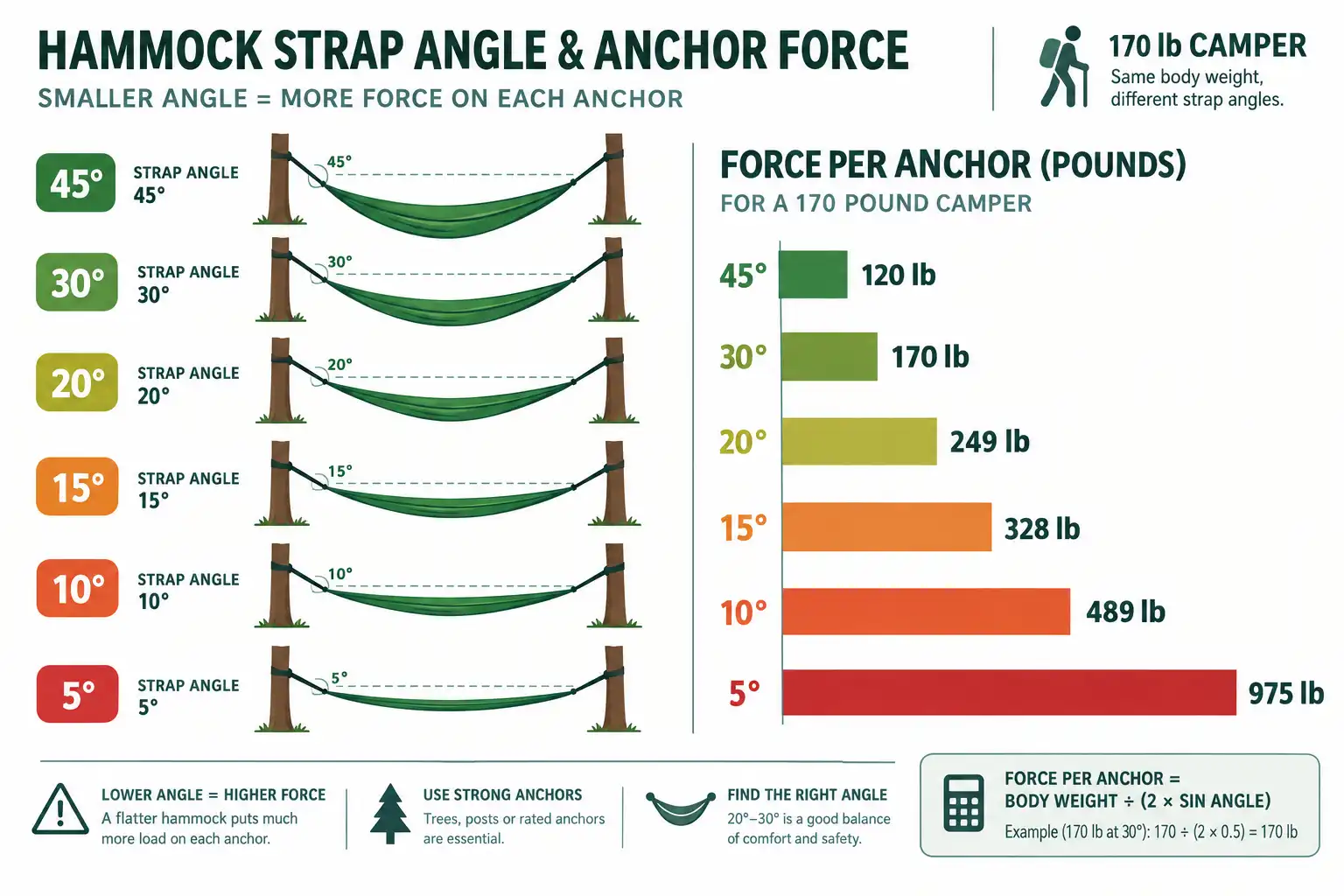
At a 30 degree hang, each anchor carries a force equal to your entire body weight, not half of it. That number catches most campers off guard. The load per anchor equals your body weight divided by twice the sine of the hang angle, measured from horizontal. So the flatter you pull the hammock, the harder each anchor works.
Here is what that means for a 170 pound camper:
| Hang angle | Load multiplier | Force per anchor |
|---|---|---|
| 45 degrees | 0.71x | 120 lb |
| 30 degrees | 1.0x | 170 lb |
| 20 degrees | 1.46x | 249 lb |
| 15 degrees | 1.93x | 328 lb |
| 10 degrees | 2.88x | 489 lb |
| 5 degrees | 5.74x | 975 lb |
That table drives every decision below. A tight, flat hammock looks neat, yet it nearly triples the pull on whatever you tied to. Sag is not sloppiness. Instead, think of it as load control.
Two more things follow from the math. First, your anchor needs to resist a mostly sideways pull, which is the direction most improvised anchors fail. Second, a rated anchor beats a guess every time.
What gear do you need for a no-tree hang?
You need more webbing than a tree hang uses, because most substitute anchors are wider or lower than a tree trunk.
Pack these:
- Two hammock straps rated well above your weight. Most quality tree straps list 400 pounds or more per strap.
- Two locking carabiners, steel or rated aluminum. Skip the keychain type sold with cheap hammocks.
- A 10 to 12 foot tie down strap for reaching around a vehicle or a wide post.
- A structural ridgeline so your sag stays the same no matter what you tie to.
- Ground anchors if you plan to use pole stands. Screw anchors work in soft soil, while boom stakes hold better in hard ground.
- A short length of old carpet or a rag to protect webbing from sharp rock and metal edges.
Also bring a sleeping pad. Because a pad protects you from cold air underneath and softens any fall, it earns its space on an improvised hang. Anyone who has felt a cold back at 3 a.m. knows why keeping your insulation working underneath you matters as much as the hang itself.
How do you hang a hammock from your vehicle?
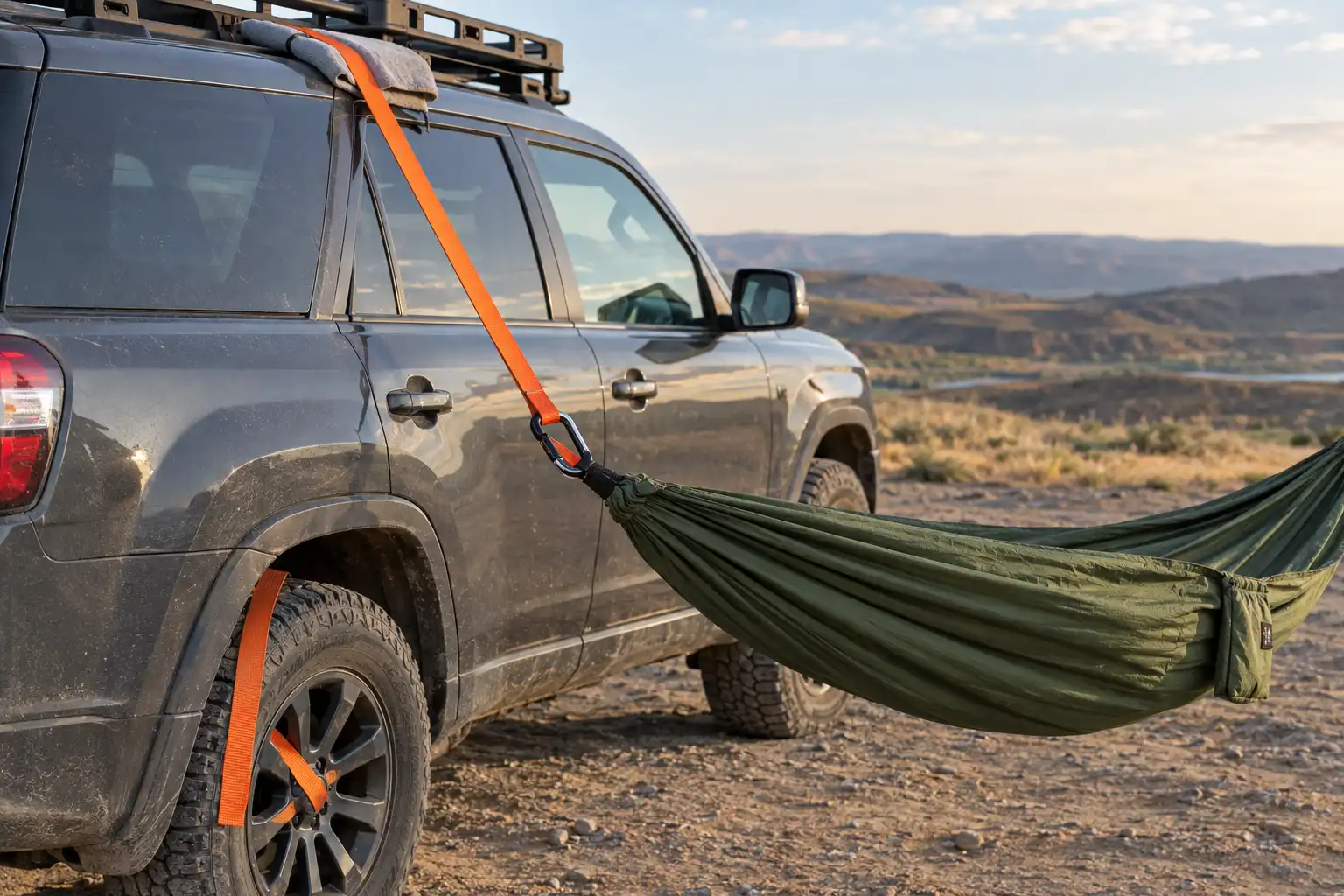
Run a strap over the roof and down to the wheel on the far side, then clip your hammock to that strap on your side. Roof racks handle downward load well, but they are not built for the sideways pull a hammock creates. Sending the load over the roof to the opposite wheel puts the force into the axle instead.
Vehicle points that hold
- Tow hitch receiver. A 2 inch Class III or IV receiver is the strongest point on most vehicles.
- The opposite wheel. Pass webbing through the spokes, then over the roof. Pad the roof edge first.
- The center door frame. Open both doors on one side, loop a sling around the B pillar, then shut the front door on it.
- Truck bed tie down hooks and bed rails. These are rated points, so use them.
- Roll bars on open top vehicles.
Aftermarket rack towers from brands like Thule or Yakima handle far more than factory crossbars. Kammok notes that crossbars commonly carry a 165 pound rating, so check yours before trusting it.
Vehicle points to skip
Mirrors, door handles, plastic bumper covers, and glued-on roof rails all fail under load. Also avoid any vehicle that someone else might drive away. Take the keys with you.
Which hammock stands work without trees?
Three kinds work, and they suit completely different trips: free-standing frames, vehicle-mounted stands, and pole stands held up by guylines.
Free-standing frames
These are the steel arc stands you see in yards. Ratings usually fall between 300 and 500 pounds, and lengths run from 9 to 15 feet. However, they weigh 30 to 60 pounds and need a flat surface, so they stay home or ride in a car.
Hitch and roof mounted stands
A hitch stand slides into a 2 inch receiver and holds the hammock behind your vehicle. Typical ratings sit around 275 to 350 pounds, with spans near 114 to 125 inches. Roof-mounted versions such as the Kammok Outpost clamp to crossbars instead, though your rack rating then becomes the limit.
Pole and guyline stands
These use two or four poles braced by guylines and ground anchors, which is the only approach light enough to carry. Tensa Outdoor reports that guyline forces on their Tensa4 seldom pass about 40 pounds, since the lines balance the stand rather than carry you. Their Trekking Treez model lists a 250 pound user limit, and the company notes that soil and anchoring technique matter more than the poles themselves.
How do you hang a hammock on sand or a beach?
Bury deadman anchors, because ordinary stakes pull straight out of loose sand. Sand has very little shear strength, so a narrow stake simply slices through it under load.
Here is the method that works:
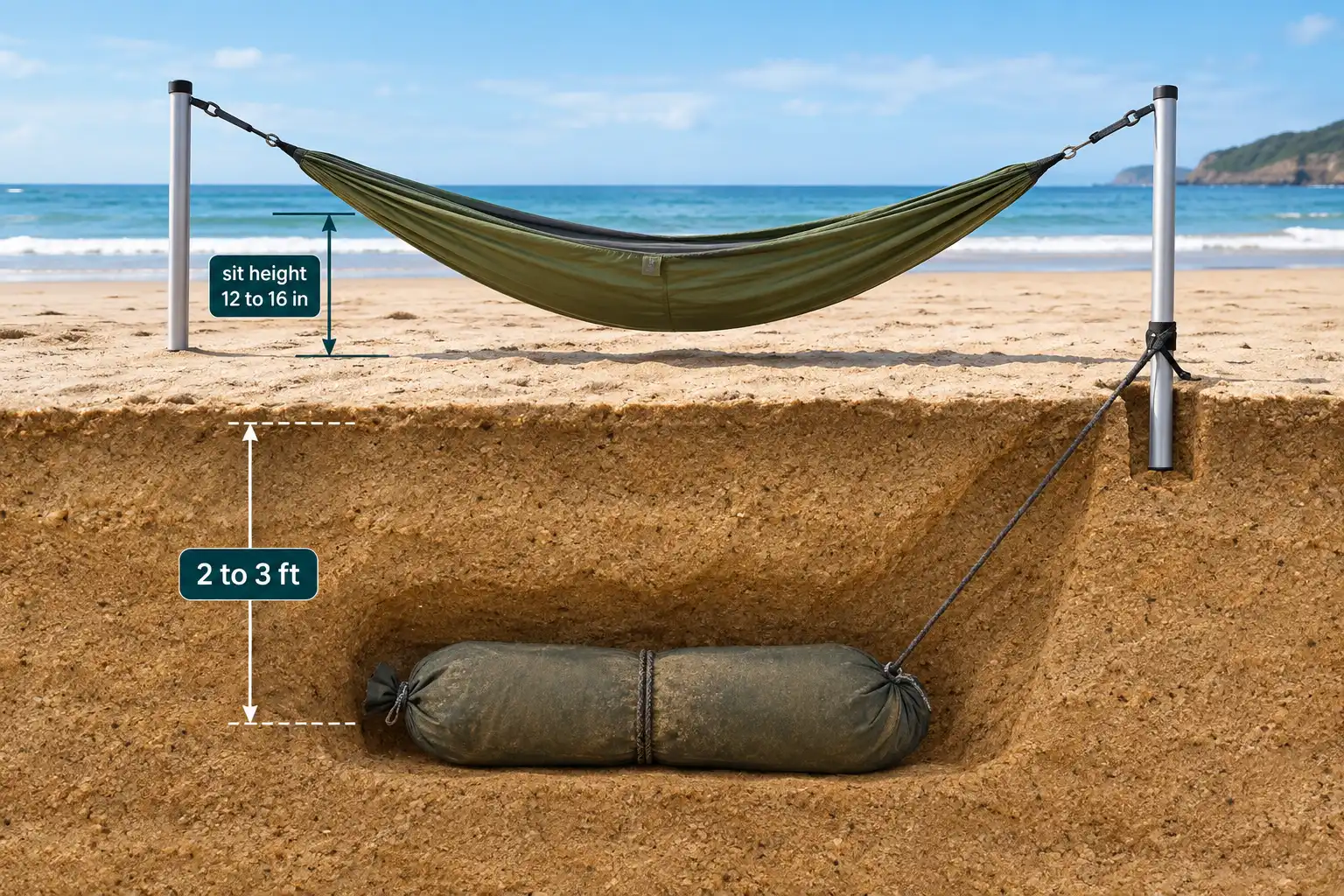
- Dig a hole 2 to 3 feet deep at each end.
- Lay a filled stuff sack, a driftwood log, or a flat rock horizontally in the hole.
- Tie your line around the middle of it, then run the line up to the surface at an angle.
- Backfill and pack the sand hard. Pouring water over it helps the sand settle.
- Attach the hammock end to a pole or a short A-frame standing over the anchor.
Set your sit height low on sand, around 12 to 16 inches. That way a failure means a short drop rather than a fall. Note that no anchor maker will guarantee pullout strength in sand, since it varies by site, so treat published numbers as rough guidance only.
Many of the same rules apply above ground. Campers who also pitch a shelter beside the hammock will find that staking a tent on loose or sandy ground follows the same logic. Likewise, the buried-anchor trick used for holding a tent down when stakes will not grip transfers straight across.
Can you hang a hammock from posts, pillars, or rocks?
Yes, provided the post sits in concrete and the rock is too heavy to shift. Both need to resist a horizontal pull, not just hold weight.
Good candidates include porch columns, pergola posts, verandah pillars, dock pilings, and braced fence corner posts. Line posts in a fence are not braced, therefore they bend or lift. Watch out for leverage as well, because a strap tied high on a tall thin post multiplies the force at its base.
For rocks, girth hitch your strap around a boulder heavier than a person can budge. Then slide a rag or carpet scrap under the webbing where it crosses any sharp edge.
Skip public infrastructure. Utility poles, light poles, park signs, and playground frames all carry rules or hidden weaknesses, and some carry live wiring. On my Kaptai trips, I stick to bamboo-braced posts around fishing platforms, which are sunk deep and stay put.
How do you hang a hammock indoors without trees?
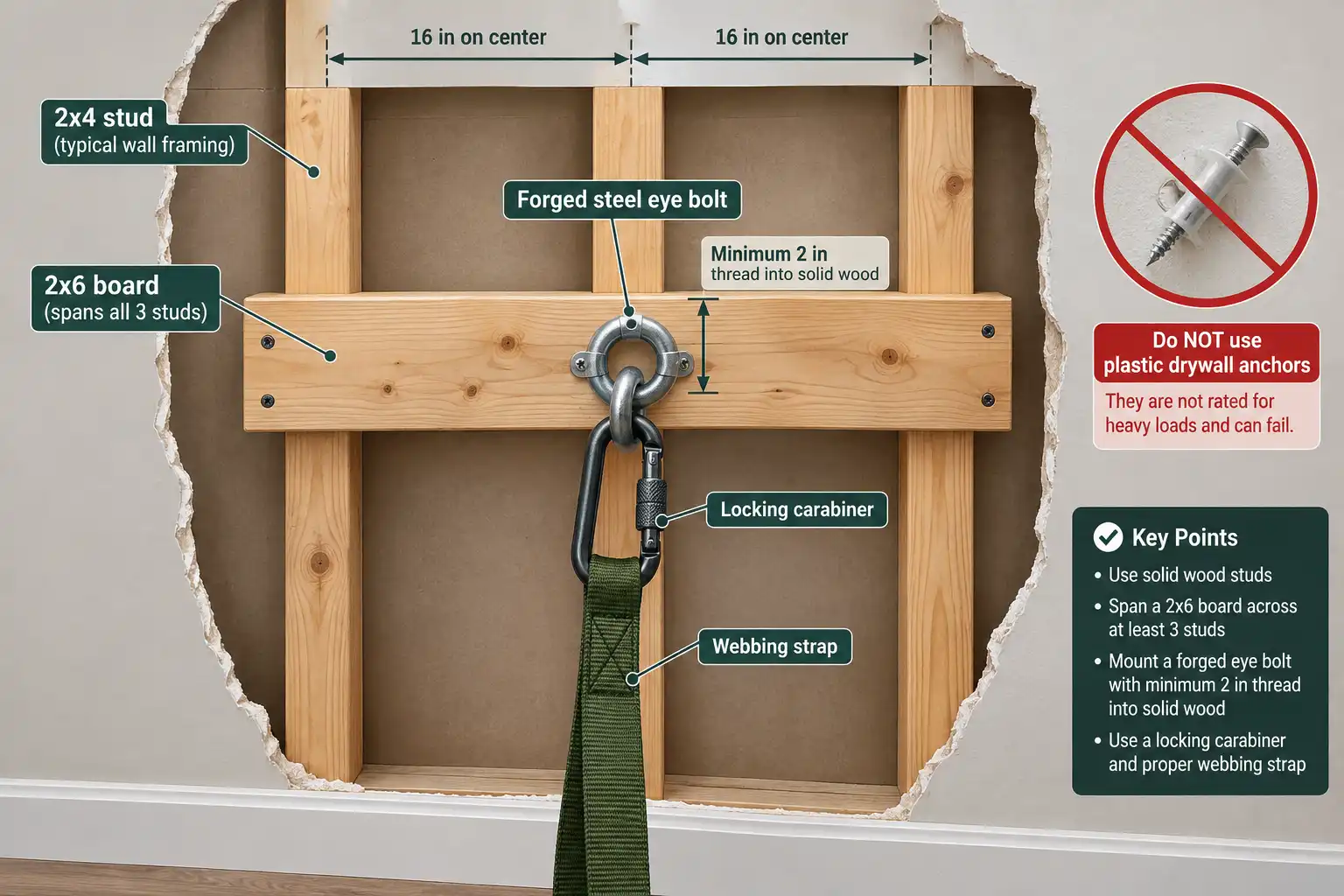
Anchor into framing, never into drywall alone. Drywall anchors hold picture frames, not people.
Find the stud with a stud finder, then confirm both edges with a fine nail so you can mark the true center. Drill a pilot hole and drive a forged eye bolt or lag hook at least 2 inches into solid wood. A better method spreads the load: screw a 2×6 board across three studs, then hang from an anchor mounted in that board.
For concrete or brick walls, use wedge anchors or lag shields sized to the bolt. Plastic plugs are not enough. Whatever you use, hang the hammock low and loose, and keep a mattress or pad underneath for the first few sessions.
What height and spacing should you use?
Set your anchor points 12 to 15 feet apart. Then attach the straps 5 to 6 feet up, and let the hammock bottom sit about 18 inches off the ground. Together those three numbers produce roughly the 30 degree strap angle you want.
A few adjustments help:
- Closer anchors need higher attachment. As the span shrinks, raise the strap height to keep the same sag.
- Use a ridgeline about 83 percent of your hammock length. For an 11 foot gathered end hammock, that means roughly 110 inches.
- Drop your height on improvised anchors. A lower hang costs comfort and saves ankles.
A tarp changes the picture too. Pole stands and vehicle hangs usually sit in the open with no canopy above. So matching your tarp size to the setup below it matters far more here than it does under forest cover.
How do you test an anchor before you trust it?
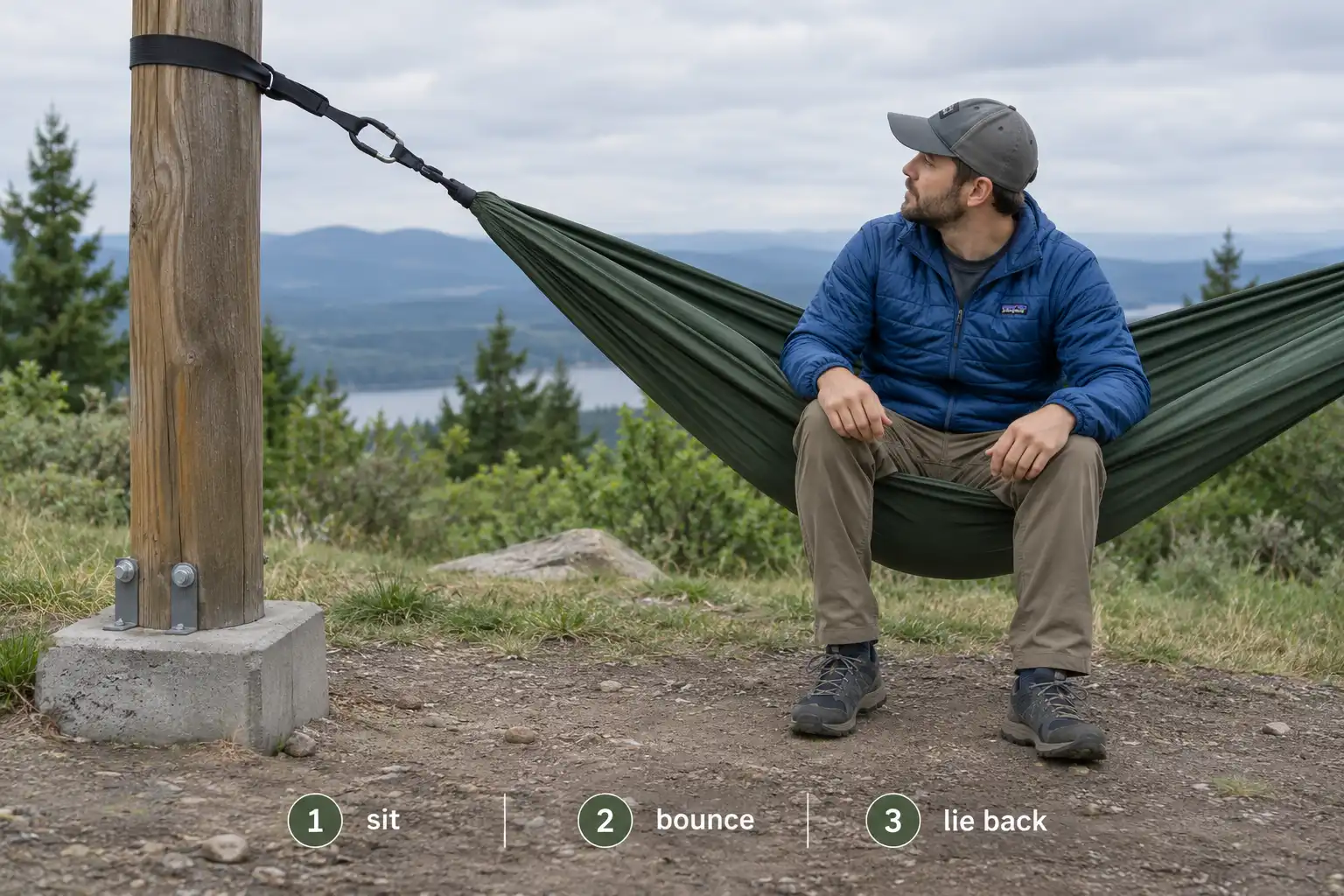
Load it in stages. Sit in the hammock with your feet still on the ground, then bounce gently, then lift your feet, and only then lie back.
Watch the anchor rather than the hammock while you do it. Look for a post flexing, webbing creeping down a pole, stand feet sliding, or a buried anchor lifting the sand above it. Stay loaded for a full minute and keep watching.
Then check again after ten minutes, because both webbing and soil settle under steady load. Rain deserves a fresh check as well, since wet soil gives up grip fast. Once you have slept on a setup twice without movement, you can trust it.
These failures show up most often:
- Stakes driven into loose or sandy soil
- Factory roof crossbars used for a side pull
- Unrated carabiners that bend open
- A flat, tight hang that multiplies the load
- Straps sawing over a sharp metal or rock edge
FAQs about Hanging a hammock without trees

Can you hang a hammock with only one tree?
Can you use regular trekking poles as a hammock stand?
How far apart should two vehicles park for a hammock?
Is a portable hammock stand worth carrying on a backpacking trip?
Final thoughts
Hanging a hammock without trees comes down to one question: will this anchor hold a sideways pull equal to my body weight? Once you can answer that, the options open up fast. A hitch stand covers car camping. Deadman anchors cover sand. A pole stand covers open ground, and framing covers indoor hangs. Keep the sag deep, keep the hang low when the anchor is improvised, and load-test everything before you settle in. The usual habits from pitching a hammock between two trees at camp still apply once your anchors are solid.