Is Hiking a Good Workout? METs, Calories, and How It Compares

I hike the hills around Kaptai most weeks, and friends still ask whether walking on a trail counts as training. It does, and the research supports it. Below I cover what hiking does to your heart and muscles, how many calories it burns, how it compares to running and the gym, and how to make any hike harder.
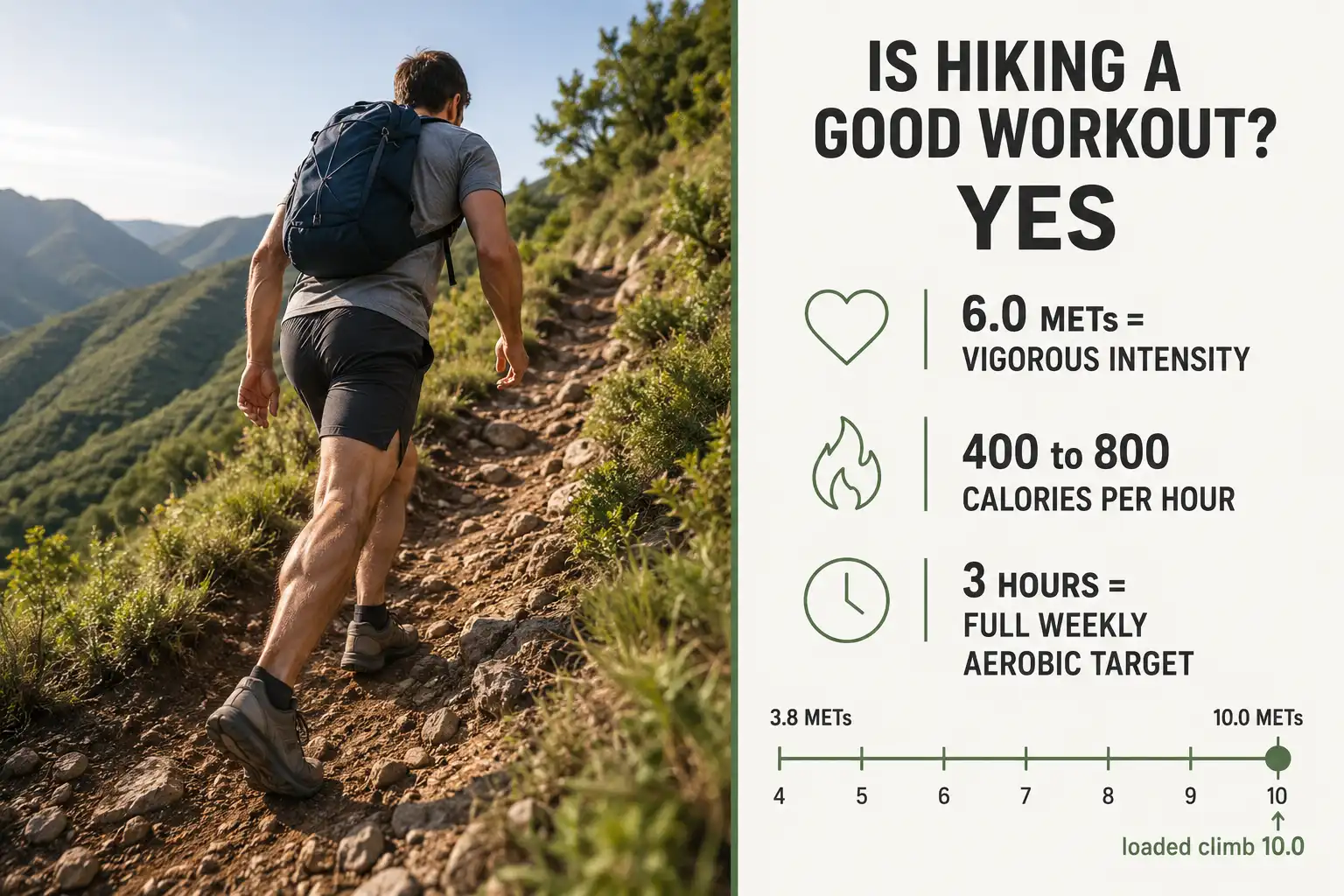
Yes, hiking is a good workout for almost everyone. Cross country hiking rates at 6.0 METs, which the CDC classifies as vigorous intensity. Add a daypack and it climbs to 7.8 METs, roughly the same energy cost as jogging. So one three hour hike can cover your entire weekly aerobic requirement.
What makes hiking count as exercise
Exercise scientists measure intensity in METs, or metabolic equivalents. One MET equals the energy your body uses sitting still. Because the scale is standardized, you can compare a hike against any gym session without guessing.
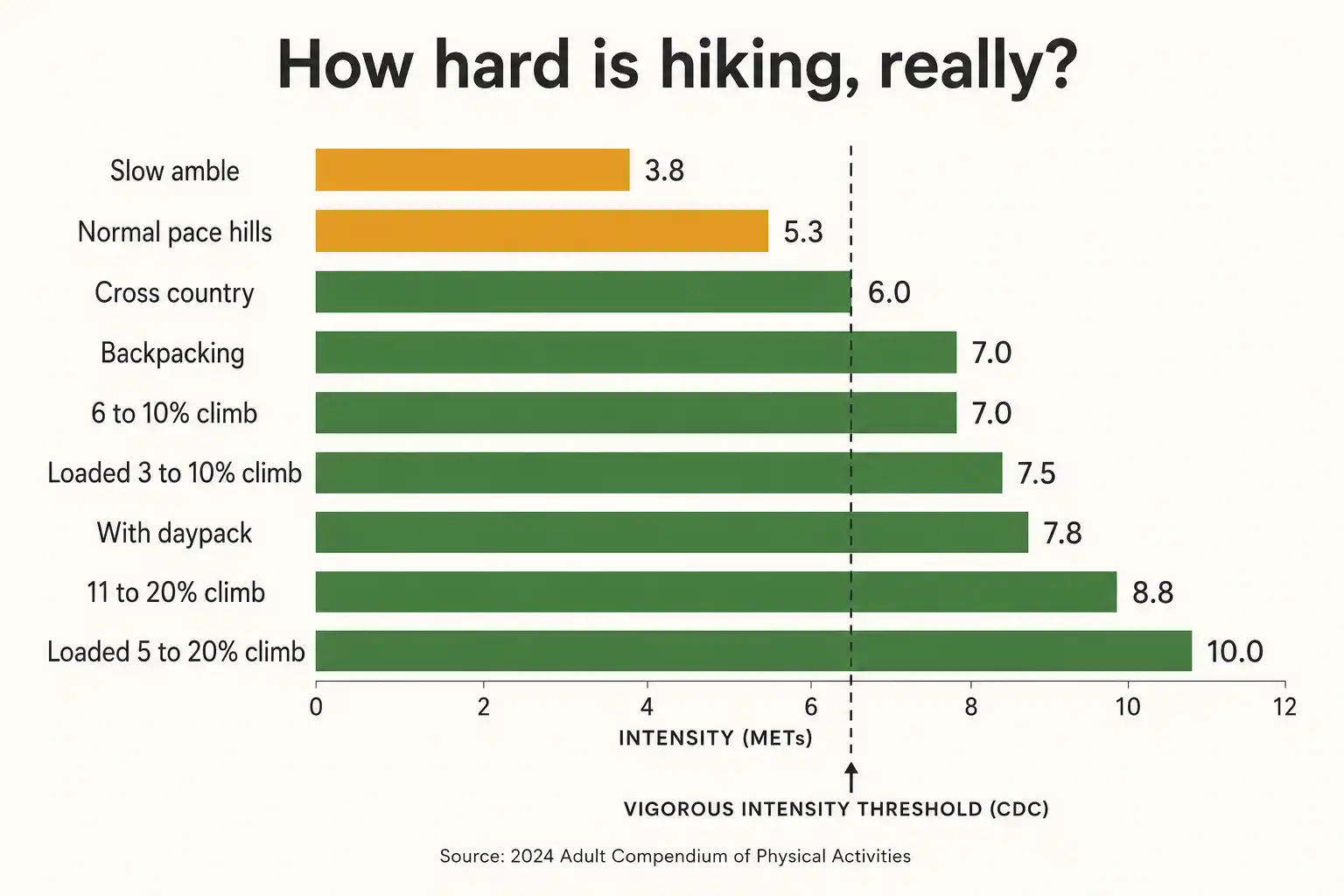
The CDC treats 3.0 to 5.9 METs as moderate intensity and 6.0 or above as vigorous. Here is where hiking falls, using values from the 2024 Adult Compendium of Physical Activities:
| Type of hiking | METs | Intensity |
|---|---|---|
| Slow amble through fields and hillsides, no load | 3.8 | Moderate |
| Normal pace through fields and hillsides, no load | 5.3 | Moderate |
| Cross country hiking | 6.0 | Vigorous |
| Backpacking | 7.0 | Vigorous |
| Climbing hills, no load, 6 to 10% grade | 7.0 | Vigorous |
| Climbing hills, 21 to 40 lb load, 3 to 10% grade | 7.5 | Vigorous |
| Hiking with a daypack | 7.8 | Vigorous |
| Climbing hills, no load, 11 to 20% grade | 8.8 | Vigorous |
| Climbing hills, 20+ lb load, 5 to 20% grade | 10.0 | Vigorous |
Notice the spread. A flat forest stroll is light work, while a loaded climb sits above most people’s running pace. Therefore the honest answer depends on terrain, pack weight, and how hard you push.
How many calories does hiking burn?
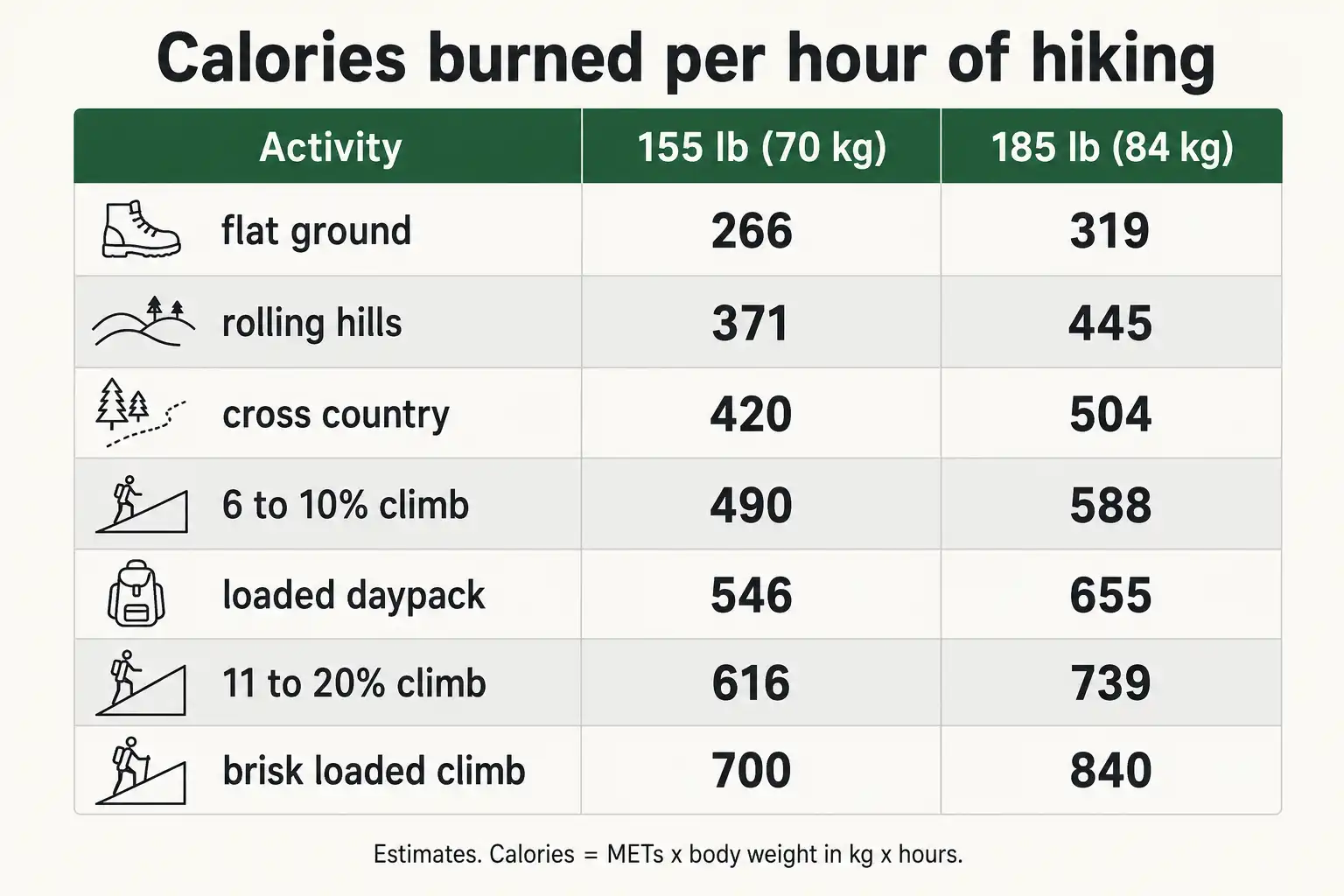
Hiking burns roughly 265 to 840 calories per hour depending on your weight, the grade, and your load. The formula is simple: calories equal METs multiplied by body weight in kilograms multiplied by hours.
| Hike type | 155 lb (70 kg) | 185 lb (84 kg) |
|---|---|---|
| Slow amble, flat ground | 266 | 319 |
| Normal pace, rolling hills | 371 | 445 |
| Cross country hiking | 420 | 504 |
| Steady 6 to 10% climb | 490 | 588 |
| Carrying a loaded daypack | 546 | 655 |
| Steep 11 to 20% climb | 616 | 739 |
| Loaded climb at brisk effort | 700 | 840 |
These figures are population averages, so treat them as a range rather than a promise. Fitness, heat, altitude, and stride efficiency all shift the result. Still, the pattern holds: grade and pack weight move the burn far more than distance alone. Fat loss also depends on the gap between calories burned and calories eaten, which is why hiking for weight loss works best when your food intake stays steady.
Is hiking cardio or strength training?
Hiking is mainly cardio with a genuine strength component in the lower body. Your heart rate climbs and stays elevated, which trains aerobic capacity. Meanwhile your quads, glutes, calves, and hamstrings work against gravity on every step up.
The strength side is not trivial. Climbing a 15% grade loads your glutes and quads much harder than level walking does. Descending then loads them again in a different way. On top of that, your core and hip stabilizers fire constantly to keep you upright on loose ground.
Still, hiking is no substitute for resistance training. It builds muscular endurance well and maximal strength poorly. The muscles hiking works hardest all sit below the waist, so your back, chest, and arms stay largely idle unless you carry a heavy pack.
Why trail terrain beats a treadmill
Uneven ground changes the workout. Every root, rock, and loose stone forces small corrections at your ankle, knee, and hip. As a result, hiking trains balance and joint position sense in a way that flat, predictable surfaces cannot.
Grade changes add a second layer. A rolling trail pushes your heart rate up on climbs and lets it settle on flats, which creates a natural interval effect without a stopwatch. When I climbed Keokradong, my effort swung far more than it ever does on a steady road walk.
Nature adds a measurable mental benefit too. In a Stanford study published in PNAS, people who walked 90 minutes in a natural setting reported less rumination and showed reduced activity in the subgenual prefrontal cortex, while urban walkers showed no such change. Same duration, same physical effort, different environment.
What downhill hiking does to your body
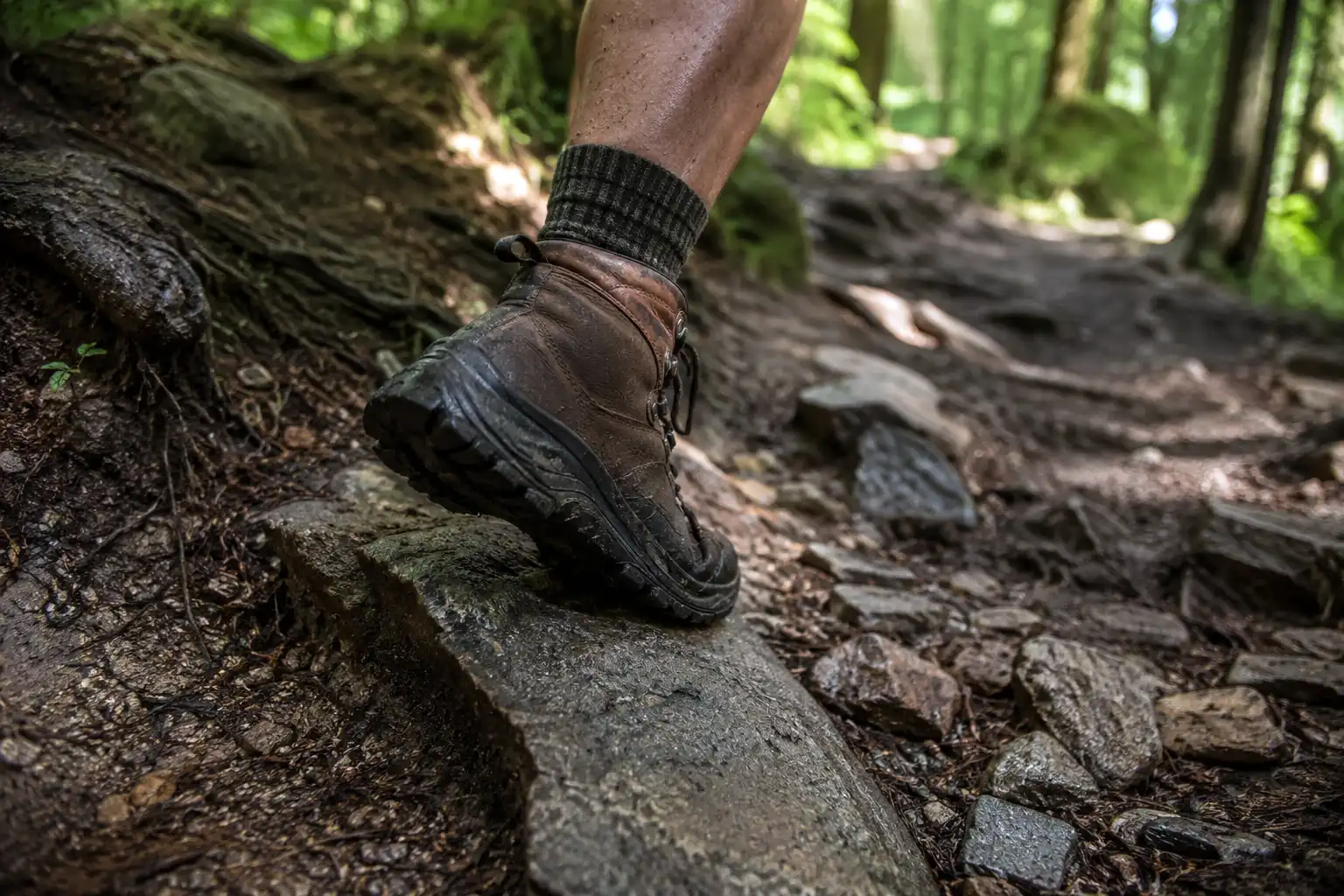
Descending is eccentric work, meaning your muscles lengthen under load instead of shortening. Your quads act as brakes on every step down. Because of that, descents cause more muscle soreness than climbs, even though they feel easier on your lungs.
The metabolic payoff is well documented. In a controlled trial published in Scientific Reports, two months of downhill hiking improved insulin resistance, fasting glucose, glucose tolerance, and triglyceride tolerance, while also lowering C reactive protein and BMI. An earlier Austrian crossover study found that both uphill and downhill hiking improved lipid and glucose markers in sedentary adults.
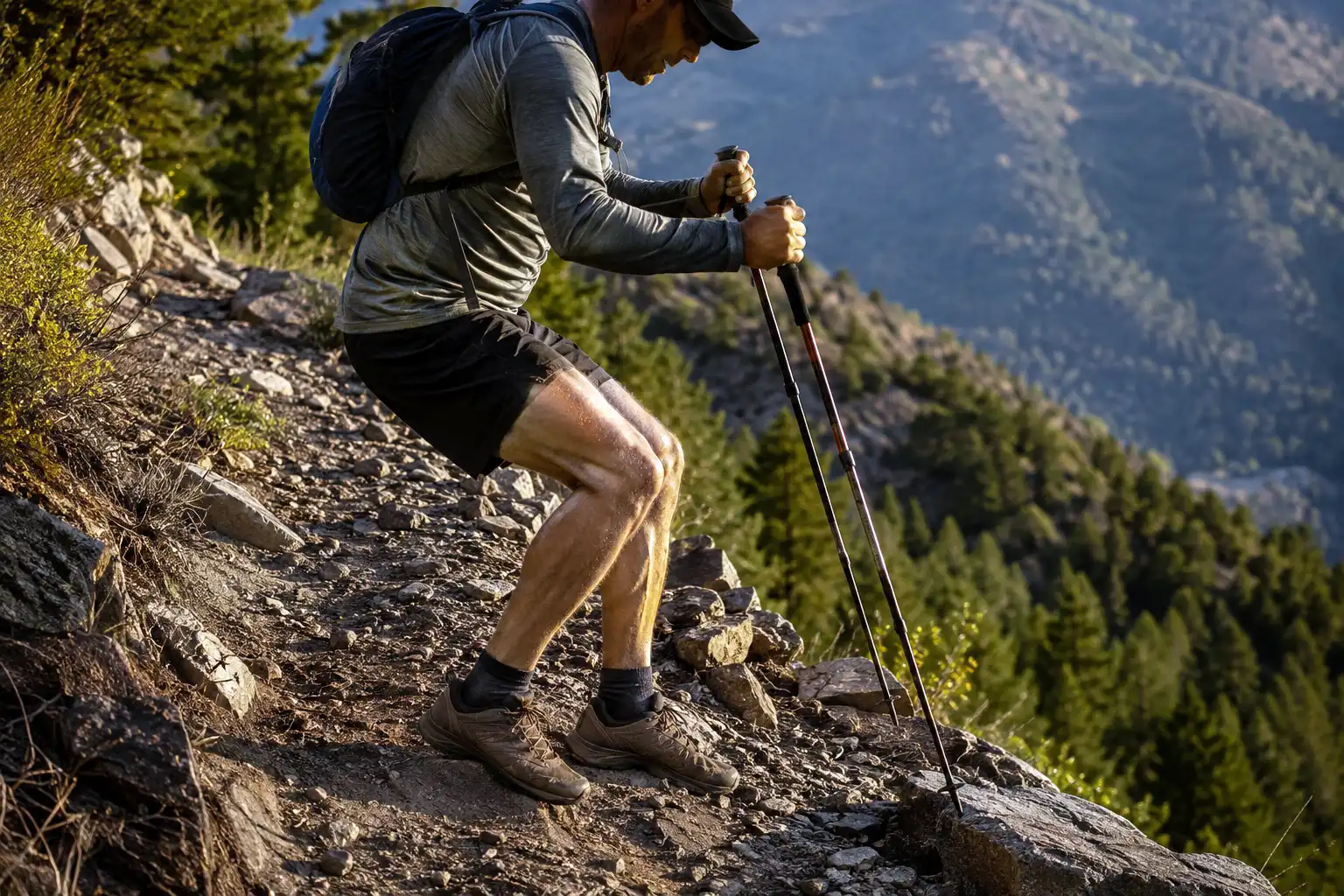
There is a cost, though. The American Academy of Orthopaedic Surgeons reports that downhill walking can generate forces up to three times body weight across the knee. That is why knee pain on descents shows up so often among hikers who felt fine on the climb. Poles, shorter steps, and a slower descent all reduce the load.
How hiking compares to running, walking, and gym cardio
Hiking with a pack sits close to jogging in energy cost and well above brisk walking. Here is the comparison on the same MET scale:
| Activity | METs |
|---|---|
| Brisk walking, 3.5 to 3.9 mph, level | 4.8 |
| Hiking, normal pace, hills, no load | 5.3 |
| Cross country hiking | 6.0 |
| Stair climbing, general | 6.8 |
| Jogging, general | 7.5 |
| Hiking with a daypack | 7.8 |
| Running, 6.0 to 6.3 mph | 9.3 |
| Climbing hills with a 20+ lb load | 10.0 |
Running beats hiking minute for minute. However, hikes usually last far longer than runs, so total energy expenditure often favors the trail. For example, a four hour hike at 6 METs burns more than a 40 minute run at 9.3 METs.
Impact is the other difference. Running loads your joints through repeated flight phases, while hiking keeps one foot on the ground most of the time. If your knees dislike running, the gap between hiking and everyday walking gives you a useful middle option.
Does hiking count toward your weekly exercise target?
Yes, and it counts generously. Adults need 150 minutes of moderate activity or 75 minutes of vigorous activity each week, plus muscle strengthening on two days. Since most hiking sits at or above 6 METs, it qualifies as vigorous.
Run the math yourself. A three hour hike at cross country pace equals 180 vigorous minutes, well past the 75 minute floor. Even a two hour moderate hike delivers 120 of your 150 moderate minutes.
How often should you hike to get fitter?
Two hikes per week builds fitness for most people. One long hike on the weekend plus one shorter midweek session works well. If you can only hike once a week, add two strength sessions so your legs and core keep progressing.
Beginners should start with a single weekly hike and build duration before grade. After a month, add a second outing. That progression kept me injury free when I first started climbing the steeper Bandarban routes.
How to make a hike a harder workout
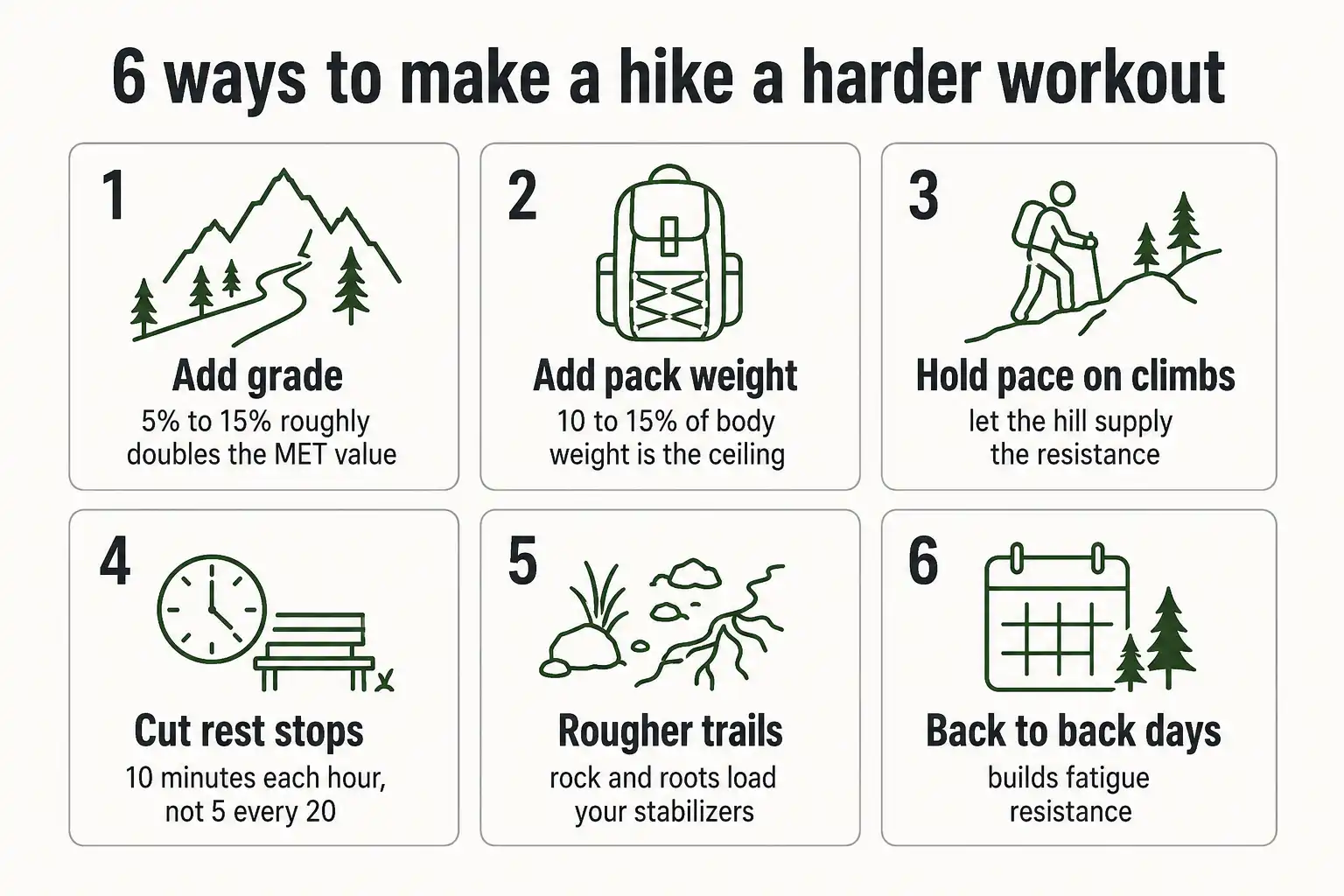
Six levers control hiking intensity. Pull them one at a time instead of all at once.
- Add grade. Moving from a 5% to a 15% climb roughly doubles the MET value. Elevation raises intensity faster than extra miles do.
- Add pack weight. A loaded daypack pushes a 6.0 MET hike to 7.8. Ten to fifteen percent of body weight is a sensible ceiling, so deciding how heavy your pack should be matters more than most beginners expect.
- Hold your pace on climbs. Most hikers slow down as the grade steepens. Instead, keep your effort steady and let the hill supply the resistance.
- Cut rest stops. Shorter breaks keep your heart rate inside the training zone. Ten minutes every hour beats five minutes every twenty.
- Choose rougher trails. Rock, roots, and scree demand far more stabilizer work than a graded path.
- Hike back to back days. Consecutive days build the fatigue resistance that longer trips demand.
Where hiking falls short as a workout
Hiking has three clear gaps. First, it trains almost nothing above the waist. Your arms, chest, and back get very little unless you carry serious weight or drive hard with poles.
Second, progressive overload is hard to control. A gym lets you add five pounds a week with precision, while trails give you whatever grade they happen to have. Building leg muscle through hiking works up to a point, then stalls without added resistance.
Third, hiking depends on access and weather. One rainy month or a long stretch of work travel can wipe out a training block. Gym sessions survive those weeks better.
There is also the descent issue covered above. High knee loads on steep downhills can aggravate existing joint problems, so anyone with cartilage damage should manage descents carefully.
Who gets the most out of hiking as exercise
Hiking suits beginners, desk workers, and anyone returning after a long layoff. The intensity self regulates, since you can slow down on any climb without ending the session. Older adults benefit especially, because the balance demands of uneven ground address fall risk directly.
People carrying extra weight often do better on trails than on a treadmill. The pace feels manageable, the scenery holds attention, and sessions naturally run long. Runners also use easy hiking as low impact volume between hard training days.
Take more care if you have knee osteoarthritis, a heart condition, or uncontrolled blood pressure. Talk to a doctor before starting steep terrain. Also begin conservatively at altitude, where the same grade costs noticeably more effort.
Frequently asked questions

Is hiking better than going to the gym?
Can hiking alone get you fit?
Is a two hour hike enough exercise for the week?
Does hiking burn belly fat?
Is hiking bad for your knees?
Final thoughts
Hiking is a good workout by any reasonable measure. It reaches vigorous intensity at ordinary trail pace, burns 400 to 800 calories an hour on real terrain, and trains balance and eccentric strength that flat cardio ignores. The gaps are upper body work and controlled progression, and two short gym sessions fill both. Start with one hike a week, build duration first, then add grade and pack weight. Your legs and your head will both notice the difference.