What Size Hiking Poles Do I Need for My Height? (Full Chart)

Pole length decides how much work your arms do on a trail. Set it wrong and your shoulders ache within an hour. This guide gives you the right length for your height, the quick test that confirms it, and the adjustments that matter once the trail tilts.
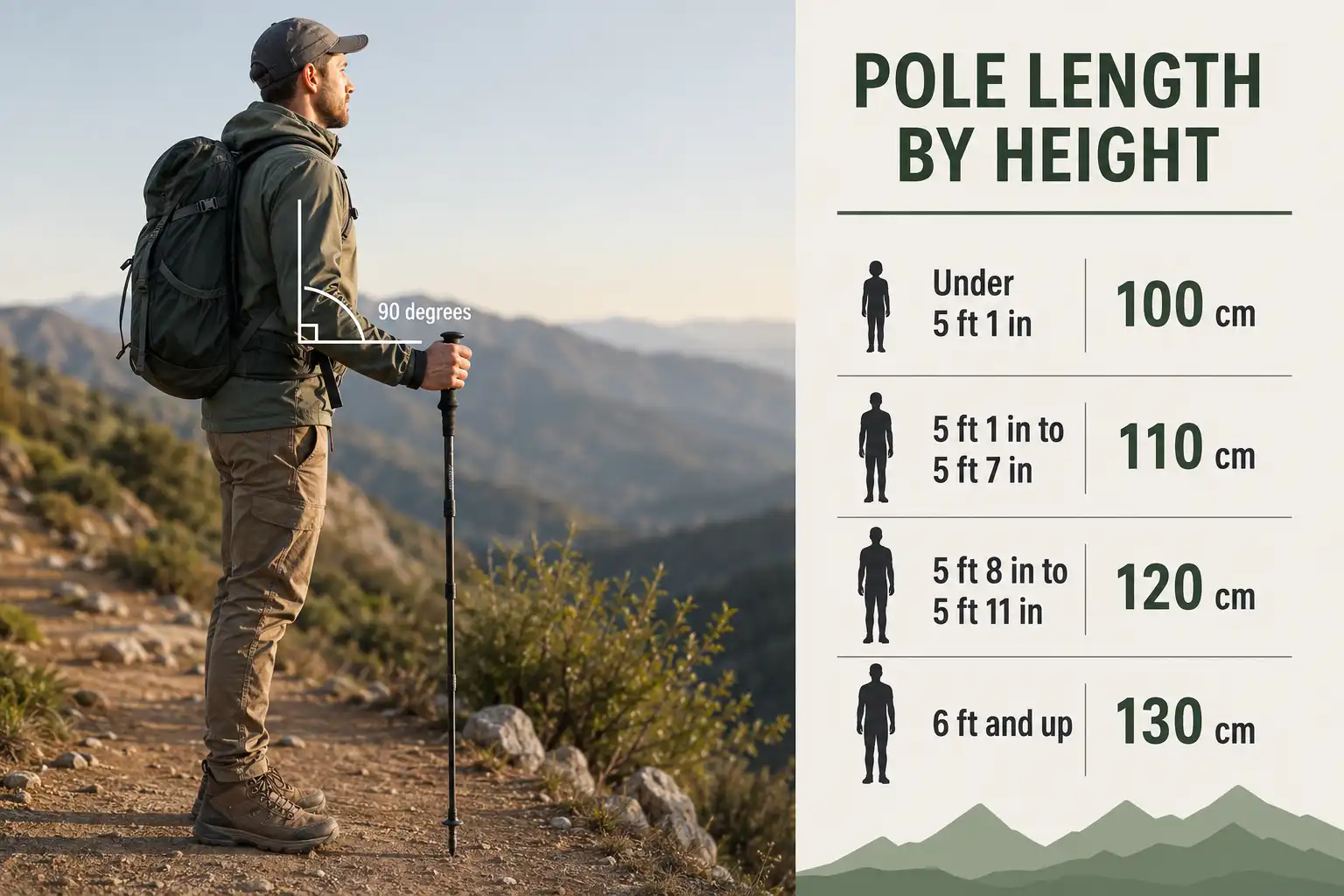
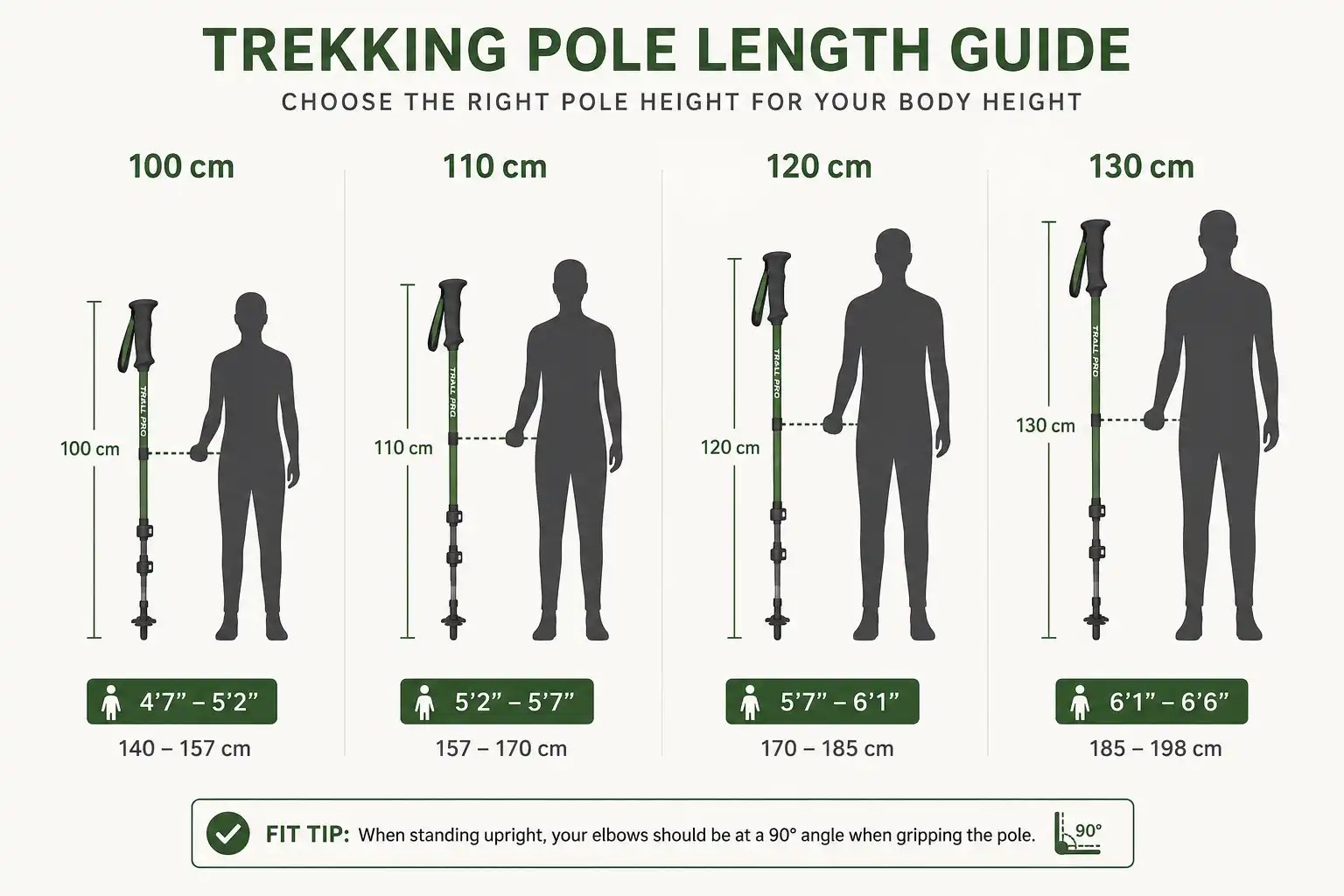
Most adult hikers need poles between 100 cm and 130 cm. Under 5’1″ use 100 cm. Between 5’1″ and 5’7″ use 110 cm. At 5’8″ to 5’11” use 120 cm, and from 6’0″ upward use 130 cm. Then check the fit yourself: your elbow should sit at roughly 90 degrees when the pole tip touches the ground beside your foot.
Hiking pole size chart by height
Here are the four length bands REI publishes for fixed-length poles, and they match what most brands recommend.
| Your height | Pole length |
|---|---|
| Under 5’1″ (155 cm) | 100 cm (39 in) |
| 5’1″ to 5’7″ (155 to 170 cm) | 110 cm (43 in) |
| 5’8″ to 5’11” (173 to 180 cm) | 120 cm (47 in) |
| 6’0″ and taller (183 cm+) | 130 cm (51 in) |
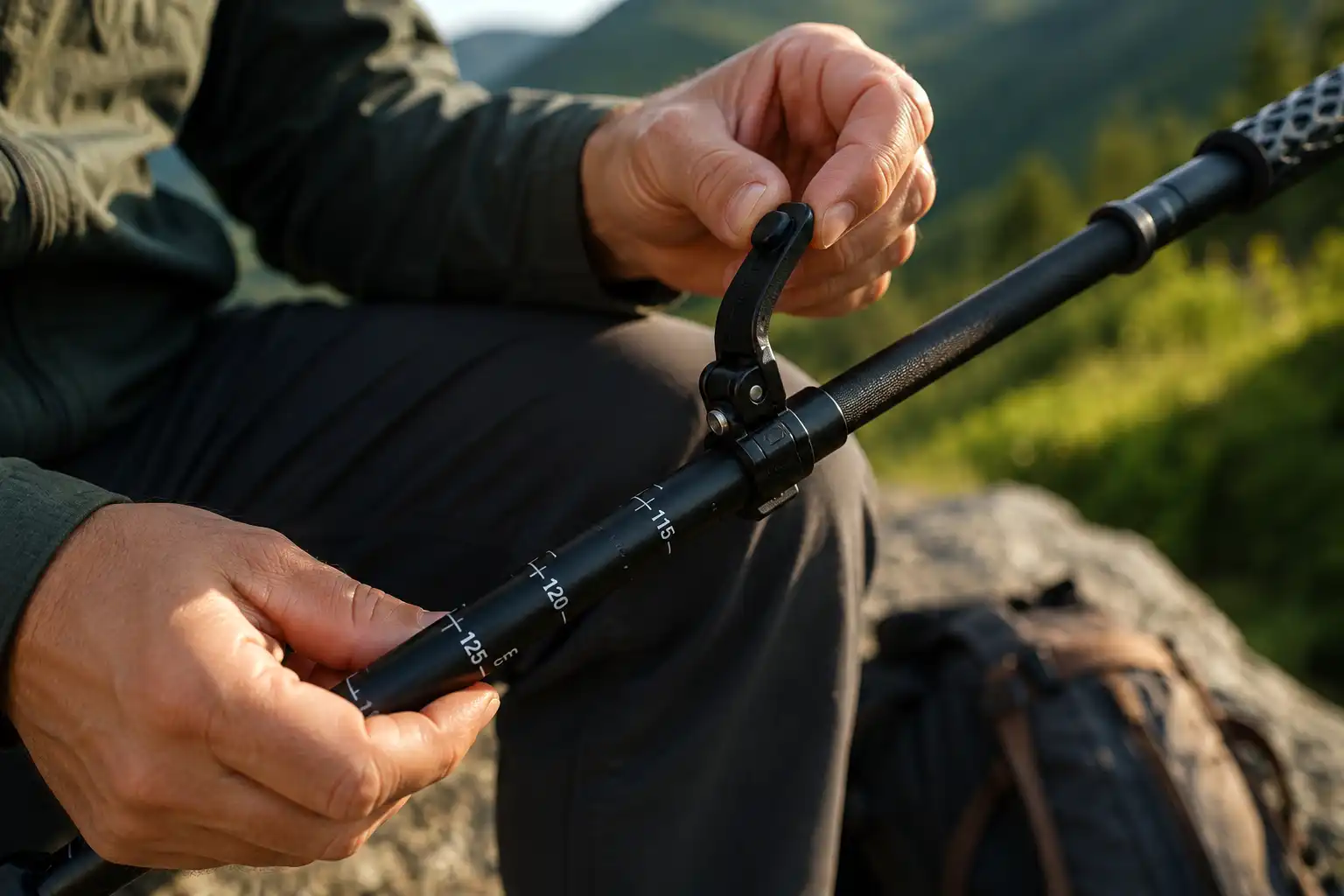
Many poles now come in 5 cm steps instead of 10 cm steps, so you can get closer to your number. Black Diamond, for example, sells the Distance Carbon Z in 110, 115, 120, 125 and 130 cm, plus a women’s version running from 100 to 120 cm.
Treat the chart as a starting point rather than a verdict. Two hikers at 5’9″ can need different lengths because arm length and leg length vary. Therefore the physical test in the next section carries more weight than any table.
Learn more: Clothing Guide for Hiking in Hot Weather
How do you check if your hiking poles are the right length?
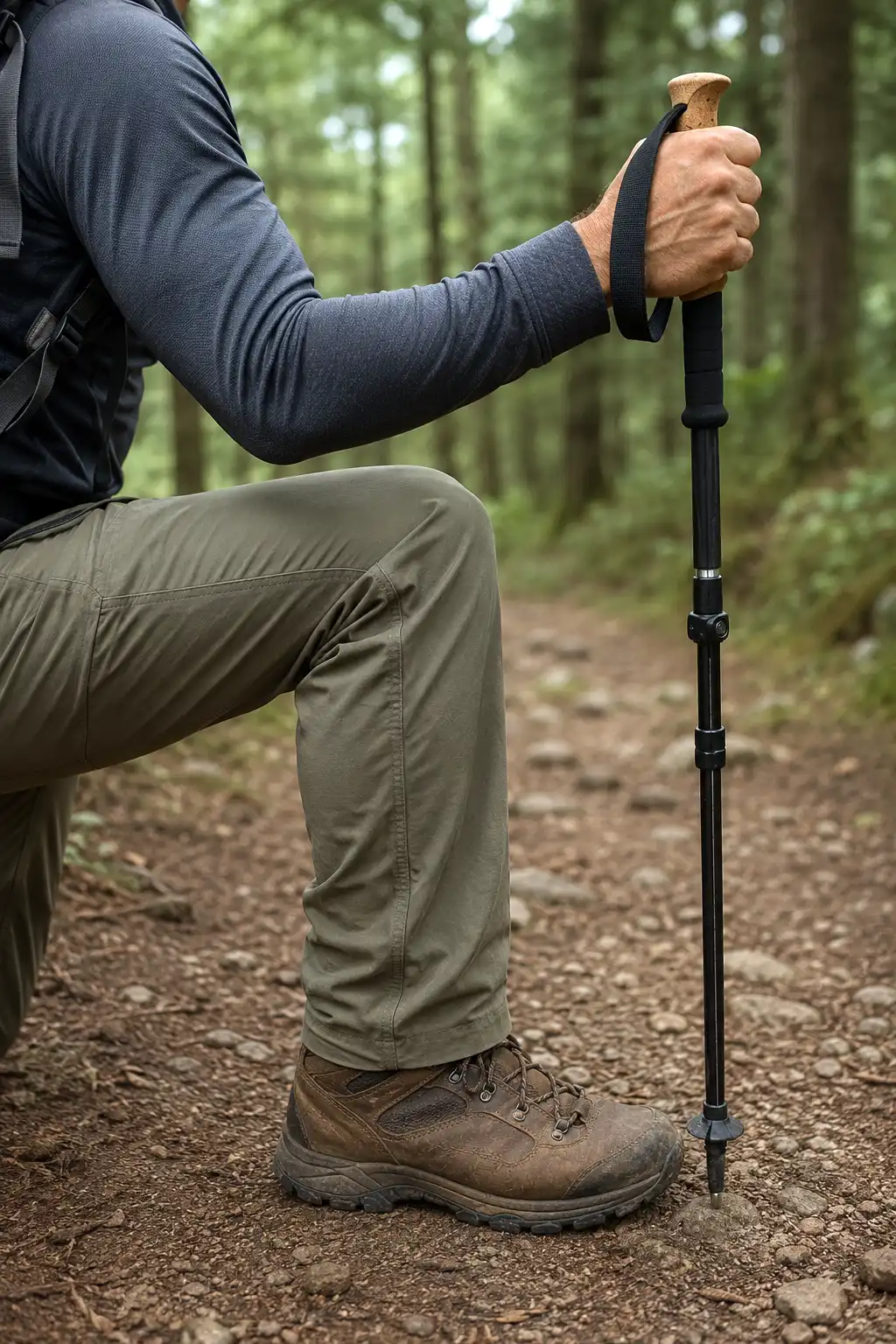
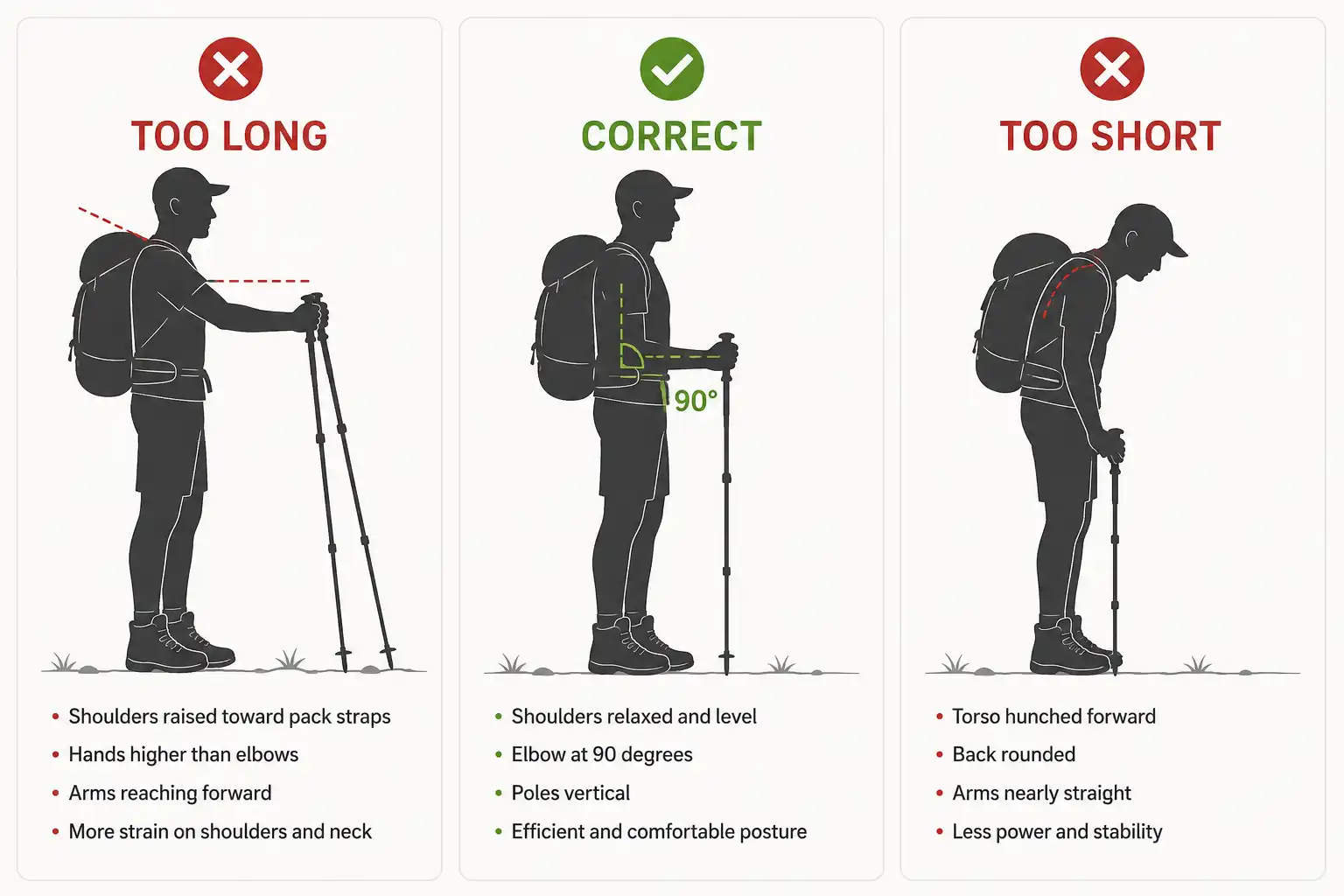
Stand on flat ground in the boots you actually hike in, hold the grip, and put the tip on the ground next to your foot. Your forearm should sit parallel to the ground with about a 90 degree bend at the elbow. That is the correct length.
Wearing your hiking boots matters here. A thick midsole and deep lugs can add close to an inch of stack height, which shifts your measurement. Since boot fit affects your whole setup anyway, it helps to know how a hiking boot should fit around the heel before you size anything else.
No poles yet? Use a tape measure instead. Bend one arm to 90 degrees with your forearm level, then measure from the top of your hand straight down to the floor. That number in centimeters is your pole length.
Two signs tell you the length is off:
- Too long: your hands sit higher than your elbows, your shoulders lift toward your pack straps, and you reach forward to plant the tips.
- Too short: you lean and hunch to reach the ground, and the poles feel like they give you nothing on flat sections.
The formula for buying poles online
Multiply your height in centimeters by 0.68. The result is your pole length in centimeters, and most brands use this same math to build their size charts.
Worked examples:
- 165 cm tall: 165 × 0.68 = 112 cm, so pick 110 or 115 cm
- 175 cm tall: 175 × 0.68 = 119 cm, so pick 120 cm
- 183 cm tall: 183 × 0.68 = 124 cm, so pick 125 cm
Notice that the formula runs slightly shorter than the chart at the tall end. A 6’0″ hiker lands on 125 cm by the math but 130 cm by the table. Neither is wrong. Both sit inside the range where the elbow test still passes, which is exactly why brands publish bands instead of single numbers.
Why arm length matters more than height
Your arm length sets pole length, and height is only a rough stand-in for it. Two people at the same height can have arms that differ by several centimeters, so the same pole feels tall to one and short to the other.
Leg-to-torso ratio shifts things too. Long legs with a short torso push your ideal length up. Short legs with a long torso pull it down.
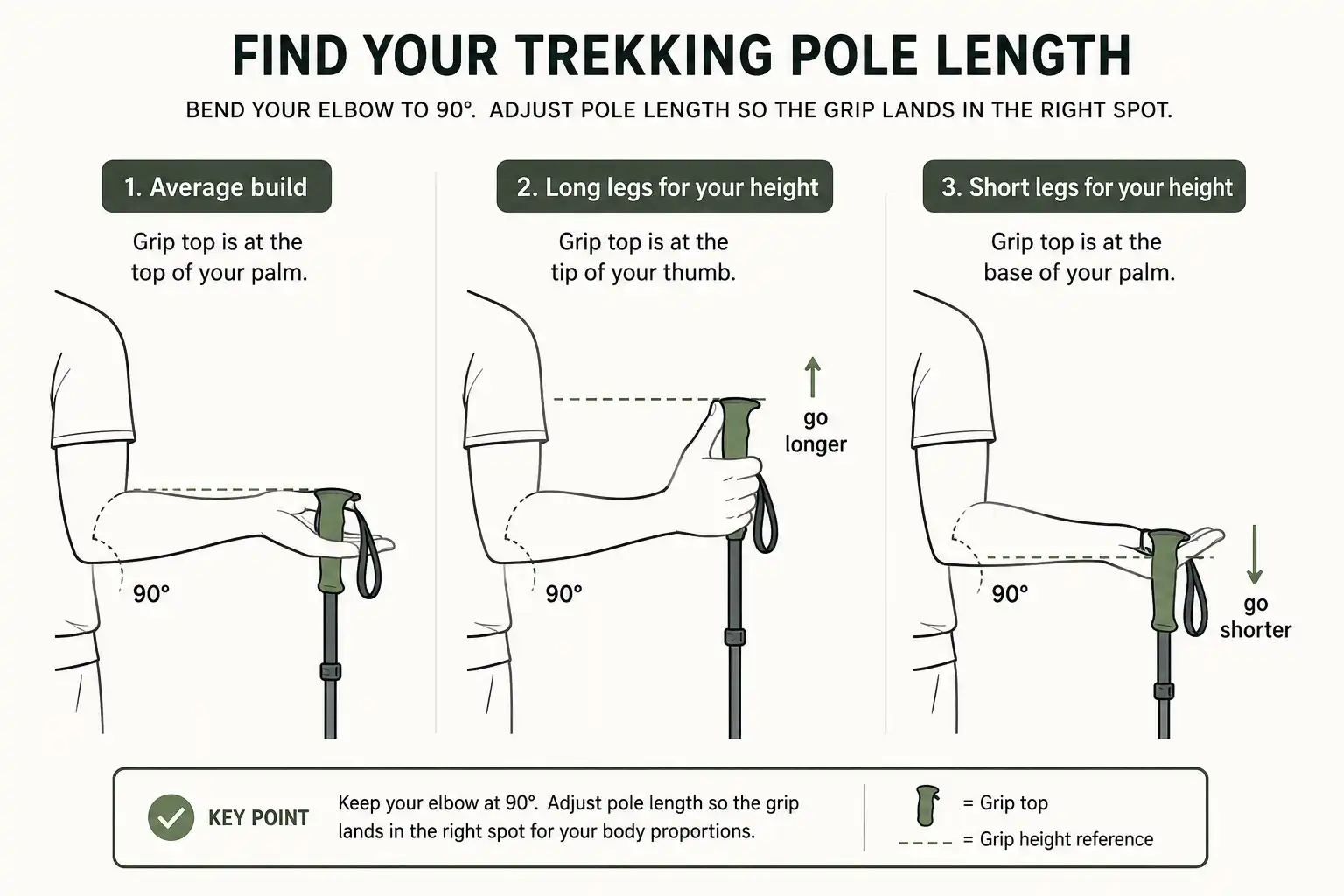
Mountain Warehouse suggests a useful adjustment for this. Hold your forearm out at 90 degrees, then look at where the grip top lands:
- Average build: aim for the top of your palm
- Long legs for your height: go a bit longer, up toward your upturned thumb
- Short legs for your height: go a bit shorter, down toward the base of your palm
I am on the shorter side, and on the Bandarban hill trails I ended up about 5 cm below what the chart suggested for my height. My shoulders stopped aching on long climbs after that change.
Should you buy adjustable or fixed-length poles?
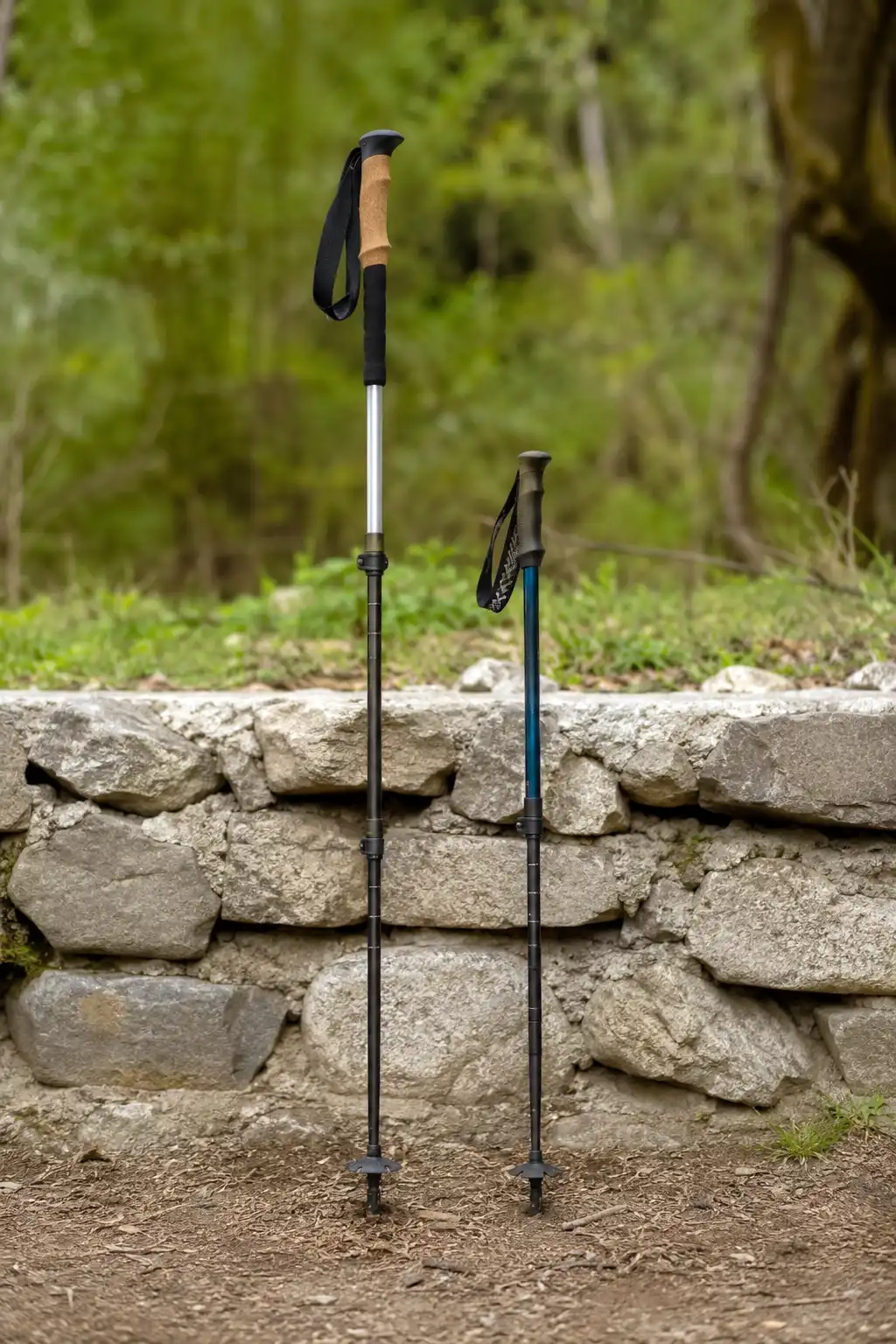
Adjustable poles suit most hikers, because you can tune the length for your body and then change it again for climbs and descents. Fixed-length poles suit hikers who want the lightest possible setup and already know their number.
Sizing adjustable poles
Check the adjustment range, not a single length. Common ranges run 100 to 120 cm, 105 to 135 cm, and 115 to 135 cm. Your target length should sit near the middle of the range, not at either end.
Middle placement matters for a reason. You want room left to extend on descents and room to shorten on climbs. If your flat-ground setting already maxes out the pole, you lose the descent adjustment entirely.
REI adds one clear rule for tall hikers: above roughly 6 feet, choose poles with a maximum length of at least 51 inches. Below 6 feet, most adjustable poles shorten enough to work.
Sizing fixed-length poles
Buy the exact length, because you cannot change it later. Fixed poles come in 5 or 10 cm steps, and the whole reason people accept that limit is weight. Fewer parts mean lighter poles, which is why trail runners and ultralight backpackers like them. That same lack of parts cuts both ways, though, so picking poles that hold up during a race comes down to shaft material as much as length.
What if you are between two sizes?
Size up. Nearly every pole has a foam or cork grip extension below the main grip, so you can slide your hand down the shaft and effectively shorten a long pole. Meanwhile a pole that is genuinely too short offers no fix at all.
There is one exception worth knowing. Hikers who move with a fast cadence, especially trail runners, often prefer the shorter size instead. A shorter pole swings quicker and plants faster.
For general hiking with a pack, sizing up remains the safer choice.
How to set the length on adjustable poles
Set the lower section first, then use the upper section for on-trail changes. Here is the sequence REI recommends for three-section poles:
- Extend the top section to the middle of its adjustment range.
- Adjust the bottom section until your elbow hits 90 degrees.
- Lock both sections and check the clamping tension.
- Leave the top section as your quick-adjust for terrain.
That last step saves real time. Once the bottom is dialed in, you never touch it again on the trail.
Never hike with poles fully extended on flat ground either. Keep some length in reserve so you can lengthen for descents.
How much should you adjust for uphill and downhill?
Shorten your poles by 5 to 10 cm for sustained climbs, and lengthen them by 5 to 10 cm for sustained descents. The steeper the grade, the bigger the change.
Short poles work better going up because you get more leverage on each plant. Your shoulders should never feel lifted or pushed into your pack straps. If they do, shorten the poles further.
Long poles work better going down because they keep your torso upright and let you plant ahead of your feet. Descents are where poles do the most for your joints. Correct length only helps if your plant and grip are right too, so taking pressure off your knees with poles depends on technique as much as setup. Hikers who already feel sore knees on steep downhill sections usually gain the most from lengthening.
On a long traverse, use different lengths in each hand. Shorten the pole on the uphill side and lengthen the pole on the downhill side.
The climb up Keokradong taught me this faster than any article could. I hiked the first hour with poles set for flat ground, and my shoulders were done before the steep section even started.
What size hiking poles do tall hikers need?
Hikers at 6’0″ and above generally need 130 cm poles, and very tall hikers need 135 cm or more. Standard trekking poles usually top out around 135 cm, so above about 6’4″ your options narrow.
Two practical notes for tall hikers:
- Fixed-length poles often stop at 130 cm, so adjustable models give you more headroom.
- Check the maximum length in the specs, not the size label. Some poles labeled “long” still cap at 130 cm.
What size hiking poles for short hikers and kids?
Hikers under 5’1″ need 100 cm poles or shorter, and kids need dedicated youth models that adjust down much further. Adult poles rarely shorten enough for a child to use comfortably.
Youth poles typically adjust in a range like 91 to 117 cm, and some go down near 55 cm for small kids. Smaller grips matter as much as length, because a child cannot hold an adult grip properly.
Women’s models help here too. They usually pair shorter maximum lengths with narrower grips, which suits smaller hands regardless of who buys them.
Common sizing mistakes
These four mistakes account for most of the discomfort I hear about from other hikers:
- Sizing by height alone. The chart gets you close. Your elbow angle confirms it.
- Measuring barefoot. Boots change your standing height, so measure in them.
- Setting the length once and never touching it. Even a 5 cm change on a steep grade feels different immediately.
- Buying poles too long because they look more capable. A long pole forces your shoulders up and your posture forward.
One more thing about buying poles before a trip abroad. Length affects packed size, and airlines treat poles as checked items, so read up on taking trekking poles through airport security before you fly.
FAQs on Hiking Pole Size by Height

Is 120 cm too long for a 5'5" hiker?
Do hiking poles come in one size?
Should both poles be the same length?
Does pole length change with a heavy pack?
Are longer poles better for river crossings?
Final Thoughts on Hiking Poles Length
Start with the chart, confirm it with the elbow test in your hiking boots, and then adjust for the grade you are walking. Under 5’1″ points to 100 cm and 5’1″ to 5’7″ points to 110 cm. Taller hikers land on 120 cm through 5’11”, then 130 cm from 6’0″ up. Choose adjustable poles for varied terrain, because the terrain adjustment matters more than a perfect flat-ground number. Sizing is also the second question, since whether poles earn their weight on trail depends on the terrain you hike and the load you carry.